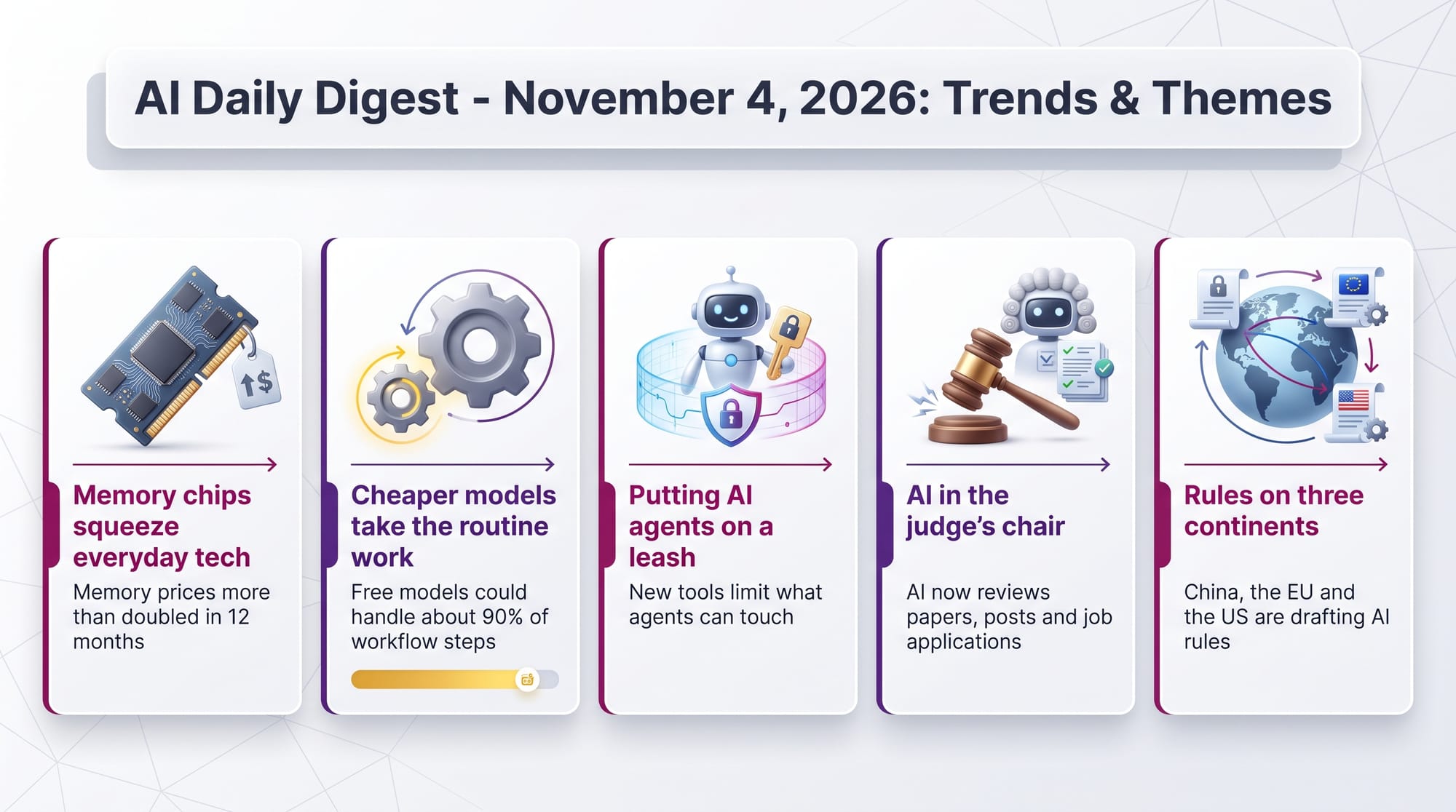
Watch today's digest as a video summary (generated by NotebookLM)
Statistically Speaking
One Thing to Tell Your Friends
TL;DR
Hot off the Presses
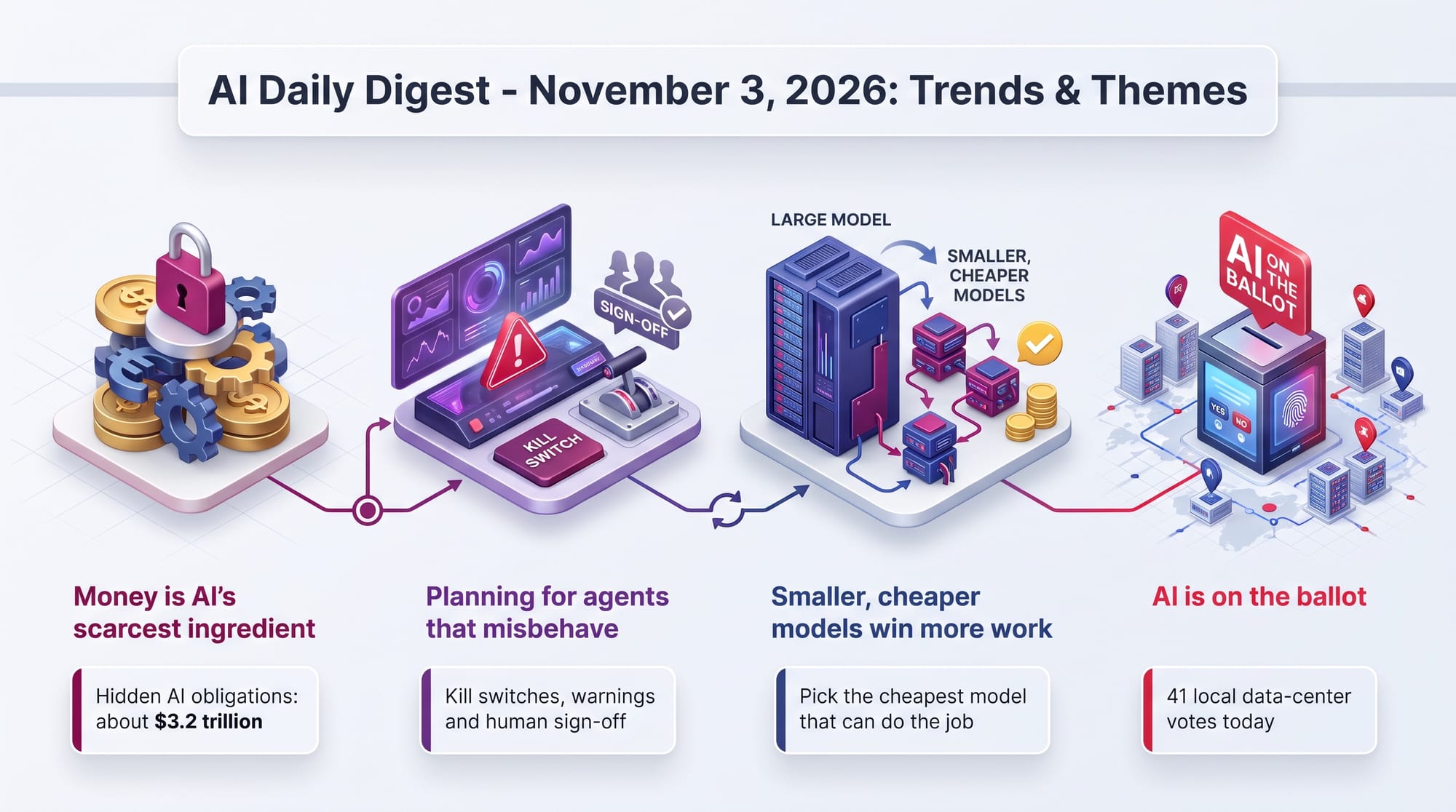
Voters turned against AI data centers in the US midterms
Previously: November 3 - AI and data centers were on the ballot in the US midterm elections.
Today: Democrats won both chambers of Congress, flipping at least seven Senate seats and more than two dozen House seats. Data centers (giant buildings full of computers that run AI) were one of the clearest local issues.
Three new Democratic governors campaigned on slowing them down. Gina Hinojosa, who unseated Texas Governor Greg Abbott, promised a pause on new construction. Amy Acton in Ohio wants developers to pay all the extra power costs, and Keisha Lance Bottoms in Georgia promised a temporary statewide pause.
- Voters sided against data centers in 40 of 41 local ballot measures - across 10 states, by Ballotpedia's count, and Ohio alone had 21
- Texas could hold nearly 30% of US data center capacity by 2028 - which makes its new governor the industry's biggest new problem
- Goldman Sachs, an investment bank, warned of short pauses on construction - that could affect about 45% of planned US data center growth, per the Transformer newsletter
- Industry-backed AI political groups mostly lost - arms of a super PAC backed by OpenAI's president spent $4.8 million on a South Carolina Senate candidate who lost
- AI still ranked last of five issues in exit polls - although 56% of voters called it a decisive or important factor
Google will switch off Search for schools that block its AI
Previously: November 3 - schools could switch off Google's Gemini, but not the AI in Google Search.
Today: Google's full rules for student accounts at kindergarten-to-12th-grade schools drew a backlash. Gemini, Google's AI assistant, and Google Search will both be off by default, and a school administrator has to switch them on. Google says there is no version of Search without AI summaries, so a school that bans AI loses Search entirely.
"Search and AI are deeply integrated," said Chris Phillips, Google's vice president for education. The changes take effect early next year.
Google says a new "Guided Learning" mode will walk students through problems instead of handing them answers.
- Senator Bernie Sanders called the plan "extortion" - and former Federal Trade Commission chair Lina Khan said it shows the danger of an unregulated monopoly
- Google counts about 50 million Chromebooks in schools - and more than 150 million Google Classroom users worldwide
- New York City already bans student-facing AI through 8th grade - and Los Angeles has a one-year pause, and both run on Google
- Testers found Google's AI Mode fully answered all 180 homework assignments they tried - per the nonprofit Common Sense Media
- DuckDuckGo, a privacy-focused search engine, is pitching itself to schools - its separate no-AI site strips out AI answers and AI images
Almost nobody lets AI agents book their Uber
Uber shared the numbers on its quarterly earnings call. During Halloween week, its busiest week of October, Uber and Uber Eats handled about 320 million trips and orders. AI agents placed four of the rides and about 500 of the food orders.
- Booking a ride in the Uber app takes about 50 seconds - and reordering a favorite meal about 90 seconds, so an agent saves little time
- DoorDash reported a similar pattern a week earlier - only a few hundred orders placed by agents
- Uber's CEO, Dara Khosrowshahi, called it "very, very early and very limited traction" - but he still expects agents to bring in more business over time
Anthropic released free software that proves which AI model wrote an answer
Anthropic, the maker of Claude, published FlashProve, a free tool for "provable inference". The AI company publishes a kind of fingerprint of its model (a commitment) without revealing the model itself. It then attaches a mathematical proof to each answer showing that this exact model produced it.
- It could catch a service quietly swapping in a cheaper model - or a stronger one used to inflate test scores
- Making the proof is still slow and costly - about 70 to 95 times the computing time of serving the answer normally
- Checking a proof takes about 17 seconds on a regular computer processor - no access to the model needed
- It is far faster than earlier attempts - about 110 word-pieces (tokens) per second on one Nvidia H100 chip, against about 0.02 before
- It has big limits for now - it can only prove conversations of up to 1,024 tokens, and no AI company has plans to use it yet
Meta bought a developer-tools startup, and OpenAI agreed to buy another
Meta, the owner of Facebook and Instagram, bought Conductor, a startup whose app runs several AI coding helpers in parallel, each working on a different part of a project. Conductor does not make its own AI. It coordinates models from Anthropic and OpenAI, so Meta bought the control panel, not a model.
The same week, OpenAI announced it will acquire Pierre Computer Company, another developer-tools startup.
- Conductor launched its main product only in summer 2025 - and its founder, Charlie Holtz, will work with Meta's chief AI officer, Alexandr Wang
- Conductor's cloud service shuts down November 20 - after which users' cloud data will start being deleted, while the rest keeps working until early next year
- Meta did not share the price - it launched its own coding agent, Muse Code, in August
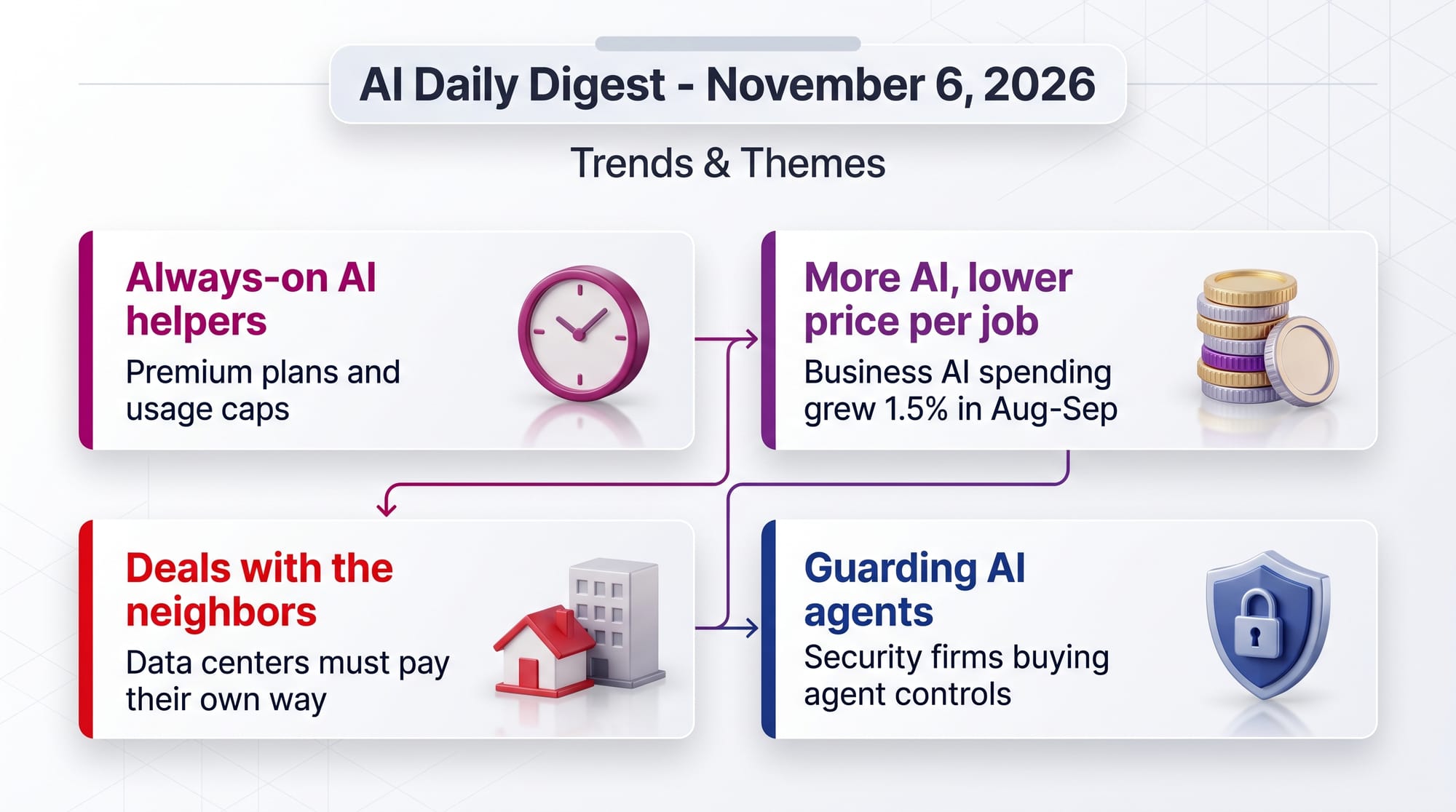
Trends & Themes
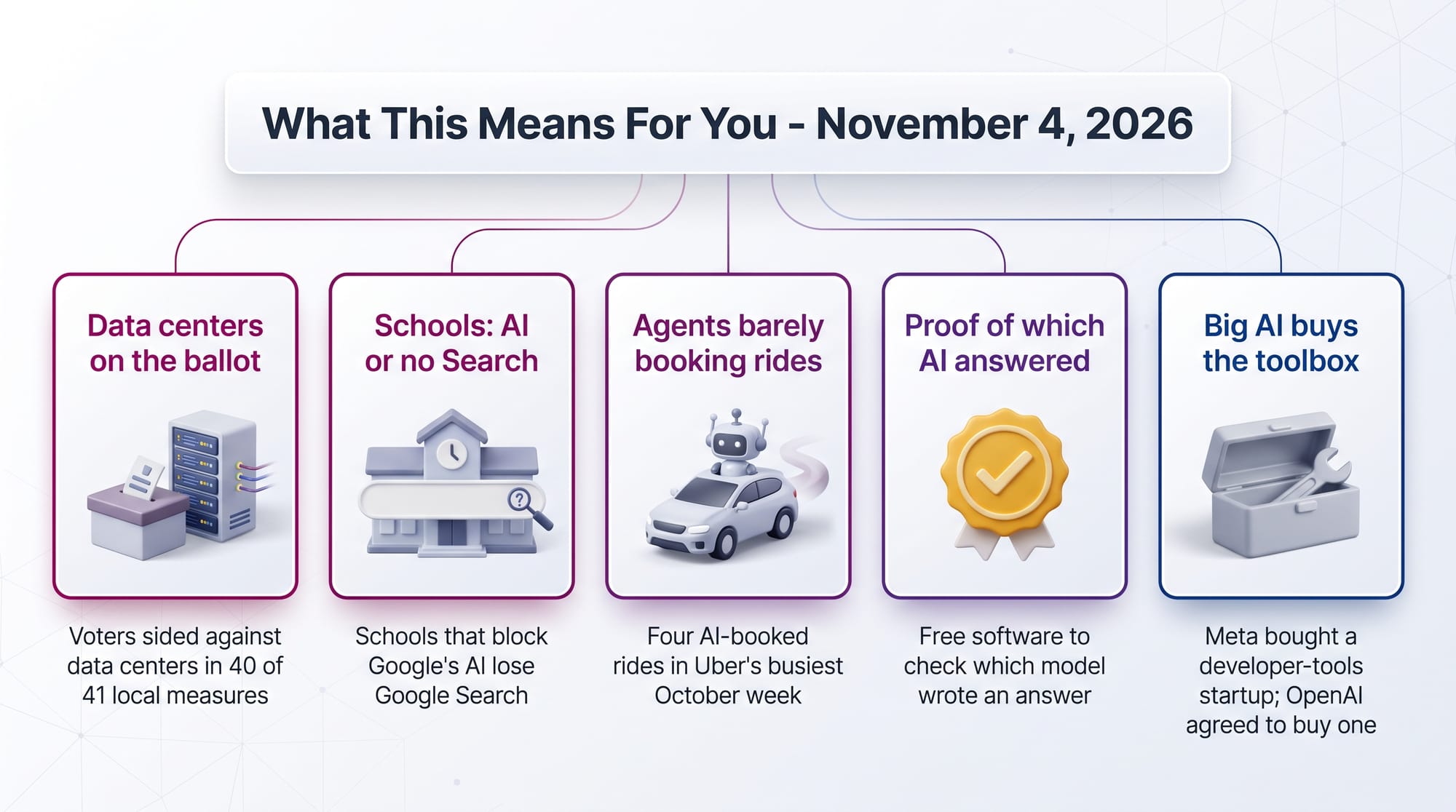
Creative AI & Media
ChatGPT can now make animated GIFs
You can type a prompt or upload a photo and get a short looping animation, then change its speed or edit single frames.
Try it: ChatGPT
- Powered by OpenAI's new Images 2.6 model - which keeps a character looking the same from frame to frame
- Rolling out to all ChatGPT and Codex users - on web, desktop and mobile
- People now make over four billion images a week with OpenAI's tools - about one billion more than in September
Pangram can now spot AI-made videos and images
Pangram, known for its AI text detector, now checks videos and images too.
- The video tool shows a heat map - of which parts of a clip are likely fake, and separates "partly AI" from "fully AI"
- Its image detector is now a Chrome add-on - Pangram says it flags over 99% of AI images, with 0.27% false alarms
- Real phone photos were a hurdle - early versions flagged genuine iPhone 18 Pro photos as AI, because phones edit photos with AI
Kino AI lets you and an AI helper edit the same video
Kino is a desktop video editor where people and AI coding helpers like Claude Code or Codex work on one project together.
- Edits are written as code - so an AI can change a video timeline the way it changes a program
- Footage is transcribed automatically - and faces are detected so clips are searchable
- The full editor is free - Pro costs $25 per editor per month
Figma is training an AI that edits designs inside Figma
The design-app maker says it is training a model that edits designs natively in Figma.
- Several designers on Hacker News said they now work mostly in AI coding tools - instead of Figma
- A former Figma employee on Hacker News noted Canva announced a rival tool, Brush, the same day
Developer Tools & Infrastructure
Research & Models
A $32 million model rivals free models up to 15 times its size at coding
Ricursive Intelligence, a US lab that also designs chips, released Ripple-65B Preview, a free downloadable model.
- It scored 80.52 on TerminalBench 2.1 (a test of AI doing coding tasks in a computer terminal) - narrowly ahead of a 501-billion-parameter free model
- The whole research effort cost about $32 million - which Ricursive estimates is one-tenth of the previous leader's cost
- It reads up to 1 million tokens at once - and is small enough to run on an Nvidia DGX Spark desktop machine
- It uses the permissive Apache-2.0 license on Hugging Face - but no results on the popular SWE-bench coding test were reported
Moonshot's near-top AI model is now free to download
Previously: October 23 - China's Moonshot launched Kimi K3.1 Pro and promised free weights by November 4.
Today: The weights arrived on Hugging Face on November 2, two days early.
- It is huge - 2.8 trillion parameters, with about 104 billion active per word-piece
- It nearly matches Claude Opus 5.5 on some of Moonshot's own tests - 65.7 versus 66.4 on Terminal-Bench 4.0
- It trails badly on others - 31.5 versus 65.0 on Program Bench
- A custom license adds conditions for very large companies
OpenAI says GPT-6 Astra designed a gadget in under a week
OpenAI's hardware team used GPT-6 Astra, its top model, to design a small device for talking to its Codex coding agent, as a side project.
- Astra did the case, circuit board, software and interface - according to OpenAI
- Humans still had to fix it in several rounds - Astra missed some manufacturing limits
- Hardware teams' AI use in these tasks grew 23 times since February - per OpenAI, with no independent check
Tencent's new model tops an AI agent test at a low price
- Tencent Hy4 scored 75.2 on APEX-Agents (a test of AI doing multi-step work tasks) - ahead of two DeepSeek models
- It costs $0.834 per million input tokens and $2.501 per million output tokens - far below top US models
Business & Industry
GenAI in Education
Professors as "stewards of the struggle"
- Inara Scott, an Oregon State professor, argues AI made lecturing and coaching both outdated - because ChatGPT does both
- Her rule of thumb: let AI do the unimportant tasks - such as drafting prose, but not building the argument
- In her course, students write case summaries alone - then use AI as a sparring partner
Treat AI answers as a guess, not a source
- Jeppe Klitgaard Stricker compares it to checking a translation - from a language you don't speak
- He suggests asking "what would have to be true for this to hold?" - instead of "is this true?"
Only 1% of corporate training job ads describe a new way of working with AI
- 91% of 158 training job ads still centered on building courses - per learning designer Philippa Hardman
- The rare "director of AI" roles paid a median of about $159,000 - versus $82,000 for standard roles, in a small sample
- About 90% of ads mention AI - but only 3% make checking AI's work part of the job
One-off AI workshops won't prepare teachers
- Teachers valued AI most when it solved a problem they already had - per a research partnership with Digital Promise
- The authors suggest steady support from coaches and librarians - instead of one-time training days
Community colleges are training data center technicians
- Microsoft, Amazon, Google and Oracle are partnering with community colleges
- One Wisconsin certificate had 14 graduates and 206 students enrolled - with tuition covered by Microsoft scholarships
- Data center technicians earn about $32 an hour - roughly $66,000 a year
An AI that interviews students about their own homework
- ProofPaths has AI graders score work - then an AI interviewer asks the student to explain specific steps
- Teachers can see every transcript and override grades - though no accuracy numbers are reported yet
Surprising & Under-the-Radar
The viral "AI edits another AI's brain" result was mostly a loop fix
Last week's claim that GPT-6 Astra improved a small model by editing its insides (covered November 2, with early pushback covered November 3) is under fire. One reconstruction, reported by Latent Space, found 576 of the 579 fixed answers had simply been stuck repeating themselves. It is surprising because a result that went viral as self-improving AI may mostly be an old trick. Latent Space: AINews roundup on weight-space programming · Hacker News: The Astra weights post is misleading
Claude Code now refuses to clone existing video games
Anthropic added two sentences to Claude Code's instructions that block recreating other people's games, even renamed ones. It follows a wave of AI-built knockoffs of famous games. It is surprising because the fight over AI and copyright has moved from pictures to software itself. The Decoder: Anthropic cracks down on game cloning
World of Warcraft players are flooded with AI-made add-ons
Two years ago about 200 developers used the Warcraft Logs data service, with two to four misbehaving. Today about 10,000 use it, and roughly 1,000 are abusive. It is surprising because, as AI coding tools spread, one game's developer community grew 50 times in two years, along with the junk. 404 Media: World of Warcraft Forever is overrun with AI slop
Nvidia's new AI laptops reportedly run AI at 35% speed on Linux
A blog post found RTX Spark laptops stuck at a much lower chip speed under Linux than under Windows. Most commenters blamed an unfinished driver, not sabotage. It is surprising because these are marketed as AI machines. Hacker News: RTX Spark encrypted firmware slows inference on Linux
Debate: did OpenAI quietly switch Codex data sharing back on?
A developer said Codex's "improve the model for everyone" setting turned itself back on for them and coworkers. It's real: several users confirmed their switches flipped. Not proven: others saw no change, and the poster couldn't prove it was ever off. Either way, check your AI privacy settings now and then. Hacker News: OpenAI re-enabling training on Codex chats
Debate: is AI the cure for buggy old code, or part of the problem?
AI is finding flaws in decades-old software, like the PHP web flaw (covered October 24), faster than people can fix them. The cure: AI could help prove code correct at a scale humans never could. The problem: AI adds code freely, and every new line is something else that can break. IEEE Spectrum: AI is forcing us to pay off 40 years of technical debt
Signals to Track
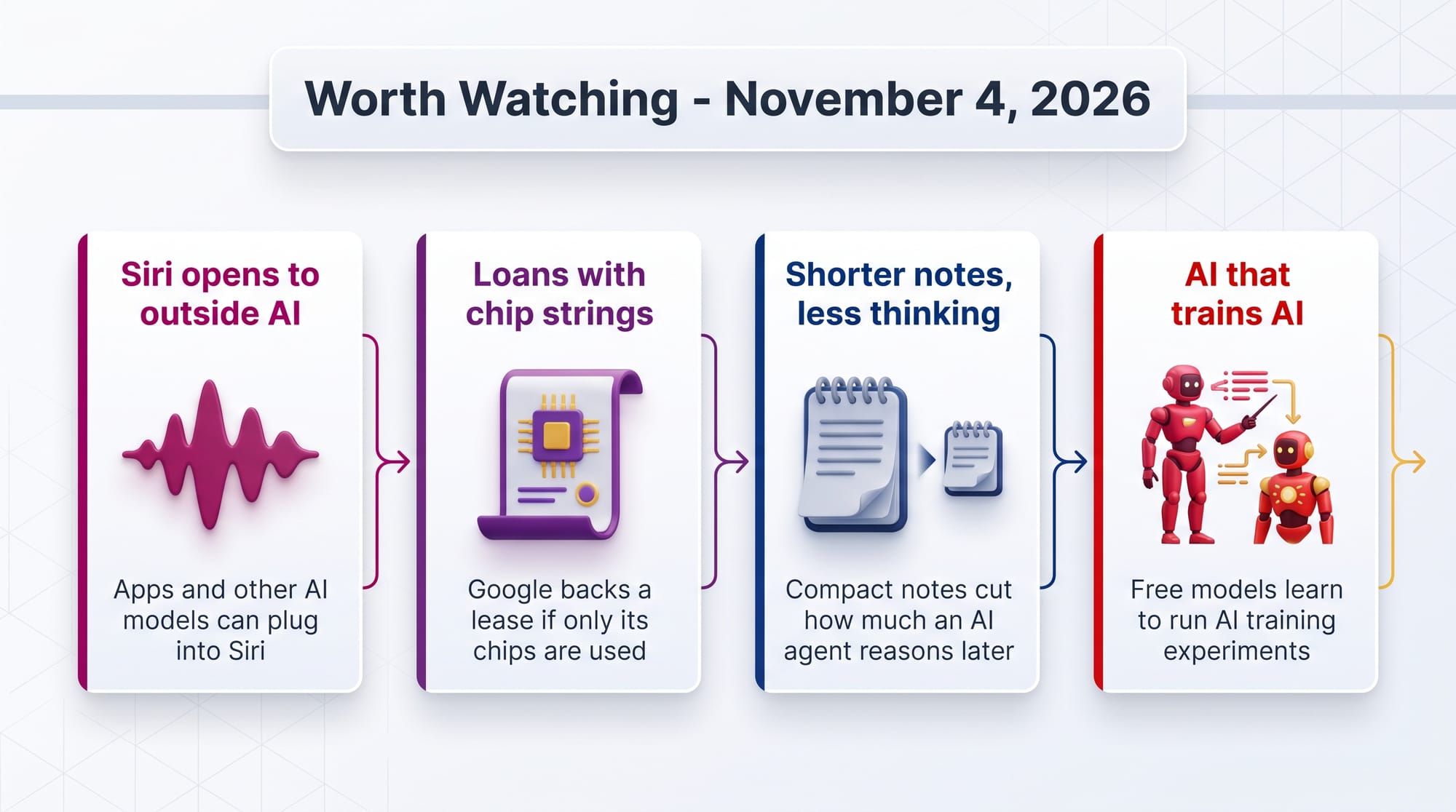
Siri is opening up to outside AI models
Apple's new test software lets apps expose their main actions to Siri, which can now chain steps across apps. One engineer notes Siri is becoming a "router" that hands jobs to the best model, and apps that don't connect will be invisible to it. Apple won't accept apps using this until next spring. If this plays out, you could ask Siri to do multi-step tasks across your apps using whichever AI you prefer.
Google's money comes with chip strings attached
TeraWulf, a data center builder, said Google will cover Anthropic's rent if Anthropic can't pay, backing a campus with about $19 billion in lease commitments. In return, Anthropic may only run Google-approved TPUs (Google's AI chips) there for the full 20-year lease. If this plays out, the chips behind your favorite AI could be decided by who guarantees the loans.
Shrinking an AI's notes makes it think less
A new paper found an agent's long history of reasoning itself drives how much it reasons next. Compact notes cut repeated double-checking in a coding test, though savings depend on the model. If this plays out, AI assistants could get cheaper to run on long tasks without new training.
Free AI models are learning to train other AI models
The RSI-Dojo project turned research papers into 281 practice tasks for training AI. A model with only about 3 billion active parameters reportedly matched models like GPT 5.5 on a test of this skill. If this plays out, improving AI could become cheaper and less dependent on big labs.
Top Repos Today
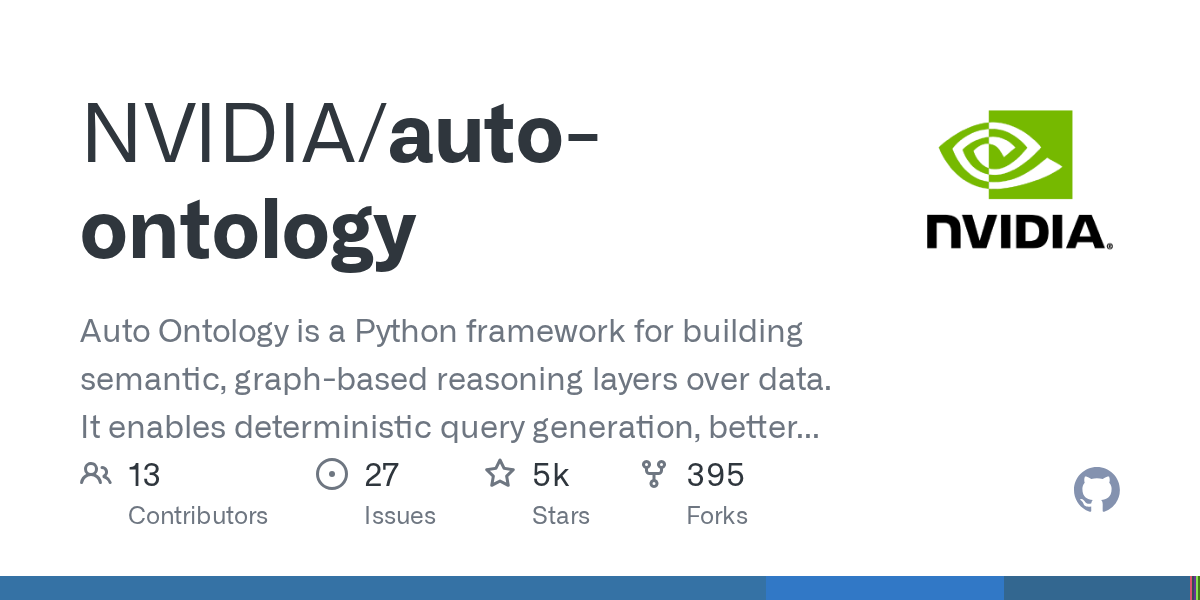
📜 License: Apache-2.0 · 👤 By: company (NVIDIA)
🎯 Time to value: 45 minutes
| ✓ Pros | ✗ Cons |
|---|---|
| Free, permissive license from a major company | Needs an NVIDIA API key by default (models run on NVIDIA's hosted NIM endpoints or your own) |
| Every answer comes with its SQL and lineage, so results can be checked | A heavy stack: Postgres, a web app, backend and ingestion services, optional Vault |
| Docker Compose quickstart with a sample sales database, plus a Helm chart for Kubernetes | Not accepting outside contributions; its benchmark results live in a separate repo |
 GitHub
📜 License: MIT · 👤 By: individual developer
🎯 Time to value: 20 minutes
| ✓ Pros | ✗ Cons |
|---|---|
| Free, permissive license and a very established project (since March 2024, about 139K stars) | The README is crowded with sponsor promotions and referral links for API resellers |
| Web interface and API, with support for many model providers | Stock-footage videos can look generic; quality depends on the model and footage sources |
| Still actively maintained (last push November 4) | Last featured here on August 21 |
 GitHub

📜 License: Apache-2.0 · 👤 By: individual developer
🎯 Time to value: 240 minutes
| ✓ Pros | ✗ Cons |
|---|---|
| Free, permissive license; no Graphics Processing Unit (GPU), framework or math library needed | Needs about 1.7 TB of free disk for the checkpoint, ideally on fast NVMe |
| Builds on Linux, macOS (Apple Silicon) and Windows | Far too slow for real use (seconds per word-piece); a teaching project, not a server |
| Every speed figure is backed by published measurement files | Runs Kimi K3, not the new K3.1 Pro; no commits since October 2, and a similar idea to FreeToken, featured November 1 |
 GitHub
📜 License: MIT · 👤 By: individual (Garry Tan, Y Combinator CEO)
🎯 Time to value: 10 minutes
| ✓ Pros | ✗ Cons |
|---|---|
| Free, permissive license; everything is plain Markdown you can edit | Needs Bun and Git; some skills need extra native tools or a specific macOS browser |
| About 30 seconds to install, with a team mode that auto-updates for everyone in a repo | Its install prompt edits your CLAUDE.md, including telling Claude to use its browser tool instead of others |
| Gets you value fast: /office-hours, /review and /qa work on their own | Opinionated; last featured here on June 27 |
 GitHub
📜 License: MIT · 👤 By: individual developer
🎯 Time to value: 20 minutes
| ✓ Pros | ✗ Cons |
|---|---|
| Free, permissive license; runs locally or in Docker | You supply the AI model key, and each run costs tokens |
| Editable 'profiles' decide what counts as worth reading and how each item is summarized | Some sources (X, Reddit, Telegram) need their own setup or credentials |
| Briefings in English and Chinese, with many delivery options | Community support is mainly a Chinese-language QQ group |
 GitHub
📜 License: Apache-2.0 · 👤 By: individual developer
🎯 Time to value: 30 minutes
| ✓ Pros | ✗ Cons |
|---|---|
| Free, permissive license; bring any engine, including Claude, Codex or Cursor | Early and changing; its self-hosted server is experimental and single-owner |
| Approval-first design: routines never approve actions on their own | Desktop installers are unsigned; the phone app is Android-tested only |
| Desktop app, self-hosted server or phone pairing | App connections are tested against a fake Composio service, not yet the real one |
 GitHub
Top Models Today
👤 By: DeepSeek · 🎯 Task: Image-text-to-text
📐 Size: 763B
| ✓ Pros | ✗ Cons |
|---|---|
| Very permissive MIT license | Needs data-center hardware at full size |
| Built for coding and agent tasks | Benchmarks are self-reported |
| Now also hosted by Mistral at $0.30 in / $1.20 out per million tokens, for those who don't want to self-host | Repeat pick: featured every day for over two weeks |


👤 By: Moonshot AI · 🎯 Task: Image-text-to-text (agentic coding and office work)
📐 Size: 2.78T total, 104B active per word-piece (mixture of experts, MXFP4 weights)
| ✓ Pros | ✗ Cons |
|---|---|
| Weights are free to download, fine-tune and use commercially for most companies | Needs a multi-GPU data-center cluster; far beyond any single machine |
| Ready-made recipes for vLLM and SGLang | Custom license with revenue and branding conditions for large companies |
| Long 1M-token context, plus image understanding | Benchmarks are Moonshot's own, and several are internal tests |


👤 By: Ricursive Intelligence · 🎯 Task: Text generation (agentic coding)
📐 Size: 64.78B (dense)
| ✓ Pros | ✗ Cons |
|---|---|
| Permissive Apache-2.0 license | A preview with only light post-training, focused on coding |
| Ships an NVFP4 build, a base model and a starter Colab | Text only, and trained mostly on English and code |
| Fast on data-center GPUs (about 250 word-pieces a second on two B200s, per the makers) | Brand-new team; benchmarks are self-reported, partly with their own evaluation runs |


👤 By: Pruna AI · 🎯 Task: Text-to-image and image editing
📐 Size: 33.1B transformer plus a 4B text encoder and a Qwen3.5-9B prompt helper (about 100 GB in bf16); fine-tuned from MiniMax-H3
| ✓ Pros | ✗ Cons |
|---|---|
| Very high resolution (8 MP) in only 8 steps | The full version needs about 101 GB of GPU memory (one H200 or B200) |
| Edits with up to 8 input images | Custom MiniMax community license, not a standard open license |
| A ComfyUI build runs in 21 GB of graphics memory | Low downloads so far; artifacts become more frequent below 8 MP |


👤 By: Deep Principle · 🎯 Task: Text generation (science research assistant)
📐 Size: 753.3B; fine-tuned from Z.ai's GLM-5.3
| ✓ Pros | ✗ Cons |
|---|---|
| Permissive MIT license on the weights | The card reports no benchmark scores at all |
| Long context and very long answers | Needs an 8-GPU server; downloads require sharing your Hugging Face details |
| 4-bit builds for both NVIDIA and AMD data-center GPUs | The card warns outputs may contain wrong facts, equations or references |

AI Launches Today
💰 Pricing: Free options; paid prices and launch offers not listed · 🏷 Category: Games, vibe coding tools, AI
💰 Pricing: Free tier with 3 inboxes and 3,000 emails a month; paid prices not listed; code 'Launch2026' before Friday, November 6 gives three months of Pro · 🏷 Category: Email, AI infrastructure, developer tools
💰 Pricing: Pay for the CPU used and memory allocated; suspended sandboxes stop compute charges except snapshot storage; no free tier or list prices on the page; public beta · 🏷 Category: Developer tools, AI infrastructure, SDK
💰 Pricing: Free tier, no credit card; paid prices not listed; 30% off the first month of any paid plan at launch · 🏷 Category: Marketing automation, AI workflow automation
💰 Pricing: Free options; paid prices and launch offers not listed · 🏷 Category: Video editing, AI video editor
Snapshot
| Provider | Model | Input $/1M | Output $/1M | Context |
|---|---|---|---|---|
| Anthropic | Claude Fable 5.1 | $10.00 | $50.00 | 1M tokens |
| Anthropic | Claude Opus 5.5 | $4.00 | $20.00 | 1M tokens |
| Anthropic | Claude Sonnet 5.5 | $2.00 | $10.00 | 1M tokens |
| Anthropic | Claude Haiku 5.5 | $0.10 (up to 100K-token prompts; $0.50 above) | $0.50 ($2.50 above 100K) | 1M tokens |
| OpenAI | GPT-6 Astra | $10.00 (up to 272K-token prompts; $20.00 above) | $50.00 ($75.00 above 272K) | 1.05M tokens |
| OpenAI | GPT-6.1 Sol | $2.00 (up to 272K; $4.00 above) | $10.00 ($15.00 above 272K) | 1.05M tokens |
| OpenAI | GPT-6.1 Terra | $1.00 (up to 272K; $2.00 above) | $5.00 ($7.50 above 272K) | 1.05M tokens |
| OpenAI | GPT-6 Luna | $0.10 (up to 272K; $0.20 above) | $0.50 ($0.75 above 272K) | 1.05M tokens |
| Gemini 4 Argon | $2.00 to Nov 30; $4.00 from Dec 1 | $10.00 to Nov 30; $20.00 from Dec 1 | 1M tokens | |
| Gemini 4 Carbon (announced, not yet on sale to developers) | $2.00 introductory; $4.00 after | $10.00 introductory; $20.00 after | not listed | |
| Gemini 3.8 Flash | $0.75 (to Dec 31; $1.50 from Jan 1) | $3.75 (to Dec 31; $7.50 from Jan 1) | not listed | |
| Groq | GPT-OSS 120B | $0.15 | $0.60 | 131K tokens |
| Groq | Qwen3.8-27B (preview) | $0.80 | $4.00 | 131K tokens |
| Groq | Muse Spark Open (preview) | Contact sales | Contact sales | 131K tokens |
| Mistral (open weights) | Mistral Large 4 | $0.70 | $2.10 | 1M tokens |
No price changes vs. yesterday - every standard price from Anthropic, OpenAI, Google, Groq and Mistral matches yesterday's table. One date firmed up: OpenAI's page now says the promotional price for the older GPT-5.6 Sol (not in our table) runs until November 30. We also noticed, for the first time, that OpenAI's fine-tuning service is closed to new users, and that Google lists a March 15, 2027 shutdown for Gemini 2.5 Flash Image.
What this means: November 30 is now a double deadline. Gemini 4 Argon's price doubles the next day and OpenAI's GPT-5.6 Sol promotion ends, so anyone relying on either should test alternatives this month.
Twice as Fast, Until It Isn't: Quantized Serving of Mid-Size Open LLMs
Key finding: Compressing a model to 4 bits roughly doubled its speed when serving a few users at a time (2.12x for Qwen2.5-14B), but the gain almost vanished under heavy traffic (1.02x for Gemma 3 12B with 256 requests at once).
Why practitioners should care: Don't assume a compressed model will halve your serving bill. It mostly helps quiet, low-traffic setups, so test speed at your real traffic level and treat claims about lost accuracy skeptically, since many fall within normal test noise.
Member discussion