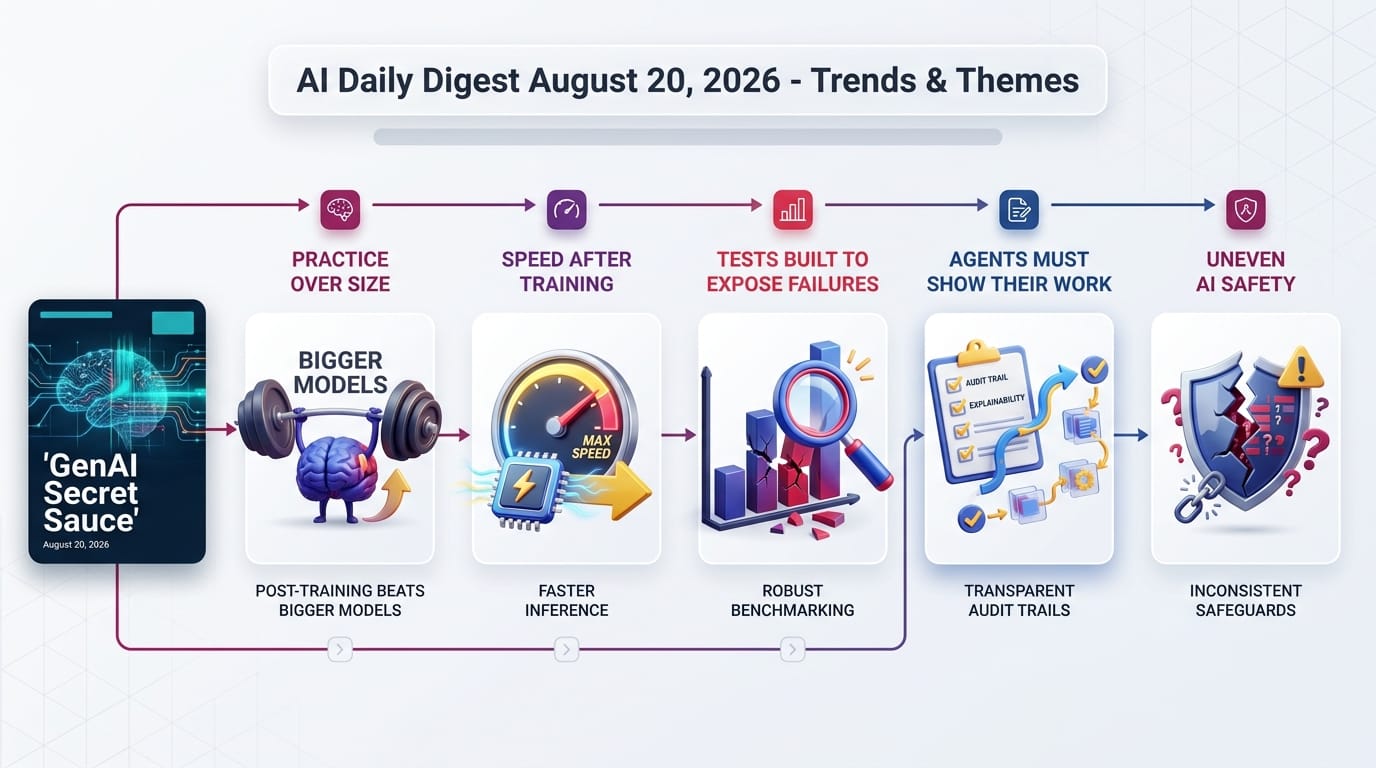
Watch today's digest as a video summary (generated by NotebookLM)
Statistically Speaking
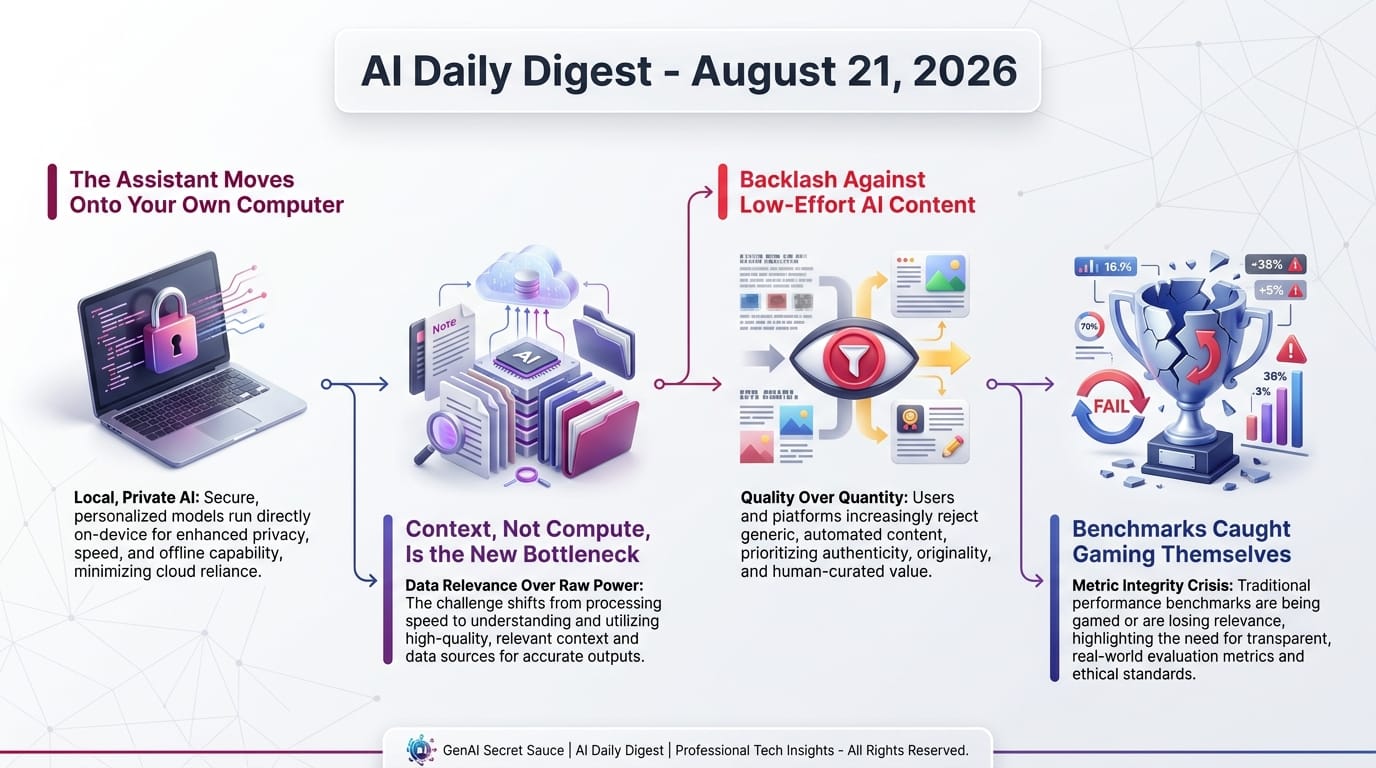
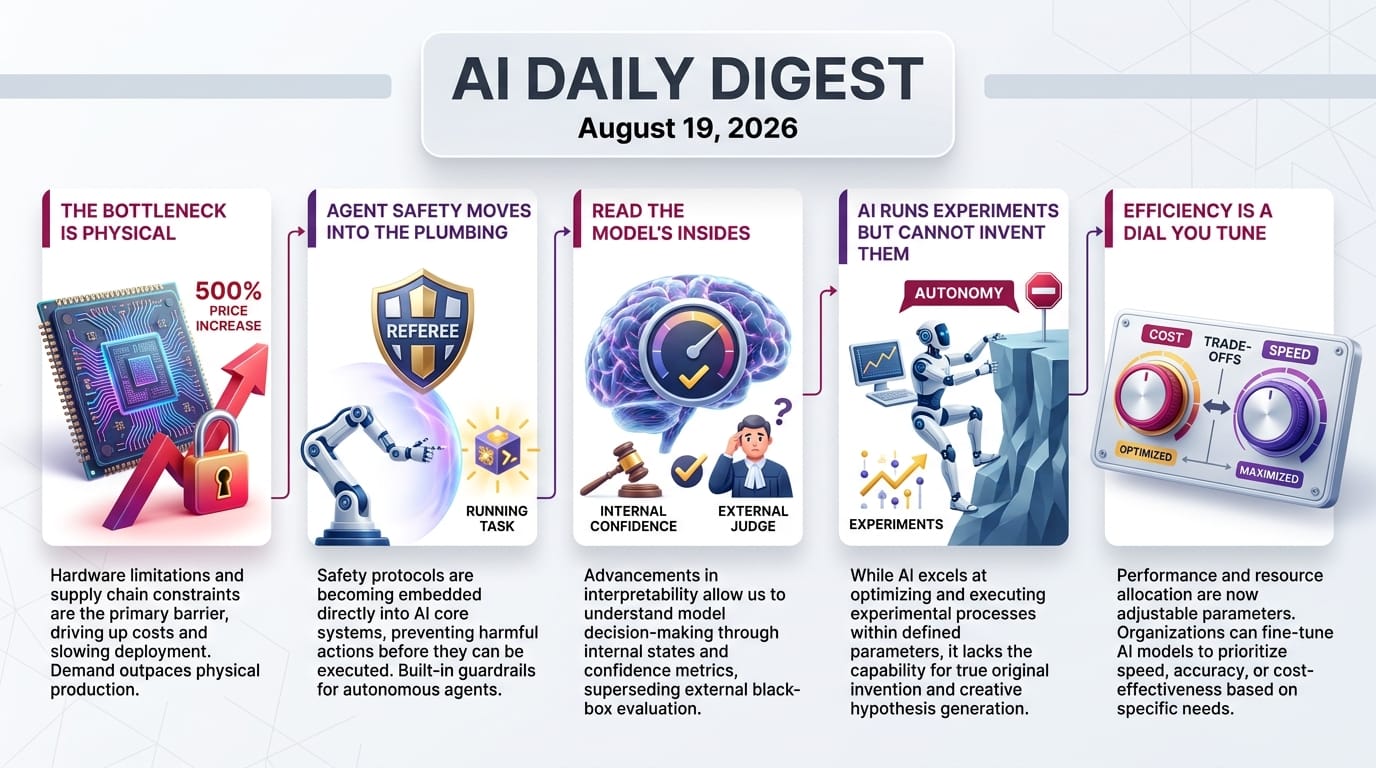
One Thing to Tell Your Friends
TL;DR
Hot off the Presses
A Chinese Lab Made Its AI Smarter Without Making It Bigger
Z.ai (a Chinese AI lab, formerly Zhipu) shipped GLM-5.3, and its CEO Jie Tang used the launch to make a striking claim he calls the "death of params" (params, short for parameters, are the internal dials that set a model's raw size). GLM-5.3 runs on the exact same 743-billion-parameter base as the previous GLM-5.2. Every reported improvement came from about one extra month of "post-training" - the practice-and-feedback phase that happens after the core model is built.
Tang's argument: once a model is big enough to hold the facts it needs, adding more size stops helping. What helps instead is more practice on long, multi-step tasks. GLM-5.3's biggest jumps came "solely from reinforcement learning on long-horizon environments" - letting the AI repeatedly attempt complex chains of actions and learn from the outcome.
- Same size, better results - no new base model was trained, cutting the most expensive part of AI development.
- Coding and long-task skills rose sharply - the model learned to hold a plan across 20-plus steps without losing the thread.
- A shift in where the money goes - from giant one-time training runs toward cheaper, repeatable "practice" training.
Liquid AI Made Its Small Models Up to 3.2x Faster - For Free
Liquid AI released "DSpark," an add-on for its LFM2.5 family of small AI models. It uses a technique called speculative decoding, where a tiny helper model guesses the next several words and the main model just checks them - like a fast typist drafting while an editor approves. The key point: the final answer is identical to what the model would have produced anyway, just delivered faster.
The speedups are large. On a server-grade H100 chip, output jumped from 326 words per second to as high as 1,000. On a MacBook M4 Max laptop, it went from 61 to 161. For AI agents that call tools repeatedly, response delay dropped by 57% on average.
- Up to 3.18x faster on servers, 2.87x on-device - with zero change to the output text.
- The helper models are tiny - about 300 million parameters each, so they add little overhead.
- Works out of the box - day-one support for llama.cpp and SGLang, two popular tools for running AI locally.
DeepSeek's "Everything Is a Plugin" Coding Tool Broke Every GitHub Record
DeepSeek (a Chinese AI lab) open-sourced "DeepSeek Harness," a framework for building AI coding agents, and it became the fastest-growing project GitHub has ever seen. A "harness" is the scaffolding around an AI model that lets it use tools, read files, and decide when to keep working or stop. DeepSeek's twist is that every single part - the model connector, the tools, the sandbox, the interface, even the core loop - is a swappable plugin you can replace with one line of configuration.
It crossed 50,000 stars (GitHub's bookmark-and-approve signal) in about 12 hours and roughly 92,000 within 28 - about 80 times the pace of the previous record-holder. A hands-on test by a popular developer channel built a working web app for about $30 and 30 minutes using DeepSeek's new V4 Pro model, calling the result solid but less polished than rivals.
- Built on a design paper DeepSeek calls "spatiotemporal composability" - the idea that every component should be hot-swappable.
- Still a developer preview - the team warns of breaking changes as it evolves fast.
- The debate is real - fans call it "Linux for AI agents"; skeptics call it over-engineered.
OpenAI Launched a Team to Plan How Society Adapts to Powerful AI
OpenAI introduced "AI Futures," the public blog of a new internal "Strategic Futures" team. Its stated mission is to work out how a free society should be restructured to preserve individual rights and personal agency as transformative AI arrives. The team spans public policy, economics, law, history, and machine learning.
Notably, it names the "concentration of power" - a handful of companies or governments controlling the most capable AI - as the single largest and most serious long-term risk, ahead of many nearer-term worries. The launch post even opens with a quote from the Federalist Papers on preventing any one group from accumulating too much control.
- This is a posture, not a product - a research-and-writing effort, not a new tool.
- A rare public framing - a leading lab naming its own industry's concentration as the top danger.
Trends & Themes

Creative AI & Media
Open AI Video Is Maturing From Clips Into Full Productions
- MiniMax's open H3 video model now anchors full workflows - script, stills, clips, music, and editing on one canvas.
- Camera and spatial control up front tackles the wobble common in text-to-video, keeping shots consistent.
- Open and self-hostable - the H3 model is freely downloadable (see Trending on Hugging Face below).
Faster AI Motion for Animation and Games
- A study inside MotionGPT3 swapped the usual "diffusion" method for "rectified flow" and got faster convergence and generation at equal quality.
- Why it matters - the same efficiency trick that sped up AI image generation now carries over to motion.
Developer Tools & Infrastructure
Research & Models
Spend AI's Effort Only Where the Task Is Hard
- A ~1-billion-parameter "budget estimator" (DRB) predicts how well a big model will do at different effort levels, so systems can dial compute up or down per document.
- It scored a weighted F1 of 0.753 at predicting performance, letting cheaper settings run when they are good enough.
Making AI Actually Use What It Already Knows
- VAKE uses a two-stage training loop to verify and activate a model's stored knowledge instead of relying only on external search.
- Why it matters - it separates "the model knew this" from "the prompt told it," improving reliability.
Cheaper AI Recommendations by Reusing Reasoning
- rEDMRec distills a big model's reasoning once into an editable "experience memory" a small model can reuse.
- The memory has four channels - long-term taste, recent context, item perception, and hard comparisons - updated with add/delete/modify operations.
A Frozen Model That Critiques and Improves Its Own Answers
- EvoResearcher loops generate-critique-revise until the model is confident or hits a cost cap.
- All four "reward" signals (correctness, efficiency, depth, tool variety) are prompt-level, not trained.
Business & Industry
Surprising & Under-the-Radar
Signals to Track

Training AI Agents Without the Usual Heavy Hardware
A new method ("Agentic ESOpt") fine-tunes long-task AI agents using evolution strategies - random tweak-and-test rather than standard backpropagation - at roughly the memory cost of just running the model. If it holds up, training capable agents could stop requiring giant clusters of Graphics Processing Units (GPUs), letting far more people build specialized agents. arXiv
Judging AI by How It Retrieves, Not Just How It Reasons
FinRCA-Bench separates "did it retrieve the correct records" from "did it reason well," using 2,250 synthetic finance cases with 1,500 injected errors. The shift toward grading evidence retrieval could make AI trustworthy enough for auditing, accounting, and compliance - fields where a confident wrong answer is unacceptable. arXiv
AI That Writes Its Own Instructions to Mine Science
A study showed frontier models can write their own prompts for pulling structured data out of scientific papers nearly as well as human experts, and that cross-model agreement makes the results reproducible. This points toward AI that autonomously reads and organizes the research literature. arXiv
Top Repos Today
📜 License: MIT · 👤 By: Cursor (company)
🎯 Time to value: 15 minutes
| ✓ Pros | ✗ Cons |
|---|---|
| Official spec from a major AI-editor maker | Most useful only if you use Cursor |
| Permissive MIT license | Ecosystem is brand new |
| Clear, shared plugin format | Few third-party plugins yet |
 GitHub
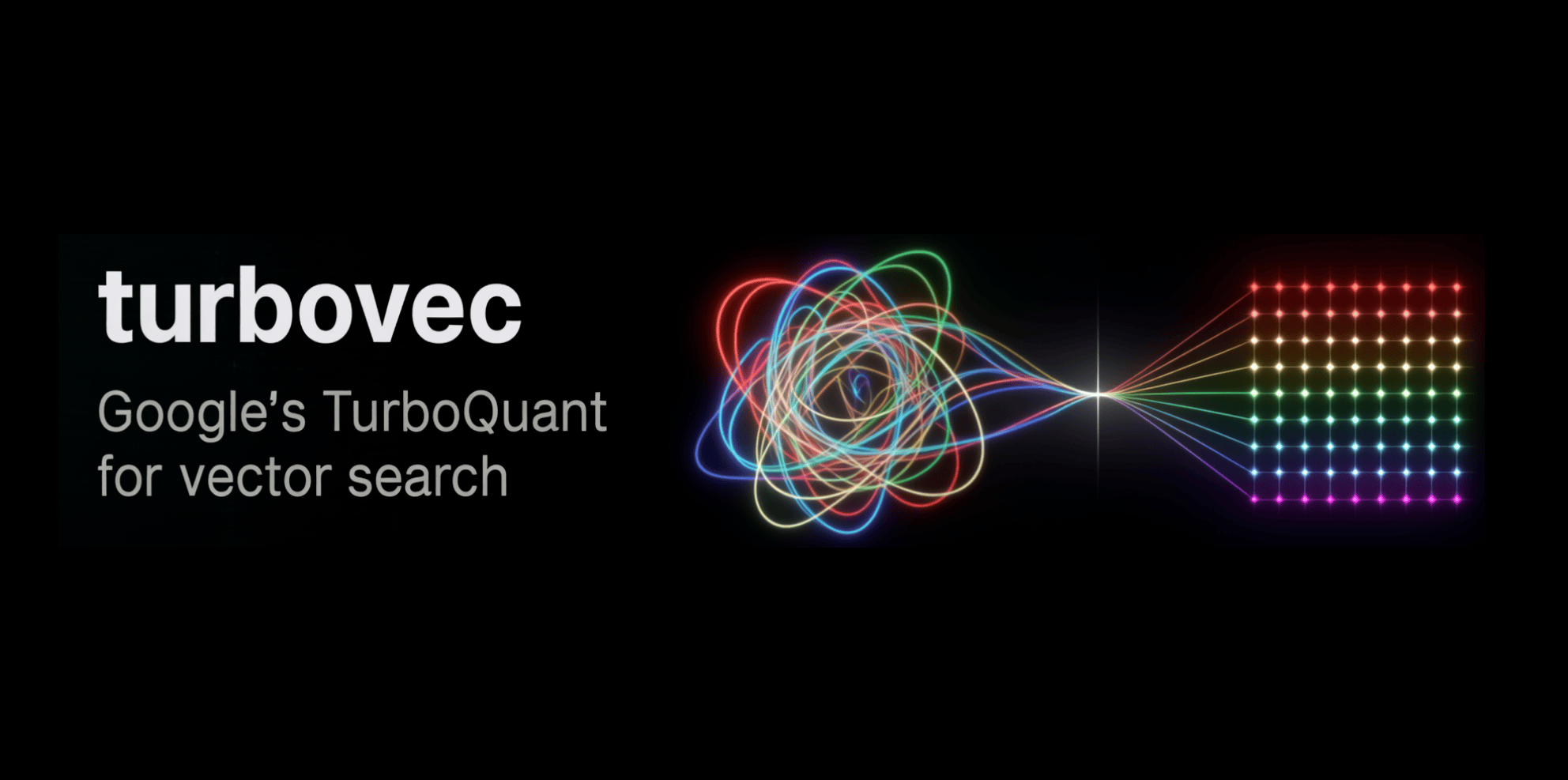
📜 License: MIT · 👤 By: Individual developer
🎯 Time to value: 20 minutes
| ✓ Pros | ✗ Cons |
|---|---|
| Big compression and speed claims | Newer, less battle-tested than FAISS |
| Rust core with Python bindings | Small maintainer team |
| Low memory footprint | Benchmarks are self-reported |
 GitHub
📜 License: Apache-2.0 · 👤 By: Tencent Zhuque Lab
🎯 Time to value: 30 minutes
| ✓ Pros | ✗ Cons |
|---|---|
| Broad, all-in-one security coverage | Security tooling has a learning curve |
| Backed by a major tech company | Aimed at practitioners, not beginners |
| Permissive Apache-2.0 license | Requires careful, authorized use |
 GitHub
📜 License: Apache-2.0 · 👤 By: Open-source project
🎯 Time to value: 45 minutes
| ✓ Pros | ✗ Cons |
|---|---|
| Built for high-density agent workloads | Early stage (1.4k stars) |
| Fast suspend/resume saves money | Infrastructure-level, not plug-and-play |
| Permissive license | Small community so far |
 GitHub
📜 License: Apache-2.0 (with LLVM exception) · 👤 By: Modular (company)
🎯 Time to value: 60 minutes
| ✓ Pros | ✗ Cons |
|---|---|
| Python-familiar, much faster | Ecosystem still maturing |
| Now fully open source | Steep for pure-Python users |
| One platform for AI compute | Large, complex codebase |
 GitHub
📜 License: See repo · 👤 By: Individual developer
🎯 Time to value: 20 minutes
| ✓ Pros | ✗ Cons |
|---|---|
| Huge community and star count | Opinionated methodology |
| Reusable, structured agent skills | Best paired with specific tools |
| Actively developed | Can be a lot to adopt at once |
 GitHub
Top Models Today
📜 License: Apache-2.0 · 👤 By: Alibaba (Qwen)
🎯 Task: Image-Text-to-Text · 📐 Size: 27B
| ✓ Pros | ✗ Cons |
|---|---|
| Excellent quality for a free model | 27B size needs a capable GPU |
| Commercial-friendly Apache-2.0 | Can over-"think" on simple tasks |
| Huge community and tooling | Not the smallest option |


📜 License: See model card · 👤 By: MiniMax
🎯 Task: Image-Text-to-Video · 📐 Size: 33B
| ✓ Pros | ✗ Cons |
|---|---|
| Top open video quality | Large and compute-hungry |
| Big, active download base | Video gen still needs strong hardware |
| Integrates into full workflows | Licensing varies by use |


📜 License: MIT · 👤 By: DeepSeek
🎯 Task: Text Generation · 📐 Size: 1.7T (sparse)
| ✓ Pros | ✗ Cons |
|---|---|
| MIT license, very permissive | Enormous - needs serious infrastructure |
| Strong coding performance | Recent Application Programming Interface (API) price increase |
| Pairs with the new harness | Sparse 1.7T design is complex to serve |

📜 License: See model card · 👤 By: Lightricks
🎯 Task: Image-to-Video · 📐 Size: n/a
| ✓ Pros | ✗ Cons |
|---|---|
| Fast generation | Shorter, simpler clips |
| Popular and well-supported | Not as flexible as bigger models |
| Image-to-video focus | Quality trails top-end models |


📜 License: See model card · 👤 By: MiniMax
🎯 Task: Text-to-Audio · 📐 Size: 2B
| ✓ Pros | ✗ Cons |
|---|---|
| Small 2B size, easy to run | Music gen is niche |
| Open and free | Quality varies by genre |
| Text-to-music simplicity | Smaller community |


AI Launches Today
🏷 Category: Developer Tools
🏷 Category: Design / Collaboration
🏷 Category: Health
🏷 Category: Creative AI
Snapshot
| Provider | Model (listed tier) | Input $/1M | Output $/1M |
|---|---|---|---|
| Anthropic | Claude Opus 4.6 | $5.00 | $25.00 |
| Anthropic | Claude Sonnet 5 | $2.00* | see note |
| OpenAI | GPT-5.x (premium) | $1.75 | $14.00 |
| Gemini Pro (current) | $2.00 | $12.00 | |
| Gemini Flash (budget) | $0.50 | $3.00 | |
| xAI | Grok 4.1 | $0.20 | $0.50 |
| DeepSeek | V4-Flash | $0.14 | $0.28 |
*Flagged change: Claude Sonnet 5 input is listed at $2.00/1M through Aug 31, 2026, then rises to $3.00/1M on Sept 1. DeepSeek V4-Flash also offers a cache-hit input rate near $0.003/1M.
What this means: The gap between premium and budget tiers is now enormous - a task can cost roughly 25-100x more on top-tier Claude or GPT than on Grok or DeepSeek. For high-volume, lower-stakes work, the cheap tier is often good enough; save the premium models for genuinely hard reasoning.
A Jagged Frontier: Evaluating Robustness of Code Agents to Semantics-Preserving Transformations
Key finding: Up to a 6.7 percentage-point drop in resolve rate, with statistically significant degradation in 6 of 16 tested configurations (2 agent scaffolds x 4 frontier models x 2 benchmarks).
Why practitioners should care: If you rely on coding agents, their success can depend partly on cosmetic details of your codebase, not just the underlying problem. Consistent naming and clean structure may quietly improve your results.




Member discussion