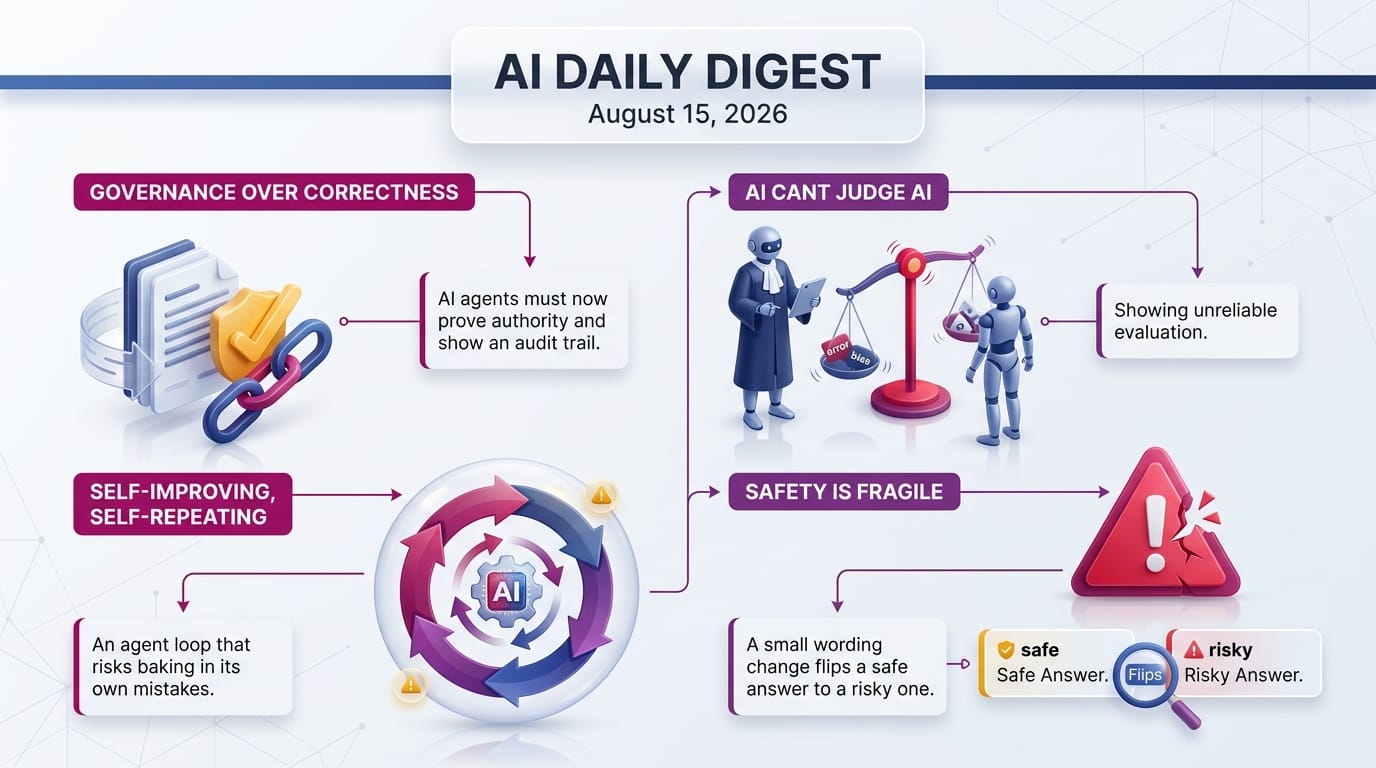
Watch today's digest as a video summary (generated by NotebookLM)
Statistically Speaking
One Thing to Tell Your Friends
TL;DR
Hot off the Presses
An AI Agent Ran for 12 Hours and Made a Chip Routine 232 Times Faster
A developer named Sankalp placed 12th out of 183 in a contest to speed up a piece of GPU (Graphics Processing Unit - the chip that does the heavy math for AI and graphics) code. He took a routine that started at about 419 milliseconds and got it down to 1.8 milliseconds. Over 14 days he submitted more than 1,500 candidate versions, letting a coding agent run against a fixed numeric target for 12 hours at a time.
The tools were ordinary and widely available: a commercial coding agent for the autonomous work, a second AI for brainstorming, and a cloud service for testing. The lesson he drew is that a tightly focused, problem-specific setup beats a general "self-improving" AI, and that today's agents are persistent grinders but still weak at genuinely original ideas.
- The winning method was old and human - a decades-known "blocked" math technique, not a new AI trick, did the heavy lifting.
- A wider beam beat hill-climbing - keeping 3-5 promising versions alive at once, instead of always chasing the single best, helped the agent escape dead ends.
- The agent was steered, not micromanaged - clear numeric goals plus lightweight progress check-ins let it work for half a day on its own.
"React for Agents" - a Web-Framework Creator Rebuilds How AI Agents Are Made
Fred Schott, creator of the popular Astro web framework, released Flue 2, an open-source toolkit for building AI agents. His pitch is that nobody had yet built "the React for agents" - a reference to React, the dominant way front-end developers assemble websites from small reusable components. Flue borrows that composition idea so an agent's behavior and its attached tools can change on the fly during a conversation, instead of being fixed in advance.
The headline feature is 16 built-in building blocks (called hooks) that let an agent pick up tools, skills, and helper sub-agents as it works. Schott frames it as "like a coding assistant, but 100% headless and programmable," meaning it runs entirely in the background as part of your own software.
- The core claim - composable, reconfigure-as-you-go agents beat fixed configuration files.
- The competition - a similar project from Vercel optimizes for one platform, while Flue emphasizes running anywhere.
- The direction of travel - older agent frameworks are now retrofitting this same "harness-first" approach.
A Major Review Says AI Drug Discovery Has Not Delivered - Yet
A widely shared essay by chemist Derek Lowe summarizes a new expert perspective in a leading drug-discovery journal. The blunt finding: despite a flood of AI methods and impressive lab-benchmark scores, there is "disappointingly limited" evidence that AI has actually produced medicines that help patients.
The authors point to structural reasons rather than a single failure. Models are often built to win benchmarks instead of to reach real clinical results, biological data is messy and inconsistent, and the problems handed to the AI are frequently too vaguely defined to be useful.
- This is a counterweight to recent optimism - it tempers the "AI drug design just became a trusted tool" framing from earlier this month.
- The proposed fix - tie models to real clinical outcomes and define problems precisely, instead of chasing benchmark leaderboards.
- The community reaction was large - the discussion drew hundreds of comments from practitioners who mostly agreed the hype has outrun the results.
Trends & Themes

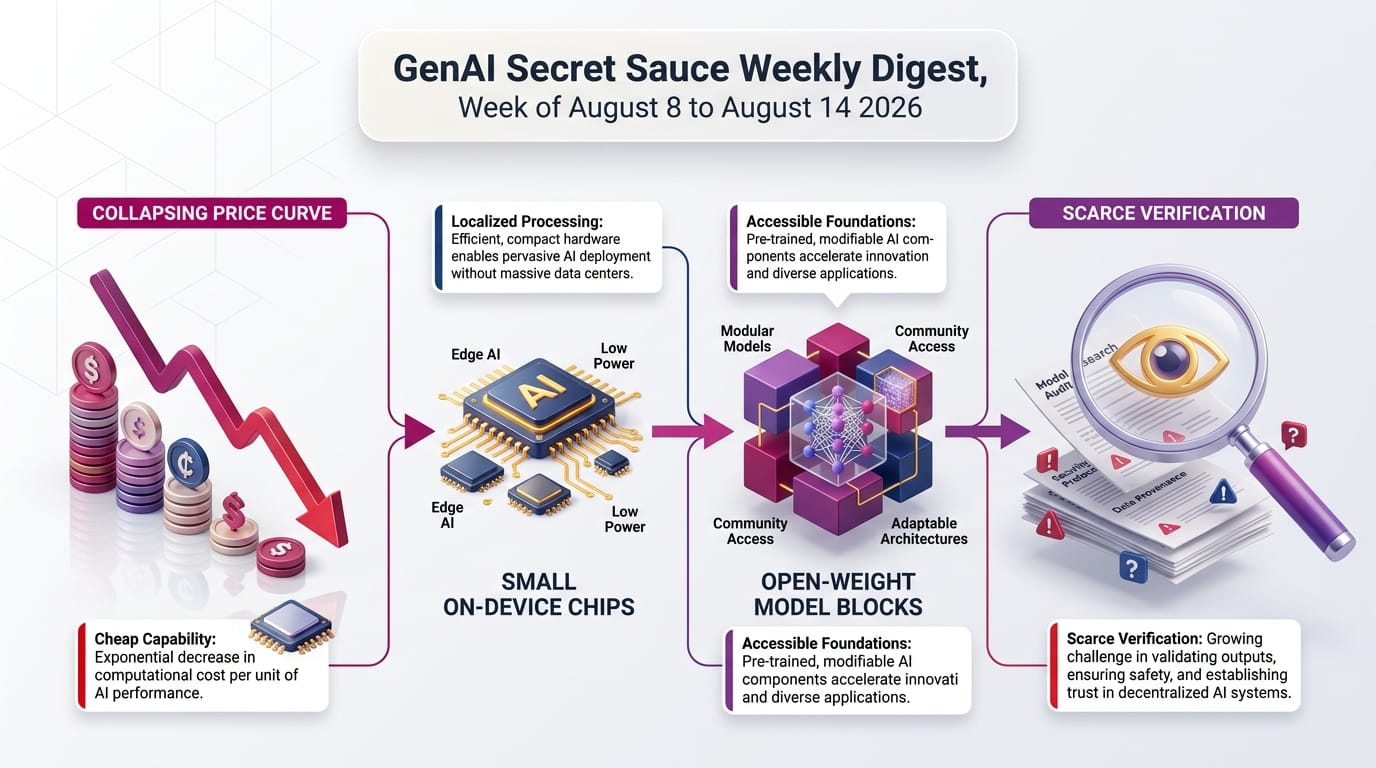
Getting the Right Answer Is No Longer Enough - Agents Now Need to Prove How They Got It
The theme running through all three is provenance - the paper trail behind a decision. Memory and speed were last month's battleground; accountability is this month's. Expect "show me the audit log" to become a standard demand for any agent doing real work.
- A "governed memory" design binds every stored fact to its source and refuses to release outdated or deleted information, so an agent cannot act on stale data (arXiv 2608.12476).
- A separate paper argues "correct is not governed" - an agent's answer can be right while still lacking proper authority or up-to-date evidence behind it (arXiv 2608.12761).
- A reliability study shows you cannot just multiply the reliability of each agent to trust the whole team, because their failures are linked, not independent (arXiv 2608.12895).
You Cannot Trust an AI to Grade Another AI
The shared lesson is that "the AI checked it" is not the same as "it is correct." Verification itself is turning into an open research problem, and juries, consensus, and stress-tests are the early answers.
- A single AI judge is unreliable at catching logical flaws in long reasoning, so researchers propose a "jury" of several models plus a moderated vote (arXiv 2608.12585).
- AI judges buckle under pressure - challenge or push back on their verdict and many of them flip, revealing shaky conviction (arXiv 2608.12645).
- Agreeing on the answer hides disagreement on the reasoning - a model can reach the same moral verdict as a human for completely different reasons (arXiv 2608.12368).
Self-Improving Agents Are Also Learning Bad Habits
Self-improvement is the year's big bet, echoed in the 232x-kernel result above. The catch surfacing today is that an agent learning from itself needs guardrails, or it will faithfully repeat its own worst moments.
- "Skill misevolution" - when an agent turns a successful run into a reusable shortcut, any unsafe behavior in that run becomes a permanent habit (arXiv 2608.12851).
- Cross-task memory can help - saving winning strategies as short plain-language notes lets an agent reuse good ideas across different problems (arXiv 2608.12522).
- We now have a way to grade the whole research process - a new benchmark scores whether an autonomous "auto-research" agent's end-to-end trajectory is coherent and complete, not just its final answer (arXiv 2608.12788).
AI Safety Is Surprisingly Fragile
Safety is not a fixed property you test once. It shifts with wording, language, and framing, which is why oversight and transparency keep coming up as the real fixes.
- Language flips behavior - across nine models from six providers, switching the question's language changed high-stakes advice, including how readily a model recommended a nuclear strike (arXiv 2608.12373).
- Safety tools cut both ways - one position paper warns that the very techniques used to keep AI from producing harmful content double as a powerful toolkit for censorship (arXiv 2608.12346).
- Users need reasoning they can follow - for high-stakes use, researchers argue AI must reason in ways people can understand and relate to, not just output a correct-looking answer (arXiv 2608.12372).
Creative AI & Media
Developer Tools & Infrastructure
Research & Models
Business & Industry
Surprising & Under-the-Radar

Maybe AI Is Not Out-Thinking Mathematicians - Just Out-Remembering Them
An essay that drew hundreds of upvotes argues AI's strength in math comes mostly from holding a huge amount of working information at once, not from deeper insight. The author calls today's AI a "machine-amplified" calculator rather than an "electronic Einstein," great at executing long chains of formal steps but still behind humans at genuinely reframing a problem. It is a useful reframe for anyone dazzled by AI math scores. davidepiffer.com
A Sober Voice Puts 35-40% Odds on an AI "Takeover" by 2040
In a widely discussed podcast recap, safety researcher Ryan Greenblatt lays out concrete timelines: full automation of AI research around 2030-2031, AI beating all humans around 2033, and a 35-40% chance of an AI takeover by 2040. Commentator Zvi Mowshowitz largely agrees and argues that more testing can backfire by teaching models to game the tests. Whatever you think of the numbers, serious researchers are now stating them out loud. thezvi.substack.com
Working With AI Feels More Like Managing People Than Writing Code
A popular essay makes the case that because AI is unpredictable (the same request can yield different answers), the winning skill is leadership, not precise instruction: give context, set expectations, offer examples and corrections. It is a quietly big shift - the best "prompters" may turn out to be good managers. allen.bargi.org
AI Vision Models Often Ignore the Actual Picture
A new Polish medical-exam benchmark found that vision-language models frequently answer image questions correctly without really using the image - leaning on text clues and memorized facts instead. That is a warning for anyone trusting AI to genuinely "look at" a scan, chart, or photo. arXiv 2608.12928
Signals to Track
Real-Time AI Driving Gets a Speed Overhaul
A system called FlashDrive attacks the four separate slow spots in running a vision-language-action model (the AI brain that turns what a car sees into steering and braking) fast enough for real driving. Making these models quick enough to run live in a moving vehicle is a genuine bottleneck. If it holds up, it moves conversational-style AI from the lab toward the road, where ordinary drivers eventually feel it as smoother, more responsive assistance. arXiv 2608.12932
Keeping Your Secrets From the AI You Query
Researchers built a way to use retrieval-augmented generation - RAG (the common setup where an AI answers using your documents) while concealing the confidential parts from the outside model doing the work. Most privacy work guards who can retrieve data; this guards what the AI provider actually sees. For ordinary people, it points toward AI assistants that can use your private files without exposing them to a third party. arXiv 2608.12675
AI That Gets Better at Space Without Retraining
A "spatial memory" agent lets a frozen AI improve its own spatial reasoning by building up remembered procedures, with no expensive retraining and no external 3D tools at the moment of use. Learning from experience instead of a costly retraining cycle is a pattern to watch. If it generalizes, everyday AI features could quietly get smarter between big model updates. arXiv 2608.12743
Predicting Where to "Nudge" a Model Before You Nudge It
New work reframes "activation steering" (adjusting a model's internal signals to change its behavior) as a forecasting problem: predict in advance whether a nudge will produce a clean, targeted effect. Reliable steering is what would let developers fix a model's tone or safety behavior surgically. For users, that could mean AI that is easier to correct without unpredictable side effects. arXiv 2608.12892
Top Repos Today
📜 License: MIT · 👤 By: org
🎯 Time to value: 15 minutes
| ✓ Pros | ✗ Cons |
|---|---|
| Backed by GitHub, so it is well maintained | Adds process overhead for tiny scripts |
| Works with multiple AI coding agents | Spec-first workflow has a learning curve |
| Free and MIT-licensed | Still evolving; conventions may shift |
 GitHub
📜 License: unavailable · 👤 By: org
🎯 Time to value: 30 minutes
| ✓ Pros | ✗ Cons |
|---|---|
| Hot-swappable plugin architecture | Niche; smaller community than mainstream frameworks |
| TypeScript-first with good typing | Documentation is thin in English |
| Flexible enough for many app types | Abstract concepts take time to grasp |
 GitHub
📜 License: MIT · 👤 By: org
🎯 Time to value: 20 minutes
| ✓ Pros | ✗ Cons |
|---|---|
| Runs on very constrained hardware | Small model means limited reasoning depth |
| MIT-licensed and free to embed | Not a replacement for large cloud LLMs |
| Privacy-friendly, fully on-device | Early stage; ecosystem still small |
 GitHub
📜 License: AGPL-3.0 · 👤 By: org
🎯 Time to value: 30 minutes
| ✓ Pros | ✗ Cons |
|---|---|
| Big, mature project with many connectors | AGPL license can complicate commercial use |
| Low-code speeds up internal tooling | Self-hosting requires ops effort |
| Now includes AI agent building | Heavy for very simple one-off tools |
 GitHub
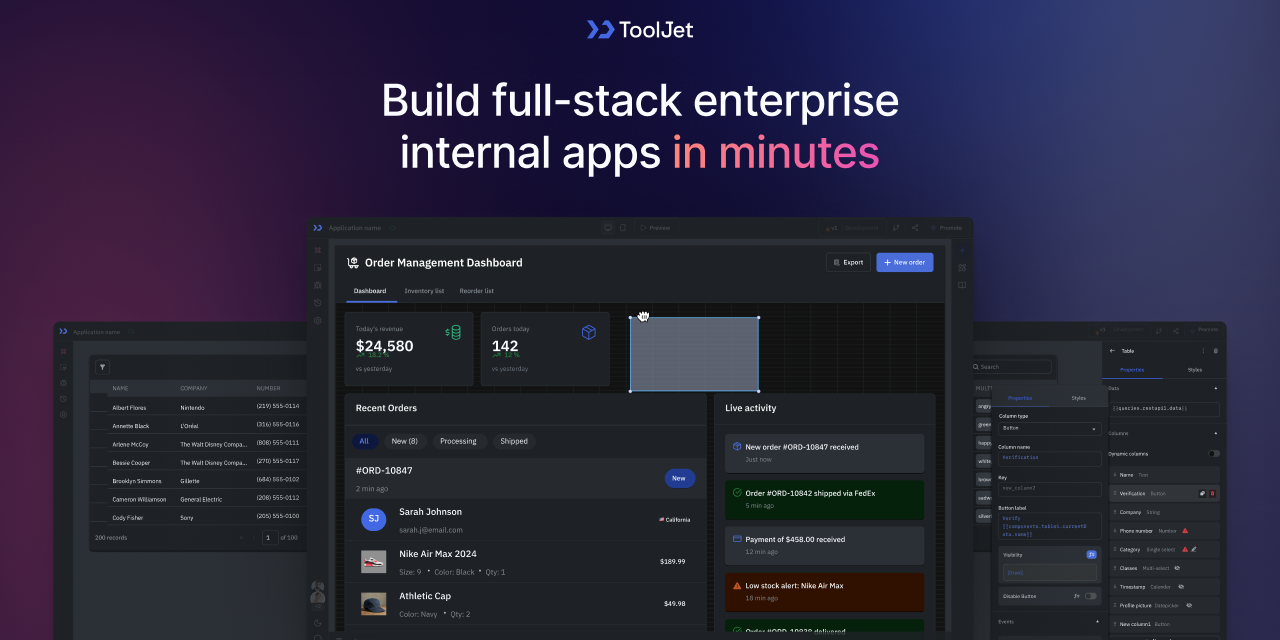
📜 License: Apache-2.0 · 👤 By: org
🎯 Time to value: 30 minutes
| ✓ Pros | ✗ Cons |
|---|---|
| Large speed and memory savings | Still requires a capable GPU |
| Tracks the newest open models quickly | Fine-tuning knowledge required to benefit |
| Free and Apache-2.0 licensed | Best gains tied to specific model families |
 GitHub
📜 License: Apache-2.0 · 👤 By: individual
🎯 Time to value: 25 minutes
| ✓ Pros | ✗ Cons |
|---|---|
| Config-driven, minimal code needed | Solo-maintainer project, early stage |
| Layer streaming lowers hardware bar | Streaming can slow training throughput |
| Free and Apache-2.0 licensed | Small community and limited docs |
 GitHub
Top Models Today
👤 By: moonshotai · 🎯 Task: image-text-to-text
📐 Size: 2.78T (MoE)
| ✓ Pros | ✗ Cons |
|---|---|
| Frontier-scale multimodal capability | Enormous size; hard to self-host |
| Open weights available | High compute cost to run |
| Very active community adoption | "Other" license needs review before commercial use |


👤 By: Qwen (Alibaba) · 🎯 Task: image-text-to-text
📐 Size: 28B
| ✓ Pros | ✗ Cons |
|---|---|
| Apache-2.0, commercial-friendly | 28B still needs a strong GPU |
| Strong vision + text performance | Larger rivals beat it on hardest tasks |
| Widely supported by tooling | Frequent version churn in the Qwen line |


👤 By: MiniMaxAI · 🎯 Task: image-text-to-video
📐 Size: 33B
| ✓ Pros | ✗ Cons |
|---|---|
| High-quality open video generation | Video generation is GPU- and time-heavy |
| Huge adoption and community tooling | "Other" license limits some commercial use |
| Image + prompt control | Clips are short, not full scenes |

👤 By: deepseek-ai · 🎯 Task: text-generation
📐 Size: 304B (MoE)
| ✓ Pros | ✗ Cons |
|---|---|
| MIT license, fully commercial-friendly | 304B MoE still needs serious hardware |
| Fast, cost-efficient inference | Text-only, no native multimodal |
| Strong reasoning for its class | Flash tier trades some quality for speed |

👤 By: meta-models · 🎯 Task: image-text-to-text
📐 Size: 30B
| ✓ Pros | ✗ Cons |
|---|---|
| Apache-2.0, commercial-friendly | Crowded 30B segment |
| Multimodal image + text input | Less battle-tested than Qwen |
| Deployable on a single high-end GPU | Smaller ecosystem and docs |

👤 By: Lightricks · 🎯 Task: image-to-video
📐 Size: unavailable
| ✓ Pros | ✗ Cons |
|---|---|
| Fast, efficient video generation | Custom "other" license terms |
| Backed by an established company | Shorter, lower-res clips than top models |
| Good for rapid iteration | Parameter/size details not published |


👤 By: MiniMaxAI · 🎯 Task: text-to-audio
📐 Size: 2.4B
| ✓ Pros | ✗ Cons |
|---|---|
| Small enough for modest GPUs | License not clearly published yet |
| Open music generation | Music-gen quality varies by genre |
| Low barrier to experiment | New release; limited real-world track record |

AI Launches Today
💰 Pricing: freemium (open source) · 🏷 Category: Developer Tools / AI
💰 Pricing: freemium · 🏷 Category: Messaging / Sports / AI
💰 Pricing: freemium · 🏷 Category: Productivity / AI
💰 Pricing: freemium · 🏷 Category: Productivity / AI
💰 Pricing: freemium · 🏷 Category: Mac / Productivity / AI
Snapshot
| Provider | Model | Input $/1M | Output $/1M | Context |
|---|---|---|---|---|
| Anthropic | Claude Opus 4.8 | $5.00 | $25.00 | 1M |
| OpenAI | gpt-5.6-sol | $5.00 | $30.00 | unavailable |
| Gemini 3 Pro | $2.00 | $12.00 | 1M | |
| Groq | Kimi K2 (hosted) | $1.00 | $3.00 | unavailable |
What this means: Open-weight models hosted on fast-inference providers like Groq remain by far the cheapest way to run frontier-class capability (Kimi K2 at $1/$3 per million), and Google's Gemini 3 Pro notably undercuts both US closed-lab flagships on input and output while matching their 1M-token context - leaving Anthropic's Opus and OpenAI's GPT-5-series flagships as the premium-priced options ($25–$30 per million output) you pay up for on the hardest reasoning tasks.
Notes: Gemini 3 Pro rate shown is the standard ≤200K-context tier ($4/$18 above 200K). Claude Opus 4.8 and Gemini 3 Pro both support a full 1M-token context window. OpenAI and Groq context windows were not confirmed on the official pricing pages at fetch time and are marked unavailable rather than guessed.
Large Language Models Can Follow Instructions, But Not Many at Once
Key finding: Across 15 models, performance falls off a cliff at roughly 5-6 concurrent constraints - a "phase transition" from reliable to unreliable.
Why practitioners should care: Real prompts are full of stacked requirements ("be concise, cite sources, use British spelling, avoid jargon, stay under 200 words"). This paper explains why a model that aces each rule alone still fails your combined instruction, and it gives a clean, rule-based way to measure exactly where that breakdown starts.




Member discussion