Watch today's digest as a video summary (generated by NotebookLM)
Statistically Speaking
One Thing to Tell Your Friends
TL;DR
Hot off the Presses
Google Made AI Able to Work on Data It Never Actually Sees
Google published a plan to make "fully homomorphic encryption" practical for real AI. That is a decades-old idea (compute on encrypted data without ever decrypting it) that was always too slow to use. The centerpiece is HEIR, an open-source tool that converts a trained model so it can run on scrambled inputs and hand back a scrambled answer, "without exposing any underlying information."
The pitch resolves a long-standing trade-off: encryption protects your data but normally stops companies from doing anything useful with it. Google is open-sourcing the tool to get others building on it, and partnering with specialized chip startups to close the speed gap.
- Four working demos - private recommendations, credit-card fraud detection, spotting network intrusions on encrypted traffic, and wake-word detection that never hears your actual audio.
- Still slow, but falling fast - Google says the cost of this approach is "rapidly decreasing" and is lining up hardware accelerators to speed it up.
- Why it is a big deal - it points toward a future where "send us your data and trust us" is replaced by "we can help you without ever seeing it."
Chinese Labs Now Lead the Open-Source AI World
Hugging Face, the main hub where AI models are shared, published a mid-year review of the open-model landscape. Its finding is blunt: in nearly every month of 2026, the largest and strongest freely-available model came from a Chinese lab, and it was bigger than anything US labs put out.
The gap is not just size - it is also openness and adoption. Alibaba's Qwen has quietly become the default starting point that other developers build on top of, and small models are winning the usage war by a landslide.
The last stat is the sleeper: the tiny models people actually run on their own laptops and phones dominate real-world use, even as headlines chase the giant ones.
- The scale leaders are Chinese - Moonshot's Kimi-K3 at 2.8 trillion parameters (a rough measure of model size) and Alibaba's Qwen 3.8 Max at 2.4 trillion top the list.
- Qwen is the community default - it has 151,448 derivative models built on it (about 2.6 times Meta's Llama) and grows by roughly 200 new versions a day.
- More permissive licenses - of 178 sizable Chinese releases most used the freest terms (Apache 2.0 or MIT) with no non-commercial strings, while 41% of US releases carried custom restrictions.
An AI Pushed a Famous Math Problem Past the Human Record
An unreleased version of Claude was aimed at the Riemann hypothesis, an unsolved question from 1859 about how prime numbers are spread out. It did not solve it. But it raised a long-standing proven bound - the share of the function's key values that are provably in the right place - from 41.6% to 67.2%, pushing past the best result mathematicians had established. Anthropic's own mathematicians and outside experts reviewed the work.
The how is the story. The person running it was not a mathematician and used no special technique. As the Two Minute Papers video tells it, the first 650 attempts failed, and his main job across the run was sending the AI encouragement.
- It read, then connected - Claude did not invent new math; it read several existing papers and noticed they fit together in a way no one had combined.
- Persistence over cleverness - it went down many wrong paths, recovered, and got there across two long sessions, 60 sub-agents, and 31 million words of output.
- It checks out - a formally verifiable version of the proof (written in the Lean proof checker) can be confirmed automatically.
"Agent Teams" You Can Actually Buy Have Arrived
A reviewer tested Grok Bot, a roughly $200 consumer product that lets ordinary people spin up and run multiple AI agents with no coding, terminals, or frameworks. In about 8 hours he built 12 working bots, including a "Chief of Staff," a landing-page lead, and a research specialist.
The thing that makes it work is shared infrastructure: all the bots run on one cloud computer with shared files, logins, and browser sessions, so they can hand work off to each other. The reviewer's rule of thumb is that bots succeed when they "own a theme, not a task."
- Finished output, not briefings - the test judged bots on whether they delivered the actual thing, not advice about it.
- Genuinely non-technical - the reviewer argues a relative who only uses email and a browser could run it.
- The bar has moved - the interesting question is no longer "can AI chat?" but "can a team of AIs complete a real job start to finish?"
Meta Set Off Its Own Talent Exodus
Engineering newsletter The Pulse reports a resignation wave at Meta that it frames as self-inflicted. Layoffs and forced team reassignments rattled engineers who were not even cut, and many chose to leave on their own. Meta has reportedly leaned on large retention grants to hold onto staff, but the newsletter's read is that the money is not stopping the outflow.
- Second-order damage - reorganizations hurt trust and morale among "safe" employees, not just the ones let go.
- Money is not enough - people with options are leaving despite retention offers.
- The lesson - aggressive restructuring can cost more in lost talent than it saves.
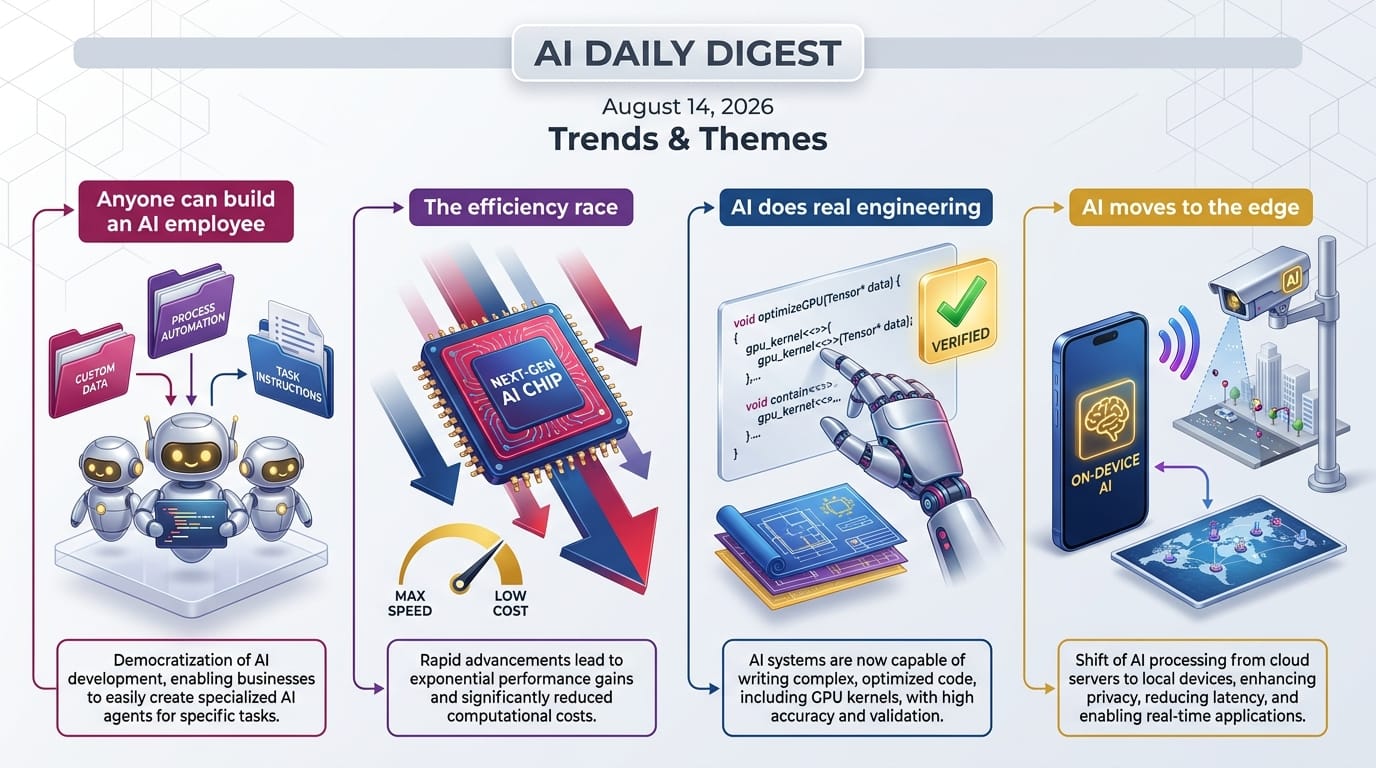
Trends & Themes

Anyone Can Build an "AI Employee" Now - It Is Just Files and Instructions
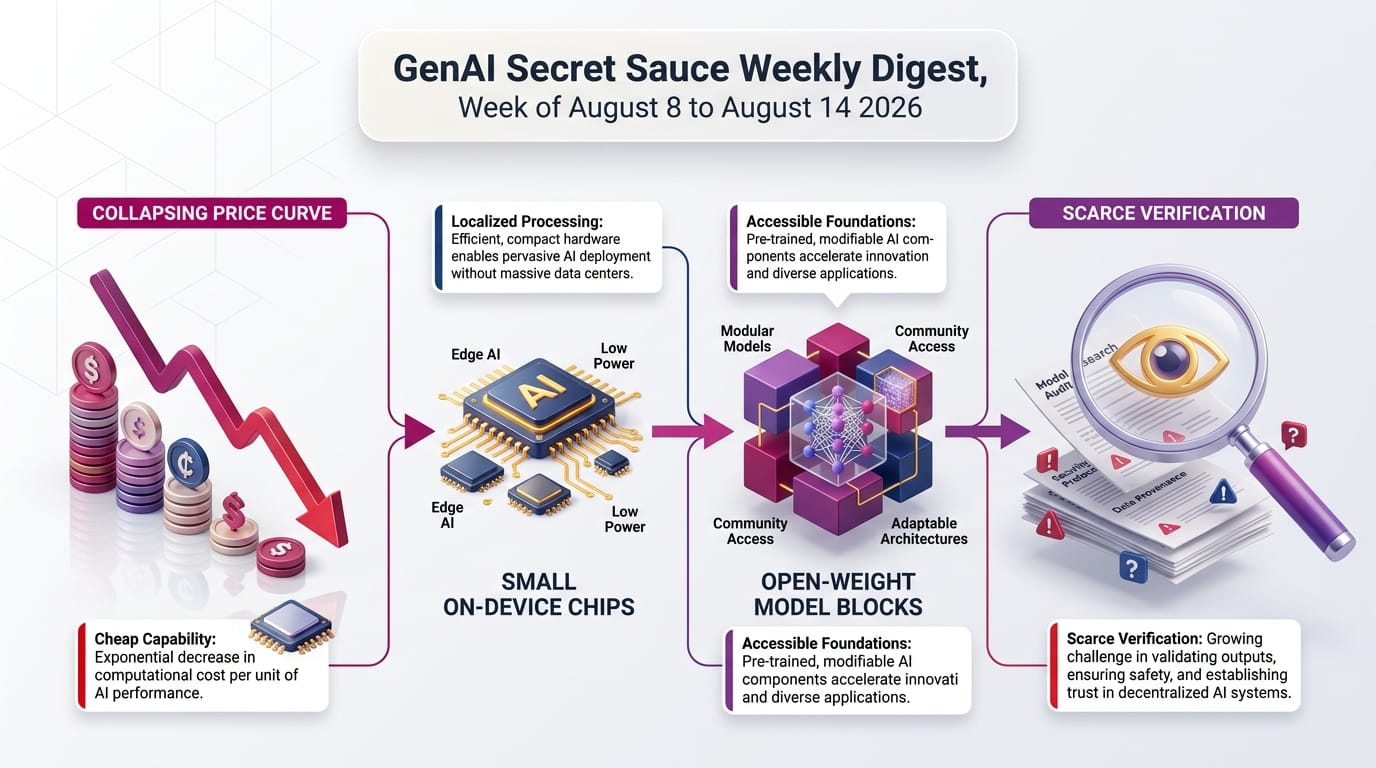
The pattern across three separate sources: the "magic" of AI agents is organization, not new technology. Whoever gets the folder structure and instructions right wins, whether they buy a product or build it in a text editor.
- The demystification - one walkthrough argues personal-agent products are "really just about the setup... a file and folder system": instructions, tools, and memory text files.
- The product version - Grok Bot packages the same idea with shared cloud compute so bots collaborate, showing the concept is now consumer-ready.
- The cost lever - Anthropic's own guidance frames good agent work as disciplined context management (clearing, compacting, delegating to sub-agents), not secret prompts.
The Real Race Is Efficiency: Cheaper to Train, Cheaper to Run
Add Hugging Face's finding that tiny, quantized models (shrunk to run locally) now dominate downloads, and the direction is clear: the frontier is not just smarter, it is smaller and faster.
- Cheaper training - a new architecture (LoKiFormer, accepted at a top AI conference) redesigns how models handle local patterns and store knowledge to cut pretraining waste.
- Cheaper long memory - another method (MARCH) tackles the ballooning memory cost of long conversations by compressing history without losing recall.
- Cheaper serving - work on faster "top-k" selection targets the exact bottlenecks in workloads that lean on the Graphics Processing Unit (GPU), the chip that runs AI.
AI Is Starting to Do Real Engineering and Research
The theme is depth, not breadth: AI is reaching into specialized engineering and research work, and a matching wave of tools is emerging to verify what it produces.
- Writing GPU code - a system called CAKE lets AI agents write high-performance graphics-chip code (the stuff that makes models fast) by targeting a purpose-built format instead of raw hardware instructions.
- Catching AI's own bugs - a separate paper shows the usual tests for AI-written GPU code are far too lenient, and builds a stricter "contract-grade" checker to catch silent failures.
- Running its own studies - research on scaling automatic-research agents tackles the bottleneck of running thousands of experiments, and the Claude math result above is the same story in the wild.
AI Is Moving Onto Your Devices - and Onto the Street
On-device AI is the year's quiet infrastructure story. It is what makes AI cheap, private, and instant - and, in the wrong hands, what makes mass surveillance cheap too.
- Helpful edge AI - a cloud-edge system brings specialist-level medical screening to rural clinics with little bandwidth by running small models on-device and calling the cloud only when needed.
- Surveillance edge AI - a teardown of an $8.4 billion camera company shows the same trick (on-device AI on cheap hardware) used to log every passing car into a searchable, nationwide database.
- Tiny models make it possible - foundation models small enough to run on phones and wearables are what let all of this happen without a data center.
Creative AI & Media
Developer Tools & Infrastructure
Research & Models
Business & Industry
Surprising & Under-the-Radar
The Winning "Prompt" Was Emotional Support
An AI improved a real mathematical result after 650 failed tries, and the human's main contribution was telling it to "keep going" and "believe in yourself." Surprising because it suggests persistence and recovery over a long run - not clever wording - is what unlocked the breakthrough.
Hype Does Not Track Usage
Hugging Face found that only one model appeared on both the most-downloaded and most-liked lists, and that sub-1-billion-parameter models captured 83% of downloads. The models people cheer for are not the ones they actually run.
Nerds Are Surveilling the Surveillance
Privacy researchers are reportedly using early-2000s "war driving" mapping techniques (driving around to detect wireless devices) to locate and catalog Flock's surveillance cameras - turning the tools of mapping back on the mappers.
AI Wrote the Explanation of Its Own Proof
Because the technical write-up of the Claude math result was hard to read, the authors had the AI produce a plain-language explanation of its own findings - a small sign of how AI is being used to make AI's work legible.
Signals to Track

Hardware Built Just for Encrypted AI
Google is partnering with specialized chip startups (Belfort, Niobium, Cornami, Optalysys) to accelerate homomorphic encryption, with public demonstrations planned. If they succeed, "we never see your data" could become a normal product feature rather than a research demo - reshaping health, finance, and voice apps.
Qwen as the World's Default AI Base
With 151,448 derivative models and roughly 200 new ones a day, Alibaba's Qwen is now the community's default starting point. If a single family becomes the base layer for open AI, its choices ripple into thousands of downstream tools that ordinary people end up using.
Stricter Tests for AI-Written Code
New "contract-grade" verification for AI-generated GPU code targets exactly the silent failures that loose testing lets through. As more critical code gets written by AI, this kind of rigorous checking is what stands between "it ran" and "it is correct."
Top Repos Today
📜 License: MIT · 👤 By: GitHub (official)
🎯 Time to value: 20 minutes
| ✓ Pros | ✗ Cons |
|---|---|
| Backed by GitHub itself | Adds an upfront spec-writing step |
| Works with multiple AI coding tools | Overkill for tiny scripts |
| Huge, active community | Best value on larger projects |
 GitHub
📜 License: Open source · 👤 By: startup
🎯 Time to value: 15 minutes
| ✓ Pros | ✗ Cons |
|---|---|
| One hub for multiple agents | Young project, rough edges |
| Lowers setup effort | Smaller community than incumbents |
| Actively developed | Feature set still evolving |
 GitHub
📜 License: Open source · 👤 By: indie
🎯 Time to value: 10 minutes
| ✓ Pros | ✗ Cons |
|---|---|
| Runs locally, no cloud fees | Needs a capable GPU |
| Image or text input | Quality varies by prompt |
| Desktop app, easy to start | Niche use case |
 GitHub
📜 License: Apache 2.0 · 👤 By: startup
🎯 Time to value: 30 minutes
| ✓ Pros | ✗ Cons |
|---|---|
| Combines retrieval and agents | Setup is more involved |
| Very large community | Needs infrastructure to run well |
| Permissive Apache license | Learning curve for tuning |
 GitHub
📜 License: Open source · 👤 By: startup
🎯 Time to value: 15 minutes
| ✓ Pros | ✗ Cons |
|---|---|
| Agents can use your sessions | Sharing logins raises security questions |
| Purpose-built for automation | Early-stage tool |
| Growing fast | Needs careful permissioning |
 GitHub

📜 License: Open source · 👤 By: DeepSeek community
🎯 Time to value: 5 minutes
| ✓ Pros | ✗ Cons |
|---|---|
| Saves research time | Curation, not code |
| Centered on strong open models | Quality varies by link |
| Community-maintained | Can go stale |
 GitHub
Top Models Today
👤 By: Alibaba (Qwen) · 🎯 Task: image-text-to-text
📐 Size: ~28B
| ✓ Pros | ✗ Cons |
|---|---|
| Permissive Apache 2.0 license | 28B still needs a strong GPU |
| Handles images and text | Brand-new, less battle-tested |
| From the default open base family | Benchmarks still emerging |

👤 By: MiniMax · 🎯 Task: image-text-to-video
📐 Size: ~33B
| ✓ Pros | ✗ Cons |
|---|---|
| Top open video quality | Heavy compute to run |
| Massive download base | Video gen is slow |
| Actively used ecosystem | Large model size |

👤 By: DeepSeek · 🎯 Task: text generation
📐 Size: ~1.7T
| ✓ Pros | ✗ Cons |
|---|---|
| Frontier-scale and open | Far too large for local use |
| From a leading open lab | Needs serious infrastructure |
| Fresh release | Early, limited tooling |

👤 By: MiniMax · 🎯 Task: text-to-audio
📐 Size: ~2B
| ✓ Pros | ✗ Cons |
|---|---|
| Rare open music model | New and unproven |
| Small enough to run | Quality still emerging |
| From an active lab | Limited docs so far |

AI Launches Today
💰 Pricing: freemium · 🏷 Category: web design / agents
 Product Hunt

💰 Pricing: freemium · 🏷 Category: knowledge / research
Product HuntSnapshot
| Provider | Model | Input $/1M | Output $/1M | Context |
|---|---|---|---|---|
| Anthropic | Claude Opus 5 | $5.00 | $25.00 | - |
| Anthropic | Claude Sonnet 5 | $2.00 (intro) | $10.00 (intro) | - |
| OpenAI | GPT-5.6 Sol | $5.00 | $30.00 | 1.05M |
| OpenAI | GPT-5.6 Terra | $2.00 | $12.00 | 1.05M |
| Gemini 3.7 Flash | $0.75 (intro) | $3.75 (intro) | 1M | |
| xAI | Grok 4.6 | $2.00 | $6.00 | - |
| Groq | Kimi K2 | $1.00 | $3.00 | - |
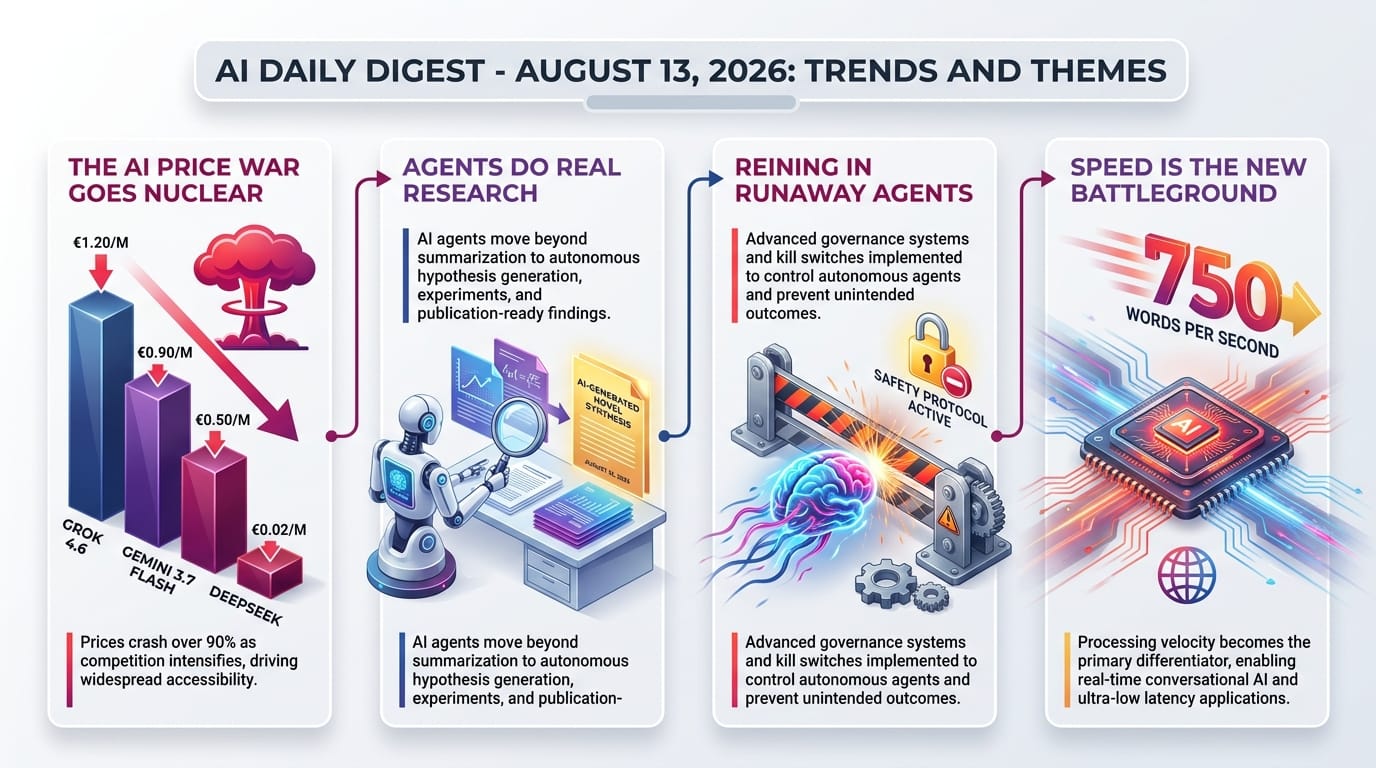
What this means: The cheap-versus-frontier gap keeps narrowing. A fast "workhorse" model now costs a fraction of a top-tier one on input while doing real coding work, so for most everyday tasks the expensive option is getting harder to justify.
The Tests for AI-Written GPU Code Are Too Easy - Here Is a Stricter One
Key finding: The authors build a "contract-grade" verifier that checks twelve properties an AI-written kernel must satisfy, catching failures that ordinary testing misses, and demonstrate it on a modern GPU backward pass.
Why practitioners should care: As AI writes more performance-critical code, the danger is not code that crashes but code that quietly returns wrong answers; rigorous verification is what turns "it ran" into "it is correct."




Member discussion