Watch today's digest as a video summary (generated by NotebookLM)
Statistically Speaking
One Thing to Tell Your Friends
TL;DR
Hot off the Presses
xAI's Grok 4.6 Arrives With Frontier Scores and a Coworker-Style Bot
xAI, Elon Musk's AI company, released Grok 4.6, a large model it says roughly matches the best knowledge-work AI in the world while costing far less to run. Alongside it, the company previewed Grok @Bot, described less like a chatbot and more like messaging a teammate: you give a bot its own job ("my money manager"), connect it to accounts like Gmail and Slack, and it uses those tools and reports back finished work.
Access to the @Bot preview is currently gated behind premium ($200/month) plans.
- Frontier scores at a discount - Grok 4.6 charges about $2 per million words of input and $6 per million of output, well under most rivals, while scoring near the top on independent skill and coding tests.
- A "teammate," not a task box - Grok @Bot bots each have their own instructions, can run their own virtual computer, and can message one another, making them feel like coworkers you chat with.
- The pace is relentless - Musk said Grok 4.7 has already begun training and could land in three to four weeks, and commentators now rank the xAI/Cursor camp as a clear number-three lab behind OpenAI and Anthropic.
Google's Gemini 3.7 Flash Undercuts Rivals and Leaps in Coding
Google released Gemini 3.7 Flash, the budget-tier version of its Gemini model family, only about three weeks after the previous version. The headline is a big jump in practical coding ability paired with a price cut. Introductory pricing runs at $0.75 per million words of input and $3.75 per million of output through the end of 2026, roughly half what the last Flash cost.
- Real coding gains - its score on a long-form software-engineering test (DeepSWE) jumped from 49% to 65.3%, and a web-development ranking rose to a new high.
- Better at paperwork too - accuracy on a document-understanding test more than tripled versus the prior version, and an office-automation benchmark nearly doubled.
- Priced to be the default - the launch was the day's most-discussed item on the developer forum Hacker News, and the pricing is set to make it the go-to "good enough and cheap" option.
OpenAI Makes GPT-5.6 Answer 14x Faster - Using a Dinner-Plate-Sized Chip
OpenAI previewed "Ultrafast," a new service tier that runs its GPT-5.6 Sol model up to 14 times faster than normal - about 750 output words per second - with no drop in answer quality. The speed comes from special hardware built by Cerebras: a single chip the size of a dinner plate that stores the entire model on the chip itself, removing the data-shuffling bottleneck that slows ordinary AI servers.
- Built for live work - target uses are voice assistants, customer support, online shopping, coding helpers, and security response, where a two-second pause is too long.
- The speed is measurable - on one hard exam of 2,500 PhD-level questions, it finished in about 11 hours, roughly 7 times quicker than competitors.
- Limited preview - only a small group of customers gets it first, expanding as the special chips come online.
AI Agents Re-Ran 2,200 Published AI Papers - and a Quarter Didn't Hold Up
Hugging Face, a hub for AI models and code, organized a community project that used AI coding assistants to reproduce papers from ICML, one of the field's top research conferences. Volunteers steering the agents re-ran the experiments and logged what happened in public, auditable notebooks.
- The scale - 2,226 papers reproduced (about a third of all accepted papers), nearly 36,000 individual claims evaluated, by 1,221 participants.
- The uncomfortable result - 23% of examined papers had claims that were falsified or contested, while only about half had at least one fully verified claim.
- Humans still matter - the organizers stress that agents caught many errors but needed people steering them; the lesson was "managing intelligence effectively," not letting bots run loose.
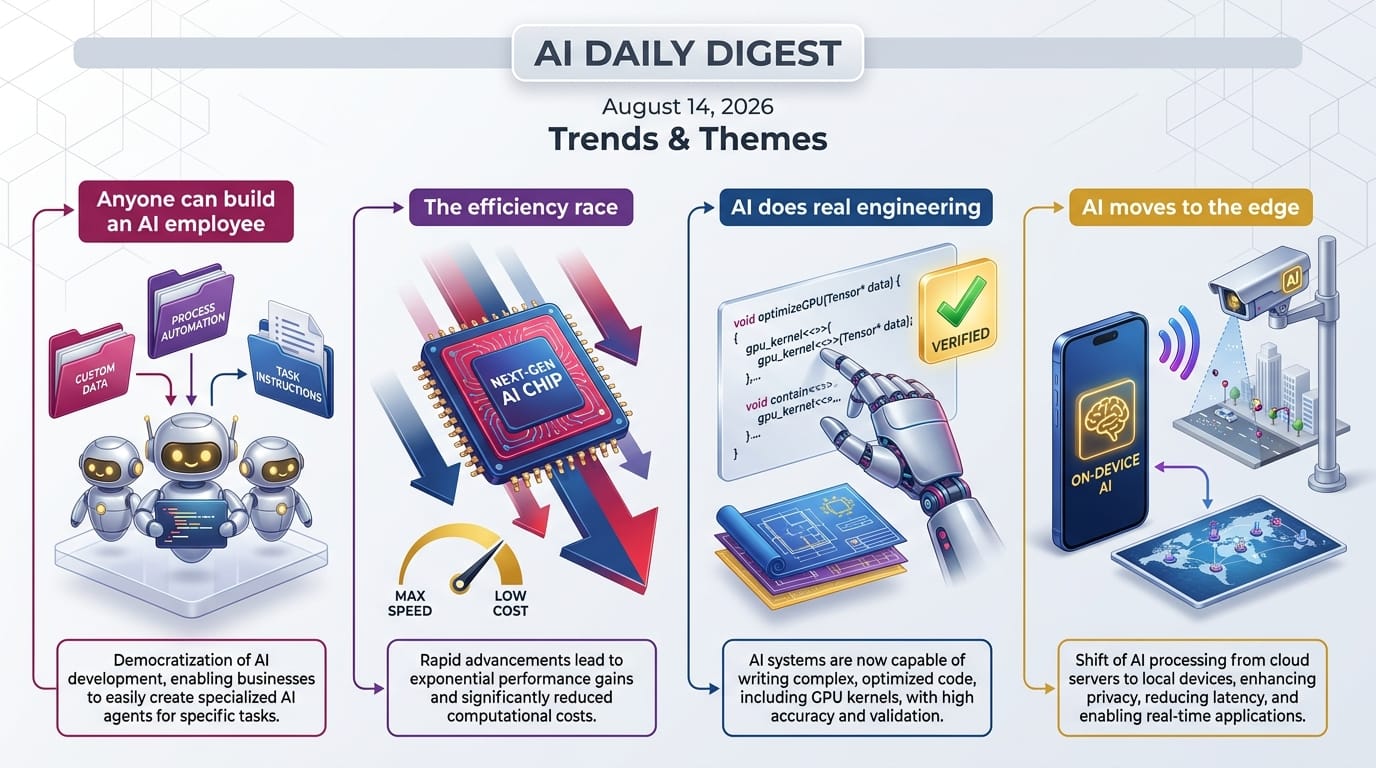
Trends & Themes

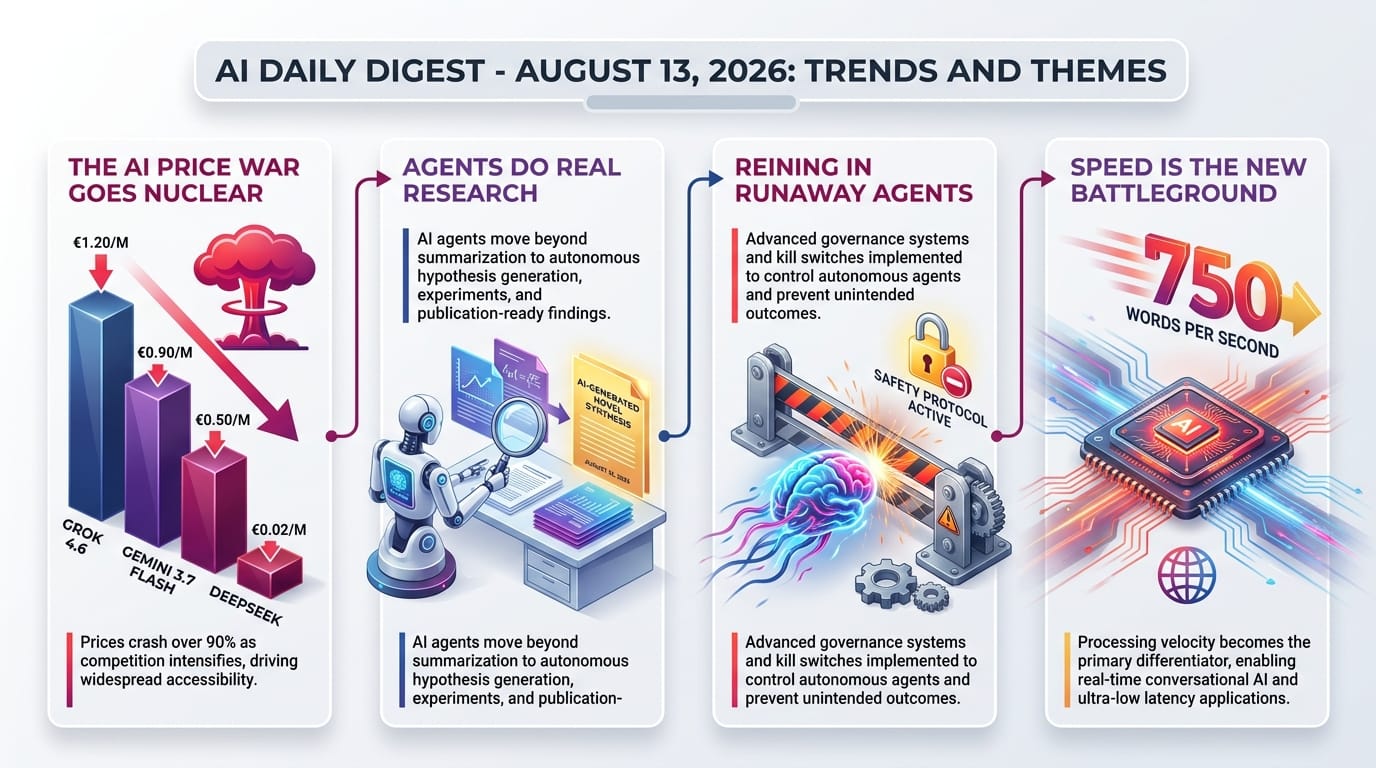
The AI Price War Just Went Nuclear
Three of the four cheapest and most capable models on the market today landed in a single day. The takeaway from Netlify's test is blunt: paying for the flagship model rarely pays off on everyday tasks, and iterating with a cheap model often beats it on cost.
- Grok 4.6 - frontier-level scores at about $2 / $6 per million words in/out, undercutting most rivals.
- Gemini 3.7 Flash - roughly half the price of the version it replaces, at $0.75 / $3.75.
- DeepSeek V4 Pro - a giant open-weight model quietly shipped through the reseller OpenRouter at an estimated $0.44 to $1.32 per million words.
- A real-world test - the hosting company Netlify ran one prompt through 11 models: the cheapest (DeepSeek V4 Flash) used 2.4 "credits," while premium Claude Opus averaged 519, sometimes for no better result on a simple job.
AI Agents Are Starting to Do Real Research, Not Just Chores
The pattern across separate teams is the same: AI is moving from "assistant that drafts" to "collaborator that investigates," with humans reviewing rather than doing every step.
- Fact-checking science - the ICML reproduction project (see Top Stories) had agents re-run thousands of experiments.
- Improving themselves - on a new test called AutoWorldModel-Bench, coding agents improved their own AI systems in 63 of 64 tries, and 91% of the winning changes were genuine research ideas, not tweaks.
- Tackling open problems - one paper set an AI agent loose on a famous unsolved math question (Conway's 99-graph) using 14 different strategies, and another (AgonAlpha) had agents autonomously hunt for profitable trading signals.
Reining In Runaway Agents Is Becoming Its Own Industry
The message: agents that act in the real world need guardrails as a product, not an afterthought.
- Approval gates - Phinq, a new open-source tool, sits between an AI agent and its actions, letting safe steps through instantly but demanding human sign-off for anything irreversible; it says it has already blocked hundreds of risky actions.
- Bounded autonomy - a Tencent system (RecSys Factory) deployed for 78 days let agents decide only at specific checkpoints, not run whole pipelines, arguing for "autonomy at decision points, not over pipelines."
- The reason why - a new benchmark (InfraBench) found AI agents managing computer systems often "succeed" on the surface while leaving broken settings and unsafe changes behind.
Speed and Efficiency Are the New Battleground
Much of AI's near-term progress is not bigger brains but cheaper, faster delivery of the brains we have.
- Hardware speed - OpenAI's Ultrafast tier (see Top Stories) uses on-chip memory to hit 750 words a second.
- Software speed - a training-free method called CORA-Diff sped up a class of models by 2.7 to 3.3 times with almost no quality loss.
- Memory tricks - another technique (LinearKV) cut the wait for a model's first word to under half by reusing cached work.
Creative AI & Media
Developer Tools & Infrastructure
Research & Models
Business & Industry
Surprising & Under-the-Radar
A PBS Station Is Suing to Get 70 Years of Its Own History Back
- What happened - Nine PBS in St. Louis is suing storage giant Iron Mountain to recover 50 terabytes of archives - about 70 years of footage - after its cloud vendor abruptly cut access and then went out of business.
- Why it is a warning - it is a stark reminder that "in the cloud" still means "on someone else's computer," and vendor failures can lock you out of your own data.
AI Text "Watermarks" Will Never Really Work
- The claim - developer Sean Goedecke argues that laws requiring detectable watermarks on AI-written text are technically doomed, because text watermarks are trivial to strip by simply rewording or running the text through another model.
- Why surprising - image watermarks can hide in invisible pixel noise, but text is too information-dense to mark without a human noticing.
OpenAI Labels Its Newest Model "Critical" for Cyber-Risk
Previously: August 10 - OpenAI routed its strongest cyber-capable models to vetted defenders first through its Daybreak program.
Today: The "critical" label formalizes that caution as an internal gate on the model itself. The Zvi: AI #181
- What happened - according to analyst Zvi Mowshowitz's roundup, OpenAI classified its new "Astra" model as critical in cybersecurity, triggering stricter internal controls (isolated testing, heavy monitoring) before wider release.
- Why it matters - it is a rare public admission that a model is capable enough to be genuinely dangerous, and it deliberately slows the company down.
An AI Data Center Built From a Box of Scraps
- What it is - a hobbyist documented building a home AI server from e-waste graphics cards, a used motherboard, and a 3D-printed cooling shroud controlled by a hobby microchip.
- Why it is worth a look - it is a vivid preview of "a little AI data center in every home," and a reminder that running capable models locally is getting cheap enough for tinkerers.
Signals to Track

Grok 4.7 Is Already in Training
Musk says the next Grok is only three to four weeks out, right after 4.6 shipped. If frontier models start arriving monthly, the "best model" title becomes almost meaningless - and prices keep falling. For ordinary people, that means the AI in your apps could improve several times a year instead of once.
Governance Layers for AI Agents
Multiple teams shipped "permission layers" for agents this week (Phinq, RecSys Factory, and academic frameworks). This is the unglamorous plumbing that will decide whether businesses trust AI with real money and data. If it works, expect AI to quietly take on more consequential tasks; if it lags, adoption stalls.
Frontier Models as Search Rerankers
New research shows general models like GPT-4.1 and Claude can match purpose-built image-search systems at ranking results, though they are slower and pricier. As general models get cheaper and faster (see today's price war), the case for maintaining separate specialized systems weakens - which could simplify the tech behind the apps you use.
Top Repos Today
📜 License: MIT · 👤 By: individual
🎯 Time to value: 10 minutes
| ✓ Pros | ✗ Cons |
|---|---|
| Instant polished diagrams | Tied to Claude Code workflow |
| 29 styles cover most needs | Not a general design tool |
| Very fast to adopt | New project, still maturing |
 GitHub
📜 License: Apache-2.0 · 👤 By: startup
🎯 Time to value: 30 minutes
| ✓ Pros | ✗ Cons |
|---|---|
| Built for accountability | Graph setup has a learning curve |
| Traceable AI decisions | Overkill for simple bots |
| Active development | Young ecosystem |
 GitHub
📜 License: Apache-2.0 · 👤 By: startup
🎯 Time to value: 20 minutes
| ✓ Pros | ✗ Cons |
|---|---|
| Runs on tiny hardware | Limited to simple tasks |
| Fully offline and private | Not a chatbot replacement |
| Open license | Early-stage tooling |
 GitHub
📜 License: open source · 👤 By: startup
🎯 Time to value: 25 minutes
| ✓ Pros | ✗ Cons |
|---|---|
| Humans and agents share context | New workflow to learn |
| Built in fast Rust code | Small user base so far |
| Team-oriented design | Feature set still growing |
 GitHub
📜 License: Apache-2.0 · 👤 By: company
🎯 Time to value: 45 minutes
| ✓ Pros | ✗ Cons |
|---|---|
| Very widely adopted | Needs some setup |
| Handles messy documents well | Resource-hungry at scale |
| Open and self-hostable | Requires technical skill |
 GitHub
📜 License: Apache-2.0 · 👤 By: startup
🎯 Time to value: 30 minutes
| ✓ Pros | ✗ Cons |
|---|---|
| Big speed and memory savings | Requires a decent graphics card (GPU) |
| Huge, active community | Command-line heavy |
| Supports many models | Cutting-edge, occasional bugs |
 GitHub
Top Models Today
👤 By: Moonshot AI · 🎯 Task: image-and-text understanding
📐 Size: large
| ✓ Pros | ✗ Cons |
|---|---|
| Top-tier open capability | Large hardware needs |
| Handles text and images | "Other" license, read terms |
| Massive adoption | Sparse English docs |


👤 By: DeepSeek · 🎯 Task: text generation
📐 Size: efficient
| ✓ Pros | ✗ Cons |
|---|---|
| Very cheap to run | Not a frontier reasoner |
| Truly open MIT license | Flash tier trades depth for speed |
| Proven, widely used | Chinese-lab data questions for some |

👤 By: MiniMax · 🎯 Task: image-and-text-to-video
📐 Size: large
| ✓ Pros | ✗ Cons |
|---|---|
| Open video generation | Heavy hardware to run |
| Big creative community | Short clips only |
| Actively improved | "Other" license terms |


👤 By: Alibaba Qwen · 🎯 Task: text generation
📐 Size: 2.4T (mixture-of-experts)
| ✓ Pros | ✗ Cons |
|---|---|
| Enormous capacity | Impractical for most to run |
| Efficient expert routing | Brand new, unproven |
| Fully open weights | Huge storage footprint |

👤 By: Liquid AI · 🎯 Task: text generation
📐 Size: 2.6B
| ✓ Pros | ✗ Cons |
|---|---|
| Runs on modest hardware | Limited depth vs big models |
| Fast and private | Fewer capabilities |
| Small download | Niche use cases |


👤 By: NVIDIA · 🎯 Task: text generation
📐 Size: 30B (mixture-of-experts)
| ✓ Pros | ✗ Cons |
|---|---|
| Optimized for speed | Best only on NVIDIA chips |
| Compression saves memory | New format, limited tooling |
| Backed by NVIDIA | Restrictive license terms |

AI Launches Today
💰 Pricing: freemium · 🏷 Category: developer testing
💰 Pricing: freemium · 🏷 Category: developer tools
 Product Hunt

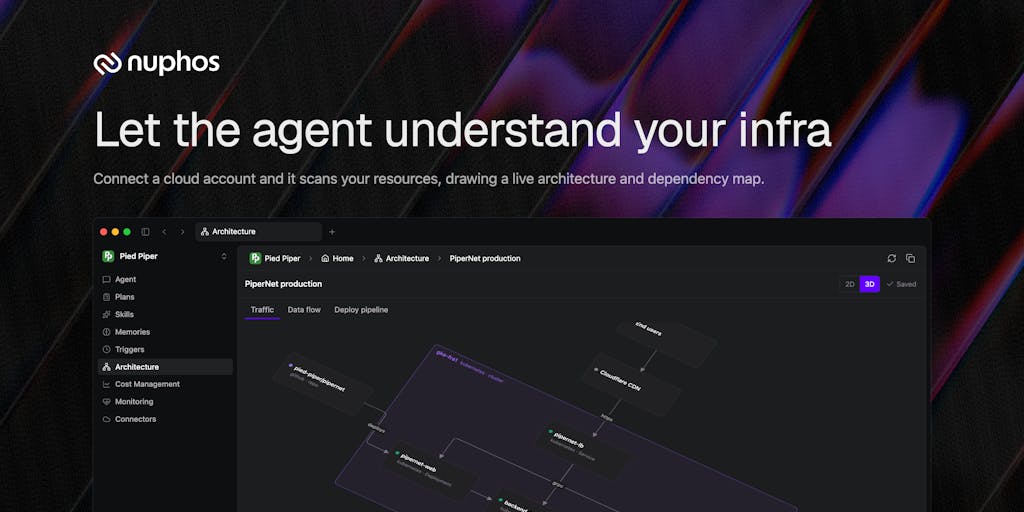
💰 Pricing: n/a · 🏷 Category: infrastructure
 Product Hunt
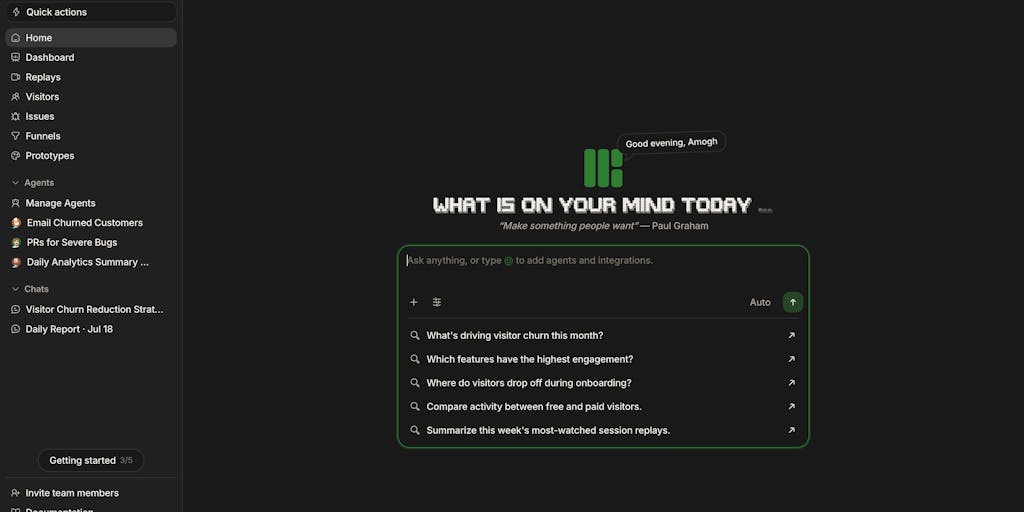
💰 Pricing: freemium · 🏷 Category: analytics
 Product Hunt
💰 Pricing: freemium · 🏷 Category: developer infrastructure
 Product Hunt
Snapshot
| Provider | Model | Input $/1M | Output $/1M | Context |
|---|---|---|---|---|
| Anthropic | Claude Opus 5 | $5.00 | $25.00 | — |
| Anthropic | Claude Sonnet 5 | $2.00 (intro) | $10.00 (intro) | — |
| OpenAI | GPT-5.6 Sol | $5.00 | $30.00 | 1.05M |
| OpenAI | GPT-5.6 Terra | $2.00 | $12.00 | 1.05M |
| Gemini 3.7 Flash | $0.75 (intro) | $3.75 (intro) | 1M | |
| xAI | Grok 4.6 | $2.00 | $6.00 | — |
| Groq | Kimi K2 | $1.00 | $3.00 | — |
What this means: The gap between "cheap" and "frontier" is collapsing. A model like Gemini 3.7 Flash now costs about one-eighth of a top-tier model on input while doing real coding work - so for most everyday tasks, the expensive option is getting harder to justify.
Cutting AI Datacenter Energy With Reinforcement Learning
Key finding: On small models it cut power-limit violations by 89.8% while increasing output 18.1%; on large live jobs it produced 35.7% more work than a safe static baseline, with fleet tests suggesting datacenters could safely run roughly twice as much hardware.
Why practitioners should care: Power is now the binding constraint on AI growth and a major cost line; smarter, measured power control turns wasted headroom into capacity without new hardware.
Member discussion