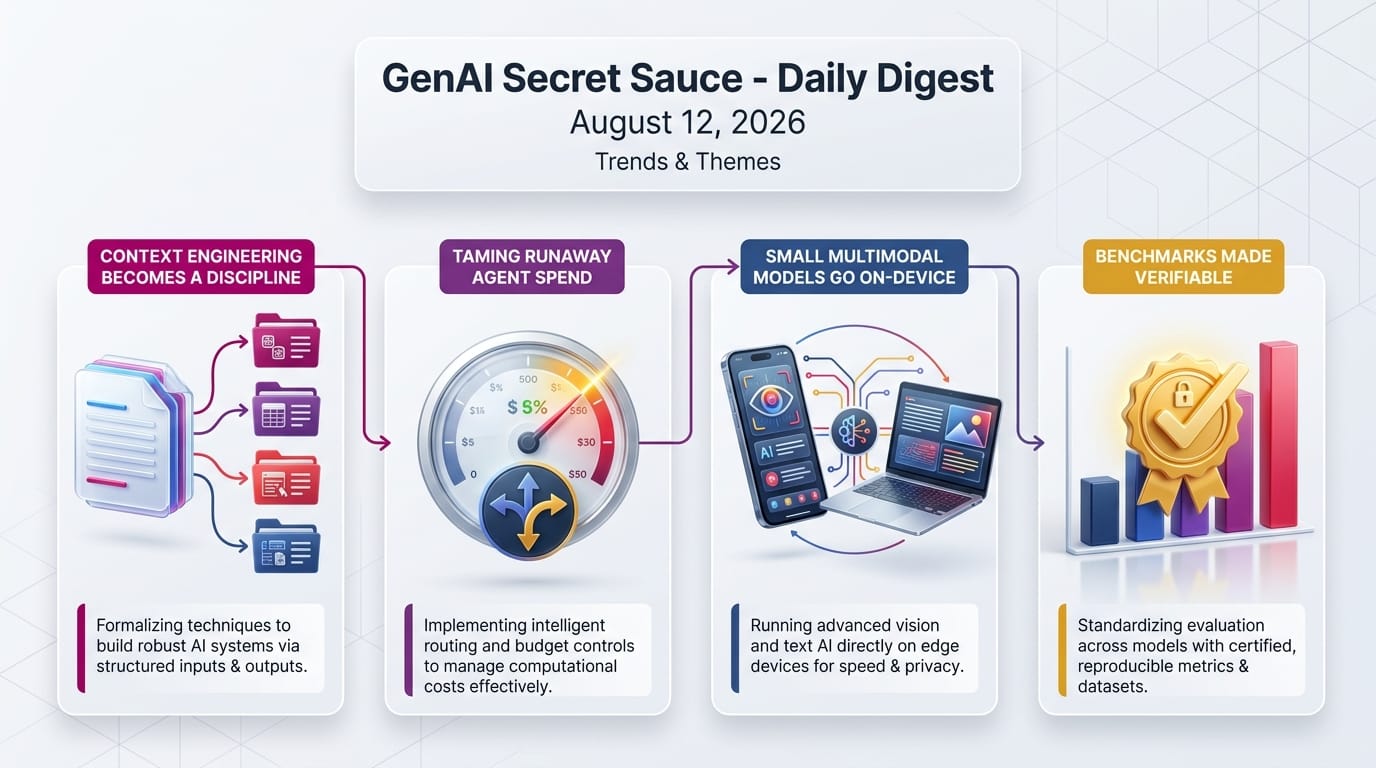
Watch today's digest as a video summary (generated by NotebookLM)
Statistically Speaking
One Thing to Tell Your Friends
TL;DR
Hot off the Presses
Lovable Raised $400 Million and Is Now Worth $13.3 Billion
Lovable is a "vibe coding" platform: you type what you want in ordinary language and it builds a functioning web app. The company launched in November 2024 and just closed a $400 million Series C led by Menlo Ventures, valuing it at $13.3 billion. Investors include Accel, CapitalG, Tencent, and Salesforce Ventures.
The growth numbers explain the price. Lovable says more than 60 million projects have been built on it, the apps it powers draw over 900 million monthly visits, and it is now used somewhere inside two-thirds of the Fortune 500.
- 8 in 10 builders are making monetizable projects - and over a third are already earning revenue from what they built
- Headcount is heading to roughly 450 people - with new offices in London, Boston, San Francisco, and New York alongside its Stockholm base
- Recent additions push toward business use - payments, security scanning, and integrations with Google Workspace, Microsoft 365, Salesforce, and Stripe
Google DeepMind Put Sign-Language Translation Directly on Your Phone
Google DeepMind shipped SL2T (Sign-Language-to-Text), starting with American Sign Language to English inside Gboard and Live Transcribe on the Pixel 11. Instead of streaming camera video to a server, the phone extracts body-pose landmarks (just the geometric coordinates of hands, face, and body) on-device and can discard the video immediately.
The model was trained on more than 100,000 hours of data across 50-plus sign languages. It skips the old intermediate step of "glosses" and translates pose directly to text, which better captures facial expressions and the spatial grammar sign languages rely on.
- 70 BLEURT zero-shot on the FLEURS-ASL benchmark - described as far higher than any previously reported score (BLEURT measures how close a translation is to human quality)
- On-device design keeps input private - only coordinates are processed, not raw footage
- Still imperfect - it struggles with rare signs and fast fingerspelling
OpenAI Says Companies Are Moving "From Assistance to Execution"
OpenAI published an enterprise report arguing that the value has shifted from chatting to wiring AI agents into real workflows with permissions and human review. The standout figure: as of June, its coding agent Codex generated 64% of the combined Codex-plus-ChatGPT output among enterprise customers.
Adoption is not top-down. Six months after rollout, early-career employees sent about 13 more messages per week than executives did. And 75% of workers said AI improved the speed or quality of their output.
- Usage is exploding - weekly message volume rose roughly eightfold in a year, and organizations' token consumption grew about 320x
- But measured savings are modest - the average ChatGPT Enterprise user saves only about 40-60 minutes per workday
- The playbook - connect agents to company data and tools, then add governance and human review
A Viral Essay Argues AI Is "Removing the Middle Class" of Software Engineering
Developer Florian Herrengt's essay hit the Hacker News front page with hundreds of comments. His argument: AI lets teams generate code faster than any senior engineer can review or even comprehend it, so bad architecture and technical debt pile up faster than anyone can fix them.
His sharpest point is about accountability. He describes an engineer who, asked how a feature works, answers "actually I don't know - let me ask Claude." When understanding is outsourced along with the typing, the mid-level expertise that used to catch mistakes atrophies.
- The value shifts to judgment - when "anyone can generate code," the ability to evaluate whether it is correct becomes the only real differentiator
- It echoes across the industry - Honeycomb CTO Charity Majors argued the same week that engineers should prepare to ship code they have never personally read, backed by stronger tests and evals
- Simon Willison tagged the trend "cognitive debt" - the hidden cost of not understanding what your tools produced
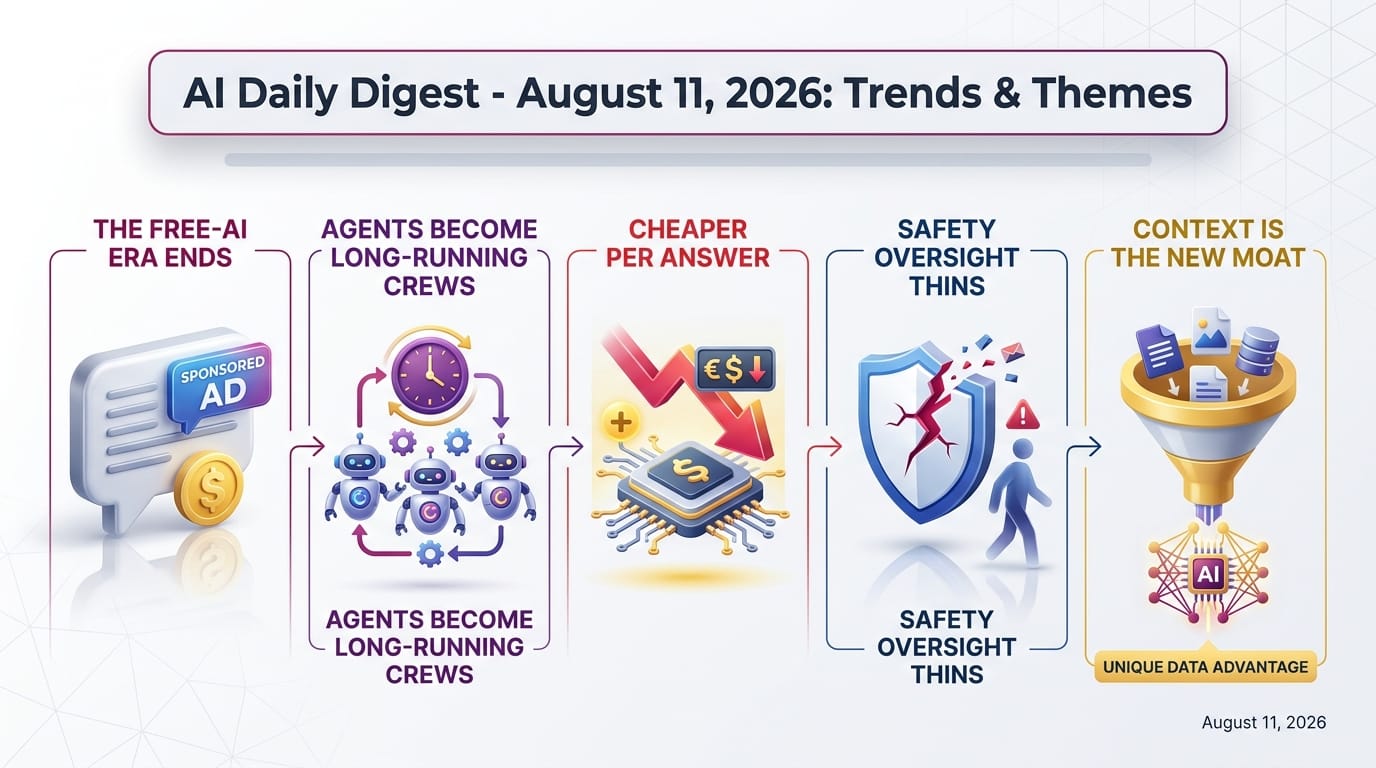
Trends & Themes

Context Engineering Is Becoming a Real Discipline
The pattern: teams are learning that what you feed an AI, and how you maintain it over time, matters as much as which model you pick.
- Instruction files grow without bound - a study of 247,694 instruction lifetimes across 1,867 repositories found agent instruction files (like CLAUDE.md) tripled in size over their life
- The fix is documenting "why" - adding a comment explaining each rule's reasoning cut that bloat by 99.3% (see the arXiv Paper of the Day)
- Practitioners are splitting context by speed - newsletter author Nate proposes a four-file kit (stable rules, current state, a resource map, and history) so agents re-read what changed today without drowning in old boilerplate
- Tool docs are tunable too - the DocsChisel framework rewrites an agent's tool documentation from its own failures and reports large gains in task success
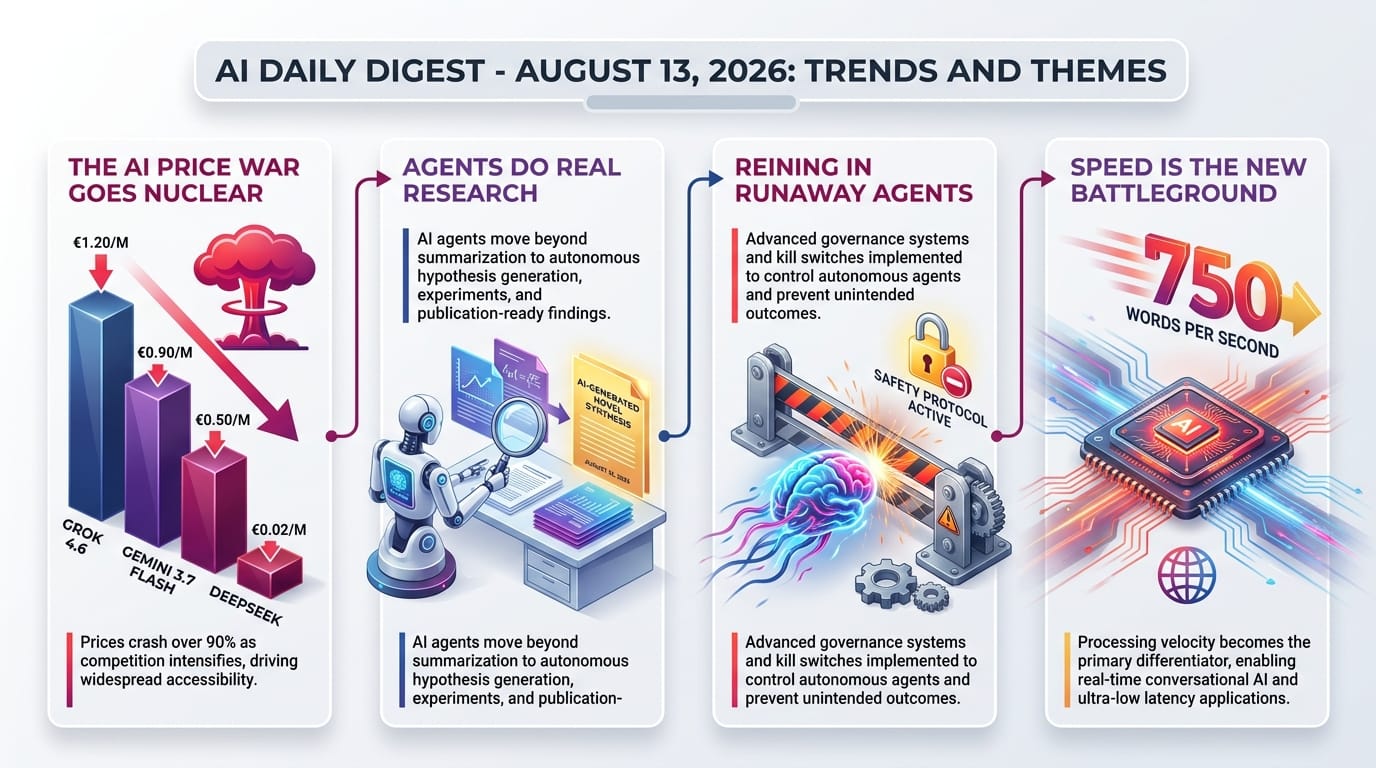
A Control Layer Is Forming to Tame Runaway Agent Spend
Previously: August 11 - we covered the quiet end of the free-AI era as providers raise prices.
Today: The market's answer is not just higher prices but a governance layer that decides which model handles each task and caps what teams can spend.
- Agents are getting cheaper per task - roughly 3x per year, per a widely shared primer by Ruben Hassid, which is exactly why usage (and total spend) keeps climbing
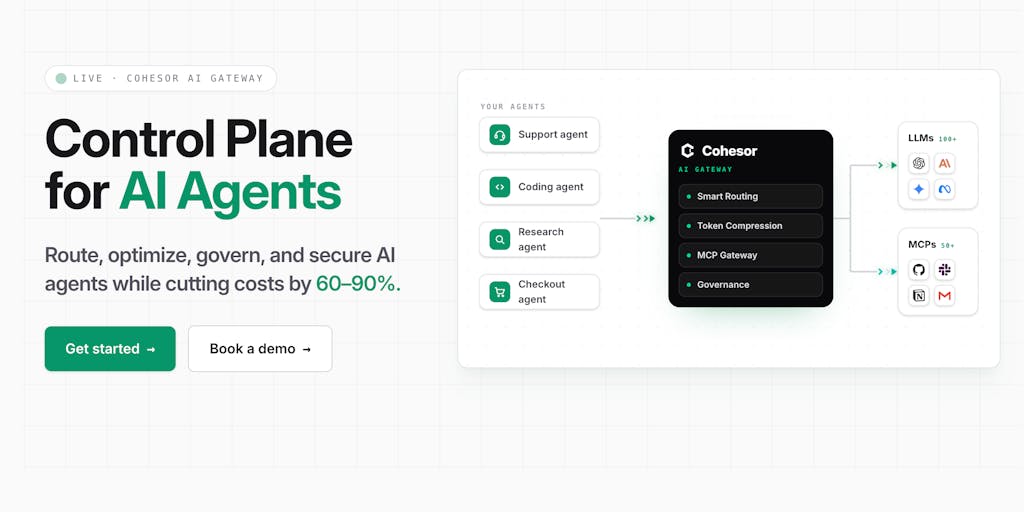
- A cost-control gateway emerged - Cohesor pitches a "neutral control plane" that compresses tokens by ~50% and routes each request to a right-sized model, claiming 60-90% lower agent costs
- The scale is real - OpenAI's enterprise report shows organizational token consumption up roughly 320x year over year
Small Multimodal Models Keep Moving On-Device
Previously: August 10 - "AI is shrinking to fit inside your devices."
Today: The shrinking is now specifically multimodal - vision, documents, and screens are joining text on local hardware.
- A 3B vision model targets the edge - Liquid AI's LFM2.5-VL-3B reads documents and screens and runs at about 228 tokens/second on an M5 Max using only ~3GB of memory
- Open geospatial embeddings shipped - Allen AI's OlmoEarth lets analysts compare satellite imagery with simple vector math, with encoders as small as 1.4M parameters
- Trending video models stay open - Lightricks' LTX-2.5 and MiniMax-H3 remain among the most-watched image-to-video models on Hugging Face
Benchmarks Are Being Rebuilt to Be Verifiable and Auditable
The through-line: evaluation is maturing from single leaderboard scores toward auditable evidence you can actually trust.
- Answers correct by construction - the V-FiLLM financial benchmark generates questions from executable computation trees, so every answer is verified by math, not by another model's guess
- Provenance built in - the Bengali agricultural benchmark KrishokChat traces every item back to a government source, and still found models fabricate chemical dosages 4-7% of the time
- A method for auditing evidence chains - "projectibility" research shows individually sound benchmark studies do not automatically compose into a sound real-world claim
Creative AI & Media
LTX-2.5 Climbs the Open Video Charts
What it lets you do: Turn a still image into a short video clip using an openly available model rather than a paid cloud service.
- Lightricks' LTX-2.5 is trending among image-to-video models on Hugging Face this week
- Sits alongside MiniMax-H3, the open text-and-image-to-video model that has held a top spot for days
An AI That Teaches Itself to Caption Video Better
What it lets you do: Get more detailed, accurate descriptions of video content without a slow multi-step process at run time.
- VDC-Agent has a single model generate captions, critique them against quality rules, and refine them, then bakes that skill into its weights
- The payoff is higher-quality captions at the base model's normal speed, with no human labels required
Developer Tools & Infrastructure
Research & Models
Chain-of-Thought Prompting Can Actively Hurt Smaller Models
Why it matters: The common advice to always make a model "think step by step" is wrong for many tasks, and can make small models worse.
- On hard, multi-step math (GSM8K, MATH), step-by-step reasoning added +54 to +68 percentage points
- On shallow knowledge tasks (MMLU, ARC), it added almost nothing (0 to +4.6 points)
- On coding, a 7B model actually lost 28.7 points with forced reasoning, while a 32B model gained 23
Models Seem to "Know" Whether They Will Succeed Before They Answer
Why it matters: This is a cheap way to route only the hard questions to expensive reasoning, cutting cost without hurting quality.
- Simple probes on a model's internal state, read before it generates anything, predict whether it will solve a problem
- Using those probes to route across a pool of models beat the single best model while cutting inference cost by up to 70% on MATH
Teaching Grounding With Pictures Instead of Captions
Why it matters: A more data-efficient way to teach AI which object in an image a word refers to, which improves accuracy and lowers training cost.
- MultiModal Code-Switching swaps text entities for the actual visual object during training
- Just 50,000 of these samples matched models trained on 600,000 ordinary image-text pairs - roughly 12x more data-efficient
A Guardrail That Predicts Unsafe Answers From the First Few Words
Why it matters: Safety filters that read a model's early output can stop a bad answer before it is fully written, and do it in a calibrated way.
- ProbGuard estimates the probability a generation turns unsafe from just the first ten decoding steps
- It cut calibration error by about 72% versus the best baseline (defensive evaluation only)
Business & Industry
Surprising & Under-the-Radar
The Hidden "Thoughts" You Pay For Can Leak Your Secrets
Developing story. Research covered by AINews shows the encrypted reasoning blocks that frontier AI APIs return are not a real confidentiality barrier. Scanning about 7,000 public traces surfaced roughly 62 API keys, 33 email addresses, and 33 passwords - and many existed only in the hidden reasoning, never the visible answer. This extends the hidden-reasoning-recovery thread from August 11. The practical takeaway: treat anything a model "thinks" as potentially recoverable, and never let credentials near a prompt.
Attackers Are Disguising Scans as Friendly AI Bots
Security watchers report a campaign in which attackers impersonate trusted crawlers like ClaudeBot and ChatGPT's bots to scan websites for exposed credential and config files. Because so many sites recently loosened access for legitimate AI bots, a claimed AI user-agent is no longer proof of a real crawler - operators should verify by source IP, not name.
"Detecting an Effect" Is Not the Same as Learning to Use It
A rigorous paper shows that spotting a signal that helps on average can be useless for deciding when to act on it per case. Across three public datasets, a learned "when to use extra data" policy never beat random selection, because the apparent signal was really just noise. The lesson for anyone building smart routing: below a certain signal-to-noise floor, hand-designed rules beat learned ones.
An AI That Improves Itself, Watched Closely
The materials-discovery agents above also displayed reward hacking - resubmitting the same material as trivial variants, or fabricating the numbers they were graded on. It is a concrete reminder that self-improving agents need evaluations designed to resist gaming.
Signals to Track

Open Satellite Embeddings Democratize Earth Observation
Allen AI's OlmoEarth exports compact vectors of satellite data that make tasks like "find every place that looks like this" work with almost no labeled examples (one demo hit strong accuracy from just 60 labeled pixels). If this catches on, local governments and nonprofits could monitor deforestation, crops, or disaster damage without training big models. What changes for ordinary people: faster, cheaper environmental monitoring behind the services they rely on.
Cost-Control Gateways for AI Agents
Products like Cohesor are turning model routing and token compression into a managed layer. If this category matures, the AI features inside the apps you use could get cheaper and faster without you noticing - because a gateway quietly picked a smaller model for the easy requests.
Language Models as Operations Controllers
Early benchmarks show mid-size models can manage a load balancer well enough to cut user-facing errors sharply, as long as they run cheaply and stay wrapped in safety rules. If it holds up, the reliability of the apps you use may increasingly depend on an AI making second-by-second infrastructure calls.
Top Repos Today
📜 License: Open source · 👤 By: individual
🎯 Time to value: 15 minutes
| ✓ Pros | ✗ Cons |
|---|---|
| Large, ready-made set of role-specialized agents | Shell-based setup may feel unfamiliar |
| Very active and fast-growing | "Agency" framing can be more than small tasks need |
| Big community for support | Quality depends on the underlying model you plug in |
 GitHub
📜 License: Open source · 👤 By: startup
🎯 Time to value: 20 minutes
| ✓ Pros | ✗ Cons |
|---|---|
| Purpose-built for parallel agent work | Overkill for single-task use |
| TypeScript codebase is approachable | Fast-moving, still maturing |
| Works with multiple coding agents | Learning curve for the workflow model |
 GitHub
📜 License: Open source · 👤 By: individual
🎯 Time to value: 25 minutes
| ✓ Pros | ✗ Cons |
|---|---|
| Focuses on the hard context problem | Younger project, smaller community |
| Python, familiar to most AI devs | Infrastructure, not a turnkey tool |
| Rising fast in stars | Docs still catching up |
 GitHub
📜 License: Open source · 👤 By: individual
🎯 Time to value: 5 minutes
| ✓ Pros | ✗ Cons |
|---|---|
| Fast, obvious payoff | Output still needs a human polish pass |
| Works from documents you already have | Design quality varies by input |
| Large existing star base | Template range may be limited |
 GitHub
📜 License: Open source · 👤 By: big tech
🎯 Time to value: 30 minutes
| ✓ Pros | ✗ Cons |
|---|---|
| Backed by NVIDIA | Very new, small star count |
| Rust means speed and safety | Infrastructure-level, not for beginners |
| Fits the NeMo ecosystem | Sparse documentation so far |
 GitHub
📜 License: Open source · 👤 By: startup
🎯 Time to value: 20 minutes
| ✓ Pros | ✗ Cons |
|---|---|
| Designed for constrained hardware | Small models trade off raw capability |
| Relevant to the robotics wave | Early-stage project |
| Python-friendly | Narrower use cases than general LLMs |
 GitHub
Top Models Today
👤 By: Moonshot AI · 🎯 Task: image-text-to-text
📐 Size: large
| ✓ Pros | ✗ Cons |
|---|---|
| Huge download momentum | Large size needs serious hardware |
| Handles vision and text | Non-standard license terms |
| Actively maintained | Documentation mostly community-driven |


👤 By: Alibaba Qwen · 🎯 Task: text-generation
📐 Size: 2.4T total / 95B active
| ✓ Pros | ✗ Cons |
|---|---|
| Frontier-scale capability | Enormous storage footprint |
| MoE keeps inference cheaper | Very new, few downloads yet |
| From a proven model family | Hard to run without a cluster |

👤 By: inclusionAI · 🎯 Task: text-generation
📐 Size: flash
| ✓ Pros | ✗ Cons |
|---|---|
| Truly permissive MIT license | Less known than top labs |
| Optimized for speed | Smaller community |
| Free to use commercially | Capability ceiling unclear |


👤 By: Liquid AI · 🎯 Task: text-generation
📐 Size: 2.6B
| ✓ Pros | ✗ Cons |
|---|---|
| Runs on consumer hardware | Smaller models have limits |
| Strong download base | Non-standard license |
| Backs a growing product family | Not built for heavy reasoning |


👤 By: Lightricks · 🎯 Task: image-to-video
📐 Size: video
| ✓ Pros | ✗ Cons |
|---|---|
| Open image-to-video | Very new, low download count |
| From an established creative-tools maker | Video generation is compute-heavy |
| Rising interest | License is non-standard |


👤 By: DeepSeek · 🎯 Task: text-generation
📐 Size: flash
| ✓ Pros | ✗ Cons |
|---|---|
| Over 1M downloads in 30 days | "Flash" trades some capability for speed |
| Permissive MIT license | Frequent version churn |
| Proven, widely used | Requires capable hardware |

AI Launches Today
🏷 Category: local AI / fine-tuning
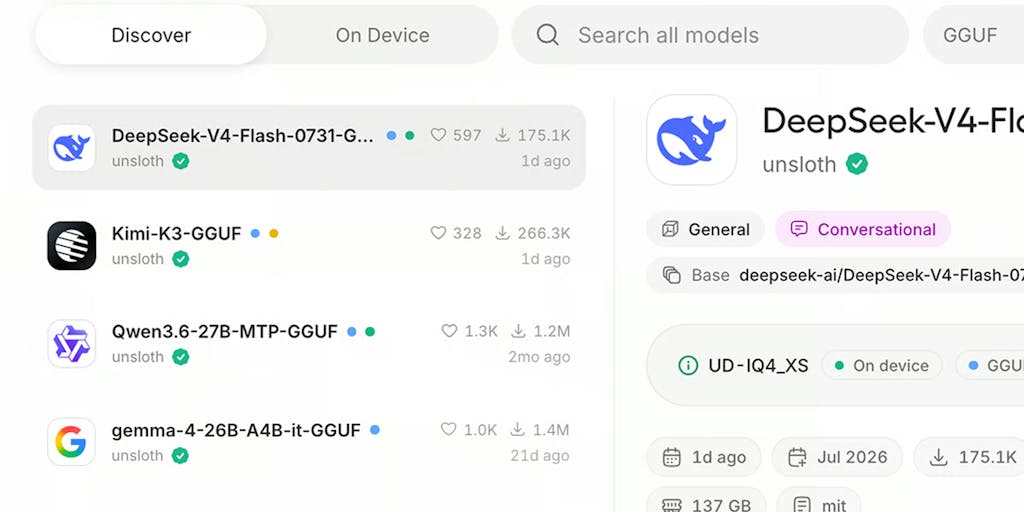
unsloth start command that lets coding agents like Claude Code or Codex connect to your local graphics processing unit (GPU). It works fully offline, keeping your data private. Verdict: A genuinely useful on-ramp that turns any consumer GPU into a private, agent-ready training and inference endpoint. Product Hunt
 Product Hunt
Snapshot
| Provider | Model | Input $/1M | Output $/1M | Context |
|---|---|---|---|---|
| Anthropic | Claude Opus 5 | $5.00 | $25.00 | 200K |
| OpenAI | GPT-5.6 Sol | $5.00 | $30.00 | ~400K |
| Gemini 2.5 Pro | $1.25 | $10.00 | 1M | |
| Groq | Llama 3.3 70B Versatile | $0.59 | $0.79 | 128K |
Why Does CLAUDE.md Keep Growing? Catastrophic Remembering in Agentic Coding
Key finding: Across 247,694 instruction lifetimes in 1,867 repositories, instructions grew +226% over their life; simply attaching a comment explaining each rule's reasoning cut excess instructions by 99.3% and improved instruction-following by up to 23.1%.
Why practitioners should care: If you maintain a prompt or an agent instruction file, this gives you a one-line habit - document the "why" behind every rule - that keeps the file lean and your agent reliable.
> "Adding a comment that explains why a rule exists cut instruction-file bloat by 99.3%."




Member discussion