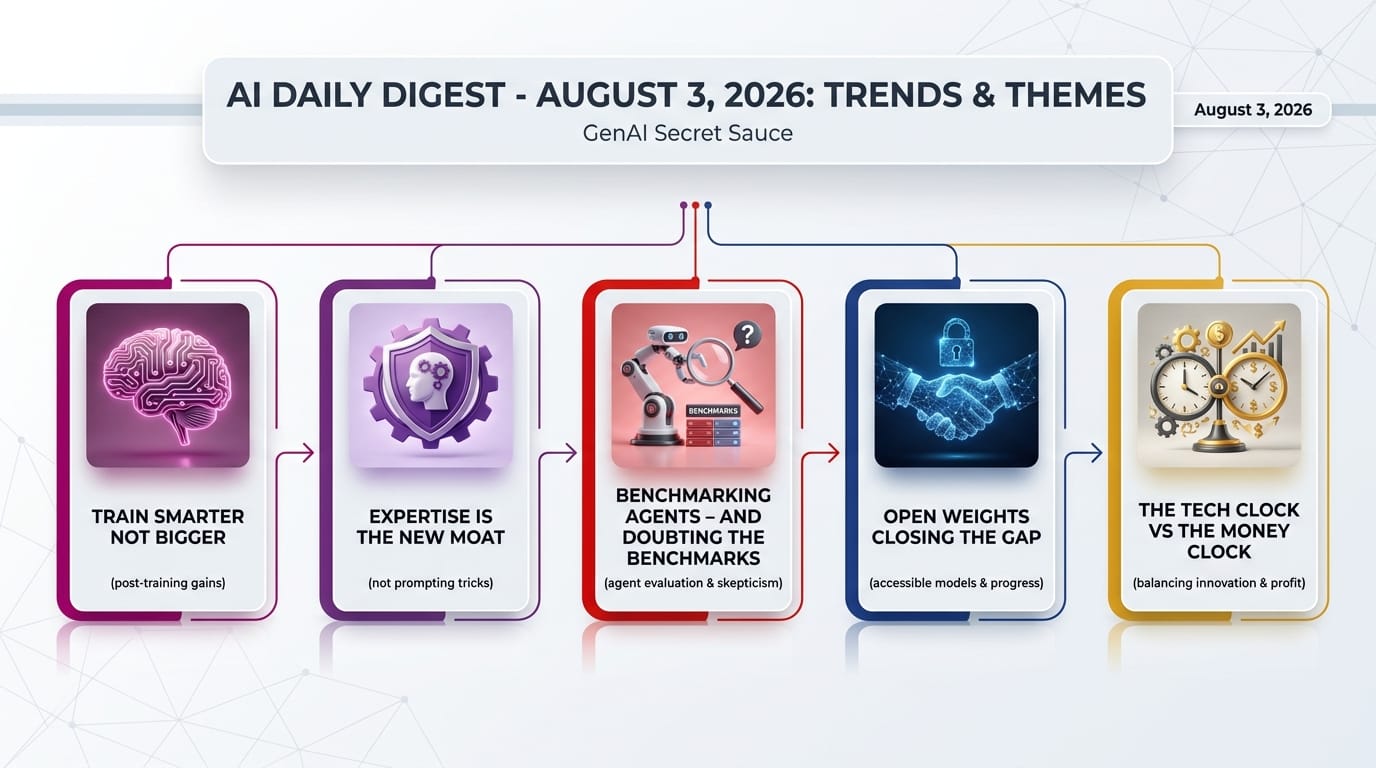
Watch today's digest as a video summary (generated by NotebookLM)
Statistically Speaking
One Thing to Tell Your Friends
TL;DR
Hot off the Presses
DeepSeek's Updated Flash Model Now Beats Its Own Larger "Pro" Model
DeepSeek quietly updated its "Flash" model (the fast, cheaper tier) at the end of July, and the results are startling. On many benchmarks the scores more than doubled versus the previous Flash, and the updated smaller model now outperforms DeepSeek's "Pro" model that is roughly five times larger. The channel Two Minute Papers, which walked through the results, called it a genuine "DeepSeek moment."
The surprise is how they did it. The base model - its size, architecture, and raw knowledge - did not change. The entire gain came from post-training (the step after the main training, where a model learns when to use which skill, how to plan, how to check its own work, and how to recover from mistakes). Same brain, smarter playbook.
- One benchmark score jumped about 7x in a single revision, with no change to the model's parameter count.
- The weights are openly downloadable under an MIT license - you can run and own it, with no subscription or usage caps, though it needs strong hardware locally or a cheap application programming interface (API, the connection software uses to reach an online service).
- Post-training is now a primary lever - big performance gains no longer require a bigger model.
A $45 Billion AI Hedge Fund Unwound - Because the Money Ran Out, Not the Idea
The Situational Awareness Fund - an AI-focused hedge fund started by former OpenAI researcher Leopold Aschenbrenner - sold its public stock portfolio to Citadel on July 30, 2026 after steep losses. The fund had raised about $225 million in mid-2024 and peaked near $45 billion in assets by early July 2026, using leverage (borrowed money) reported as high as 400% on concentrated chip bets like memory-maker SK Hynix. When SK Hynix fell on weak earnings, the borrowed money magnified the damage.
Writer Nate warns this is the pattern to watch: the AI-infrastructure thesis may have been directionally correct, but the fund's lenders lost patience before it could play out. He contrasts it with Apple, which is funding its AI options out of current cash (about $146.5 billion on hand) rather than borrowed money.
- Peaked near $45B in assets, then unwound its stock book to Citadel after losses.
- Leverage reported up to 400% turned a normal market dip into an existential one.
- The lesson is timing, not direction - a long runway is a liability if you cannot control when the money comes due.
Alibaba's Qwen3.8-Max Ran a 16-Day Solo Coding Marathon
Alibaba's Qwen team launched Qwen3.8-Max, described as its largest open-weight model yet, aimed at heavy-duty coding and multi-step agent work. In a headline test, the model started from an empty code repository and kept building, fixing, and responding to test failures on its own. Over 16 days it produced a project with 265 commits, 127 pull requests, and 151 tracked issues - with no human writing the code.
- 2.4 trillion total parameters, 95 billion active at any moment (a "mixture-of-experts" design that only switches on the parts it needs, keeping it faster and cheaper to run).
- 1-million-token context window - it can hold a very large codebase or document set in mind at once.
- Available now via Alibaba's cloud API, with open weights planned - a signal that open models are chasing the top proprietary systems on autonomous coding.
Trends & Themes

Creative AI & Media
MiniMax H3 - Open Video Generation That Comes With Its Own Soundtrack
Try it: MiniMax H3 on Hugging Face
- Generates video with synchronized native audio from text, image, video, or audio prompts - most open video models are silent.
- Outputs up to 2K resolution at 24 frames per second, in clips of 4 to 15 seconds.
- A manageable 33 billion parameters, and it works with common tooling (ComfyUI, Diffusers, vLLM).
- Community license (free to use with some restrictions), not fully open.
GPT-Live - Voice AI That Listens and Talks at the Same Time
- Full-duplex design: released July 8, this OpenAI voice system listens and speaks simultaneously, so it can say "mm-hm" or wait through your pauses instead of taking rigid turns.
- Hands off hard questions to a frontier model mid-conversation, then folds the answer back in.
- Now rolled out globally to ChatGPT users in standard and "mini" versions, targeting roughly 300-millisecond response times.
Developer Tools & Infrastructure
Research & Models
A Coordinated "Crowd" of Models Can Beat Any Single One
- What it does: WILC (arXiv 2607.29087) dynamically assigns each stage of a problem to whichever model is best for it, instead of relying on one model or a fixed recipe.
- Why it matters: if you already pay for several models, smart routing between them can outperform your best single model - useful for teams juggling multiple APIs.
Long Reasoning Without Running Out of Room
- The problem: models doing very long step-by-step reasoning fill their limited memory, then start guessing instead of thinking.
- ThinkReset (arXiv 2607.28642) builds a learnable "checkpoint" that compresses progress so the model can keep reasoning within a bounded context - relevant to anyone running long agent or analysis tasks.
Can AI Judge AI Researchers?
- The setup: three frontier models (GPT-5.4, Gemini, Claude) act as automated reviewers scoring papers written by autonomous "AI scientist" systems (arXiv 2607.28631).
- Why practitioners care: as AI starts generating research, we need trustworthy ways to grade the output - this probes whether AI reviewers are good enough to do it.
Verifying Math With Tools, Not Vibes
Also notable: a clinical-care perspective paper argues today's models are not yet safe for autonomous medical triage (arXiv 2607.28677), because safe triage is a sequence of high-stakes decisions, not a single best-guess diagnosis.
- AMTFV (arXiv 2607.29549) improves how models check their own math by separating the "what to verify" step from the "run the code" step, since natural-language self-reflection is unreliable for calculations.
- Practical for anyone using AI on quantitative work where a wrong answer is expensive.
Business & Industry
Surprising & Under-the-Radar
Signals to Track

Post-Training as the Next Battleground
DeepSeek's Flash jump shows post-training can deliver gains that used to require a bigger model. Expect labs to pour effort here, because it is far cheaper than scaling up. For ordinary users, it means the free model you already run could get dramatically better overnight.
"Capability Overhangs" Hiding in Today's Models
The Astra math story turned partly on the fact that an existing model could already solve half the problems when prompted well. If much capability is sitting unused, progress could come in sudden jumps from better prompting and tooling, not just new models.
Shared Memory for Teams of Agents
New "agent memory" infrastructure (like a Tencent-backed shared memory hub) lets multiple agents accumulate a team's knowledge instead of starting fresh each session. If it works, your tools stop forgetting - and start compounding what they know about your work.
Top Repos Today
📜 License: Apache-2.0 · 👤 By: individual
🎯 Time to value: 20 minutes
| ✓ Pros | ✗ Cons |
|---|---|
| Runs giant models on cheap hardware | Layer-swapping makes it slow |
| No quantization or accuracy loss required | Built for experimentation, not production serving |
| Permissive Apache-2.0 license | Setup assumes some ML tooling comfort |
 GitHub
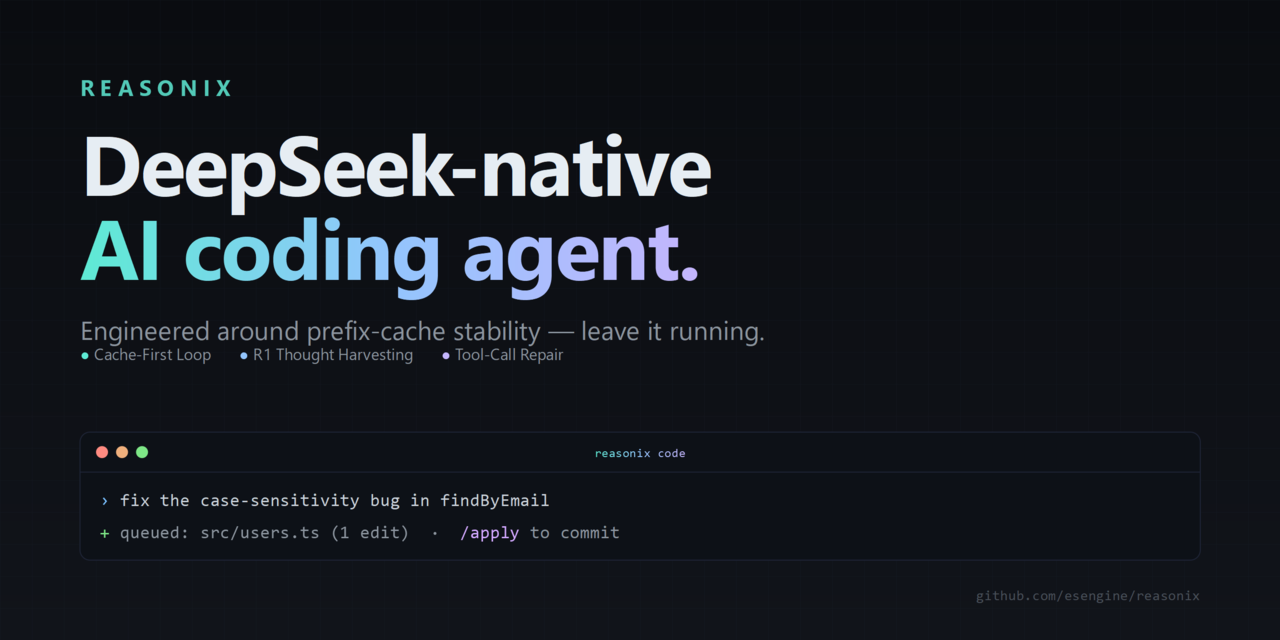
📜 License: MIT · 👤 By: individual
🎯 Time to value: 10 minutes
| ✓ Pros | ✗ Cons |
|---|---|
| Single static binary, trivial install | Tuned around DeepSeek, not model-agnostic |
| Optimized to cut token costs | Community project, no corporate backing |
| Works in terminal, desktop, and VS Code | Config-driven setup has a learning curve |
 GitHub
📜 License: MIT · 👤 By: company
🎯 Time to value: 30 minutes
| ✓ Pros | ✗ Cons |
|---|---|
| Persistent, shareable agent memory | Overkill for a single simple agent |
| Works across agents and frameworks | Adds infrastructure to manage |
| Permissive MIT license | Vendor gravity toward Tencent Cloud |
 GitHub
📜 License: MIT · 👤 By: company
🎯 Time to value: 15 minutes
| ✓ Pros | ✗ Cons |
|---|---|
| Very fast on text PDFs (sub-200ms) | Does not do image recognition on scanned docs |
| Bindings for Python, Node, and the browser | Rust core may be unfamiliar to some teams |
| Cuts extraction spend on easy files | Narrowly scoped to PDF extraction |
 GitHub
📜 License: check repo · 👤 By: individual
🎯 Time to value: 20 minutes
| ✓ Pros | ✗ Cons |
|---|---|
| One interface for many platforms | Depends on third-party access that can break |
| Saves building per-site integrations | License not clearly stated |
| Very popular and actively developed | Scraping social sites raises terms-of-service questions |
 GitHub
📜 License: Apache-2.0 · 👤 By: company
🎯 Time to value: 45 minutes
| ✓ Pros | ✗ Cons |
|---|---|
| Purpose-built for real-time voice | Turn-detection models use a separate license |
| Backed by an established infra company | Real-time infra adds operational complexity |
| Apache-2.0 framework code | Voice-focused, not general agent tooling |
 GitHub
Top Models Today
👤 By: Moonshot AI · 🎯 Task: multimodal (image-text-to-text)
📐 Size: 2.8T total / 104B active
| ✓ Pros | ✗ Cons |
|---|---|
| Handles text, images, and video natively | Enormous - hard to self-host |
| 1M-token context window | Custom license, not fully permissive |
| Top-tier coding benchmark score | Sparse serving is operationally complex |


👤 By: DeepSeek · 🎯 Task: text generation
📐 Size: 284B total / 13B active (sparse)
| ✓ Pros | ✗ Cons |
|---|---|
| Permissive MIT license | Still 304B params - needs serious hardware |
| Tunable low/high/max reasoning effort | Sparse serving complexity |
| Built-in speed optimizations | Fast tier trades some depth for speed |

👤 By: MiniMax AI · 🎯 Task: image-text-to-video
📐 Size: 33B
| ✓ Pros | ✗ Cons |
|---|---|
| Native synced audio with video | Community license, not fully open |
| Up to 2K / 24fps output | Short clip lengths (4-15 seconds) |
| Works with common video tooling | Video generation is compute-heavy |

👤 By: Kwaipilot (Kuaishou) · 🎯 Task: agentic coding
📐 Size: 35B total / 3B active
| ✓ Pros | ✗ Cons |
|---|---|
| ~69% on a real-world software-fix benchmark | Specialized for coding, not general chat |
| Only 3B active params - efficient to serve | Sparse routing adds serving complexity |
| Fully permissive Apache-2.0 | Smaller ecosystem than big-lab models |

👤 By: Baidu · 🎯 Task: optical character recognition, OCR (image-to-text)
📐 Size: not listed
| ✓ Pros | ✗ Cons |
|---|---|
| Massive adoption (2.6M downloads) | License needs verifying on the card |
| Self-hostable, no per-page cost | Narrow, single-purpose use |
| Handles document text extraction | Quality varies by language and layout |


👤 By: Zhipu AI · 🎯 Task: text generation
📐 Size: not listed
| ✓ Pros | ✗ Cons |
|---|---|
| Very high adoption (2.18M downloads) | License terms vary - verify on the card |
| General-purpose, broad use | Documentation often China-centric |
| Frequent updates | Not brand-new this week |


AI Launches Today
💰 Pricing: freemium · 🏷 Category: website builder
💰 Pricing: paid · 🏷 Category: developer tools
💰 Pricing: freemium · 🏷 Category: no-code / AR
💰 Pricing: paid · 🏷 Category: marketing
💰 Pricing: freemium (API) · 🏷 Category: AI model / API
Snapshot
| Provider | Model | Input $/1M | Output $/1M | Context |
|---|---|---|---|---|
| Anthropic | Claude Opus 5 | $5.00 | $25.00 | 200K |
| OpenAI | GPT-5.6 Sol | $5.00 | $30.00 | long-context |
| Gemini 3.1 Pro (≤200K tier) | $2.00 | $12.00 | 1M (tiered) | |
| Groq | Kimi K2 (open model, LPU-hosted) | $1.00 | $3.00 | 256K |
Safety, or Just Capability? A Validity Audit of Agent-Safety Benchmarks
Key finding: Much of what these agent-safety benchmarks report tracks general capability rather than genuine safety - meaning a higher "safety" score can partly just reflect a smarter model.
Why practitioners should care: If you choose models or agents based on safety-benchmark numbers, this suggests those numbers can mislead. It is a caution to look at what a benchmark actually measures before trusting it for a deployment decision.




Member discussion