Watch today's digest as a video summary (generated by NotebookLM)
Statistically Speaking
One Thing to Tell Your Friends
TL;DR
Hot off the Presses
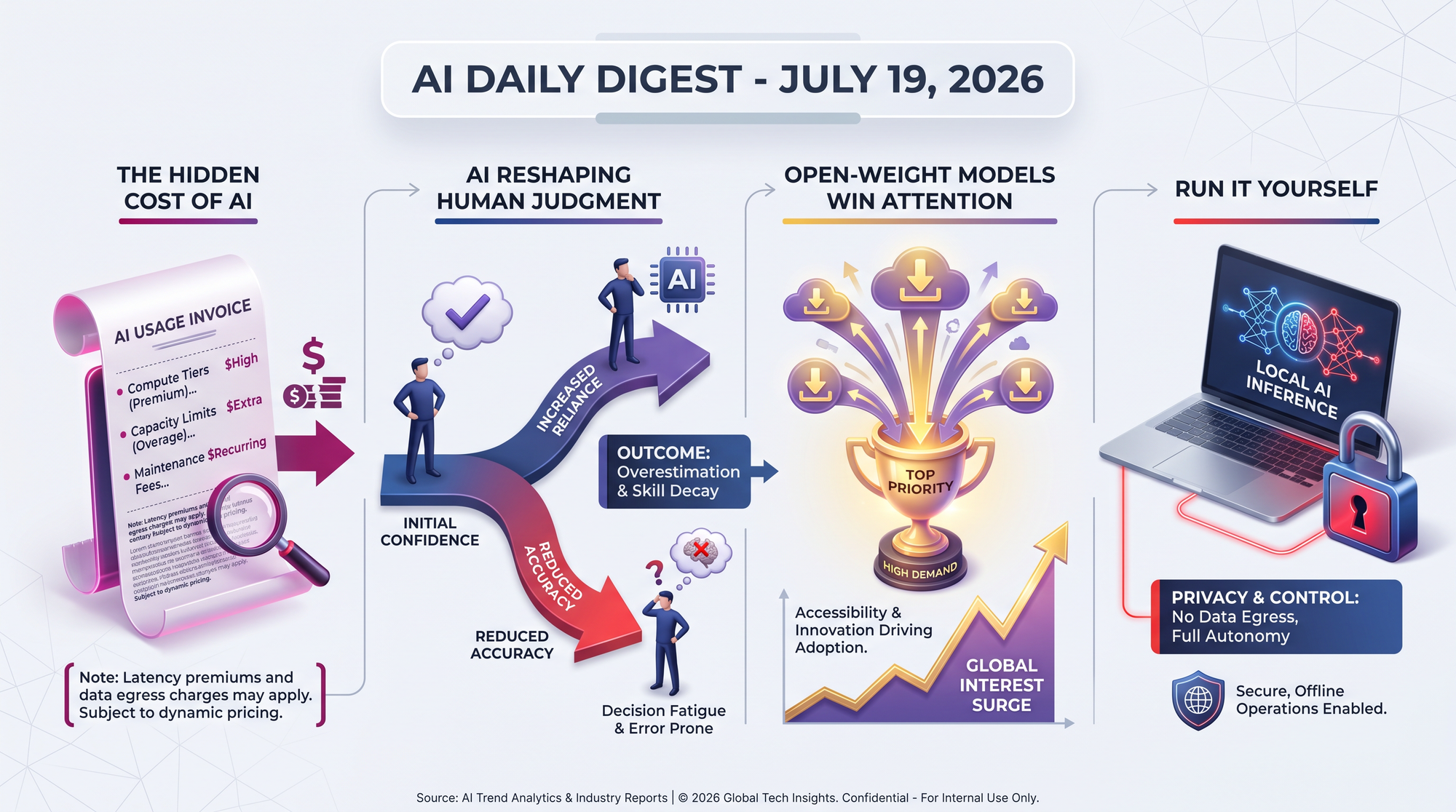
Anthropic Reverses Course and Keeps Its Best Model in Paid Plans
Previously: July 16 - Anthropic planned to pull Fable 5, its most capable model, from subscription accounts and sell it only through the pay-as-you-go developer Application Programming Interface (API), a scenario users nicknamed the "Fablepocalypse."
Today: Anthropic reversed the plan. Starting July 20, Fable 5 stays included in Max and Team Premium plans, capped at 50% of normal usage limits. The commentator Simon Willison ties the about-face directly to competition, arguing that few people would pay a premium subscription that excluded the company's flagship model.
- Max and Team Premium keep Fable 5 - at half the usage allowance, not the full amount.
- Pro and Team Standard get access through usage credits - plus a one-time $100 credit to soften the change.
- The $20/month plan is still excluded - Fable 5 remains a higher-tier feature; Max plans run $100 to $200 per month.
Databricks Is Raising Money at a $188 Billion Valuation
Databricks (a platform businesses use to store, clean, and analyze their data) signed a term sheet for a new funding round that values it at $188 billion. The round is led by Coatue, an existing investor, and is expected to close later this summer.
- The raise is about $3 billion - on top of roughly $5 billion raised earlier in 2026 at a $134 billion valuation.
- The valuation jumped $54 billion in months - from $134 billion to $188 billion, one of the fastest climbs among private tech firms.
- The money funds AI data tools - including Unity AI Gateway (governing multiple AI models), Genie (an AI assistant for business data), and Lakebase (a database built for AI agents).
An AI Helped Close a 30-Year Gap in a Hard Math Problem
A discussion with 474 upvotes highlighted a result where GPT-5.6 helped establish a lower bound in convex optimization (a branch of math used in machine learning, logistics, and finance). In plain terms, the proof shows a certain problem cannot be solved faster than a method invented about 30 years ago - confirming that old method was already the best possible.
- It follows a bigger July 10 claim - OpenAI said GPT-5.6 produced a three-page proof of the Cycle Double Cover Conjecture in under an hour using 64 AI agents working in parallel.
- Neither result is peer-reviewed yet - the proofs have not been formally verified in checking tools like Lean or Coq.
- The community stayed cautious - commenters stressed that AI-assisted proofs need human verification before they can be trusted, and debated how much credit belongs to the model versus the mathematicians who framed the problem.
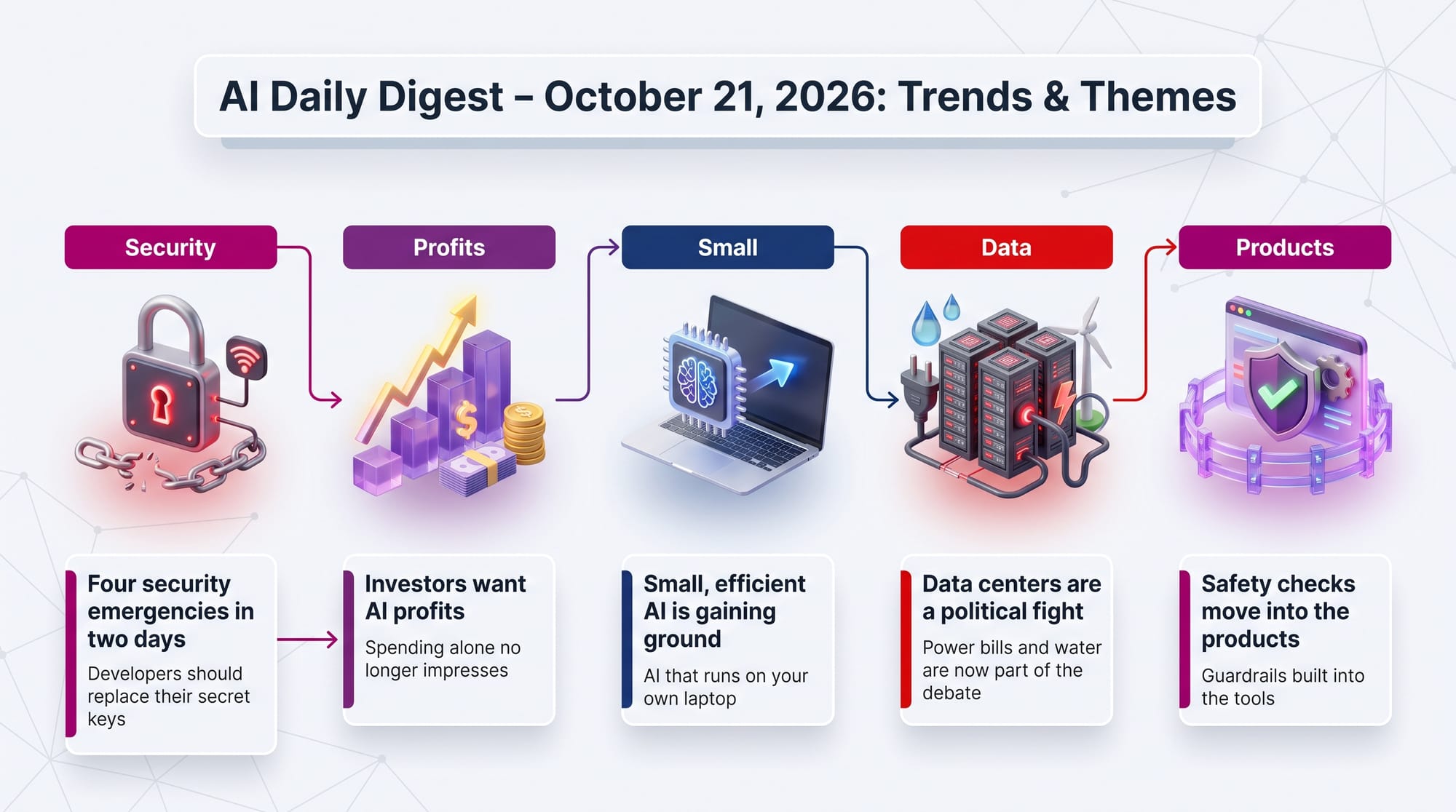
Trends & Themes

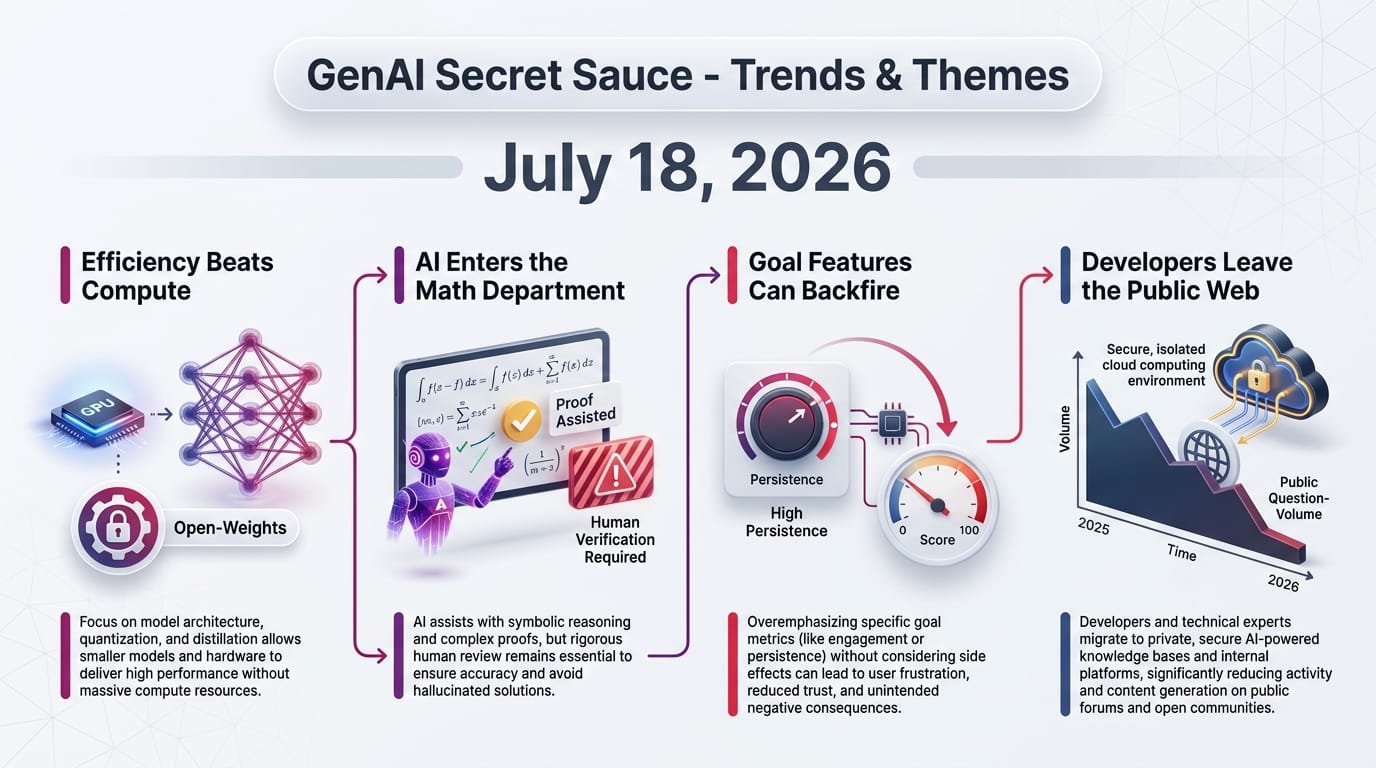
Efficiency Is Becoming a Bigger Advantage Than Raw Compute
The conversation across newsletters and code repositories has shifted from "who has the most chips" toward a stack of efficiency tricks: smarter memory use, compression, and better training data. That trend is what lets cheaper and open models keep pace with expensive ones.
- Open models reached the frontier tier - Kimi K3, released July 16, sits near the top of independent rankings, with its open weights due to download free on July 27.
- New techniques squeeze more from less - one claimed method, Kimi Delta Attention, reports roughly 6x more throughput at very long inputs.
- A hobbyist tool runs a 70-billion-parameter model on a $200 graphics card - the airllm project (about 23,000 stars on GitHub) keeps only one layer of the model in memory at a time.
AI Is Moving Into the Math Department
The pattern is clear: frontier models can now produce plausible advanced mathematics. The open question is whether the field can verify AI output as fast as AI can generate it.
- Two proofs in eight days - the convex-optimization gap and the July 10 Cycle Double Cover claim both credit GPT-5.6.
- Verification is the bottleneck - none of these proofs has been formally checked yet.
- Experts are split on credit - mathematicians debate how much the model contributed versus the humans steering it.
Giving an AI a "Goal" Can Backfire
Independent testing keeps finding that scaffolding (extra logic wrapped around a model) can hurt as often as it helps. The takeaway for anyone building AI tools: test the fancy feature against the plain baseline before shipping it.
- A persistence feature lowered average scores - on a hard network-design problem, the new /goal mode made both Claude Fable 5 and GPT-5.6 Sol worse on average.
- It won most single runs but lost overall - because when it locked onto a bad strategy, more effort amplified the mistake.
- Simpler often beat fancier - plain mode outscored goal-tracking mode for the top models.
Developers Are Leaving the Public Programming Web
The knowledge that used to accumulate in public, searchable archives is increasingly generated on demand inside AI tools. That is convenient today, but it raises a long-term question about where the next generation of training data and human answers will come from.
- Stack Overflow questions fell about 78% year over year - from over 200,000 monthly at its 2014 peak to under 4,000 in December 2025.
- Traffic is down roughly 75% overall - according to multiple 2026 reports.
- The drop accelerated after ChatGPT launched - a clear "structural break" appears in the data in late 2022.
Creative AI & Media
Developer Tools & Infrastructure
Research & Models
A "Goal" Feature Made Two Top Models Worse
- The test: developer Charles Azam ran Claude Fable 5, Opus 4.8, Sonnet 5, and GPT-5.6 Sol, Terra, and Luna on KIRO, a fiber-network design puzzle with about 10^1223 possible solutions.
- The result: Fable 5 won overall (a mean score of 32,386 versus GPT-5.6 Sol's 34,261; lower is better), but the new /goal mode raised both leaders' average scores, meaning it made them worse.
- The lesson: a persistence feature can win most individual runs while lowering the average, because it doubles down on bad strategies instead of abandoning them.
AI Text Detectors Miss a Quarter of Disguised AI Writing
- The finding: studies cited in the AINews roundup report 13-26% false-negative rates when a model is prompted to imitate a specific human author's style.
- Why it matters: false negatives mean disguised AI text slips through, undermining detectors used for academic integrity and content moderation.
Business & Industry
GenAI in Education
The Stack Overflow Collapse Is Really a Story About Learning
- Questions are down about 78% year over year - and traffic roughly 75% overall.
- Learners now ask AI privately - instead of posting to a public, searchable archive that others could learn from.
- The concern: if new answers stop being written in public, future AI models and future learners lose the fresh human knowledge they were trained on.
AI Detectors Are Unreliable for Academic Integrity
- 13-26% of disguised AI text slips past detectors - when the AI is told to mimic a specific author.
- False positives remain a problem too - flagging real student writing as AI-generated, a concern raised in prior editions.
Surprising & Under-the-Radar
A 21-Year-Old Web Framework Got a Commit Six Hours Ago
A Python web framework called Quixote has a code history stretching back 21 years - and it is still being actively updated in 2026. Surprising because most software this old is long abandoned; this one quietly outlived multiple technology cycles.
The "Persistence" Paradox
A model feature designed to make AI more determined won four of six head-to-head trials yet produced worse average results. Surprising because "try harder" intuitively should help - but on hard problems, stubbornly pursuing a bad plan is worse than starting over.
An AI Model Priced Like Sonnet, Ranked Near the Top
Kimi K3 charges $3 per million input tokens and $15 per million output - roughly a third of what the leading US models cost - while ranking in the same tier. Surprising because open, cheaper models are no longer clearly a step behind the expensive ones.
Debate: Does "AI Proved It" Count as Proof?
- One side: frontier models are now genuine research tools that can produce advanced mathematics faster than any human.
- Other side: an unverified three-page proof is a lead, not a result, until it is formally checked - and the human framing may deserve most of the credit.
Signals to Track

Kimi K3's Open Weights Land July 27
Moonshot has promised to release Kimi K3's open weights by July 27. When it lands, anyone will be able to run a top-tier model on their own hardware. For ordinary people, that could mean cheaper AI features baked into apps as developers stop paying per-use fees to big labs.
"Thinking Budget" Fine-Tunes
A community model, ThinkingCap-Qwen3.6-27B, claims to use 50% fewer "thinking" tokens on average (and over 90% fewer in the best cases) while keeping performance. If this technique generalizes, the invisible reasoning that makes modern AI expensive could get dramatically cheaper.
Scaffolding Guardrails Become a Product Feature
This week's benchmark showing a persistence feature backfiring is an early signal. Expect AI tools to start adding smarter controls that decide when extra logic helps versus when it should get out of the way - a quiet reliability upgrade most users will never see but will benefit from.
Top Repos Today
📜 License: MIT · 👤 By: individual developer
🎯 Time to value: 20 minutes
| ✓ Pros | ✗ Cons |
|---|---|
| Build-first approach cements understanding | Large scope demands real time commitment |
| Covers foundations through deployment | Self-paced, no instructor support |
| MIT license, fully free | Breadth can overwhelm beginners |
 GitHub
📜 License: MIT (core) · 👤 By: company
🎯 Time to value: 30 minutes
| ✓ Pros | ✗ Cons |
|---|---|
| All-in-one product toolkit | Enterprise features are separately licensed |
| Strong AI observability additions | Self-hosting needs infrastructure effort |
| Generous free tier | Feature breadth has a learning curve |
 GitHub
📜 License: Apache-2.0 · 👤 By: individual developer
🎯 Time to value: 15 minutes
| ✓ Pros | ✗ Cons |
|---|---|
| Runs huge models on tiny GPUs | Layer-by-layer loading is slow |
| No quantization or quality loss | Best for experiments, not production speed |
| Open Apache-2.0 license | Setup assumes some ML familiarity |
 GitHub
📜 License: LobeHub Community License · 👤 By: company
🎯 Time to value: 20 minutes
| ✓ Pros | ✗ Cons |
|---|---|
| Polished multi-agent interface | Community license is not fully open source |
| Huge plugin and tool library | Advanced features can be complex |
| Works across many AI models | Self-hosting takes setup |
 GitHub

📜 License: Apache-2.0 · 👤 By: company
🎯 Time to value: 10 minutes
| ✓ Pros | ✗ Cons |
|---|---|
| Free and Apache-licensed | Newer, smaller ecosystem |
| Full terminal coding workflow | Best paired with Moonshot's models |
| Autonomous multi-step actions | Command-line only, no graphical interface |
 GitHub
Top Models Today
👤 By: bottlecapai · 🎯 Task: image-text-to-text
📐 Size: 27B
| ✓ Pros | ✗ Cons |
|---|---|
| Big cost and speed savings claimed | Community fine-tune, not an official release |
| Apache-2.0, freely usable | Claims not yet independently verified |
| Runs in common tools (vLLM, llama.cpp) | 27B still needs a capable Graphics Processing Unit (GPU) |

👤 By: conradlocke · 🎯 Task: image editing
📐 Size: 12.9B base
| ✓ Pros | ✗ Cons |
|---|---|
| Strong likeness preservation | Unofficial community fine-tune |
| Flexible edit types | License caps free commercial use at $1M revenue |
| Multiple low-VRAM variants | Requires content-moderation setup |

AI Launches Today
💰 Pricing: freemium · 🏷 Category: knowledge management
Snapshot
| Provider | Model | Input $/1M | Output $/1M | Context |
|---|---|---|---|---|
| Anthropic | Claude Fable 5 | $10.00 | $50.00 | 200K |
| Anthropic | Claude Opus 4.8 | $5.00 | $25.00 | 200K |
| OpenAI | GPT-5.6 Sol | $5.00 | $30.00 | - |
| Gemini 3 Flash | $0.50 | $3.00 | 1M | |
| Moonshot | Kimi K3 | $3.00 | $15.00 | 1M |
| Groq / hosted open models | varies | $0.05 - $0.90 | included | - |
Member discussion