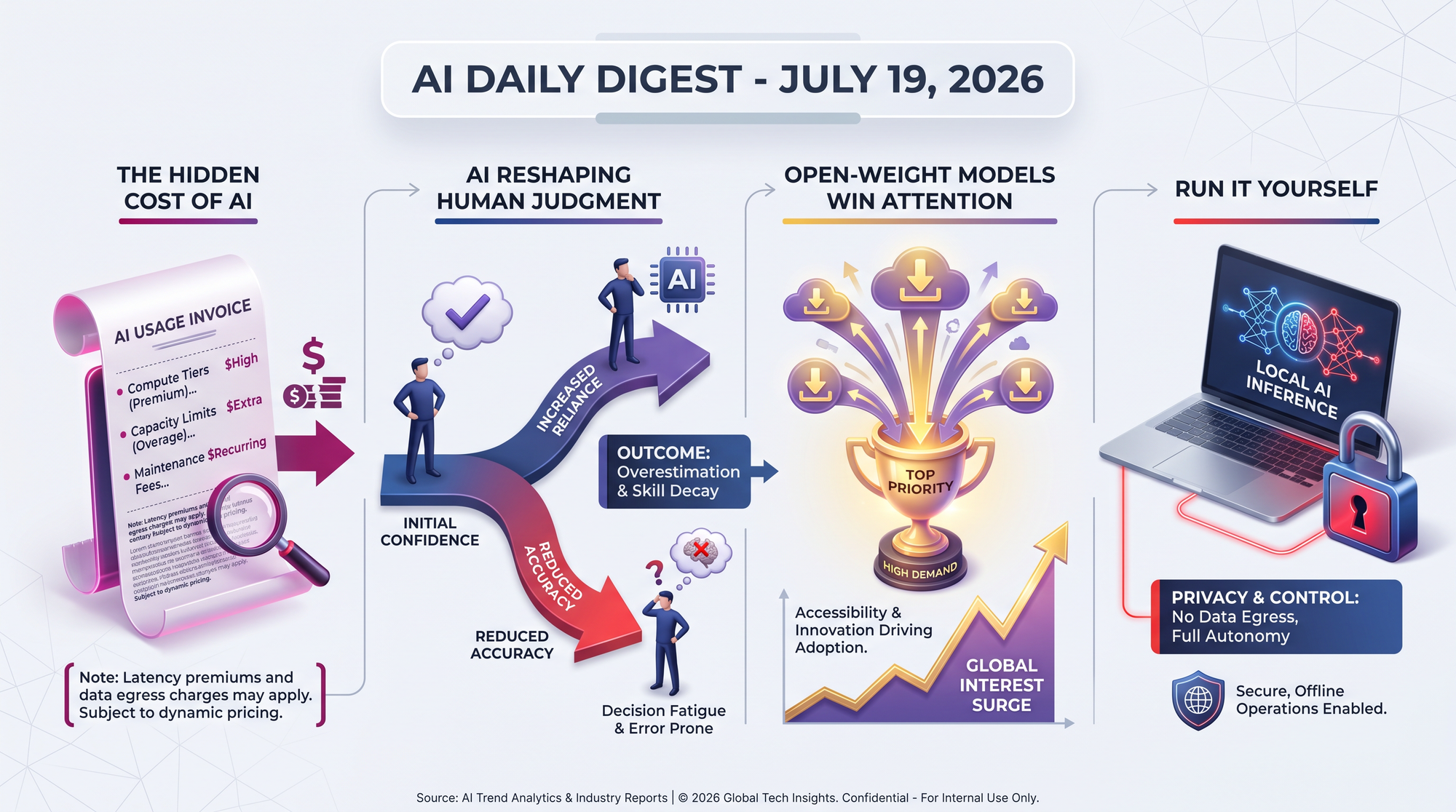
Watch today's digest as a video summary (generated by NotebookLM)
Statistically Speaking
One Thing to Tell Your Friends
TL;DR
Hot off the Presses
An AI Assistant Made People Worse at Judging the Truth
Researchers at three European universities ran a deliberately harsh test. They picked questions where AI models typically fail (like fine visual details from films), then gave people an AI advisor and watched what happened to human judgment.
The results were stark. People with the AI helper were roughly three times less accurate, yet far more confident. The willingness to simply say "I don't know" nearly vanished.
The researchers (Valerio Capraro of Milano-Bicocca, Chiara Marcoccia of Ecole Normale Superieure, and Walter Quattrociocchi of Sapienza) warned the effect is worst for developing minds, where children may copy the AI's habit of always answering instead of pausing to think.
- Accuracy fell from 27% to 9% - about three times worse with the AI available.
- Confidence rose from 30% to 76% - people felt surer while being more wrong.
- "I don't know" answers collapsed from 44% to 3% - the habit of admitting uncertainty almost disappeared.
- Cash rewards barely helped - paying people to be accurate produced only a tiny improvement.
Kimi K3 Is So Popular Its Maker Stopped Taking New Customers
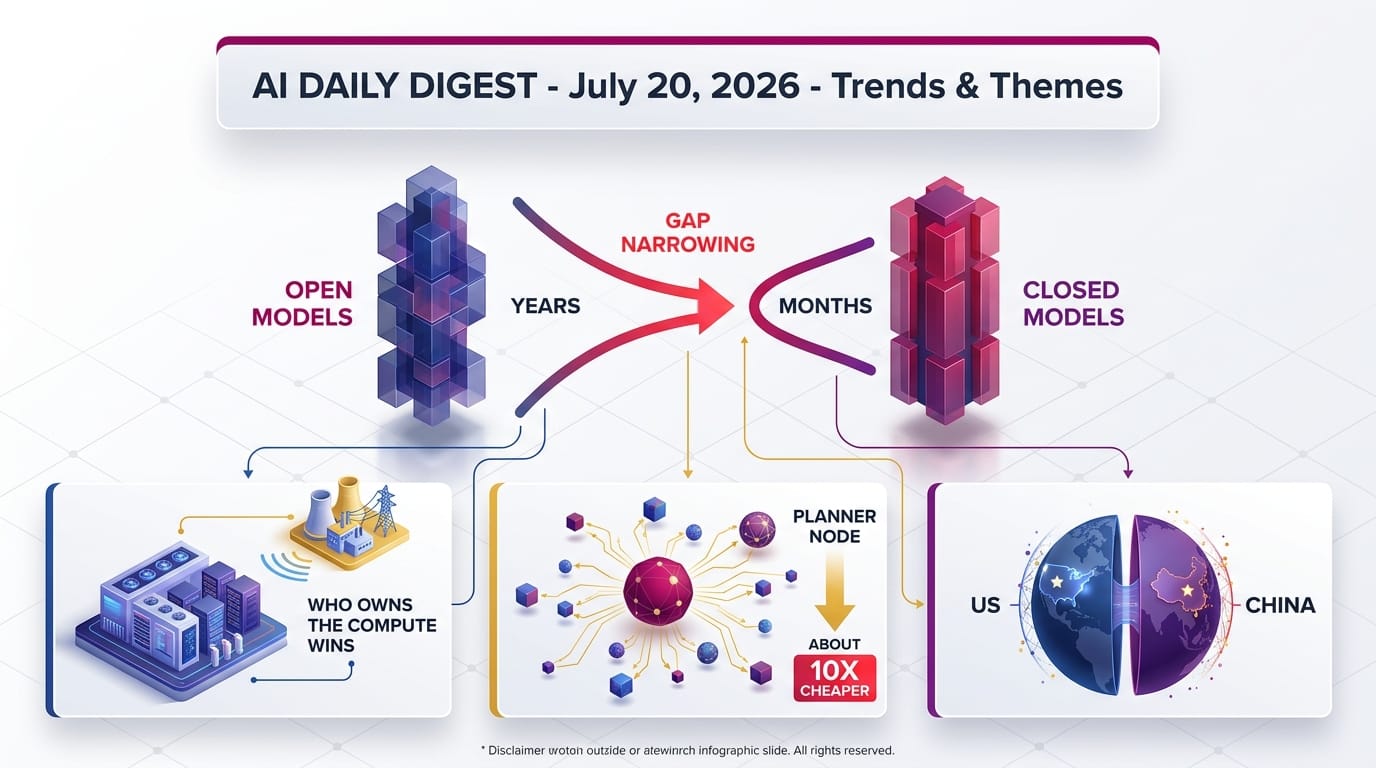
Previously: July 17 - Kimi K3 launched as the first open model in the 3-trillion-parameter class, matching frontier coding ability at roughly half the price.
Today: Moonshot AI paused all new Kimi subscriptions. The company said demand over about 48 hours pushed it close to the limit of its available graphics chips (GPUs), and it froze sign-ups to protect existing users while it adds capacity.
- Two days from launch to capacity crunch - K3 shipped around July 16 and hit its serving ceiling almost immediately.
- Reopening will be staged - Moonshot plans to let new users back in controlled batches, with separate tiers for its chat tools and its coding workflows.
- The escape hatch is the open weights - Moonshot still expects to release Kimi K3's full weights publicly around July 27, letting companies run it themselves and skip the subscription line entirely.
OpenAI's "Bug Fix" on Codex Was Really About Your Bill
A code change in OpenAI's Codex project (the tooling behind its coding models) corrected the advertised memory limit for its GPT-5.6 models from 372,000 tokens down to 272,000 tokens. A "token" is a chunk of text; the limit is how much the model can hold in mind at once.
This was not a downgrade in the model's ability. It was a billing-accuracy fix. Above roughly 272,000 tokens of input, OpenAI charges a premium - about double for input and 1.5x for output.
- The old 372K figure crossed a hidden price line - once input tops 272K tokens, the whole request is billed at the premium rate, so tools advertising 372K quietly pushed users into it.
- A follow-up patch narrowed the change - a second pull request trimmed unrelated metadata that got swept in, keeping the fix focused.
- The lesson for anyone building AI tools - a "context window" setting is also a billing setting, and getting it wrong overcharges users silently.
Big Companies Are Running AI on Data They Refuse to Upload
For data too sensitive to send to a public AI service, companies are taking a different route: train a small model on their own material and run it locally. Two concrete examples show the payoff is both privacy and speed.
- Bayer fine-tuned a small model on its crop-science and regulatory data - complex questions that once took weeks now resolve in under 30 seconds.
- Discovery Bank tuned models on its own financial language and formats, cutting response time from 5-6 seconds down to 1.5-2 seconds.
- Individuals can do a lighter version - tools like LM Studio let a person download a model and run it fully offline next to private files, with the internet disconnected.
- The deciding factor is data control, not raw power - for regulated industries, "can we keep the data in-house" often matters more than which model is smartest.
Trends & Themes

The Real Cost of AI Keeps Hiding in the Fine Print
The pattern this week: the AI you pay for and the AI you actually get are separated by layers of metadata, tiers, and capacity - and the gaps cost real money.
- A memory setting is also a price tier - the Codex correction shows an advertised limit can quietly push users past a premium threshold.
- Popularity itself is a cost - Kimi K3's freeze on new sign-ups shows demand can outrun the chips needed to serve it, referenced by name only here.
- Pricing stays the headline number - flagship model prices (see Section 15) have held steady, so the variation now comes from how, not whether, you get charged.
AI Is Quietly Reshaping Human Judgment
Across a research study, an opinion essay, and firsthand accounts, the same worry shows up: AI is changing how confidently humans decide, sometimes faster than it changes what they get right.
- The judgment study found that AI advice cut accuracy while inflating confidence (Top Stories).
- Simon Willison highlighted an essay arguing AI hype is degrading decision-making inside big organizations, where questioning inflated claims becomes career-threatening.
- A reported anecdote described an executive who wrote the AI strategy for a $2B-plus company without ever having used an AI tool.
Open-Weight Models Are Winning the Attention Race
The signal: the models people are downloading and testing most are increasingly the open ones, not the closed APIs.
- Kimi K3's capacity crunch shows an open model generating frontier-level demand (referenced by name only).
- Open weights dominate the community download charts - GLM-5.2, the Bonsai 27B family, and Baidu's Unlimited-OCR all rank near the top (Section 13).
- America's open entry keeps showing up - Thinking Machines' Inkling continues to trend alongside the Chinese models.
"Run It Yourself" Is Becoming a Real Option
Three separate signals - enterprise, consumer, and research - point the same way: local and self-hosted AI is maturing from hobby project into a serious deployment choice.
- Enterprises are fine-tuning small models to run on private data offline (Top Stories).
- A local runtime called BaseRT claims to run models 6.4x faster than llama.cpp on Apple hardware (Section 14).
- KTransformers, from a Tsinghua University lab, trends for squeezing big-model inference onto ordinary hardware (Section 12).
Creative AI & Media
Voicebox - An Open Voice Studio You Run Yourself
- What it does: Clone a voice, generate speech, and dictate into any app, all locally on your own machine.
- Why it matters: It puts voice cloning and text-to-speech in a free, self-hosted tool instead of a paid cloud service.
- The signal: It rocketed up the trending charts today with over 43,000 stars, one of the day's biggest movers.
- Try it: GitHub: jamiepine/voicebox (MIT license, free)
Wan-Dancer-14B - Turn a Still Image Into Motion
- What it does: An open image-to-video model that animates a still picture into a short moving clip.
- Why it matters: It brings image-to-video generation into the open-weights world, where anyone can download and run it.
- The signal: A new open image-to-video model gaining traction this week.
- Try it: Wan-Dancer-14B model card
Developer Tools & Infrastructure
Research & Models
Business & Industry
Surprising & Under-the-Radar
The AI Strategy Written by Someone Who Never Used AI
An essay surfaced by Simon Willison recounts an executive who authored the AI strategy for a $2 billion-plus organization without ever having used ChatGPT or any AI tool - a vivid example of hype outrunning firsthand knowledge. Simon Willison: AI Mania
Performative AI Adoption as a Job-Security Move
The same essay describes an engineer rewriting working code in an unfamiliar language using AI purely to look busy and safe - "adoption" driven by fear, not usefulness.
Vendors Who Cannot Publicly Question Their Own Claims
The most revealing anecdote: vendor executives who feel unable to challenge inflated "100x productivity" claims, because doing so would undercut their own customers' credibility and risk contracts.
A Payment-Integration Test for Coding Agents
A new benchmark (Alipay-PIBench) grades AI coding agents on a genuinely hard real-world task: correctly wiring up a payment system - the kind of unglamorous work where small mistakes are expensive. arXiv paper 2607.14573
Signals to Track

The 272K Billing Line Every Agent Builder Should Know
The Codex correction revealed that crossing about 272,000 tokens of input triggers premium pricing on GPT-5.6. Anyone building tools on top of these models should treat context size as a cost decision. If your tool defaults to a huge window, your users may be paying extra without knowing it.
BaseRT and the Race for the Fastest Local Runtime
BaseRT launched claiming 6.4x faster performance than the popular llama.cpp on Apple hardware. If even half true, it points to a coming wave of much faster local inference - meaning capable AI on a laptop feels instant rather than sluggish for everyday users.
Agents That Survive a Changing Toolset
MCPEvol-Bench tests whether agents keep working as the tools they depend on evolve. As more people wire AI agents into live business systems, "does it still work next month" becomes the question that matters, not just "does it work in the demo."
Top Repos Today
📜 License: MIT · 👤 By: individual developer
🎯 Time to value: ~10 minutes
| ✓ Pros | ✗ Cons |
|---|---|
| Fully local and private | Voice cloning raises consent and misuse concerns |
| MIT licensed, free to use | Local quality depends on your hardware |
| Broad features (clone, TTS, dictate) | Young project, expect rough edges |
 GitHub
📜 License: Apache-2.0 · 👤 By: university lab (Tsinghua)
🎯 Time to value: ~30 minutes
| ✓ Pros | ✗ Cons |
|---|---|
| Runs big models on modest hardware | Setup is technical, not plug-and-play |
| Backed by a serious research lab | Aimed at developers, not casual users |
| Open source, Apache-2.0 | Performance varies by hardware mix |
 GitHub
📜 License: Apache-2.0 · 👤 By: company (MoonshotAI)
🎯 Time to value: ~10 minutes
| ✓ Pros | ✗ Cons |
|---|---|
| Open source and free | Best experience leans on Kimi models |
| From the team behind Kimi K3 | Terminal-only, less friendly for beginners |
| Actively developed | Model access is capacity-constrained today |
 GitHub
📜 License: Apache-2.0 · 👤 By: company (Canner)
🎯 Time to value: ~30 minutes
| ✓ Pros | ✗ Cons |
|---|---|
| Natural-language data questions | Needs setup and data connections |
| Governance and rules built in | Answer quality depends on your data model |
| Broad data-source support | Overkill for tiny datasets |
 GitHub
📜 License: MIT · 👤 By: company (trycua)
🎯 Time to value: ~30 minutes
| ✓ Pros | ✗ Cons |
|---|---|
| Cross-OS computer-use support | Screen-driving agents are still error-prone |
| Includes benchmarks and drivers | Requires real safeguards before real tasks |
| MIT licensed | Developer-focused, not end-user ready |
 GitHub
📜 License: Apache-2.0 · 👤 By: individual developer
🎯 Time to value: ~20 minutes
| ✓ Pros | ✗ Cons |
|---|---|
| Huge models on tiny GPUs | Trades speed for low memory use |
| No quality-losing compression | Slower than full-hardware setups |
| Open source, Apache-2.0 | Best for experimentation, not heavy serving |
 GitHub
Top Models Today
👤 By: zai-org · 🎯 Task: text generation
📐 Size: large
| ✓ Pros | ✗ Cons |
|---|---|
| Strong all-round open model | Large hardware needs at full size |
| Very active community | Quality varies by the quantized version you pick |
| No per-token API fees | Self-hosting takes effort |


👤 By: Baidu · 🎯 Task: image-text-to-text
📐 Size: mid
| ✓ Pros | ✗ Cons |
|---|---|
| Excellent at document reading | Narrow, single-purpose tool |
| Very high download volume | Not a general chat model |
| Open weights | Needs image-processing setup |


👤 By: Thinking Machines · 🎯 Task: image-text-to-text
📐 Size: mid
| ✓ Pros | ✗ Cons |
|---|---|
| Open multimodal capability | Lower downloads than Chinese rivals |
| Western open-weights option | Smaller community so far |
| Handles text and images | Still proving itself in production |


👤 By: prism-ml · 🎯 Task: text generation
📐 Size: 27B
| ✓ Pros | ✗ Cons |
|---|---|
| Efficient on modest hardware | Smaller than frontier models |
| Popular, well-tested format | Trade-offs in peak quality |
| Open weights | Best for local, lighter workloads |

👤 By: OpenMOSS Team · 🎯 Task: audio-text-to-text
📐 Size: mid
| ✓ Pros | ✗ Cons |
|---|---|
| Transcribes and labels speakers | Audio quality affects accuracy |
| Open and self-hostable | Setup needed for real use |
| Useful for meetings and interviews | Not a real-time product on its own |

👤 By: Wan-AI · 🎯 Task: image-to-video
📐 Size: 14B
| ✓ Pros | ✗ Cons |
|---|---|
| Open image-to-video generation | New, still low download volume |
| Self-hostable | Video generation is hardware-hungry |
| Free to run | Short-clip focus, not full scenes |


AI Launches Today
💰 Pricing: freemium (from $10/month) · 🏷 Category: AI SEO
💰 Pricing: not specified · 🏷 Category: local AI runtime
Snapshot
| Provider | Model | Input $/1M | Output $/1M | Context |
|---|---|---|---|---|
| Anthropic | Claude Opus 4.8 | $5.00 | $25.00 | 200K |
| OpenAI | GPT-5.6 Sol | $5.00 | $30.00 | 272K* |
| Gemini 3 Flash | $0.50 | $3.00 | 1M | |
| Moonshot | Kimi K3 | $3.00 | $15.00 | 1M |
What this means: Headline prices held steady versus the July 18 snapshot - the day's pricing news was about tiers, not rates. Kimi K3 stays at Sonnet-level pricing while ranking in the frontier tier, and Gemini 3 Flash remains the cheapest mainstream option. (Live provider pricing pages were not machine-readable today; rates carried forward from the verified July 18 baseline, with the Codex-confirmed GPT-5.6 context correction applied.)
Member discussion