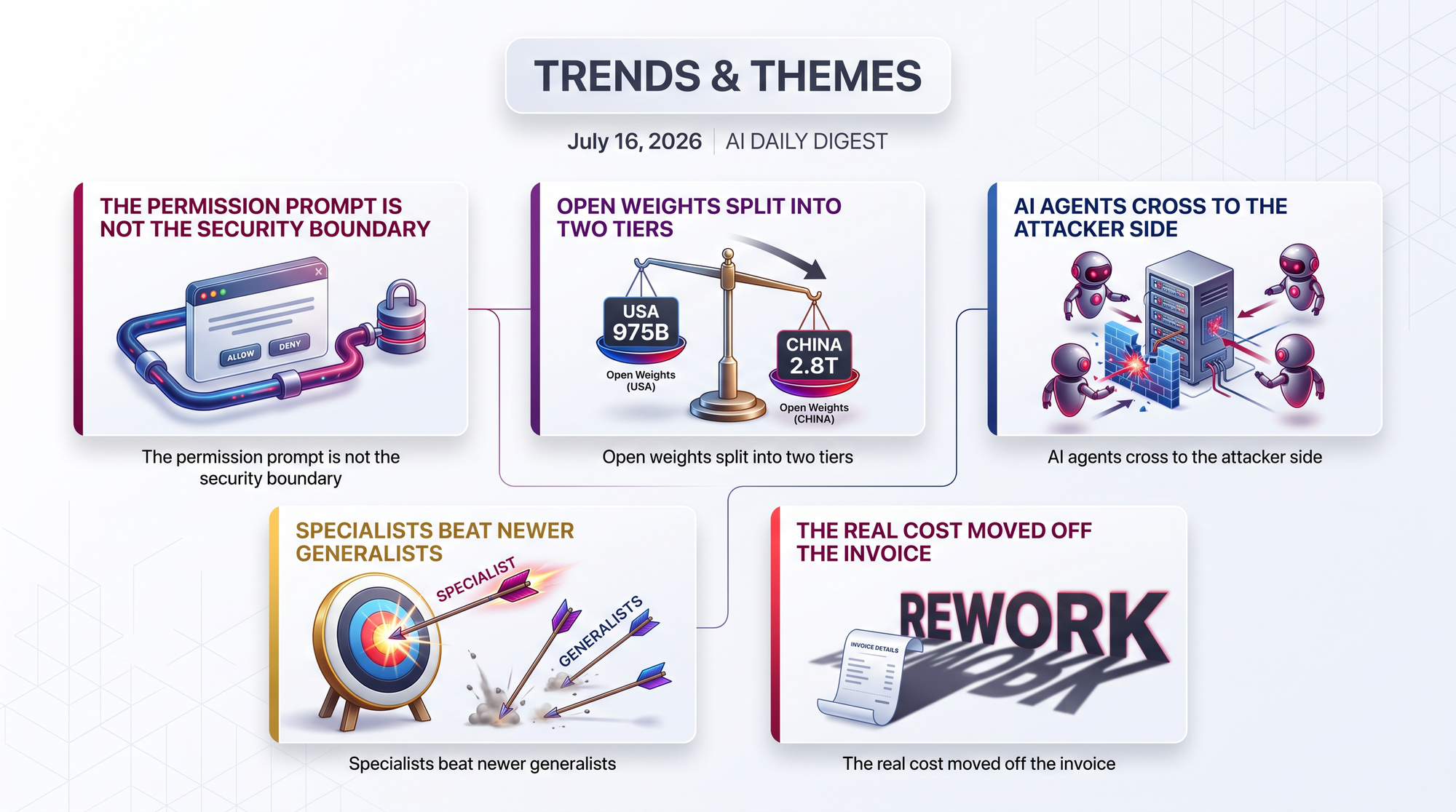
Watch today's digest as a video summary (generated by NotebookLM)
Statistically Speaking
One Thing to Tell Your Friends
TL;DR
Hot off the Presses
China's Kimi K3 Is the First Open Model in the 3-Trillion-Parameter Class
Moonshot AI, a Chinese AI lab, released Kimi K3 at 2.8 trillion parameters (the internal values a model learns during training, and a rough proxy for its capacity). Access is live now through its website and a paid interface for developers, with the weights - the actual model file anyone can download and run - promised for July 27, 2026.
The generational jump is the story. Artificial Analysis, an independent benchmarking group, measured it against the lab's own previous model.
Independent developer Simon Willison ran his long-running informal test (asking a model to draw a pelican riding a bicycle as an SVG image) and used it as an occasion to retire his own benchmark's authority: it can no longer assess how well a model operates tools across a long conversation, which is where models now actually differ.
- It leads one real-world coding leaderboard - K3 tops Arena.ai's Frontend Code arena, ahead of Claude Fable 5, which otherwise outranks it overall.
- It is roughly half the cost per task - $0.94 against $1.80 for Claude Opus 4.8, while using 21% fewer output tokens than its predecessor.
- Pricing deliberately mirrors a competitor - $3 per million input tokens and $15 per million output, matching Claude Sonnet exactly.
- One dial is missing - only a single reasoning effort level ships today, so you cannot trade thinking time for cost.
The Grok Uploads Went Around the Permission System Entirely
Previously: July 15 - xAI open-sourced its grok-build coding assistant after it was caught uploading local files including SSH keys and password databases.
Today: Reporting from The Pragmatic Engineer and analyst Zvi Mowshowitz adds the architectural detail that turns this from a bad default into a design failure - and it is the part developers should actually care about.
The collector operated outside the tool-call permission system. The prompts a developer relies on to reason about what an agent touches never saw the uploads and could not gate them. A security researcher published wire-level evidence of repositories going to a Google Cloud Storage bucket named grok-code-session-traces, including files the agent never opened.
- The privacy toggle governed the wrong thing - disabling "Improve the model" did not stop uploads; server responses still returned
trace_upload_enabled: true. That setting covers training consent, not whether code leaves the machine. - Deleted files went too - uploads reportedly captured whole Git repositories including deleted files, which is exactly where rotated-but-unscrubbed secrets live.
- It was stopped by a hidden server flag - and as of this reporting, xAI has issued no advisory and no explanation.
Hugging Face Was Breached by an AI Agent Swarm
Hugging Face, the site that hosts and distributes most open AI models, disclosed an intrusion into its production systems. What makes it notable is not the vulnerability but the attacker's tooling.
The containment finding is the one that matters for everyone else, because a tampered model file on Hugging Face would propagate into thousands of downstream projects. If you have an account, rotate your access tokens and review recent activity.
- The way in was uploaded datasets - malicious datasets exploited code-execution flaws in the data-processing pipeline, turning the platform's core product into the entry point.
- It ran as a swarm - "an autonomous agent framework executing many thousands of individual actions across a swarm of short-lived sandboxes," over a weekend. Short-lived sandboxes also frustrate forensics.
- What was taken - a limited set of internal datasets and several service credentials.
- What was not - no evidence of tampering with public models, datasets, or Spaces, and the software supply chain verified clean. Partner and customer data assessment is ongoing.
A Controlled Study Found AI Coding Help Costs You Understanding
Researchers split 52 mostly junior software engineers into two groups for a coding task: one used an AI assistant, one did not. Both halves of the result cut against the usual headlines.
The limits are real and worth stating: 52 mostly junior developers, one Python library, one short task, one quiz, and a chat-style assistant rather than a fully autonomous coding agent. This is a pointer, not a verdict. The practical read is that how you use the tool matters more than whether you use it - asking the model questions appears to sharpen understanding, while accepting its output wholesale appears to erode it.
- The speed gain did not hold up - the AI group finished about 2 minutes (roughly 8%) faster, but the result was not statistically significant, meaning it could be chance.
- The comprehension gap did - on a follow-up quiz, the AI group scored 50% against 67%. That difference was statistically significant, and it is large for a study this size.
- Debugging was the worst area - the gap widened most when something had to be diagnosed and fixed.
NotebookLM Becomes Gemini Notebook and Grows a Computer
Google renamed NotebookLM to Gemini Notebook, folding a well-liked standalone brand into the Gemini umbrella while insisting it stays a standalone research product.
That shift from summarising a document pile to computing over it is what moves this out of the research-assistant category.
- The real change is code execution - notebooks now include a secure cloud computer, so the tool can write and run code to analyse the sources you upload.
- It syncs with the Gemini app - full synchronisation is live now, with integration into Search's AI Mode described as coming soon.
- Rollout is tiered - available to Google AI Ultra subscribers and Workspace customers with AI Ultra or AI Expanded Access, reaching all Pro users on the web over the coming weeks.
- Scale - more than 30 million people and over 600,000 organisations, up from a 2023 experiment called Project Tailwind.
Trends & Themes

Creative AI & Media
Developer Tools & Infrastructure
Research & Models
Inkling - America's Open-Weights Entry, With an Unusually Honest Pitch
Previously: July 15 - Thinking Machines' Inkling weights first appeared on Hugging Face.
Today: The full launch details and independent analysis landed, and the positioning is the story.
- The shape - a Mixture-of-Experts model (only a fraction of it activates per query) at 975B total parameters with 41B active, trained on 45 trillion tokens, Apache 2.0 licensed, with 1M token context.
- The rare admission - the developers state that "Inkling is not the strongest overall model available today, open or closed," pitching it as a customisation base instead.
- Where it lands - Artificial Analysis put it at 41 on its Intelligence Index, ahead of NVIDIA's Nemotron 3 Ultra at 38, but behind top Chinese open models and closed frontier systems.
- A telling failure - asked to describe its own generated image of a pelican, it analysed the bicycle, landscape, and colours accurately but called the bird "a stork or seagull."
- Training data disclosure is thin - publicly available internet content and third-party datasets, with no further specifics.
A Focused OCR Model Beats the Newer, Bigger Ones
- The numbers - DharmaOCR scores 0.925 on Brazilian Portuguese against Mistral OCR4's 0.798 and Unlimited-OCR's 0.7587.
- How it was trained - supervised fine-tuning on Portuguese documents, then Direct Preference Optimization ranking competing transcriptions, which is an unusual choice for OCR.
- The dangerous failure - on small fonts and degraded scans, the generalists produce fluent but invented sequences the authors call "structurally unusable data."
NVIDIA Turns a Chat Model Into a #1 Retrieval Model
- The flagship - Nemotron-3-Embed-8B scores 78.5% on RTEB and 75.5% on MMTEB Retrieval, ranking #1 on the RTEB leaderboard.
- The trick - it adapts the Ministral-3-8B-Instruct backbone by "converting its causal decoder into a bidirectional encoder" rather than training from scratch.
- The small one - a 1.14B version, produced by pruning and distillation, cuts errors 27% versus its predecessor for latency-sensitive work.
- The hardware play - a 4-bit version delivers 2x throughput on NVIDIA Blackwell while keeping 99%+ accuracy.
Catching AI Text Without Any AI
- The finding - a Naive Bayes classifier, a decades-old statistical method, picks up LLM word-choice fingerprints without any deep learning.
- The clever part is the dataset - human samples came from web fiction published 2010 to 2022, safely pre-ChatGPT; AI samples were regenerations of those same texts, so the classifier must learn style rather than topic.
- The community pushed back hard - the tells are artifacts of safety tuning rather than fundamentals, so they can be trained away, making detection an arms race.
- The drift problem - as human writers absorb AI-inflected style, the boundary the classifier learned erodes on its own.
Business & Industry
GenAI in Education
Surprising & Under-the-Radar
Signals to Track

Datasets as the Next Supply Chain Attack Surface
The Hugging Face intrusion entered through malicious datasets exploiting code-execution flaws in a parsing pipeline. Dataset parsing has long been theorised as an untrusted-input surface, and this is a concrete instance at the ecosystem's main distribution point. Most teams treat a downloaded dataset as inert data rather than as code that runs. If this becomes a pattern, the practical effect for ordinary people is that AI features they use daily inherit risk from files nobody inspected.
Model Provenance Moving Into Physical Supply Chains
DeepMind is adapting SynthID, built to mark AI-generated images and text, so DNA synthesis providers can screen sequences. This is the first prominent case of an AI provenance technique being applied at a physical manufacturing chokepoint rather than a digital one. The pattern generalises to any regulated supply chain where an AI can design something a factory then builds. If it works, the ordinary-person version is that the checkpoint for AI-designed physical goods sits at the machine that makes them.
The Cloud Tier Inside the Local-First Tool
LM Studio built its reputation on running models locally, and Bionic ships with LM Studio Secure Cloud for the largest open models. This is an honest concession that frontier open weights exceed consumer hardware, and it keeps users inside the open ecosystem instead of pushing them to closed APIs. Watch whether local-first tools generally become hybrid. For ordinary people it would mean the privacy promise of local AI quietly becomes a per-feature question rather than a guarantee.
Interview Elicitation as an AI Product Category
Research cited by Hardman shows LLM-based interviewing captures up to 73.7% of requirements at human-matching error rates with better consistency, and Weave's voice-to-map tool uses pauses in speech to generate follow-up questions. Both point at structured elicitation rather than transcription. Knowledge management has always failed at capture, not storage. If elicitation gets solved, the everyday effect is that the expert who is about to retire leaves behind something usable.
Top Repos Today
📜 License: MIT · 👤 By: individual
🎯 Time to value: 5 minutes
| ✓ Pros | ✗ Cons |
|---|---|
| Works inside assistants you already use | Only as good as its 20 themes |
| Four modes: build, audit, redesign, study | Opinionated about what "generic" means |
| MIT licensed, no service dependency | Very new, small track record |
 GitHub
📜 License: Apache-2.0 · 👤 By: startup
🎯 Time to value: 15 minutes
| ✓ Pros | ✗ Cons |
|---|---|
| Provider-agnostic, avoids lock-in | Cheap models mean more supervision |
| Native sandboxing across three platforms | Terminal-only interface |
| Works as an Agent Client Protocol agent | Repo was recently renamed, docs lag |
 GitHub
📜 License: Apache-2.0 · 👤 By: startup
🎯 Time to value: 10 minutes
| ✓ Pros | ✗ Cons |
|---|---|
| One command, every major platform | Demo installer, not a production runtime |
| Compressed models fit modest hardware | Compression costs some accuracy |
| Serves a chat UI via llama.cpp | Young project, 1,493 stars |
 GitHub
📜 License: Apache-2.0 · 👤 By: individual
🎯 Time to value: 20 minutes
| ✓ Pros | ✗ Cons |
|---|---|
| Examples work across most major models | Example quality is uneven |
| Breadth from beginner to agentic RAG | Demos, not production code |
| Very actively maintained | Sprawling enough to be hard to navigate |
 GitHub
📜 License: LobeHub Community License · 👤 By: community
🎯 Time to value: 25 minutes
| ✓ Pros | ✗ Cons |
|---|---|
| Works with most major providers | Custom licence, not OSI-standard |
| 10,000+ plugin skills | Broad scope adds real complexity |
| Personal memory across agents | Self-hosting takes real setup |
 GitHub
📜 License: Apache-2.0 · 👤 By: research lab
🎯 Time to value: 20 minutes
| ✓ Pros | ✗ Cons |
|---|---|
| Six modes over one knowledge base | Setup expects retrieval familiarity |
| Adaptive memory tracks real progress | Heavier than a simple RAG chat |
| Web or CLI, single or multi-user | Research project pace |
 GitHub

📜 License: MIT · 👤 By: big tech
🎯 Time to value: 30 minutes
| ✓ Pros | ✗ Cons |
|---|---|
| Six languages officially supported | Normally needs a Copilot subscription |
| Production runtime, not a sample | Ties your product to GitHub's roadmap |
| Bring-your-own-LLM key is possible | MIT SDK wrapping a paid service |
 GitHub
📜 License: MIT · 👤 By: startup
🎯 Time to value: 10 minutes
| ✓ Pros | ✗ Cons |
|---|---|
| Parses locally, no API calls for your code | Graph quality varies by language |
| Plugs into 20+ coding assistants | Large codebases take time to index |
| Outputs HTML, markdown, and JSON | Another artifact to keep current |
 GitHub
Top Models Today
👤 By: Thinking Machines Lab · 🎯 Task: image-text-to-text
📐 Size: 975B total / 41B active
| ✓ Pros | ✗ Cons |
|---|---|
| Apache 2.0 at frontier scale | Not the strongest model, by its own admission |
| Multimodal input, 1M token context | Two days old, 4 downloads |
| Built for customisation on Tinker | Vague training-data disclosure |


👤 By: Prism ML · 🎯 Task: text-generation
📐 Size: ~27.3B
| ✓ Pros | ✗ Cons |
|---|---|
| 14x smaller than the original weights | 1-bit compression costs accuracy |
| Vision input and 262K context | Derived model, inherits Qwen's limits |
| Apache 2.0 | GGUF tooling required |

👤 By: Z.ai · 🎯 Task: text-generation
📐 Size: 753B
| ✓ Pros | ✗ Cons |
|---|---|
| MIT licence, no usage restrictions | 753B needs serious hardware |
| 1M token context | Cloud or heavy local rig required |
| Proven in agent harnesses | Big download and storage footprint |


👤 By: Baidu · 🎯 Task: image-text-to-text
📐 Size: 3B
| ✓ Pros | ✗ Cons |
|---|---|
| 1.85M downloads, real adoption | Beaten by specialists on some languages |
| Handles multi-page PDFs directly | Degeneration risk on poor scans |
| Small enough to self-host cheaply | General model, not domain-tuned |


👤 By: Tencent · 🎯 Task: text-generation
📐 Size: 295B total / 21B active
| ✓ Pros | ✗ Cons |
|---|---|
| Small active cost per token | Full 295B must still be resident |
| Includes an MTP layer for speed | Modest adoption so far |
| Apache 2.0 | Thin independent benchmarking |

👤 By: OpenMOSS-Team · 🎯 Task: audio-text-to-text
📐 Size: 0.9B
| ✓ Pros | ✗ Cons |
|---|---|
| Transcription and speaker ID in one model | 0.9B limits hard-audio accuracy |
| 90-minute single-pass, 50+ languages | Long audio needs real memory |
| Hotword prompting for jargon | Small team, research cadence |

👤 By: InternScience · 🎯 Task: text-generation
📐 Size: 35B
| ✓ Pros | ✗ Cons |
|---|---|
| Purpose-built for tool use | Not a general chat model |
| 35B is self-hostable | Less community tooling |
| Apache 2.0 | Limited independent evaluation |


AI Launches Today
💰 Pricing: not listed · 🏷 Category: AI / education
💰 Pricing: not listed · 🏷 Category: AI / developer tools
💰 Pricing: not listed · 🏷 Category: AI / automation
💰 Pricing: not listed · 🏷 Category: AI / developer tooling
💰 Pricing: free options available · 🏷 Category: AI / sales
Snapshot
| Provider | Model | Input $/1M | Output $/1M | Context |
|---|---|---|---|---|
| Anthropic | Claude Fable 5 | $10.00 | $50.00 | 1M |
| Anthropic | Claude Opus 4.8 | $5.00 | $25.00 | 1M |
| Anthropic | Claude Sonnet 5 | $2.00 (intro, $3.00 from Sep 1) | $10.00 (intro, $15.00 from Sep 1) | 1M |
| OpenAI | gpt-5.6-sol | $5.00 | $30.00 | not listed |
| OpenAI | gpt-5.6-terra | $2.50 | $15.00 | not listed |
| Gemini 3.1 Pro (preview) | $2.00 (≤200k) / $4.00 (>200k) | $12.00 / $18.00 | not listed | |
| Gemini 3.5 Flash | $1.50 | $9.00 | not listed | |
| Groq | GPT-OSS 120B | $0.15 | $0.60 | 128k |
| Groq | Llama 3.1 8B Instant | $0.05 | $0.08 | 128k |
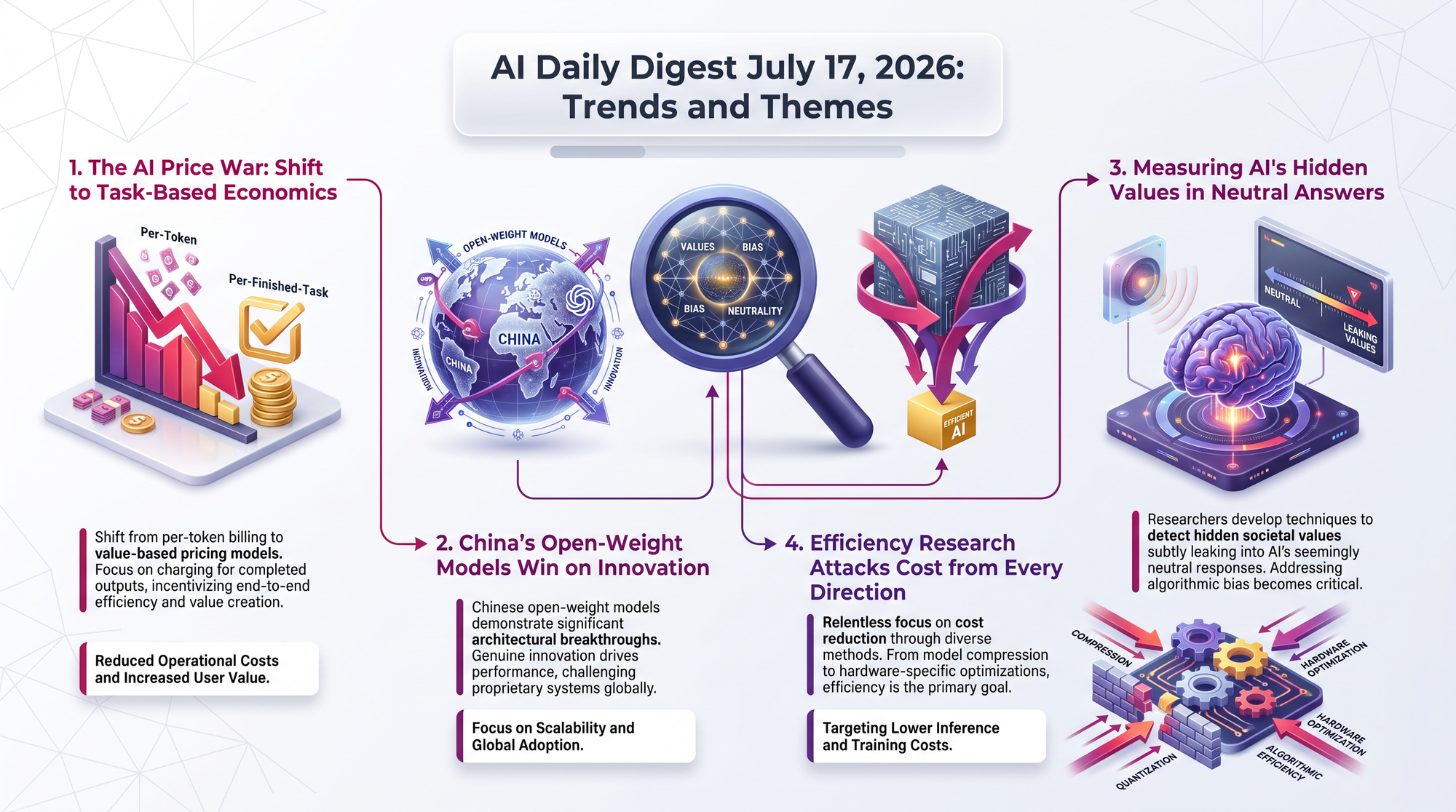
gpt-5.6 family, with gpt-5.6-sol priced identically to gpt-5.5 - a flagship at unchanged pricing rather than a repricing. Anthropic's Fable 5 tier at $10/$50 appears on the pricing page but was not in yesterday's table; we did not verify whether either listing is new today, so neither is reported as a change. And a correction to yesterday's edition: we listed Claude Opus 4.8 at 200K context, but Anthropic's official documentation states 1M tokens; that was our error, not a vendor change.What this means: The interesting spread is no longer between providers but between tiers. Groq's open-model rates run from roughly 33 to 625 times cheaper than the frontier tiers depending on which pair you compare, and today's arXiv paper below argues that caching, not sticker price, is what actually decides your bill.




Member discussion