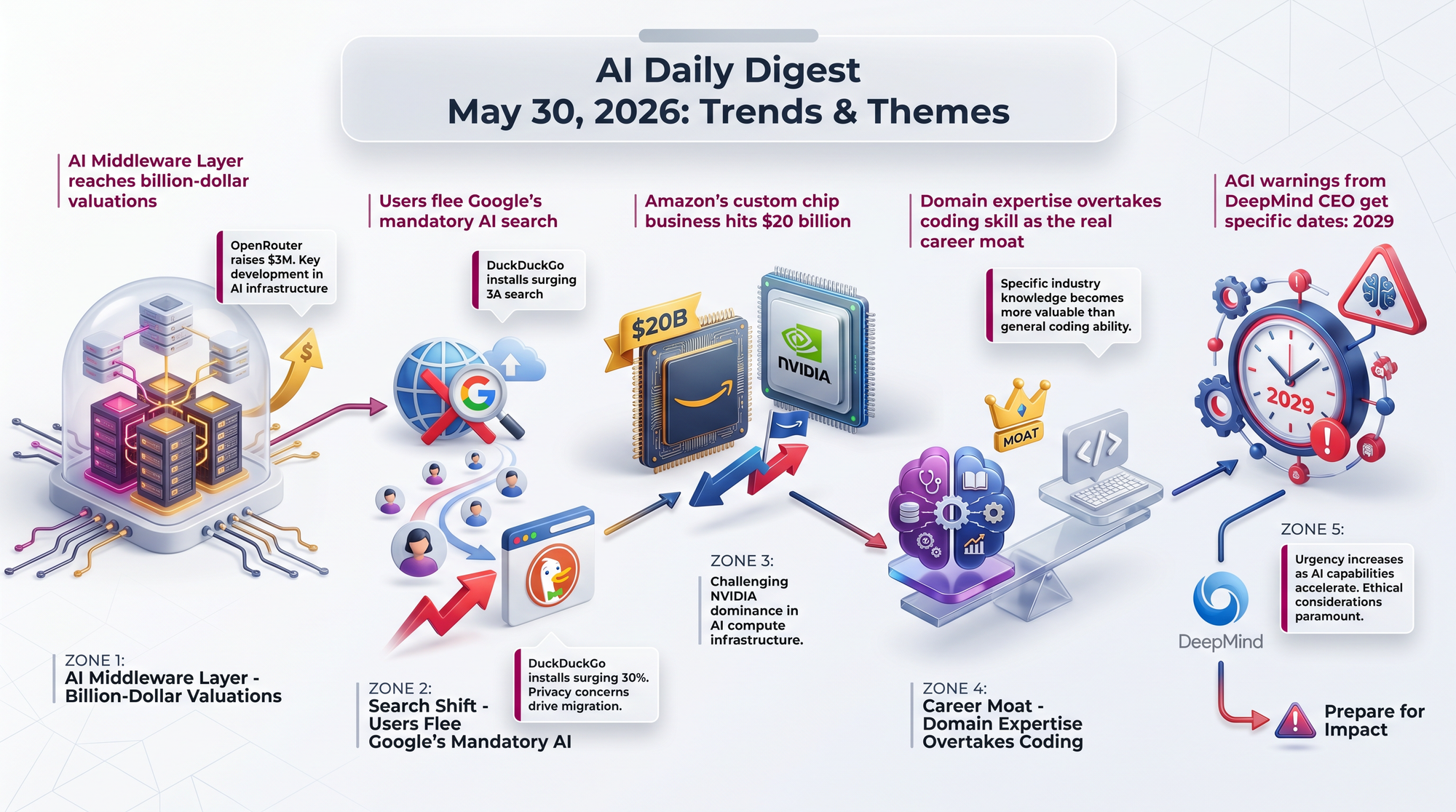
Watch today's digest as a video summary (generated by NotebookLM)
Statistically Speaking
One Thing to Tell Your Friends
TL;DR
Hot off the Presses
OpenRouter Becomes a $1.3 Billion Company by Sitting Between Every AI Model and Every App
OpenRouter raised $113 million in Series B funding led by CapitalG (Alphabet's growth fund), with participation from NVIDIA's NVentures, ServiceNow Ventures, MongoDB Ventures, Snowflake Ventures, Databricks Ventures, Andreessen Horowitz, and Menlo Ventures.
- Weekly token volume exploded from 5 trillion to 25 trillion in six months - a 5x increase
- 8 million developers now use the platform across 400+ AI models
- The business model is simple - one API that routes requests to whichever AI model is cheapest, fastest, or best for the task
- Enterprise features now include spend controls, guardrails, zero-data-retention, and intelligent routing with automatic failover
Millions of Users Are Fleeing Google Search Over Mandatory AI
DuckDuckGo's U.S. app installs jumped 18% week-over-week on average during May 20-25, peaking at 30.5% on May 25. On iOS, the growth was even more dramatic - averaging 33% with a single-day peak of 69.9%.
- The trigger was Google I/O 2026 - Google announced AI Search agents that replace the traditional list of links with an AI that answers queries, carries out tasks, and runs monitoring agents in the background
- DuckDuckGo's "AI-free" search page saw 22.7% average weekly growth - a page that turns off every AI feature by default
- U.S. growth was multiple times larger than international - confirming the surge is a direct response to Google's U.S.-centric AI search announcements
- The backlash is real - users describe being "force-fed" AI results they did not ask for
Amazon's Secret Chip Empire Hits $20 Billion and Could Challenge NVIDIA
Amazon CEO Andy Jassy confirmed that the company's custom silicon division - spanning Graviton processors (general computing), Trainium accelerators (AI training), and Nitro security chips - generates over $20 billion annually with triple-digit growth.
Previously: May 28 - Anthropic committed 5 gigawatts of AWS Trainium capacity, roughly 500,000-700,000 accelerators.
- If sold externally, the business would be worth roughly $50 billion per year - rivaling NVIDIA and AMD
- Trainium2 is completely sold out, Trainium3 nearly fully reserved, and Trainium4 already has substantial pre-orders despite being 18 months from release
- Two unnamed customers tried to buy all of Amazon's Graviton capacity for 2026 - Amazon refused to protect other customers
- Jassy is openly considering selling chips externally - transforming Amazon from chip consumer to direct NVIDIA competitor
An Open-Source Leader Quits Tech to Become "AI Amish"
Chad Whitacre, known for his work on open-source sustainability, announced he is retiring from tech to live offline. After extended sessions with Claude Opus 4.5, he described the experience as intoxication followed by an unsettling realization.
- His core complaint - "It was like I had another 'person' in my head, sharing my inner monologue - but the 'person' was a computer system owned by a budding megacorp"
- He calls himself "AI Amish" or "Internet Amish" - accepting pre-1980s technology while rejecting AI and constant connectivity
- He is not alone - the post resonated widely, tapping into a growing undercurrent of discomfort with how deeply AI tools integrate into thought processes
Anthropic Opens Up About How It Keeps Claude Contained
Anthropic released detailed documentation showing three different sandboxing approaches for three products, plus an open-source tool anyone can use.
- Claude.ai uses gVisor - a Google-developed security sandbox
- Claude Code uses Seatbelt on macOS and Bubblewrap on Linux - operating system-level isolation
- Claude Cowork runs a full virtual machine - Apple's Virtualization framework on macOS, HCS (Host Compute Service) on Windows
- Anthropic also released srt (Sandbox Runtime) - an open-source tool on GitHub for developers building their own AI applications
- The documentation references a previously discovered vulnerability involving credential exfiltration via the API files endpoint
Trends & Themes

Creative AI & Media
VoxCPM - Tokenizer-Free Speech in 30 Languages
What it does: Generates natural, expressive speech from text without the usual tokenization step, producing 48kHz studio-quality audio in 30 languages with voice cloning and voice design from text descriptions alone.
Try it: GitHub
- Real-time streaming with RTF (Real-Time Factor) of approximately 0.3 on an RTX 4090 - meaning it generates speech 3x faster than you can listen to it
- Voice design from text descriptions - describe a voice in words and it creates it
- Apache-2.0 licensed - free for commercial use
- Built on the MiniCPM-4 backbone by OpenBMB
Meituan LongCat Video Avatar 1.5
What it does: Generates video avatars - animated talking-head videos from a single image and audio input - using a new diffusion-based architecture from Meituan (China's food delivery and services giant).
- Trending on Hugging Face with rapid early adoption
- Practical use cases include marketing videos, personalized content, and virtual presenters
- Meituan's entry into generative video signals expanding competition beyond dedicated AI labs
Developer Tools & Infrastructure
Research & Models
Business & Industry
Surprising & Under-the-Radar
An "AI Amish" Movement Is Forming
People are not just complaining about AI - they are actively leaving technology over it. Chad Whitacre's decision to adopt pre-1980s technology mirrors a broader pattern: the Amish approach of evaluating each technology for whether it strengthens or weakens community bonds, applied to AI. His post generated more engagement than most product launches.
The Quote That Captures 2026's AI Mood
Daniel Jalkut's observation - "everybody who's against it is too against it and everybody who's for it is too for it" - went viral via Mastodon, Gruber, and Willison. It crystallized what many people feel but struggle to articulate: the exhaustion of living in a world where AI opinions have to be extreme to be heard.
Amazon Turned Down Customers Who Wanted to Buy All Its Chips
Two unnamed customers asked to purchase all of Amazon's Graviton instance capacity for 2026. Amazon refused. When a chip maker turns away customers buying everything, demand has outstripped what even hyperscalers can supply.
Google's AI Backlash Is Measurable in App Store Data
DuckDuckGo's surge is notable because it is not speculation about user sentiment - it is app store download data. A 69.9% peak on iOS in a single day is not a trend piece; it is an exodus caught on tape.
Signals to Track

The Model Routing Layer as Kingmaker
OpenRouter processing 25 trillion tokens per week means a significant percentage of all AI inference passes through a single intermediary. If OpenRouter optimizes for cost, it sends traffic to cheaper models. If it optimizes for quality, it favors frontier labs. This routing power is structurally similar to what Google Search was for websites - and Google's CapitalG just invested. Watch for whether model providers start offering OpenRouter exclusive pricing or priority access.
The "AI-Free" Product Category Is Emerging
DuckDuckGo's AI-free search page saw 22.7% weekly growth. This is a product differentiation strategy that did not exist a year ago. Expect to see "No AI" badges on other products - email clients, note-taking apps, search tools - as a competitive feature, not a limitation.
Amazon Could Become a Chip Seller
Andy Jassy's hints about external chip sales could reshape the AI compute market. Amazon has the manufacturing relationships, the volume, and the software stack. The question is whether Trainium4 (18 months out) will be competitive enough to attract customers who are not already locked into AWS.
Containment Documentation as Competitive Advantage
Publishing exactly how Claude is contained - gVisor, Seatbelt, Bubblewrap, full VMs - sets a transparency bar. Enterprise buyers evaluating AI vendors can now compare: "Anthropic published their containment architecture. What does OpenAI use? What does Google use?" If this becomes a procurement checklist item, it changes how AI labs prioritize security documentation.
Agent Text Mode Before Vision Mode
This reveals a strategic choice: ship agents that work with structured data (JSON, XML, PDF) first, add pixel-level understanding later. The implication is that agents operating through APIs and file formats will be more reliable than agents that have to interpret what is on screen. It also means the most useful agents will integrate with apps that expose structured data, not with apps that only have a visual interface.
Top Repos Today
📜 License: MIT · 👤 By: Individual developer
🎯 Time to value: 10 minutes
| ✓ Pros | ✗ Cons |
|---|---|
| One-command video creation from text | Output quality varies with prompt quality |
| Supports multiple TTS and LLM backends | Requires significant compute for HD output |
| Active community with frequent updates | Generated videos may feel templated |
 GitHub

📜 License: MIT · 👤 By: Microsoft
🎯 Time to value: 2 minutes
| ✓ Pros | ✗ Cons |
|---|---|
| Handles nearly every common file format | Complex table layouts may lose structure |
| Simple pip install, works as CLI or library | Large files can be slow to process |
| Backed by Microsoft with regular updates | Image-heavy documents lose visual context |
GitHub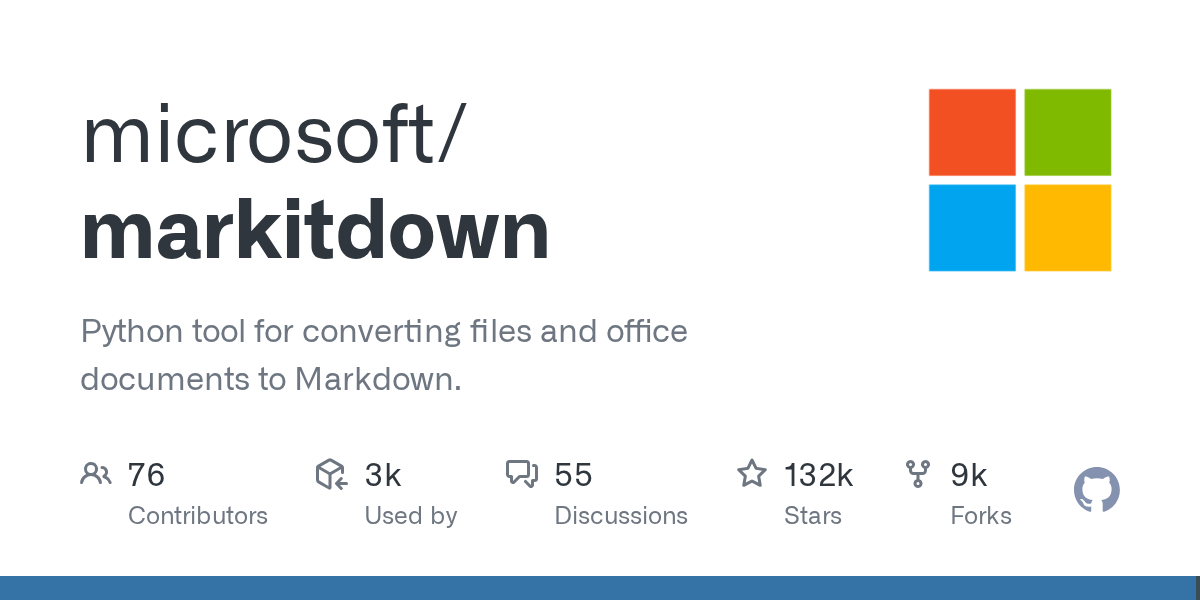
📜 License: Apache-2.0 · 👤 By: Research lab (OpenBMB)
🎯 Time to value: 15 minutes
| ✓ Pros | ✗ Cons |
|---|---|
| 30 languages with real-time streaming | Requires an NVIDIA GPU (RTX 4090 for best speed) |
| Voice design from text descriptions | Large model download required |
| Apache-2.0 - free for commercial use | Voice cloning quality varies by source audio |
GitHub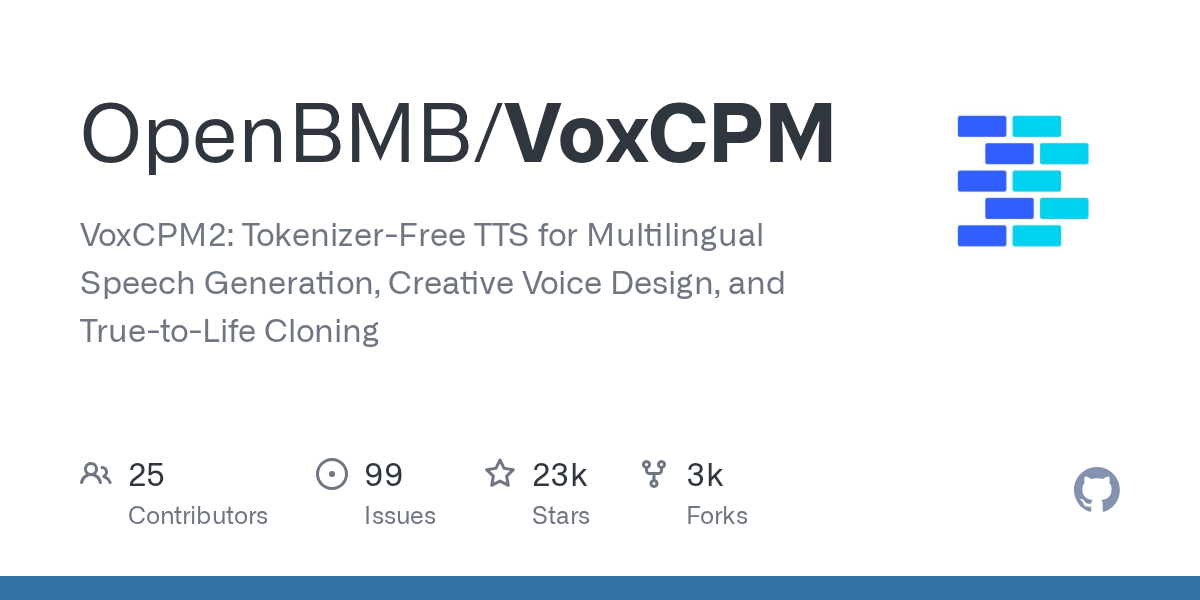
📜 License: MIT · 👤 By: LlamaIndex (company)
🎯 Time to value: 5 minutes
| ✓ Pros | ✗ Cons |
|---|---|
| Rust-based speed for large document sets | Fewer format options than markitdown |
| High-accuracy table and layout extraction | Newer project with smaller community |
| MIT licensed with LlamaIndex backing | Limited configuration options |
GitHub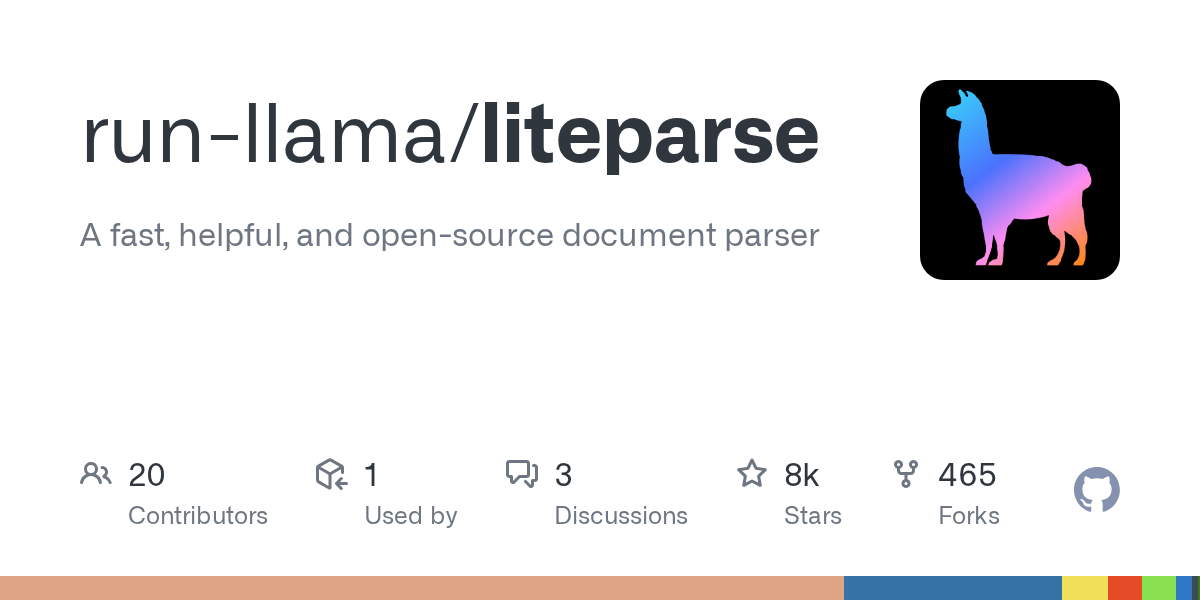
📜 License: Apache-2.0 · 👤 By: Community project
🎯 Time to value: 30 minutes
| ✓ Pros | ✗ Cons |
|---|---|
| Completely functional offline after setup | Requires significant disk space for full knowledge base |
| AI chat with document search via Ollama | Initial download of all resources is large |
| Includes medical refs, maps, and courses | Local AI quality limited by hardware |
GitHub
📜 License: Proprietary · 👤 By: Anthropic
🎯 Time to value: 5 minutes
| ✓ Pros | ✗ Cons |
|---|---|
| Deep codebase understanding and context | Requires Anthropic API subscription |
| Terminal-native workflow fits dev habits | Can be expensive for long coding sessions |
| Active development with frequent updates | Learning curve for effective prompting |
GitHub
📜 License: MIT · 👤 By: Individual researcher
🎯 Time to value: 60 minutes
| ✓ Pros | ✗ Cons |
|---|---|
| Complete pipeline from data to generation | Requires PyTorch knowledge |
| Runs on consumer GPUs | Models too small for practical use |
| Excellent educational resource | Not a production-ready framework |
GitHub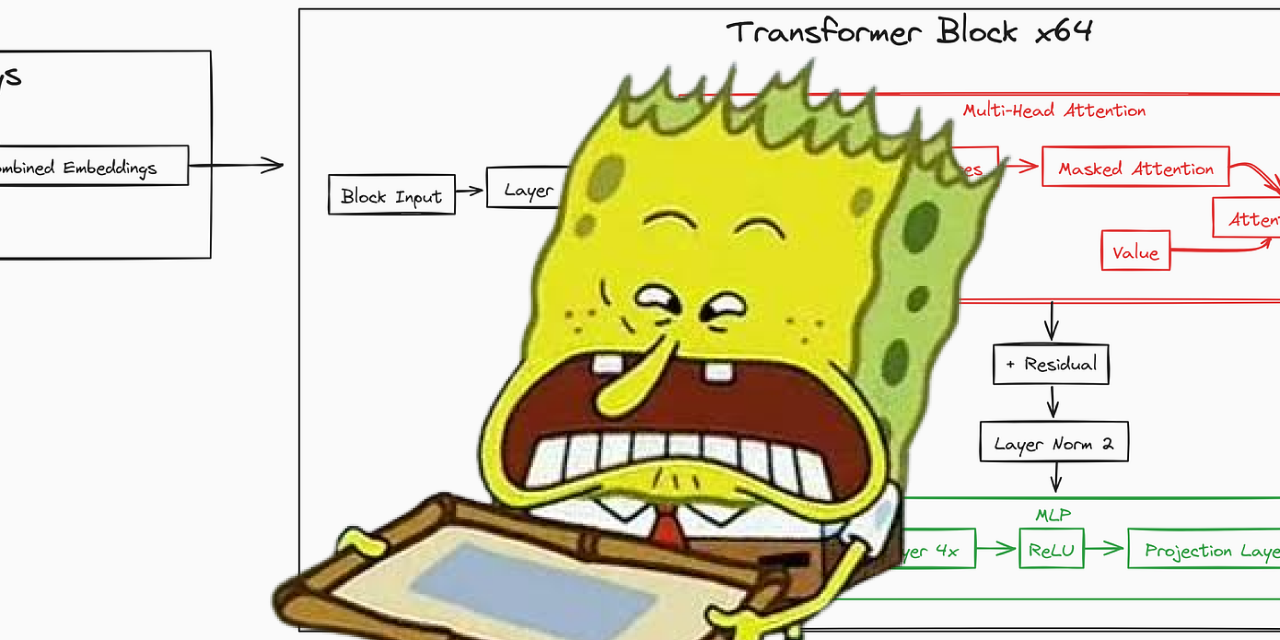
Top Models Today
👤 By: OpenBMB (research lab) · 🎯 Task: Text Generation
📐 Size: 1B
| ✓ Pros | ✗ Cons |
|---|---|
| Extremely small footprint for edge deploy | Limited compared to 7B+ models on complex tasks |
| Apache-2.0 for commercial use | Smaller training dataset than competitors |
| Fast inference on minimal hardware | English-centric despite multilingual claims |

👤 By: NVIDIA · 🎯 Task: Image-Text-to-Text
📐 Size: 4B
| ✓ Pros | ✗ Cons |
|---|---|
| Zero-shot object detection from text | Requires GPU for reasonable inference speed |
| NVIDIA-backed with strong accuracy | 4B parameters is large for edge deployment |
| Apache-2.0 license | Limited to static images (no video) |
👤 By: DeepSeek AI · 🎯 Task: Text Generation
📐 Size: 862B
| ✓ Pros | ✗ Cons |
|---|---|
| Frontier-class performance benchmarks | Requires massive GPU cluster to run |
| Nearly 6M downloads shows proven demand | DeepSeek license has commercial restrictions |
| Strong multilingual and reasoning ability | Inference costs rival closed-model API pricing |
👤 By: ByteDance Research · 🎯 Task: Any-to-Any
📐 Size: Not specified
| ✓ Pros | ✗ Cons |
|---|---|
| True any-to-any multimodal capability | Relatively low download count suggests early stage |
| Apache-2.0 for commercial use | Quality may lag modality-specific models |
| From ByteDance's well-funded research arm | Documentation still maturing |

👤 By: Tencent · 🎯 Task: Translation
📐 Size: 30B (3B active)
| ✓ Pros | ✗ Cons |
|---|---|
| Translation-specific optimization | Narrower use case than general-purpose models |
| Efficient 3B active parameters | License terms not clearly specified |
| Tencent's massive multilingual training data | Limited community documentation |
AI Launches Today
💰 Pricing: Freemium · 🏷 Category: AI Agents
 Product Hunt

💰 Pricing: Freemium · 🏷 Category: Developer Tools
Product Hunt💰 Pricing: Paid · 🏷 Category: AI Agents
Product HuntSnapshot
| Provider | Model | Input $/1M | Output $/1M | Context |
|---|---|---|---|---|
| Anthropic | Claude Opus 4.7 | $5.00 | $25.00 | 200K |
| Anthropic | Claude Sonnet 4.6 | $3.00 | $15.00 | 1M |
| Anthropic | Claude Haiku 4.5 | $1.00 | $5.00 | 200K |
| OpenAI | GPT-5.5 | $5.00 | $30.00 | - |
| OpenAI | o3 | $2.00 | $8.00 | - |
| DeepSeek | V4-Pro | Open | Open | - |
Reinforcement Learning from Community Feedback (RLCF): Training AI to Judge Scientific Ideas
Key finding: The system learned to distinguish high-impact research from low-impact research using citation patterns as a proxy for community judgment, suggesting AI can learn "scientific taste."
Why practitioners should care: If validated, this approach could help researchers prioritize which ideas to pursue, help funders evaluate proposals, and accelerate the scientific process by filtering out low-signal work before expensive experiments begin.

Member discussion