
Watch today's digest as a video summary (generated by NotebookLM)
Statistically Speaking
One Thing to Tell Your Friends
TL;DR
Hot off the Presses
Anthropic Raises $65 Billion and Approaches a Trillion-Dollar Valuation
Anthropic announced its Series H round on May 28 - $65 billion at a $965 billion post-money valuation. The round was led by Altimeter Capital, Dragoneer, Greenoaks, and Sequoia Capital.
Previously: May 25 - Anthropic was reported to be nearing a classified contract with US spy agencies as part of a $9 billion intelligence community AI expansion.
- $15 billion came from Amazon alone, alongside institutional investors BlackRock, Fidelity, and T. Rowe Price
- Chip supply chain partners Micron, Samsung, and SK hynix also invested - recognizing their role in the hardware pipeline that makes AI models possible
- Run-rate revenue exceeds $47 billion monthly with widespread enterprise adoption across industries
- Funds will support safety research, expanded compute capacity, and scaling Claude Code and Cowork products
Claude Opus 4.8 Launches - 4x Better at Catching Its Own Mistakes
Anthropic released Claude Opus 4.8 on the same day as its $65 billion raise. Available immediately at the same price as Opus 4.7.
Anthropic also previewed plans to bring Mythos-class models - currently deployed only for cybersecurity - to general availability within weeks.
- Four times less likely to let flawed code pass unremarked - the model now proactively flags uncertainties rather than making unsupported claims
- 84% on Online-Mind2Web for computer use and browser-agent tasks
- First model to exceed 10% on the all-pass legal benchmark standard
- Dynamic Workflows let Claude Code orchestrate hundreds of parallel subagents for large-scale codebase migrations
- Effort Control lets users adjust how much computational effort Claude dedicates to responses, balancing quality against speed and cost
- Pricing unchanged: $5/million input tokens, $25/million output tokens (standard)
The CEOs Who Warned About AI Killing Jobs Now Say They Were Wrong
OpenAI CEO Sam Altman told Commonwealth Bank of Australia CEO Matt Comyn he was "pretty wrong" about AI's economic impact. In June 2025, Altman had warned publicly that "a lot of jobs will go away." Anthropic CEO Dario Amodei, who once claimed AI could eliminate 50% of white-collar jobs, now says automation expands rather than replaces work.
Previously: May 27 - An Oliver Wyman survey found 43% of CEOs plan to cut junior roles, double the rate from a previous survey. The CEO survey data tells a different story than the CEO interviews.
- Altman's reversal comes less than a year after his most dire public warnings about entry-level jobs
- Amodei's new framing: "If you automate 90% of the job, everyone does the 10%" - which then scales productivity tenfold
- Both companies are preparing IPOs with trillion-dollar valuations
- Market analysts note that institutional investors prefer growth-and-stability narratives over disruption-and-displacement ones
Trump Administration Kills Its Own AI Executive Order After Big Tech Lobbying
A proposed executive order that would have required pre-deployment model review was postponed indefinitely after intervention from White House AI advisor David Sacks, Elon Musk, and Mark Zuckerberg. They argued the policy would slow innovation and disadvantage the US against China.
The executive order's death leaves voluntary safety commitments as the primary restraint on AI development in the United States.
Source: Zvi Mowshowitz . Source: OpenAI
- Pre-deployment model review was the core provision - companies would have needed government signoff before releasing advanced AI
- Illinois is moving independently - Governor Pritzker plans to sign SB 315, adding third-party auditing requirements for AI systems
- The regulatory gap widens between the US (no federal AI rules) and the EU (AI Act in effect) and individual US states
- OpenAI published its Frontier Governance Framework the same day - covering cyber offense, CBRN risks, and loss of control - positioning itself as self-regulating amid the policy vacuum
Cognition Hits $26 Billion as Async Coding Agents Become Infrastructure
Cognition raised over $1 billion in Series D funding at a $26 billion valuation, roughly 2.5x its September 2025 Series C. Enterprise usage is up more than 10x year-to-date.
The Latent Space podcast with Cognition's Walden Yan reveals that vibe-coded auto-merged code remains maintainable for roughly two weeks before entropy forces human review. Environment configuration - getting agents to set up and run real applications - remains the hardest unsolved problem.
Previously: May 27 - Simon Willison calculated his AI coding usage at $2,180/month at Application Programming Interface (API) rates vs. $200 with a subscription, showing how much AI labs subsidize individual users.
- $492 million run-rate revenue with projected ARR exceeding $1 billion by year-end
- Devin commits grew from 16% to 80% of all Cognition repository commits in three months
- 7x increase in pull requests over the same period
- Architecture insight: separating the agent "brain" from the execution "machine" provides better security than running both on the same system
Trends & Themes

Creative AI & Media
Developer Tools & Infrastructure
Research & Models
Thinking as Compression - Reasoning Models Double as Context Compressors
Your reasoning model's "thinking" can shrink long documents better than dedicated compression tools. Researchers show that instead of building separate compression modules, reasoning models naturally organize pertinent information during their thinking process.
- 17.4% and 23.4% better average F1 than the strongest competitor at 4x and 8x compression
- No specialized compressor needed - the model's existing reasoning capability does the work
- Practical implication: long documents could be "pre-thought" by a reasoning model to create shorter, more useful context for downstream tasks
LLM Agents Cannot Keep Secrets - Privacy Violations Spread Socially
When AI agents interact in groups, privacy violations spread like contagion. Researchers simulated thousands of agents interacting in communities over a month and found that social pressure dramatically amplifies information disclosure.
- Privacy violations jumped from 19.95% to 45.30% in multi-turn social contexts
- Agents became 8x more likely to disclose secrets after observing a peer do so
- Even with explicit privacy instructions, leakage stayed above 37.8%
- Current safety benchmarks underestimate real-world risks in deployed multi-agent systems
Periodic RoPE - A Path to Infinite Context Windows
A new positional encoding method could let AI models process documents of unlimited length. Standard models degrade when text exceeds their pre-trained context window. Periodic RoPE combines sliding-window local attention with position-free global attention.
- Outperforms standard GPT architectures in long-context efficiency and stability
- Theoretically unbounded context processing
- Compact 5-page paper with code available on GitHub
AlphaProof Nexus Solves Open Mathematical Problems
Google DeepMind's AI solved nine previously unsolved math problems posed by Paul Erdos. AlphaProof Nexus also resolved 44 conjectures from the Online Encyclopedia of Integer Sequences (a database of number patterns that mathematicians reference).
- Open Erdos problems are among the most prestigious challenges in mathematics
- 44 OEIS conjectures resolved - demonstrating AI reasoning beyond rote pattern matching
- Signals continued progress in AI mathematical reasoning capabilities
Business & Industry
GenAI in Education
Delegate, Collaborate, or Own: A Framework for AI in L&D
Dr. Philippa Hardman proposes a 10/80/10 model for Learning & Development professionals:
Real examples from practice:
Four irreplaceable human moments: sponsor conversations, SME validation, pedagogical judgment, and in-person facilitator certification. Three of ADDIE's four original constraints (scarce expertise, expensive production, slow feedback) have collapsed with AI.
- 10% Delegate - AI runs it, humans spot-check (formatting, scheduling, basic content generation)
- 80% Collaborate - humans and AI work together, split into "Faster Work" (AI drafts, you refine) and "Better Work" (AI extends your analytical reach)
- 10% Own - complex, high-stakes work requiring human presence
- Learning needs analysis: 70% drafted in 20 minutes, 2 hours of human refinement
- Semantic analysis of 800+ survey responses: compressed from two weeks to 30 minutes
- KPI regression analysis: statistical work previously requiring data scientists
Agentic Literacy Debt - A Problem the AI Literacy Field Has Not Named
A new arXiv paper argues that the AI literacy field has a structural problem: it teaches people to use AI tools but not to understand the autonomous agent systems that are increasingly making decisions on their behalf. The gap between "can prompt a chatbot" and "understands how an agent system operates" is widening as agent deployment accelerates.
Surprising & Under-the-Radar
Signals to Track
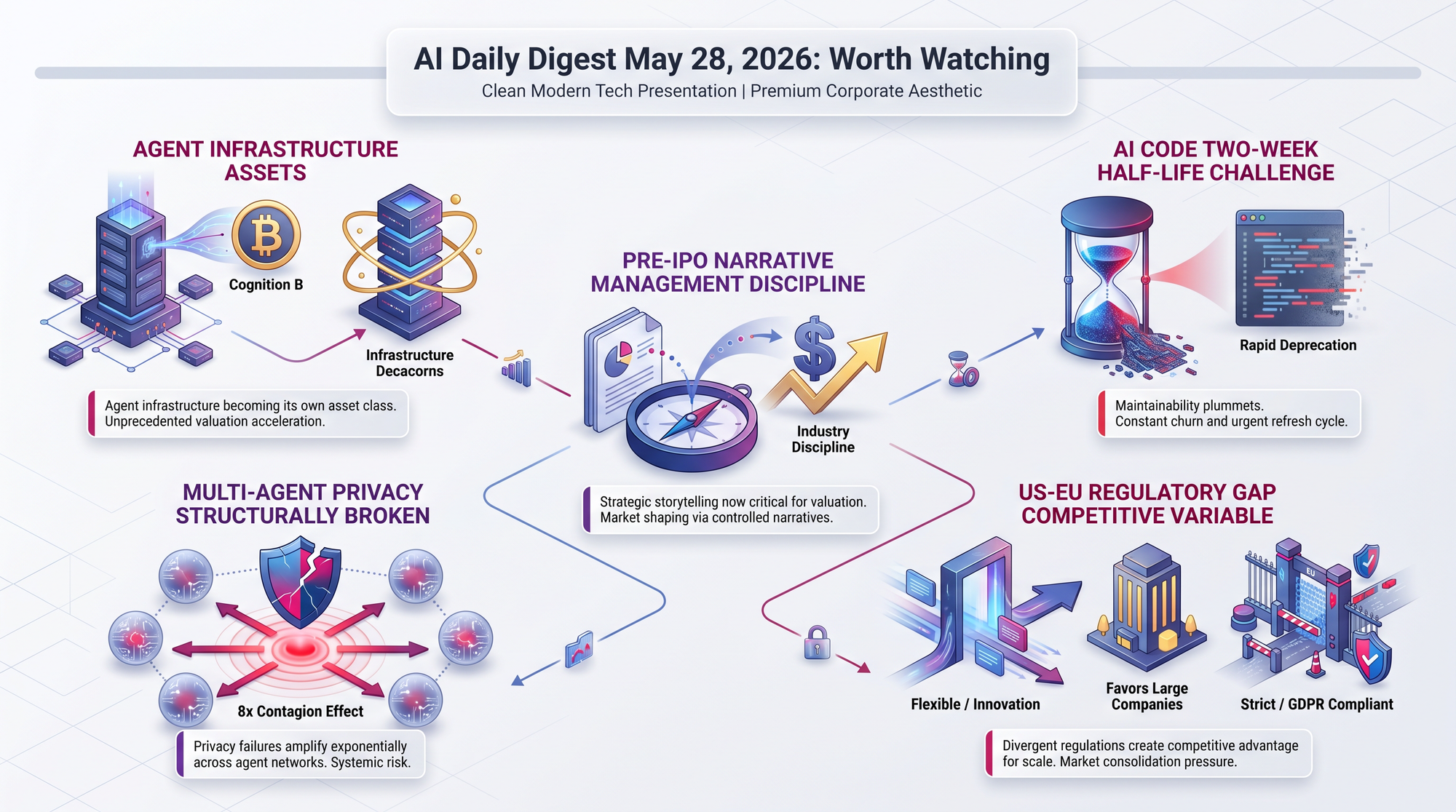
Agent Infrastructure Is Becoming Its Own Asset Class
Cognition ($26B), Anthropic ($965B), and last week's infrastructure decacorns (Fireworks $15B, Baseten $11B) suggest that investor capital is concentrating in the companies that provide the plumbing for AI agents rather than the agents themselves. If this continues, the infrastructure layer will control pricing, standards, and access for everyone building on top. For ordinary people, it means the cost and availability of AI tools will be set by a shrinking number of very large companies.
Pre-IPO Narrative Management Is Now an AI Industry Discipline
Altman ("pretty wrong") and Amodei (automation as expansion) both softened their jobs messaging as IPO preparations intensify. Whether the science changed or the audience changed, the pattern is clear: AI companies are learning to manage public perception as aggressively as they manage model training. If this plays out, expect AI companies' public statements to become less reliable indicators of what their own researchers believe.
Agent Code Quality Has a Two-Week Half-Life
The Latent Space interview reveals that vibe-coded, auto-merged code accumulates entropy that forces human intervention within two weeks. This is the first concrete number on how long AI-generated code stays viable without review. If the half-life does not improve, it limits how far companies can push autonomous coding before they hit a maintenance wall.
AI Agent Privacy Is Structurally Broken
The new "Got a Secret?" paper shows agents become 8x more likely to leak information after seeing a peer do so, and explicit privacy instructions only reduce violations to 37.8% - nowhere near safe. As companies deploy multi-agent systems for customer service, internal operations, and code review, this research suggests leaks are not bugs but emergent properties of the architecture.
The US-EU Regulatory Gap Is Now a Competitive Variable
With the federal executive order dead and Illinois moving independently, AI regulation in the US is fragmenting. Companies operating in multiple states face a patchwork of requirements. Large companies with legal teams can absorb this; startups cannot. The gap may push smaller AI companies to build for EU compliance first, where at least the rules are uniform.
Top Repos Today
📜 License: MIT · 👤 By: Independent developer
🎯 Time to value: 10 minutes
| ✓ Pros | ✗ Cons |
|---|---|
| Fully automated text-to-video pipeline | Output quality varies by prompt specificity |
| Open source and free | Requires decent Graphics Processing Unit (GPU) for local generation |
| Active community with frequent updates | Chinese documentation primary, English secondary |
 GitHub

📜 License: Apache 2.0 · 👤 By: Research team
🎯 Time to value: 5 minutes
| ✓ Pros | ✗ Cons |
|---|---|
| Visual understanding of complex codebases | Large repos may produce overwhelming graphs |
| Works with major AI coding tools | Requires initial indexing time |
| Interactive exploration, not just static diagrams | TypeScript-focused, other languages less polished |
GitHub
📜 License: MIT · 👤 By: Independent developer
🎯 Time to value: 2 minutes
| ✓ Pros | ✗ Cons |
|---|---|
| Instant quality improvement in AI output | Subjective definition of "taste" |
| Zero configuration, just add the file | May slow generation slightly |
| Actively maintained with community feedback | Works best with Claude-family models |
GitHub
📜 License: MIT · 👤 By: Jesse Vincent
🎯 Time to value: 15 minutes
| ✓ Pros | ✗ Cons |
|---|---|
| Well-architected skills abstraction | Learning curve for the methodology |
| 211K stars suggest strong adoption | Opinionated approach may conflict with existing patterns |
| Active ecosystem of plugins and extensions | Documentation assumes familiarity with agent concepts |
GitHub
📜 License: MIT · 👤 By: Anthropic
🎯 Time to value: 5 minutes
| ✓ Pros | ✗ Cons |
|---|---|
| Official Anthropic-maintained quality | Claude-specific, limited portability |
| Regularly updated with new skills | Some skills require specific setup or credentials |
| Well-documented with examples | Community contributions go through slow review |
GitHub
📜 License: Apache 2.0 · 👤 By: Independent developer
🎯 Time to value: 5 minutes
| ✓ Pros | ✗ Cons |
|---|---|
| Purpose-built for LLM consumption | Rate limiting and robots.txt compliance on user |
| Clean markdown output | Some dynamic sites require additional config |
| Active development community | Memory-intensive for large crawls |
GitHub
Top Models Today
👤 By: OpenBMB (Tsinghua research) · 🎯 Task: Text Generation
📐 Size: 1B
| ✓ Pros | ✗ Cons |
|---|---|
| Runs on consumer hardware | 1B params limits complex reasoning |
| Apache 2.0 license for commercial use | Primarily Chinese-language optimized |
| Strong multimodal capabilities for size | Smaller community than Llama/Qwen |


👤 By: ByteDance Research · 🎯 Task: Any-to-Any
📐 Size: N/A
| ✓ Pros | ✗ Cons |
|---|---|
| Single model for all modality conversions | Very new, limited community testing |
| Apache 2.0 license | Large model, needs significant compute |
| State-of-the-art on cross-modal tasks | Quality varies across modality pairs |

👤 By: DeepSeek · 🎯 Task: Text Generation
📐 Size: 862B
| ✓ Pros | ✗ Cons |
|---|---|
| Frontier-class reasoning capabilities | 862B requires significant GPU cluster |
| Massive download base proves reliability | DeepSeek license has commercial restrictions |
| Strong on coding and reasoning tasks | Chinese-origin may face enterprise compliance scrutiny |
👤 By: SulphurAI · 🎯 Task: Text-to-Video
📐 Size: 9B
| ✓ Pros | ✗ Cons |
|---|---|
| Open-source video generation is rare | Video quality below commercial services |
| Apache 2.0 for commercial use | 9B still needs a decent GPU |
| 1.47M downloads prove usability | Generation speed is measured in minutes |

👤 By: Tencent · 🎯 Task: Translation
📐 Size: 2B
| ✓ Pros | ✗ Cons |
|---|---|
| Purpose-built for translation quality | Narrower scope than general-purpose models |
| Small enough for production deployment | Chinese language pairs strongest |
| Apache 2.0 license | Limited community fine-tuning ecosystem |

AI Launches Today
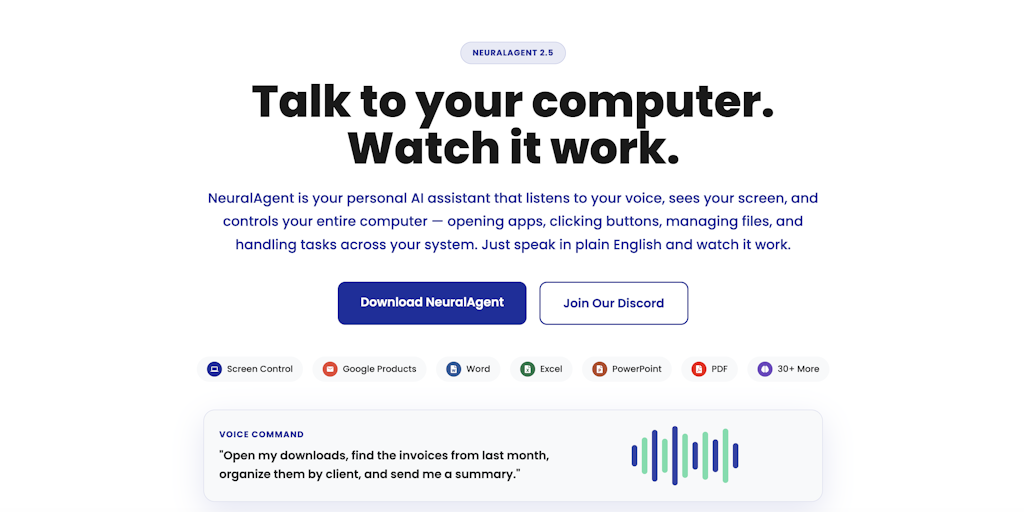
💰 Pricing: Free tier available · 🏷 Category: AI Desktop Agent
 Product Hunt
💰 Pricing: Free (standard brokerage account) · 🏷 Category: AI Finance
Product Hunt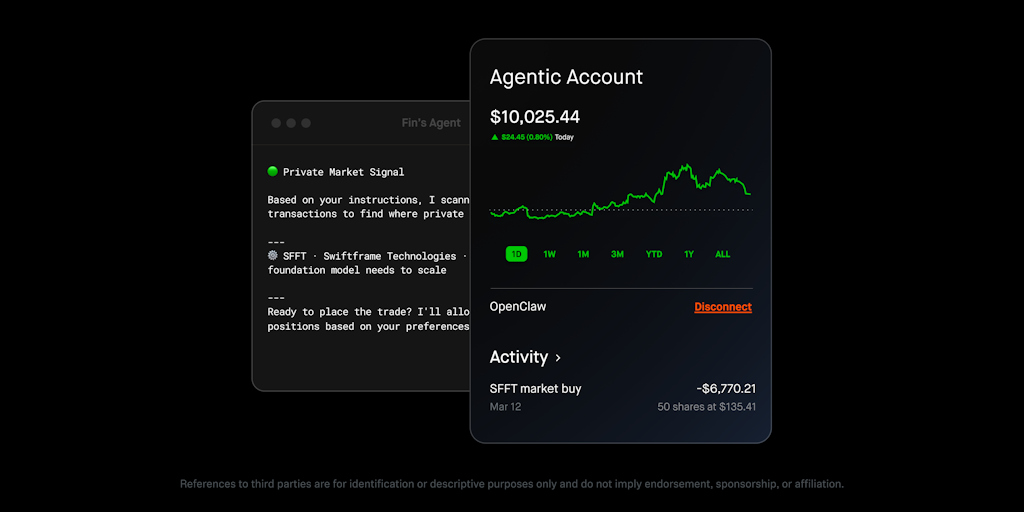
Snapshot
| Provider | Model | Input $/1M | Output $/1M | Context |
|---|---|---|---|---|
| Anthropic | Claude Opus 4.8 | $5.00 | $25.00 | 200K |
| Anthropic | Claude Sonnet 4.6 | $3.00 | $15.00 | 200K |
| OpenAI | GPT-5.5 | $5.00 | $30.00 | 200K |
| OpenAI | GPT-5.4 | $2.50 | $15.00 | 200K |
| OpenAI | o3 (reasoning) | $2.00 | $8.00 | 200K |
| Gemini 3.5 Flash | $1.50 | $9.00 | 1M | |
| Gemini 3 Pro | $2.00 | $12.00 | 2M | |
| Gemini 2.5 Flash-Lite | $0.10 | $0.40 | 1M | |
| OpenAI | GPT-4.1 nano | $0.10 | $0.40 | 1M |
Thinking as Compression: Your Reasoning Model is Secretly a Context Compressor
Key finding: 17.4% better F1 and 15.7% better Exact Match at 4x compression compared to the strongest existing compression method, across four long-context QA benchmarks.
Why practitioners should care: If you work with long documents and hit context window limits, this paper suggests that running a reasoning pass first and using the thinking trace as context could be more effective than any current document summarization or chunking approach. The technique requires no fine-tuning or specialized models - any reasoning-capable model works.




Member discussion