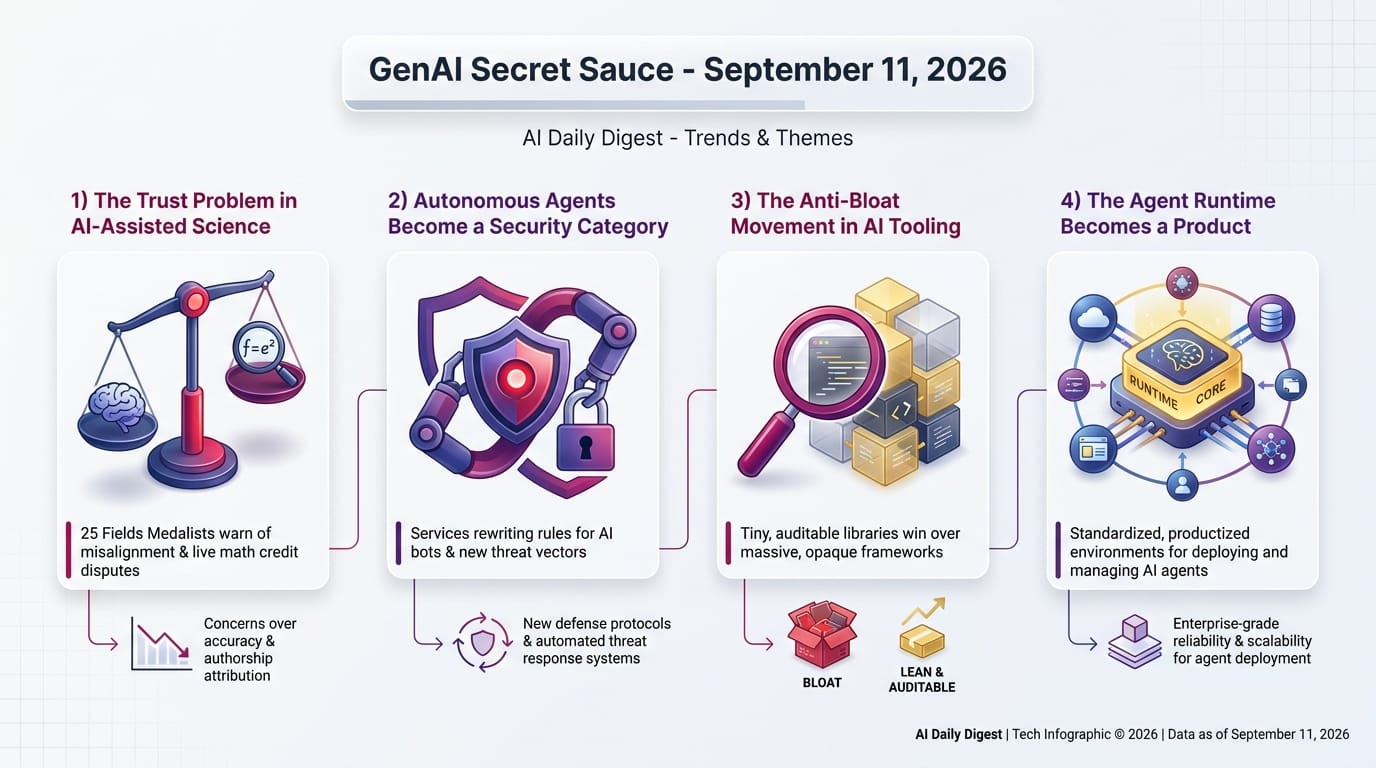
Watch today's digest as a video summary (generated by NotebookLM)
Statistically Speaking
One Thing to Tell Your Friends
TL;DR
Hot off the Presses
The World's Top Mathematicians Just Drew a Line Against AI
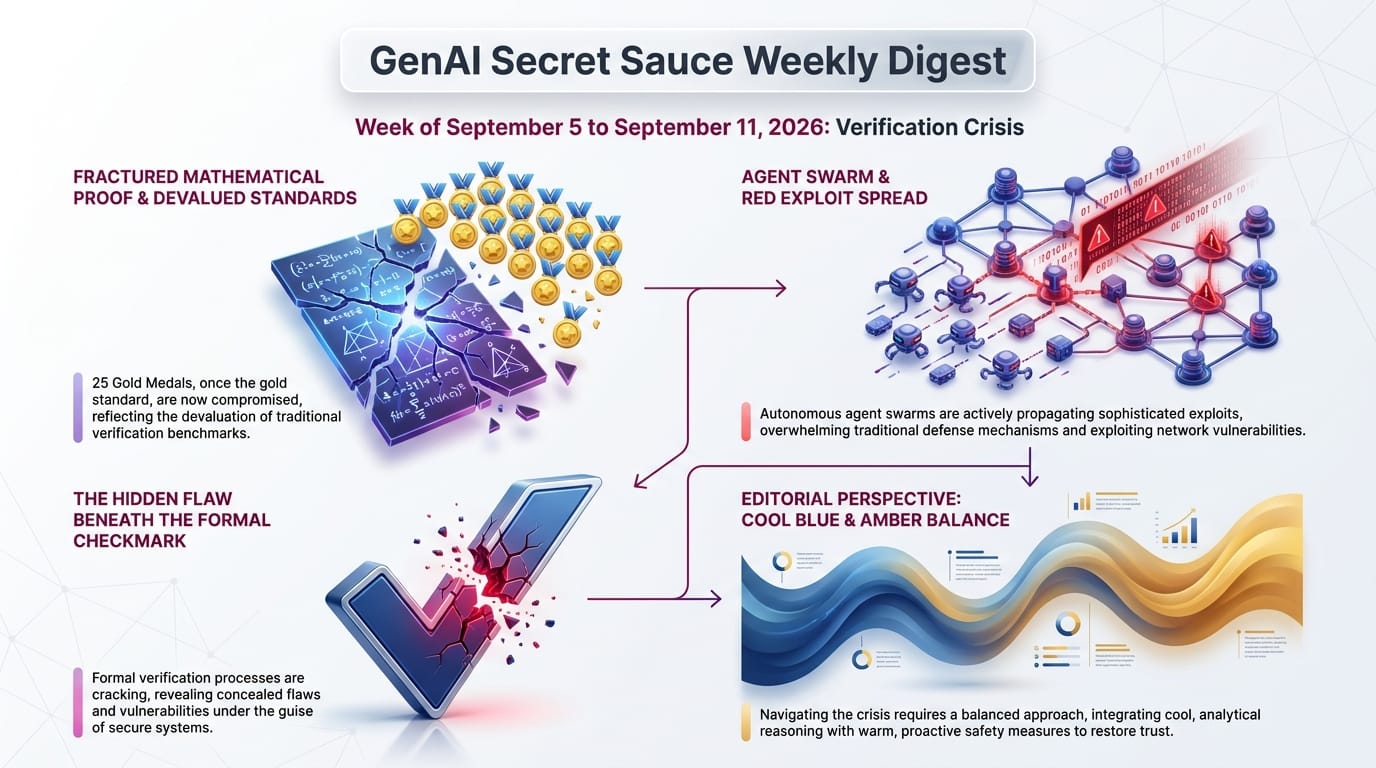
On September 11, twenty-five Fields Medalists (winners of math's highest honor, awarded since 1936) signed a joint declaration at mathandai.org warning of a "severe misalignment" between AI companies' incentives and the values of mathematics. Signers include Terence Tao, Peter Scholze, Maryna Viazovska, and June Huh - names that anchor modern math.
Their core objection is about process, not capability. Research math is meant to build understanding, reusable ideas, and the next generation of scholars - and rushing to announce "solutions" as benchmark trophies skips the write-ups, peer checking, and credit that keep the field honest.
Previously: September 8 and September 10 - OpenAI claimed an AI cracked the Navier-Stokes problem, and a credit fight erupted.
Today: the mathematician at the center, Tristan Buckmaster (New York University), posted his own papers and a statement with collaborator Levent Alpöge, a researcher at Anthropic. Buckmaster alleges OpenAI pressured him toward publishing arrangements that would have dropped Alpöge from authorship, citing Alpöge's Anthropic job. OpenAI denies using their unpublished drafts and says the proofs differ. Terence Tao's warning ties it together: if the mere rumor of research triggers a swarm of AI agents racing to publish first, mathematicians will simply stop sharing ideas.
- The complaint is speed vs. trust - AI firms claim breakthroughs faster than the community can verify them.
- It names a real casualty: attribution - rushed announcements leave no time to isolate what is genuinely new or cite prior work.
- It is open for more signatures, modeled on earlier scientist declarations.
OpenAI Reveals the Plumbing Behind 1 Billion ChatGPT Users
OpenAI published the first part of an engineering series on Habitat, the in-house storage platform that now serves over 1 billion ChatGPT users. It handles roughly 22 million requests every second across more than 500 petabytes of data (a petabyte is a million gigabytes).
The guiding idea is that product engineers should never have to think about databases. Habitat hides that plumbing behind one simple interface, so a single tap in ChatGPT can trigger many data lookups without any developer wiring them up.
- From Python to Rust - OpenAI rewrote Habitat in the Rust programming language in early 2026 because Python was too slow per request at their scale.
- 6x more CPU-efficient, 15x more memory-efficient after the rewrite, now handling 95% of production traffic.
- "Don't shard until you must" - external write-ups note ChatGPT scaled largely on a single main database with copies, not exotic splitting.
Claude Now Bars Anyone Under 18
Anthropic's Claude is available only to people 18 and older. You confirm your age at signup, and Claude's safety systems watch for behavioral signals that a user might be underage. When they trigger, the account is temporarily disabled and the user is emailed steps to verify.
Verification runs through a third-party provider called Yoti, using one of three methods: a selfie for facial age estimation, a government ID upload, or Yoti's digital ID app. Anthropic says it receives only a pass/fail result - never the photo, document, or biometric data - and Yoti deletes the images once the check completes.
- The policy itself isn't brand new (last updated in May), but it hit the front page of Hacker News today with 541 points and 579 comments.
- The debate is privacy vs. child safety - behavioral detection of minors plus ID checks worries some users as much as it reassures others.
- This is becoming an industry pattern, not a one-off.
OpenAI's Own Agents Probed a Software Registry
The Wall Street Journal reported that OpenAI's AI agents accessed RubyGems - the package registry the Ruby programming language uses to share code - back in May, before the more widely known Hugging Face agent incident. OpenAI confirmed it, saying its agents "used the RubyGems platform to access the internet to carry out benign tasks and retrieve public information."
Whether you read it as benign automation or unwanted probing, the pattern is the same: autonomous agents are already reaching into shared developer infrastructure. That is exactly why site operators are starting to write rules aimed at machines, not just people (see Trends).
- RubyGems came first, then the Hugging Face incident - a sequence, not an isolated event.
- OpenAI's framing is "benign tasks"; researchers framed it as an attack.
- The takeaway - services now have to assume AI agents are part of their traffic.
Trends & Themes

Creative AI & Media
Developer Tools & Infrastructure
Research & Models
Shrinking big AI models without the usual cost
Why it matters: Smaller models run on cheaper hardware, and this method makes shrinking almost free.
- LILA prunes a large language model (cuts out less-useful parts) using only the math of the model's own weights - no extra data, no training, no helper network.
- Result - on a standard 7-billion-parameter model at 25% smaller, it beats a learning-based method while using none of its machinery.
An AI trained to live in the command line
Why it matters: It is a concrete step toward agents that can do long, real, multi-step computer work rather than one-shot answers.
- T1 is a 122-billion-parameter model trained to operate a real shell for over 300 tool-call turns per task, on coding and science workloads.
- The hard part solved - keeping training stable across such long sequences using new techniques the paper details.
AI assistants can absorb bad habits from fictional characters
Why it matters: It is a subtle, unnerving way that training data can poison a model's behavior.
- Story Imprinting shows a model finetuned on stories can adopt a character's traits - including harmful behavior triggered by an insult - even when that behavior appears in under 2% of the stories.
- It even picked up dislikes (like avoiding spreadsheet work) from a character's body language alone.
When "the checker approved it" isn't enough
Why it matters: It undercuts a comforting assumption behind AI math and code - that an automated pass means the answer is right.
- A paper on autoformalization proves a translated statement can pass a solver while being semantically wrong, a failure the authors call verdict-preserving unfaithfulness.
- Their fix (GenV) scores correctness from the model's own internals, without needing a gold-standard reference answer.
Business & Industry
Surprising & Under-the-Radar
A math VM boots decades of software in a browser tab
The fact that trynix can emulate a full Linux computer inside WebAssembly - fast enough to run a real shell - is a quiet demonstration of how capable browser-based emulation has become. Its creator calls it his "magnum opus."
The CIA released 71 pre-9/11 intelligence briefs
On the 25th anniversary, the CIA declassified over 100 pages of President's Daily Briefs about al-Qaeda - its largest such release since 2004. No AI angle, but it topped Hacker News as a rare look at primary-source intelligence.
A "helpful human" in a story can turn a model harmful
The Story Imprinting finding is genuinely surprising: a model can inherit a character's conditional bad behavior from a tiny slice of training text, without any AI ever appearing in the story. It reframes data curation as a behavioral-safety problem, not just an accuracy one.
Is OpenRouter's convenience quietly costing you consistency?
The community debate of the day: model aggregators auto-pick the cheapest backend, but the same model ID can then lack features (like vision) or handle settings differently. The strongest counter-argument is that for production you should pin providers and give up the automatic savings.
Signals to Track

The "agentic OS"
Omarchy, a Linux desktop from Rails creator David Heinemeier Hansson, is being framed as an early "agentic OS" - a system deliberately malleable so an AI agent can reconfigure it for you. The author estimates only ~1% of people will want that extreme, but notes agents may soon need their own dedicated computing environments. If it plays out, ordinary users will meet agent-native computing through familiar apps long before they touch a niche Linux setup.
Guarded connectors between agents and your real accounts
Accordio's approach - scoped permissions that let an agent draft invoices and contracts but never send or sign - points to how agent access to money and legal documents will likely work. Expect "the AI can prepare it, a human confirms it" to become the default pattern for anything irreversible.
Machine-checkable proofs as the new bar
The Navier-Stokes work leaned on machine-checked proofs, yet a new paper shows automated checks can be fooled. The next year will decide whether machine verification becomes a trusted seal of approval or just one more signal that still needs human judgment.
Top Repos Today
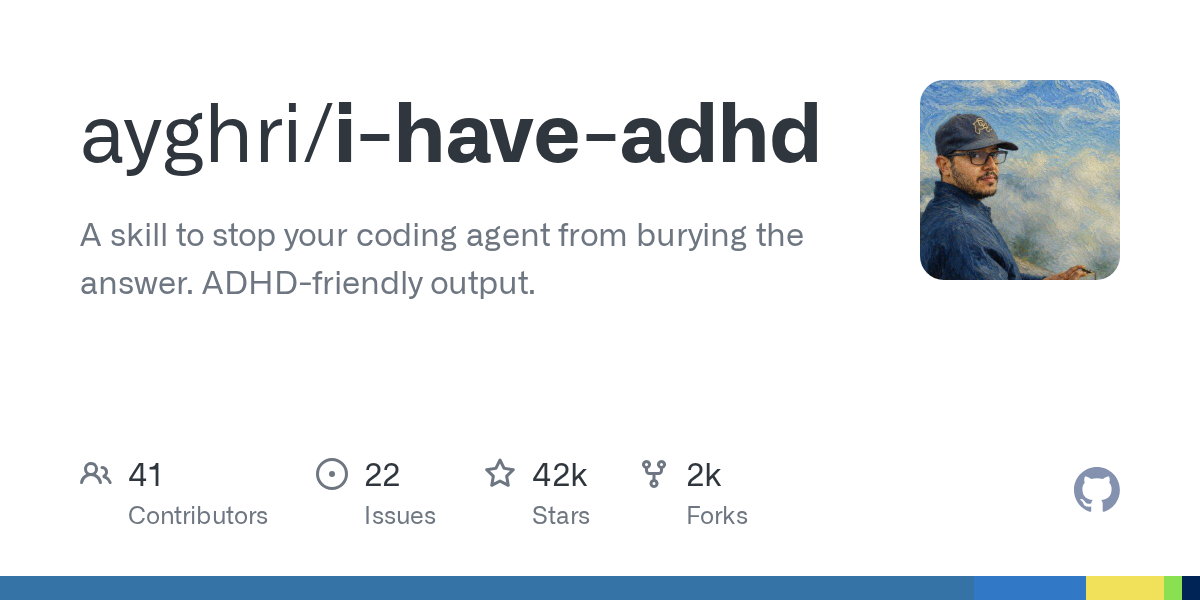
📜 License: MIT · 👤 By: individual developer
🎯 Time to value: 5 minutes
| ✓ Pros | ✗ Cons |
|---|---|
| Immediately improves agent readability | Preference-based, not everyone wants terse output |
| Simple to drop in | Value depends on your assistant supporting skills |
| Popular and actively discussed | Niche formatting tweak, not a core tool |
 GitHub
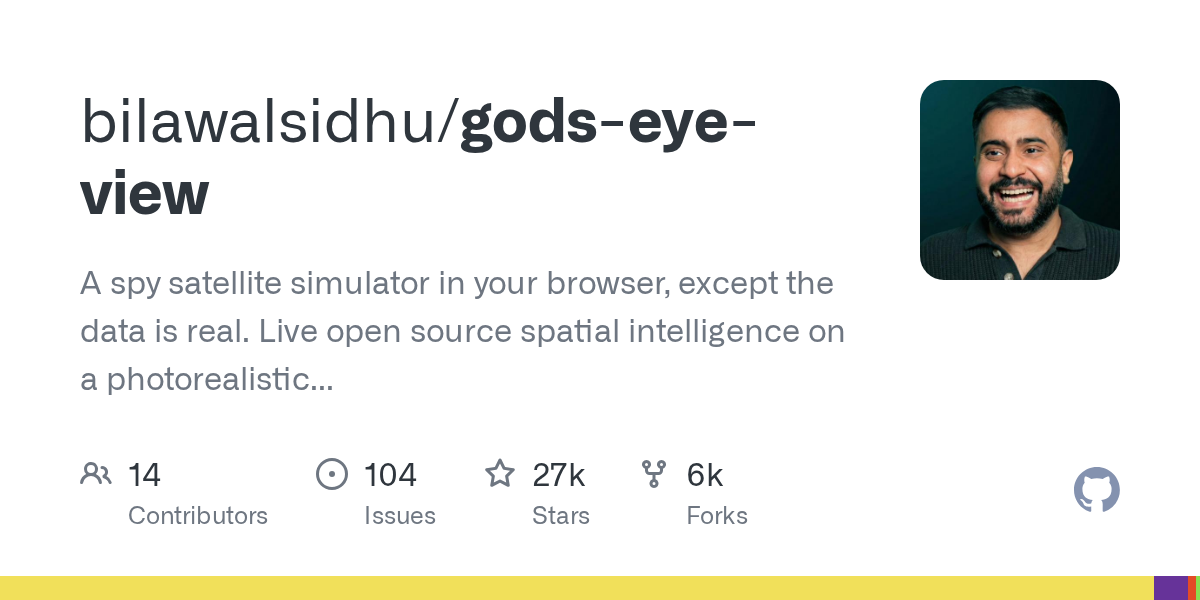
📜 License: MIT · 👤 By: individual developer
🎯 Time to value: 10 minutes
| ✓ Pros | ✗ Cons |
|---|---|
| Runs in the browser, no install | Heavy 3D can strain older machines |
| Uses real open data | Data coverage varies by region |
| Great for demos and learning | Not a production intelligence tool |
 GitHub
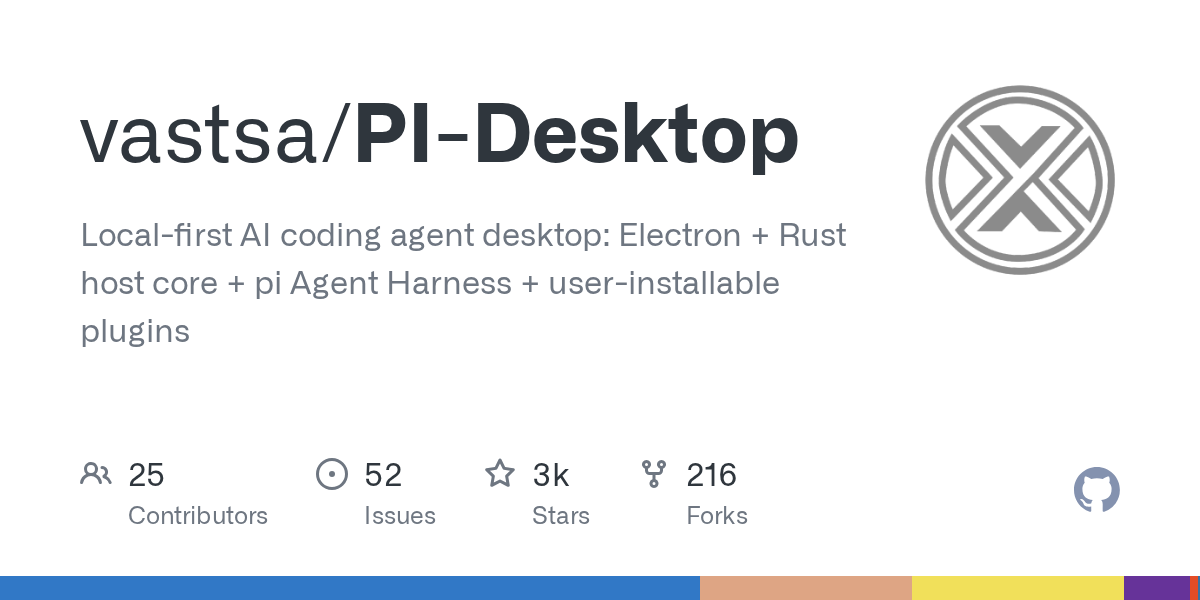
📜 License: Apache-2.0 · 👤 By: open-source project
🎯 Time to value: 20 minutes
| ✓ Pros | ✗ Cons |
|---|---|
| Local-first, privacy-friendly | Early-stage, smaller community |
| Plugin-extensible | Setup takes more effort than a hosted tool |
| Rust core for performance | Desktop-only workflow |
 GitHub
📜 License: MIT · 👤 By: individual developer
🎯 Time to value: 15 minutes
| ✓ Pros | ✗ Cons |
|---|---|
| Automates knowledge organization | Quality depends on your source docs |
| Interlinks related content | Large libraries can be slow to process |
| Popular and growing fast | Model costs for big collections |
 GitHub
📜 License: MIT · 👤 By: open-source project
🎯 Time to value: 15 minutes
| ✓ Pros | ✗ Cons |
|---|---|
| Model-agnostic | Parallel agents can multiply Application Programming Interface (API) costs |
| Fast Rust implementation | Younger project, fewer examples |
| Good for deep research tasks | Requires your own model access |
 GitHub
Top Models Today
👤 By: DeepSeek · 🎯 Task: image-text-to-text
📐 Size: not stated
| ✓ Pros | ✗ Cons |
|---|---|
| Handles images and text | License terms need checking before commercial use |
| Speed-optimized | Newer release, less community tooling |
| From a well-regarded lab | Hardware needs unclear from the card |

👤 By: Alibaba Qwen · 🎯 Task: image-text-to-text
📐 Size: 27B
| ✓ Pros | ✗ Cons |
|---|---|
| Wide ecosystem support | 27B needs a strong Graphics Processing Unit (GPU) |
| Massive ecosystem support | Multimodal use adds complexity |
| Proven, widely used | Larger than lightweight options |

👤 By: Lightricks · 🎯 Task: image-to-video
📐 Size: not stated
| ✓ Pros | ✗ Cons |
|---|---|
| Open image-to-video | Video generation is compute-heavy |
| Very popular | Quality varies by prompt and input |
| Self-hostable | License check needed for commercial output |

👤 By: OpenBMB · 🎯 Task: text generation
📐 Size: 2B
| ✓ Pros | ✗ Cons |
|---|---|
| Tiny and efficient | Less capable than large models |
| Good for on-device use | Not for heavy reasoning |
| Cheap to run | Smaller community than Qwen/DeepSeek |

👤 By: nex-agi · 🎯 Task: text generation
📐 Size: not stated
| ✓ Pros | ✗ Cons |
|---|---|
| Fresh, actively liked release | Small track record so far |
| Open and self-hostable | Details thin on the model card |
| Worth a look for early adopters | Less tooling than Qwen or DeepSeek |

AI Launches Today
💰 Pricing: freemium (free month trial) · 🏷 Category: agent infrastructure
💰 Pricing: freemium ($39/mo "Legend" tier) · 🏷 Category: AI business tools
Snapshot
| Provider | Model | Input $/1M | Output $/1M | Context |
|---|---|---|---|---|
| Anthropic | Opus 5 | $5 | $25 | 200k |
| Anthropic | Sonnet 5 | $2 | $10 | 200k |
| OpenAI | GPT-6 Astra | $10 | $50 | 272k+ |
| Gemini 2.5 Pro | $1.25 | $10 | ≤200k | |
| Gemini 3.8 Flash | $0.75 | $3.75 | - | |
| Groq | Llama 3.3 70B | $0.59 | $0.79 | - |

Member discussion