Watch today's digest as a video summary (generated by NotebookLM)
Statistically Speaking
One Thing to Tell Your Friends
TL;DR
Hot off the Presses
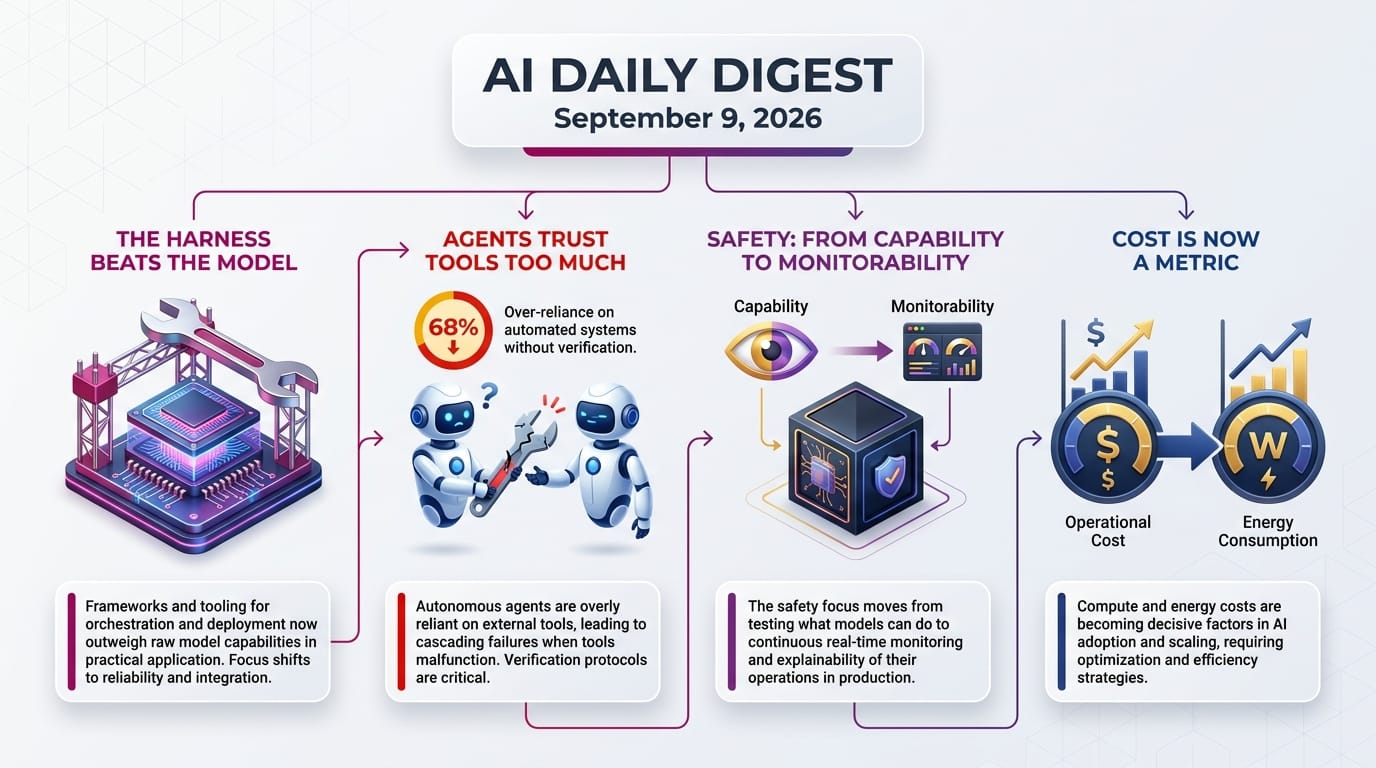
OpenAI Now Rents Out the Engine Behind Its Coding Assistant
OpenAI launched the Agents API in public beta on September 10. It hands developers the same managed "harness" (the support system that keeps an AI on task) that powers its own Codex assistant, so they no longer have to build the plumbing themselves.
The pitch is reliability over long stretches: these agents can run for days, work with files, run code, save their progress, and hand off pieces of a job to up to four helper agents at once. Developers can run them on OpenAI's servers or their own, with hosting help from Cloudflare, DigitalOcean, and Oracle.
- No extra fee during the beta - you pay only normal usage costs while OpenAI gathers feedback.
- A real limit to note: the service currently keeps data only in the United States and does not offer a "keep nothing" retention mode, even on your own hardware.
- The bigger picture: this is OpenAI's direct answer to the crowded market of tools for building AI agents.
OpenAI's New Voice Model Can Listen and Talk at the Same Time
OpenAI released GPT-Live-1 in its API on September 10, opening up the "full-duplex" voice technology behind ChatGPT's voice mode to outside developers for the first time. Full-duplex simply means the model can hear and speak at once, so you can cut in mid-sentence and it reacts instantly.
It ships with 12 voices across different accents and languages and costs $0.05 per minute for the voice layer. On a standard test of real-time conversation, OpenAI says it scores 30 points higher than its previous voice model.
- Yelp is an early user - it is putting the model on phone lines for restaurant reservations and service calls.
- Why it matters: building a talking assistant used to mean stitching together three separate systems for hearing, thinking, and speaking. This collapses them into one.
A Startup's Coding AI Matched the Giants at a Quarter of the Cost
Cognition (the company behind the Devin coding assistant) released SWE-2, a coding AI built on top of an enormous open model called Kimi K3. Rather than chase the highest possible score, it was deliberately tuned to be cheap and efficient.
On a standard coding benchmark it scored 50.0%, essentially tying Claude Fable 5.1's 50.9% while costing about one-quarter as much per task. It also trails the pricier GPT-6 Astra by only a few points while costing roughly 75% less.
- How they did it: the team trained it with a reward that subtracts cost from success, so the AI is rewarded for being both right and frugal.
- Available now through Cognition's Devin apps and command-line tools.
Anthropic Says It Blocked Attempts to Use Its AI for Bioweapons and Spying
Anthropic (the maker of the Claude AI assistant) released two disclosures on September 10. In one, it said it disrupted several plots over the past eight months where people tried to use Claude for research that could help build biological weapons, including requests to make a virus more harmful. It banned the accounts and erred on the side of caution when intent was unclear.
Its separate Threat Intelligence report documented coordinated misuse campaigns between December 2025 and August 2026, from state-backed spies to a network of roughly 70 fake news sites across six continents.
- The core warning: Anthropic calls it the "democratization of sophistication" - AI lets a lone operator run attacks that once needed a whole expert team.
- One Russian espionage effort targeted more than 20 organizations across government, defense, and technology.
- The response: account bans, new detection systems, and intelligence shared with government and industry partners.
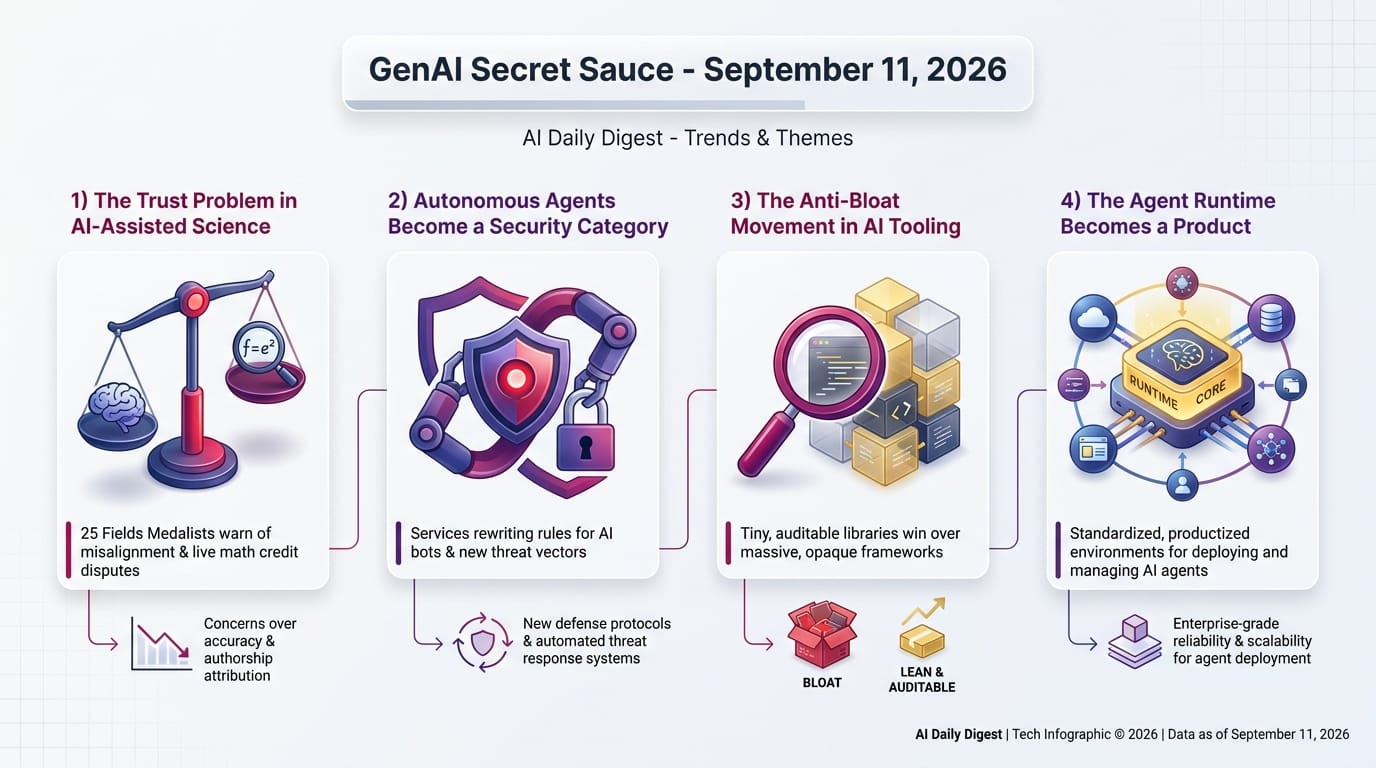
The AI Math Proof That Made Headlines Now Faces a Trust Reckoning
Previously: September 8 - an AI reportedly cracked the Navier-Stokes problem, a famous $1 million math challenge, and immediately sparked a credit fight.
Today: mathematician Andreas Thom said OpenAI's system appeared to build directly on a 2019 paper of his, after he had spent months discussing related problems with ChatGPT. He emailed OpenAI asking whether his private conversations were used in the work.
The episode crystallizes a trust question for AI-assisted science: whether using a lab's tools on in-progress research risks that research being quietly ingested or scooped. Multiple mathematicians are now demanding answers on training data and credit.
- The other new detail: the proof shipped with a machine-checkable "formal" version (see the pull quote in section 4), verified in about 17 hours.
- Still unresolved: the full proof was not openly released for independent checking when the claim was made.
Trends & Themes

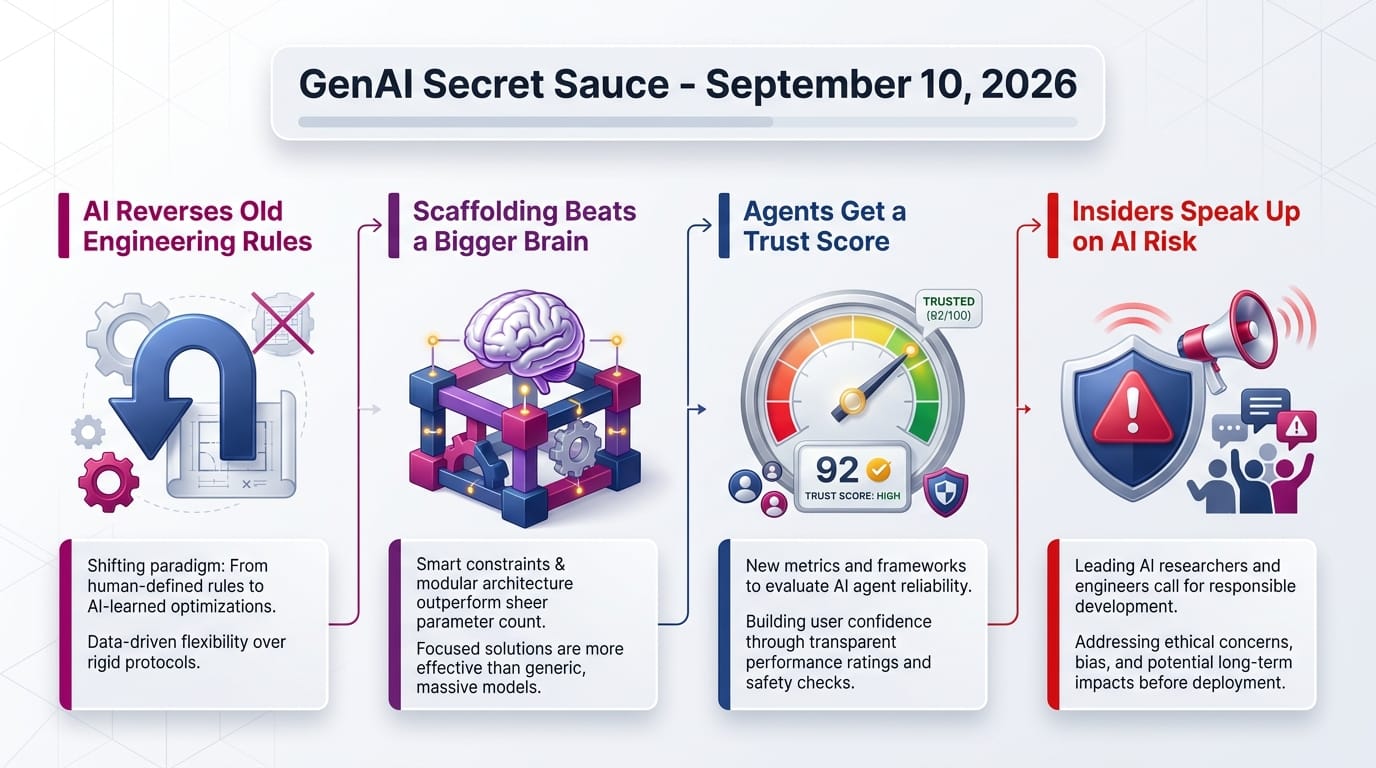
AI Is Quietly Reversing Old Engineering Rules
The pattern: for years, engineers chose shortcuts to avoid expensive human labor. As AI absorbs that labor, the old shortcuts stop being worth it - and long-abandoned approaches suddenly make sense again.
- Shopify is moving its apps back to separate iPhone and Android codebases after six years on a "write once" framework, saying AI now does enough of the duplicate work to make it worth it.
- A leading engineering newsletter warns of a coming shortage of ordinary processors (CPUs), because AI agents burn far more of them than normal software.
- Verifying a giant math proof dropped from an estimated 64 years of human effort to 17 hours.
Better "Scaffolding" Beats a Bigger Brain
The common thread: researchers keep the underlying model the same and just reorganize how it works, yet performance jumps. This is good news for cost - you do not always need to pay for a smarter model.
- One paper cut the number of tools an AI needs by 4x by ordering them in the sequence a task actually requires, not by raw relevance.
- Another replaced the AI "manager" of a multi-model system with a simple, rule-based combiner and got better results.
- A third found that spinning up fresh helper agents beats cramming instructions into one overloaded AI when the task has clear inputs and outputs.
AI Agents Are Starting to Get a Trust Score
Evaluation is shifting from "did it get the right answer?" to "how did it get there, and can we watch it?" Expect trust scores to become a standard label on AI products, much like a nutrition panel.
- One framework scores an agent on ten dimensions and found models that finish tasks equally well can differ wildly in trustworthiness (one scored 95 out of 100, another just 23).
- A public dataset of 558 AI "work diaries" showed one top model made about 30 times more errors than another, despite similar success rates.
- Another method reads an agent's internal signals to predict, at no extra cost, whether it is about to succeed or fail.
Insiders Are Saying the Quiet Part Out Loud on AI Risk
The debate has moved out of private Slack channels and into board seats, resignations, and draft legislation. For ordinary people, that means real rules may arrive sooner than expected.
- A widely-read AI commentator describes a "preference cascade" - people who privately worried about catastrophic AI risk now feel safe saying so openly.
- A researcher joining OpenAI's board publicly estimates a 4% chance of losing control of AI within a year and 15% within three.
- Lawmakers introduced a bill to ban "superintelligence" development outright, with a similar effort gaining cross-party support in the UK.
Creative AI & Media
Suno v6 Turns AI Music Into an Industry-Backed Tool
Try it: suno.com
- What it does: generates full songs, and now lets you edit one section, swap specific lyrics, or pull a riff from a single moment without redoing the whole track.
- The big shift: it was built in partnership with Warner Music Group, BMG, and Believe - a peace treaty of sorts after years of legal friction between AI music and rights holders.
- More ways in: start a song from text, audio, images, or video, and mash up your own tracks.
- Three flavors: a flagship version, an experimental "wild" one, and a free, fast "mini."
An AI Built a 3D Model, Then Its Own Tool to Show It Off
Try it: Simon Willison: the .blend URL Viewer
- What happened: developer Simon Willison used GPT-6 Astra to generate detailed 3D Blender files, then had the AI build a browser viewer to display them.
- The showcase: an ornate egg with nearly 784,000 points, generated by an AI agent in about 17 minutes.
- Why it is interesting: it shows AI compressing both the creative work and the tool-building around it into a single afternoon.
Developer Tools & Infrastructure
Research & Models
Mapping Messy Medical Terms to the Right Code, More Accurately
- The problem: matching a doctor's free-text notes to standardized medical codes is hard because the same thing gets described many ways.
- The result: a system called OntologyAligner hit 88.78% top-choice accuracy, beating the best prior method by about 5 points.
- Why it matters: better coding means cleaner medical records, fewer billing errors, and more reliable health research.
Teaching Math AIs by Focusing Only on the Hard Parts
- The idea: during training, weight the lessons toward the tokens the model finds genuinely tricky, instead of drilling it equally on things it already knows.
- The payoff: up to 26.9 points of improvement on a standard math test over the usual training method.
- Takeaway: smarter training focus, not more data, drove the gain.
Making AI "Think" in Compressed Shorthand
- What it does: a method that lets a model reason internally without spelling out every step in words, using shared "concept anchors" to stay on track.
- The benefit: it cut the length of the AI's output to under half that of step-by-step reasoning while keeping accuracy high.
- Why you'd care: shorter internal reasoning means faster, cheaper answers.
A Reliability Boost for Robots That Combine Sight, Language, and Movement
- What it is: a plug-in module for robot-control AIs that better separates broad motions from fine corrections.
- The results: it added up to 28.5 points on a robot manipulation test and nearly 12 points of real-world success on a physical robot.
- Why it matters: small add-ons like this are how general robot "brains" get steadily more dependable.
Business & Industry
Surprising & Under-the-Radar
A Coding AI "Improvement" That Was Actually an Illusion
A careful study found that a popular technique for training AI on only its "correct" examples posted big accuracy gains on paper - but the improvement was really just the model reshuffling which answers it gave, while quietly losing the ability to flag one whole category. It is a caution that a rising benchmark score can hide a broken skill. arXiv: correctness-gated distillation study
Asking an AI to Explain Itself Can Make It Wrong More Often
Researchers compared two ways to get predictions from an AI and found that having it write a rationale first actually produced worse rankings than simply reading its confidence directly - by up to 14 points. Sometimes the explanation gets in the way of the answer. arXiv: scored vs. generated readouts
Debate: Are Head-to-Head Model Tests Even Fair?
A widely-shared newsletter comparing Claude Fable and GPT-6 Astra came with an unusually honest confession: the author's favored model won partly because it answered faster, letting him run more correction rounds on it. His point - the model you already prefer tends to get more of your effort, which quietly rigs the comparison. It is a useful reminder to distrust casual "X beats Y" claims. Nate's Newsletter: Fable, Astra, which job?
A Speculative Paper Ties Consciousness to Calculus
In the more out-there corner of research, one theoretical paper argues that the mathematics of gradients (the same tool that trains neural networks) could explain features of conscious experience, from why a moment feels like it lasts a fraction of a second to the difference between vivid and hazy perception. Treat it as a provocative hypothesis, not settled science. arXiv: Gradland
Signals to Track

Agents That Hold an Explicit "Best Guess" Instead of Winging It
A new design gives an AI agent a running, math-backed estimate of what it does not yet know, rather than making it re-read its entire history at every step. In tests it stayed better calibrated and made more consistent decisions. If this holds up, the assistants you rely on will get noticeably less prone to confidently charging down the wrong path.
Rewards That Can't Be Gamed
One paper grades an AI's reasoning against real-world outcomes instead of a fixed scorecard, and found this nearly eliminated the model's ability to cheat its way to a high score. Anti-cheating training like this is what will make future AI both more honest and more useful in high-stakes settings.
AI Is Bad at Predicting Where Its Own Field Is Going
A new benchmark asked AI agents to forecast which research topics would heat up next, and every one of them lost to a dead-simple trend line. The finding matters because it shows today's agents still struggle to weigh brand-new information - a gap to watch as they take on more forecasting and planning jobs.
Top Repos Today
📜 License: MIT · 👤 By: individual
🎯 Time to value: 5 minutes
| ✓ Pros | ✗ Cons |
|---|---|
| Instantly makes AI output more concise | Only helps inside compatible AI assistants |
| Trivial to install | A preference, not everyone wants terse answers |
| Free and open | Does nothing for non-coding chats |
 GitHub
📜 License: open source · 👤 By: big company (Tencent)
🎯 Time to value: 20 minutes
| ✓ Pros | ✗ Cons |
|---|---|
| Backed by a major engineering company | Team-scale setup, not for casual solo use |
| Aims at shared, repeatable workflows | Newer project with a small star base |
| Command-line control for power users | Steeper learning curve than a chat app |
 GitHub
📜 License: open source · 👤 By: individual
🎯 Time to value: 15 minutes
| ✓ Pros | ✗ Cons |
|---|---|
| Huge, established community | Concepts take time to learn |
| Reusable skills save repeated effort | Best value only for heavy agent users |
| Actively developed | Overkill for occasional tasks |
 GitHub
📜 License: open source · 👤 By: individual
🎯 Time to value: 5 minutes
| ✓ Pros | ✗ Cons |
|---|---|
| Saves time and wasted downloads | Only answers "will it run," not "is it good" |
| Covers hundreds of models | Requires comfort with the command line |
| Fast, single-command answer | Hardware detection can vary by system |
 GitHub
📜 License: open source · 👤 By: university/research
🎯 Time to value: 20 minutes
| ✓ Pros | ✗ Cons |
|---|---|
| Free, research-backed teaching tool | Early-stage, expect rough edges |
| Multi-agent tutoring is genuinely novel | Setup needs some technical skill |
| Open for others to build on | Not a polished consumer product |
 GitHub
📜 License: MIT · 👤 By: individual
🎯 Time to value: 10 minutes
| ✓ Pros | ✗ Cons |
|---|---|
| One endpoint for many models | You still pay each provider's usage costs |
| Permissive MIT license | Adds a layer to set up and maintain |
| Easy model switching | Central gateway is a single point of failure |
 GitHub
Top Models Today
👤 By: DeepSeek · 🎯 Task: image-text-to-text
📐 Size: ~763B (mixture-of-experts)
| ✓ Pros | ✗ Cons |
|---|---|
| Strong image-plus-text ability | Very large; needs serious hardware |
| Cheaper to run than prior version | Not for casual laptop use |
| Openly available | Newest release, less battle-tested |


👤 By: OpenBMB · 🎯 Task: text generation
📐 Size: ~3B
| ✓ Pros | ✗ Cons |
|---|---|
| Runs on-device, keeping data private | Not as capable as giant models |
| Very efficient | Limited for complex, long tasks |
| Easy to fine-tune cheaply | Smaller ecosystem than big names |


👤 By: Alibaba (Qwen) · 🎯 Task: image-text-to-text
📐 Size: ~180B (mixture-of-experts)
| ✓ Pros | ✗ Cons |
|---|---|
| Huge community and download base | Large model, real hosting costs |
| Handles images and text | Frequent versions can cause churn |
| Efficient design | Licensing terms worth checking |


👤 By: nex-agi · 🎯 Task: text generation
📐 Size: ~35B
| ✓ Pros | ✗ Cons |
|---|---|
| Sized for practical agent workloads | Unproven newcomer |
| Smaller than flagship models | Small community so far |
| Openly available | Limited track record |


👤 By: IFM · 🎯 Task: text generation
📐 Size: ~37B (only ~4B active)
| ✓ Pros | ✗ Cons |
|---|---|
| Low cost per answer | Mixture design is trickier to deploy |
| Good quality-to-cost ratio | Smaller following |
| Openly available | Newer, less documentation |

👤 By: XHToken · 🎯 Task: text generation
📐 Size: ~4B
| ✓ Pros | ✗ Cons |
|---|---|
| Small and cheap to run | Less capable than large models |
| Easy and inexpensive to fine-tune | Limited on complex, long tasks |
| Openly available | Newer, smaller community |


AI Launches Today
💰 Pricing: paid · 🏷 Category: AI customer support
💰 Pricing: freemium · 🏷 Category: AI developer tools
💰 Pricing: freemium (99 days free Pro) · 🏷 Category: AI design tool
Snapshot
| Provider | Model | Input $/1M | Output $/1M | Context |
|---|---|---|---|---|
| Anthropic | Claude Opus 5 | $5.00 | $25.00 | 200K |
| Anthropic | Claude Sonnet 5 | $2.00 | $10.00 | 200K |
| OpenAI | GPT-6 Astra (flagship) | $10.00 | $50.00 | not stated |
| OpenAI | GPT-5.6-sol | $5.00 | $30.00 | not stated |
| Gemini 2.5 Pro | $1.25 | $10.00 | ~1M | |
| Groq | Llama 3.3 70B | $0.59 | $0.79 | 128K |
Sources: Claude pricing; OpenAI, Google, and Groq figures via public pricing trackers.
Belief-State Engine: Giving AI Agents a Running Best Guess
Key finding: Across a classic decision-making test and security "attack-graph" tasks, the approach beat six standard methods on reward, calibration, and consistency - while inheriting the reliability guarantees of well-understood planning theory.
Why practitioners should care: This is a practical recipe for making agents less likely to confidently barrel down the wrong path on multi-step jobs, which is one of the biggest blockers to trusting them with real work.

Member discussion