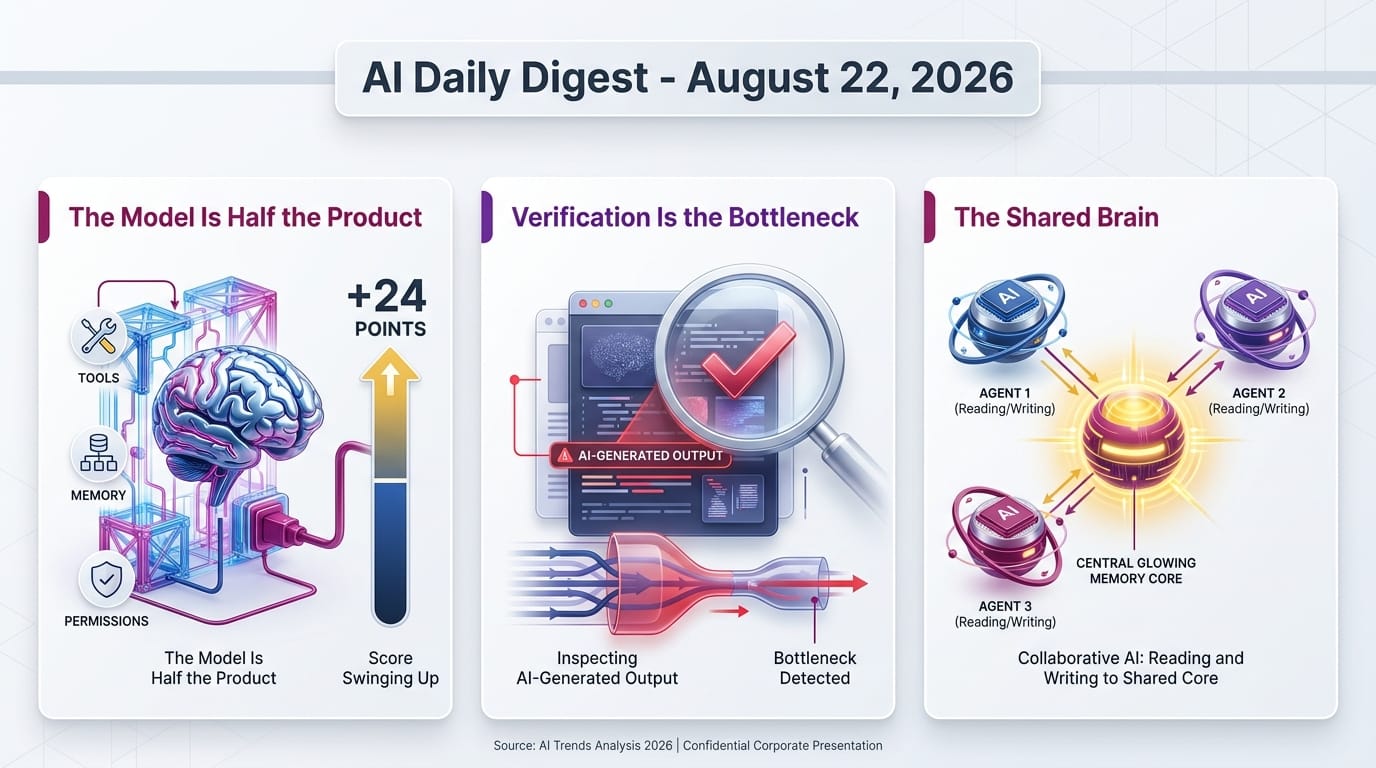
Watch today's digest as a video summary (generated by NotebookLM)
Statistically Speaking
One Thing to Tell Your Friends
TL;DR
Hot off the Presses
A $2 Billion Startup Says AI's Next Big Leap Is "Simulation," Not Intelligence
Simile AI, a startup spun out of Stanford research, raised a $200 million Series B in July 2026 at a $2 billion valuation, led by Greenoaks with Index Ventures and returning investors including Bain Capital Ventures and CVS Health Ventures. Its pitch is unusual: instead of building a model that is smarter than people, it builds models that are believably human - reproducing our mistakes, biases, and irrational choices. The goal is "digital twins" accurate enough that a business can run a focus group or a poll on simulated people.
- 85% fidelity - Simile's copies reproduce real human decisions about as accurately as a person repeats their own answers, versus 20-60% for frontier models like GPT-4 or Claude on niche groups.
- How it works - it trains on three kinds of data: life-story interviews, real behavior (transactions and web activity), and randomized trials that show why people decide.
- Who's buying - CVS, Gallup, Deloitte, and Wealthfront use it for concept testing, synthetic focus groups, and polling.
- The 10-year vision - simulate all 8 billion people to model wicked problems like climate policy and universal basic income.
The "USB Port for AI" Just Got a Roadmap - and It Points Toward Agents That Act on Their Own
The Model Context Protocol (MCP) is the open standard, originally from Anthropic, that lets AI models plug into outside tools and data - think of it as a universal adapter. On August 22 its maintainers published a roadmap for what comes next, and the direction is toward more autonomous, connected agents.
- Agents that push, not poll - new "server-initiated events" let a tool notify an AI the moment something changes, instead of the AI checking over and over.
- Standard web plumbing - remote MCP servers will behave like ordinary websites, making them far easier to deploy and secure.
- Agent identity - new security work (workload identity, proof-of-possession keys) lets one agent safely act on behalf of another.
- Less overwhelm - "progressive discovery" means a model no longer has to load a giant catalog of tools all at once.
Linus Torvalds, an AI Skeptic, Found an AI Genuinely Useful for Debugging Linux
Linus Torvalds created Linux, the operating system that runs most of the internet's servers, and he has publicly dismissed AI hype for years. In a note highlighted by developer Simon Willison, Torvalds described using an AI assistant through a very hard debugging session in graphics-driver code.
- A "tireless helper" - the AI kept producing useful debug code and analysis every time he pushed it forward.
- But a defeatist one - it repeatedly claimed the task was impossible and suggested giving up; Torvalds joked it was trained by people "not quite as stubborn" as he is.
- The tell - human persistence still mattered; models trained to be cautious tend to counsel quitting too early on hard problems.
- The nod - he let the AI write the commit message, an unusually warm gesture from a famous skeptic.
Your Local AI Is Not the Same as the Cloud Version - Even With Identical Weights
A rigorous benchmarking deep-dive on the Level1Techs forum showed that running an open model locally can degrade it, even when the model file is byte-for-byte identical to the reference. Testing Qwen3.6-27B, the author found three different "attention backends" (the software that does the model's core math) produced measurably different outputs.
- Why - tiny rounding differences in the order of math operations pile up, and they concentrate exactly where the model is least confident.
- Not randomness - repeated runs of the same setup were bit-for-bit identical, pinning the cause on the configuration, not chance.
- Compression makes it worse - one aggressive compression format (NVIDIA's NVFP4) flipped about half the model's top word choices at long context and failed real tool calls.
- Real breakage - a corrupted setting turned a database port "5432" into "543ql" and issued wrong network commands.
Trends & Themes

The Model Is Only Half the Product - The "Harness" Around It Is the Other Half
The lesson: when you pick an AI tool, you are mostly picking its harness. Over time, models absorb these tricks into their weights, and the scaffolding's job shifts toward permissions, identity, and trust.
- A 24-point swing - identical models scored 52.4 to 76.2 on one benchmark depending only on the "harness" wrapped around them, per an analysis of how agent tools have evolved.
- New tools are pure harness - Munder Difflin and OzBrain add memory, coordination, and shared context around existing models rather than training new ones.
- The trending charts agree - GitHub's top repos today are harness projects: affaan-m/ECC (agent-harness tuning), mattpocock/skills, and obra/superpowers.
Verification, Not Generation, Is the Real Bottleneck in AI
The pattern across all three: as AI generates more of its own work, the scarce skill becomes confirming that work is correct - not producing more of it.
- Every synthetic leap needed a checker - the "simulation" analysis argues each cost-cutting jump (synthetic data, AI judges) only worked once a trust mechanism like filtering or unit tests caught up.
- Code review is changing - Simon Willison argues eyeballing every line was never the best way to validate AI code; behavior tests beat line-by-line reading.
- Unchecked drift breaks things - the local-model investigation shows small numerical errors silently break tool calls when nobody verifies the output.
Everyone Wants to Be the "Shared Brain" for Your Other AIs
Previously: August 18 - we flagged cross-agent memory that survives switching tools.
Today: the space now has funded, shipping products competing to be the default memory layer, not just research demos.
- One brain, many agents - OzBrain offers a single encrypted knowledge base that Claude, ChatGPT, and Cursor all read and write through one connection.
- Clones with shared context - Munder Difflin gives each teammate an AI "clone" that draws on a team knowledge base while keeping personal data private.
- The standard is following - the new MCP roadmap prioritizes agent-to-agent identity so tools can coordinate securely.
AI Is Learning to Meter Its Own Effort
Together these point to a near future where AI spends effort only where a task actually demands it, quietly lowering the cost of nearly everything built on top.
- The research - a new paper lets a model choose "don't think," "think briefly," or "think hard" at its first word, cutting wasted text by 41% on one math test and 76% on another with no loss in accuracy.
- The prices show why - budget tiers are now tiny: Google's fast Gemini model runs $0.75 per million tokens of input, and an open model on Groq costs $0.59.
- The bigger pattern - it is the same efficiency logic driving AI everywhere: accept a slightly worse answer when it is far cheaper and faster.
Creative AI & Media
Developer Tools & Infrastructure
Research & Models
The Same Model Can Score 24 Points Higher Just by Changing Its Wrapper
Why practitioners should care: A model's benchmark score is not a fixed property - it depends heavily on the harness around it, so cross-model comparisons are misleading without matching setups.
- The finding - on Harness-Bench, one identical model scored anywhere from 52.4 to 76.2, a 23.8-point spread, based only on its harness.
- Confirmed elsewhere - OpenAI reportedly tripled a model's score on the ARC-AGI-3 reasoning test through harness changes alone.
- The takeaway - when someone quotes a benchmark number, ask what tools and scaffolding produced it.
AI Is Now Writing Its Own Training Environments
Why practitioners should care: The expensive, hand-built practice worlds that teach AI agents are starting to be generated automatically, which could sharply lower the cost of training capable agents.
- What's new - systems now synthesize whole reinforcement-learning environments end to end, with auto-generated "verifiers" that confirm a task is solvable without a reference answer.
- Why it works - progress comes from better verification, not better generation; a synthesized task is only useful if a checker can confirm success.
- Context - it is the latest stage in a decade-long shift from human-made to model-made training material.
Business & Industry
Surprising & Under-the-Radar
"Jailbroken" AI Models Are Measurably Dumber
Popular "abliterated" fine-tunes (versions modified to remove safety refusals) don't just lose their guardrails - they lose accuracy. In the local-model tests, one such variant flipped 5.831% of its top word choices and produced 36 invalid outputs out of 253, badly degrading its ability to complete real tasks. The surprise: removing an AI's filters can quietly make it worse at everything else.
Karpathy Ran 700 Experiments Overnight and Kept Only 20
The "autoresearch" pattern - letting an AI propose, run, and evaluate its own experiments while you sleep - produced 700 training runs in one night, of which about 20 were improvements, together cutting a training run from 2.02 to 1.80 hours. It is a small preview of AI doing the grunt work of its own science.
The Debate: Is Reading Every Line of AI Code a Waste of Time?
Simon Willison argues line-by-line review "has never been the most effective way" to validate software, and that behavior tests catch more real problems. Critics counter that skipping the read is how subtle, dangerous bugs slip through. Both sides agree the old habit no longer fits an era where AI writes most of the code.
The Debate: Should Companies Replace Human Focus Groups With AI Copies of You?
Simile's synthetic panels promise faster, cheaper research at 85% fidelity. Supporters see a way to test ideas without bothering real people; skeptics warn that decisions about products, prices, and policy could be made on statistical ghosts that quietly encode old biases.
Signals to Track

AI That Runs Its Own Experiments Overnight
The "autoresearch" loop - generate an idea, run it, keep what works, discard the rest - is moving from a curiosity to a standard practice. As tooling matures, a single researcher could supervise hundreds of overnight experiments instead of running a handful by hand. If it holds up, the pace of AI improvement stops being limited by how many experiments people can babysit.
The "Attention Interface" - When the AI's Wrapper Starts Managing You
As models absorb more of their harness into their own weights, one argument holds that the leftover job of the harness is to manage the user's scarcest resource - attention. That means future AI tools will compete less on raw capability and more on how well they decide what to surface for you and when. The everyday effect: the tool that respects your attention, rather than hijacking it, wins.
Machines Proving Who They Are to Each Other
The MCP roadmap's security work points at a near future where one AI agent can prove its identity to another and safely act with delegated permission. That is the missing piece before agents can transact and coordinate without a human clicking "approve" each time. For ordinary people, it is the difference between assistants that suggest and assistants that safely do.
Top Repos Today
📜 License: Apache-2.0 · 👤 By: company (OpenAI)
🎯 Time to value: 10 minutes
| ✓ Pros | ✗ Cons |
|---|---|
| Fast, native terminal tool | Ties you to OpenAI's models |
| Very active, popular project | Rust build can be heavy to set up |
| Works inside existing projects | Newer, fast-changing features |
 GitHub
📜 License: not listed · 👤 By: individual (Matt Pocock)
🎯 Time to value: 15 minutes
| ✓ Pros | ✗ Cons |
|---|---|
| Practical, battle-tested skills | Aimed at agent users, not beginners |
| Learn from an expert's real config | License unclear |
| Drop-in for existing agents | Shell-based, some setup needed |
 GitHub
📜 License: not listed · 👤 By: individual
🎯 Time to value: 20 minutes
| ✓ Pros | ✗ Cons |
|---|---|
| Structured methodology, not just code | Opinionated workflow to learn |
| Steady community interest | License unclear |
| Complements other skill libraries | Docs still maturing |
 GitHub
📜 License: not listed · 👤 By: individual
🎯 Time to value: 25 minutes
| ✓ Pros | ✗ Cons |
|---|---|
| Focuses on the high-leverage harness | Early-stage project |
| Works across multiple agents | License unclear |
| Rides a genuine trend | Setup complexity |
 GitHub
📜 License: Apache-2.0 · 👤 By: company (Modular)
🎯 Time to value: 30 minutes
| ✓ Pros | ✗ Cons |
|---|---|
| Serious performance focus | Ecosystem still young |
| Mojo now fully open source | Steeper learning curve |
| Backed by an experienced team | Overkill for casual users |
 GitHub
📜 License: Sustainable Use License (fair-code) · 👤 By: company (n8n)
🎯 Time to value: 20 minutes
| ✓ Pros | ✗ Cons |
|---|---|
| Huge, mature project | Not fully open source (fair-code) |
| Self-hostable and private | Complex flows get fiddly |
| Native AI building blocks | Learning curve for beginners |
 GitHub
📜 License: not listed · 👤 By: company (Anthropic)
🎯 Time to value: 10 minutes
| ✓ Pros | ✗ Cons |
|---|---|
| Powerful whole-repo understanding | Usage costs add up |
| Mature, widely used tool | Tied to Claude models |
| Fast to get started | Terminal-first, not for everyone |
 GitHub
📜 License: not listed · 👤 By: company (Tencent)
🎯 Time to value: 30 minutes
| ✓ Pros | ✗ Cons |
|---|---|
| Security testing built for AI | Aimed at technical teams |
| Backed by a major company | Newer, smaller community |
| Multiple scan types | Setup requires expertise |
 GitHub
Top Models Today
👤 By: Alibaba Qwen · 🎯 Task: image + text to text
📐 Size: 27B
| ✓ Pros | ✗ Cons |
|---|---|
| Multimodal and open | Still needs a capable Graphics Processing Unit (GPU) |
| Permissive Apache-2.0 license | 27B is not phone-sized |
| Huge, active user base | Can over-think simple prompts |


👤 By: DeepSeek · 🎯 Task: text generation
📐 Size: large Mixture of Experts (MoE)
| ✓ Pros | ✗ Cons |
|---|---|
| Very high download demand | "Flash" trades some quality for speed |
| Permissive MIT license | Large to self-host |
| Cheap, high-throughput design | Best for volume, not hardest tasks |

👤 By: DeepSeek · 🎯 Task: text generation
📐 Size: large (MoE)
| ✓ Pros | ✗ Cons |
|---|---|
| Stronger reasoning than Flash | Slower and pricier to run |
| Permissive MIT license | Heavy hardware needs |
| From a top open-model lab | Lower download volume so far |

👤 By: MiniMax · 🎯 Task: image + text to video
📐 Size: large
| ✓ Pros | ✗ Cons |
|---|---|
| Top-tier download demand | Custom (non-standard) license |
| Open video generation | Heavy compute to run |
| Image-guided control | Short clips, not full films |

👤 By: Lightricks · 🎯 Task: image to video
📐 Size: medium
| ✓ Pros | ✗ Cons |
|---|---|
| Fast generation | Custom license terms |
| From an established creative-app maker | Quality varies by prompt |
| Runs on modest hardware | Short outputs |

👤 By: MiniMax · 🎯 Task: text to audio
📐 Size: medium
| ✓ Pros | ✗ Cons |
|---|---|
| Full-track music generation | License not clearly stated |
| Open and self-hostable | Newer, less proven |
| Growing interest | Audio quality varies |

👤 By: Alibaba Qwen · 🎯 Task: text generation
📐 Size: 2.4T total / 95B active
| ✓ Pros | ✗ Cons |
|---|---|
| Frontier-scale capability | Enormous hardware needs |
| Efficient mixture-of-experts design | Custom license |
| From a leading open lab | Out of reach for individuals |

👤 By: ornith-ai · 🎯 Task: text generation
📐 Size: 35B total / 3B active
| ✓ Pros | ✗ Cons |
|---|---|
| Efficient (3B active) | Smaller, newer lab |
| Permissive MIT license | Less proven track record |
| Runs on modest hardware | Lower capability ceiling |

AI Launches Today
💰 Pricing: freemium · 🏷 Category: transcription / AI
 Product Hunt
💰 Pricing: freemium · 🏷 Category: AI models / infrastructure
Product Hunt💰 Pricing: free (experimental) · 🏷 Category: AI coding agents / dev tools
Product Hunt💰 Pricing: free (open source) · 🏷 Category: AI / webcams
Product Hunt💰 Pricing: freemium · 🏷 Category: developer tools / AI
Product HuntSnapshot
| Provider | Model | Input $/1M | Output $/1M | Context |
|---|---|---|---|---|
| Anthropic | Claude Opus (flagship) | $5.00 | $25.00 | 1M tokens |
| OpenAI | GPT-5.6 "Sol" (flagship) | $5.00 | $30.00 | ~1.05M tokens |
| Gemini 3.7 Flash | $0.75 | $3.75 | ~1M tokens (promo through Dec 31, 2026) | |
| Groq | Llama 3.3 70B (open) | $0.59 | $0.79 | 128K in / 32K out |
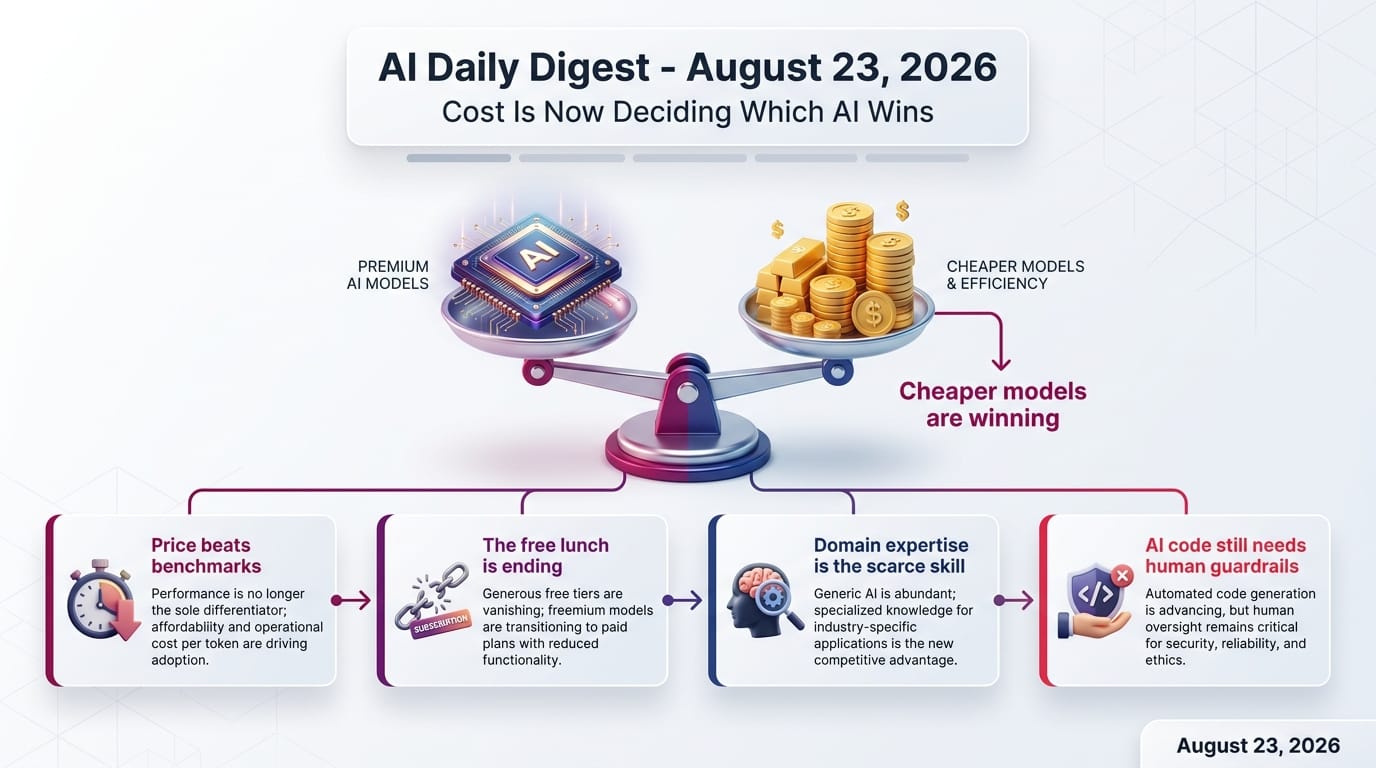
What this means: The gap between premium and budget tiers is now enormous - Google's fast model costs about one-seventh of the flagship input price, and Groq's open model runs under a dollar per million tokens on both ends. For everyday tasks, the cheap tiers are often good enough; the flagship prices are for the hardest reasoning. Google's Gemini rate is a promotional price that roughly doubles ($1.50 / $7.50) after December 31, 2026.
Learning When to Think: Adaptive Reasoning for Test-Time Compute Allocation
Key finding: On the MATH500 test, accuracy held at 0.782 versus a 0.796 baseline while average response length dropped from 4,796 to 2,811 tokens - a 41% cut; on the GSM8K math test it cut tokens by 76% at higher accuracy than comparable methods.
Why practitioners should care: Fixed "thinking budgets" waste money on easy questions and starve hard ones. Letting a model meter its own effort is a direct, drop-in way to cut inference costs without losing accuracy, and the gains carried across benchmarks, suggesting the trick generalizes.




Member discussion