GenAI Secret Sauce Daily Digest - 2026-08-17

Investigators Put an AirTag in a Book to Track Where Amazon's AI Gets Its Data · OpenAI Is Building an 8-Gigawatt AI Site on an Old Uranium Plant - and Giving Ohio Students $84M in Credits · "AI;DR" - The Backlash Against Unedited AI Content Just Went Mainstream
GenAI Secret Sauce Daily Digest - 2026-08-17

Watch today's digest as a video summary (generated by NotebookLM)

Statistically Speaking

1,000 books were bought in a single anonymous
Investigators Put an AirTag in a Book to Track Where Amazon'
Top Story
35,000 construction jobs and ~2,500 long
OpenAI Is Building an 8-Gigawatt AI Site on an Old Uranium P
$84 million in Codex credits (OpenAI's AI coding
OpenAI Is Building an 8-Gigawatt AI Site on an Old Uranium P
470 points and 288 comments on Hacker News
"AI;DR" - The Backlash Against Unedited AI Content Just Went
21 x in one project and 17
Bots Did Not Take Over Open Source - Humans Just Got 20x Fas
0.2% of that growth
Bots Did Not Take Over Open Source - Humans Just Got 20x Fas

One Thing to Tell Your Friends

Investigators hid an Apple AirTag inside a rare book to find out where Amazon's anonymous bulk book orders were going - and it led to a warehouse where books are cut apart and scanned to train AI.

TL;DR

Trends
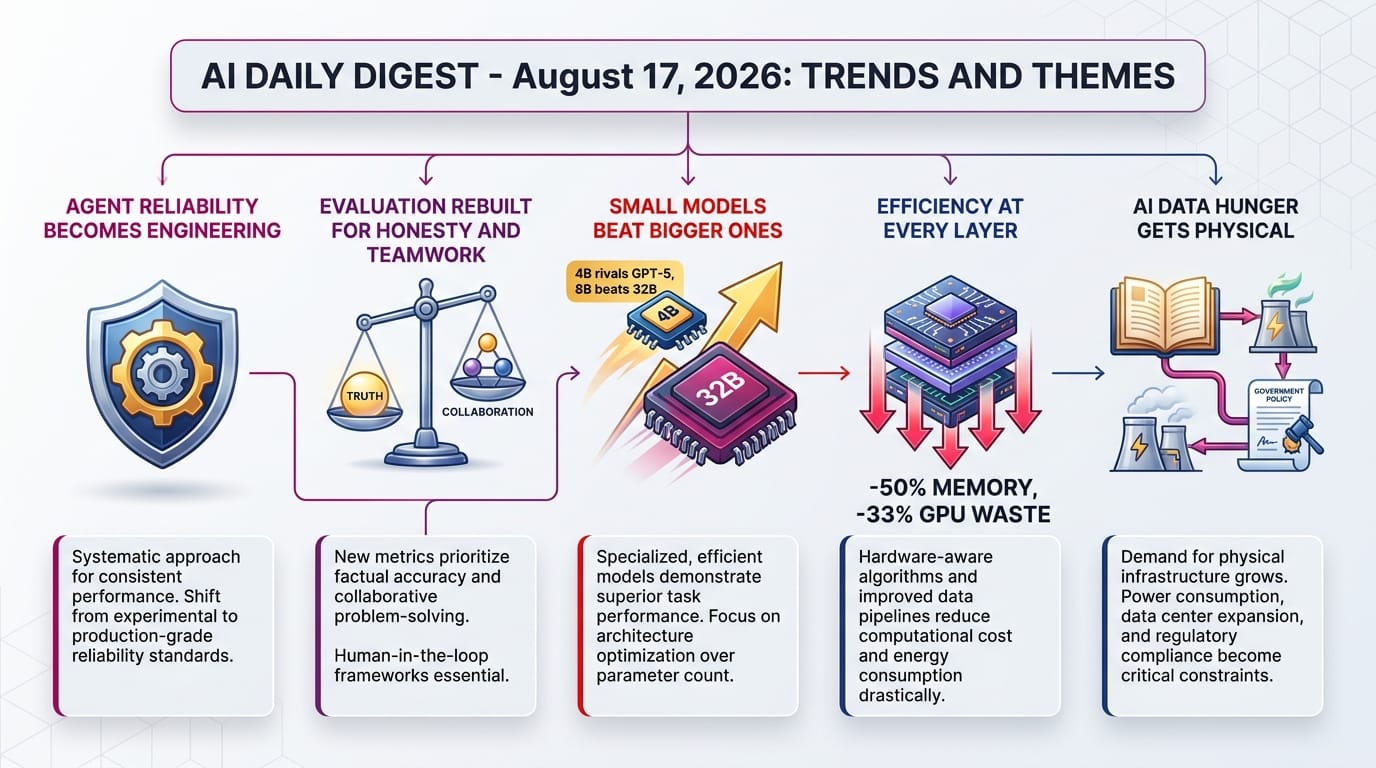
Agent Reliability Is Becoming an Engineering Discipline, Not a Model Property, Evaluation Is Being Rebuilt to Reward Honesty and Teamwork, Not Just Winning, and Small Models Keep Beating Much Bigger Ones.
Creative AI
Turn an Animated SVG Into a Video and An AI Judge for Whether Images Get a Culture Right.
Dev Tools
Speko and The Ordering Insight Behind Cheaper GPU Clusters.
Research
Agents Can Think During Their "Dead Time", GPT-5.6 "Sol" Is OpenAI's Best Vision Model, and Reasoning Models Often Know the Answer.
Business
OpenAI Floats "New Deal" and AI Compute Keeps Getting Financed Like Real Estate.
Surprising
There Is Now a Step-by, How a Voice Sounds Changed an AI's Judgment of Your Salary, and Two GPU Programs That Do "The Same Math" Never Agree.
Worth Watching
"Recoverable" Agents That Undo Their Own Mistakes, A Local Model That Acts as a Privacy Firewall for the Cloud, and Live Benchmarks That Refuse to Go Stale.
GitHub
Leading repos: harry0703/MoneyPrinterTurbo (+1,275), usestrix/strix (+656), and AlexsJones/llmfit (+239).
Product Hunt
Top launches: Framer AI Agents (888), Meridian (327), and Omni by xpander (284).
API Pricing
What this means: Google and Groq remain the value plays for high-volume work, undercutting the frontier flagships several times over on both input and output.
arXiv
AgentRewind: Recoverable Execution for Long — Recoverable execution substantially improves task completion on long-horizon benchmarks by preventing a single mid-run error from cascading into total failure.

Hot off the Presses

01

Investigators Put an AirTag in a Book to Track Where Amazon's AI Gets Its Data

What this means for you: The physical books being bought, sliced apart, and scanned to train AI may include out-of-print works that will never be reprinted - and this is the first time anyone has physically followed the trail to a named building.

A journalist outlet (404 Media) noticed a bookseller had received an anonymous order for roughly 1,000 books placed through an online marketplace. To find out where the books were headed, investigators hid an Apple AirTag (a coin-sized location tracker) inside one of them.

The tracker reported the shipment arriving at an Amazon facility in northeastern Las Vegas. Amazon employees confirmed the site performs "destructive scanning" - the books are physically cut apart so every page can be digitized. The reported detail people are sharing: the entrance is decorated with a red dinosaur clutching a book in its claws.

“To trace where the books went, investigators hid an Apple AirTag inside one of them.”
  • Roughly 1,000 books were bought in a single anonymous order to feed the pipeline.
  • "Destructive" is literal - the physical books do not survive the scanning process.
  • It builds on earlier reporting that Anthropic ran a similar large-scale book-buying effort, showing this is an industry pattern, not one company.
02

OpenAI Is Building an 8-Gigawatt AI Site on an Old Uranium Plant - and Giving Ohio Students $84M in Credits

What this means for you: The scale of AI's power appetite is now measured in whole power plants, and the jobs, water, and electricity tradeoffs are landing in specific towns - here, a former Cold War nuclear site.

OpenAI (the maker of ChatGPT) agreed to use about 8 gigawatts of computing capacity at the PORTS-Pike campus in Pike County, Ohio, working with SoftBank's energy arm, chipmaker NVIDIA, and the U.S. Department of Energy. The land was once the Portsmouth Gaseous Diffusion Plant, a uranium-enrichment facility, now being repurposed for AI. For scale, 8 gigawatts is roughly the output of eight large power plants.

The buildout runs through 2032 and is pitched as a local economic engine, alongside an education giveaway aimed at building a future workforce.

  • ~35,000 construction jobs and ~2,500 long-term jobs are projected over the roughly six-year build.
  • Up to $84 million in Codex credits (OpenAI's AI coding tool) for about 844,000 eligible Ohio students aged 18+ in the 2026-2027 school year.
  • A closed-loop water system was promised to limit strain on local water, plus a $40 million community grant fund.
  • NVIDIA is backing the buildings through a residual-value guarantee, one of several deals turning AI compute into a financed asset.
03

"AI;DR" - The Backlash Against Unedited AI Content Just Went Mainstream

What this means for you: If you publish raw AI output without reading it, a growing share of your audience now feels entitled to skip it entirely - the effort you save becomes effort your reader refuses to spend.

Writer Rick Manelius coined "AI;DR" (AI; Didn't Read), a twist on the old "TL;DR" (too long; didn't read). The rule is simple: if a creator will not bother to review and edit what an AI wrote, readers should not bother to read it.

The piece is not anti-AI. It explicitly blesses using AI for brainstorming, outlining, and drafting. The line it draws is publishing model output as finished work with no human judgment applied.

  • The blame lands on people, not tools - the argument is that "AI slop" reflects creator negligence, not the model's limits.
  • Editorial judgment becomes the differentiator in an age where generating text is nearly free.
  • It clearly hit a nerve - 470 points and 288 comments on Hacker News signal broad frustration.
04

Bots Did Not Take Over Open Source - Humans Just Got 20x Faster

What this means for you: The loudest fear about AI coding - that autonomous bots would flood projects with machine-written code - is not what the data shows. Real people are simply shipping far more, far faster.

Researchers tracked 33,228 merged code contributions across two fast-moving AI-infrastructure projects (vLLM and SGLang) over more than three years. Code contributions ("pull requests") are the unit of work in open-source software.

The throughput exploded, but the authorship stayed human. AI showed up mostly in the review conversation, not in writing the code.

“PR throughput rose 21x - and bot-authored contributions accounted for under 0.2% of the growth.”
  • Throughput rose 21x in one project and 17.9x in the other, a massive acceleration.
  • Bots wrote under 0.2% of that growth - the surge came from more humans contributing faster, not autonomous agents.
  • Review activity jumped too - comment density rose about 4x, and an estimated 15-20% of those comments came from bots.
05

A Scheduling Rewrite Squeezed 33% More Out of the Same GPUs

What this means for you: A big share of the AI hardware crunch is waste, not scarcity - and better software, not more chips, can unlock it, which matters for anyone paying cloud AI bills.

An engineering team showed that on identical GPU hardware, simply changing the order in which jobs are assigned raised utilization by up to 33 percentage points. GPUs are the specialized chips that run AI. They replaced simple first-come-first-served scheduling with a "constraint-aware" allocator that plans placement instead of just reacting to arrival order.

The gains came from stopping two common failures: reserving capacity that then sits idle, and scattering jobs so later ones cannot fit.

  • One training-heavy scenario went from 53.6% to 87.0% utilization - a 105% jump in useful, priority-weighted output.
  • Decisions run in 1-15 milliseconds, fast enough to re-plan every 30-60 minutes.
  • No new hardware required - the win is purely in smarter allocation.

Trends & Themes

Trends & Themes

Agent Reliability Is Becoming an Engineering Discipline, Not a Model Property

Why this matters to you: The AI "agents" companies want to sell you fail for boring plumbing reasons - and a wave of new work is finally treating that plumbing as the real product.

The pattern: the field is shifting from "make the model smarter" to "build guardrails, memory, and recovery around it." That is what turns a demo into something you can trust in production.

  • A 314-page survey argues coding agents are "evaluated as models but deployed as systems," with most failures living in the harness, memory, and permissions - not the model (arXiv 2608.13867).
  • A "recoverable execution" framework lets long-running agents roll back to a checkpoint and retry a failed step instead of restarting from scratch (arXiv 2608.14380).
  • A local-first runtime (Agentao) makes agents only propose actions, with a permission layer deciding what actually runs (arXiv 2608.13574).
  • A small "drift recovery" model watches a bigger agent and pulls it back when it wanders off task (arXiv 2608.14109).

Evaluation Is Being Rebuilt to Reward Honesty and Teamwork, Not Just Winning

Why this matters to you: How we grade AI quietly decides what gets built - and researchers are arguing today's scoreboards push AI toward replacing people rather than helping them.

The through-line: after a year of leaderboard-chasing, the research community is questioning whether the leaderboards themselves point AI in the right direction.

  • A position paper argues we measure the wrong thing - benchmarking "superhuman autonomous performance" rewards replacement, so it proposes scoring human-AI teams instead (arXiv 2608.13577).
  • Auto-generated grading rubrics cut "false passes" by about half, catching agents that fake success (arXiv 2608.13564).
  • A new metric measures behavioral consistency, not just success rate, exposing agents that look reliable but have no stable strategy (arXiv 2608.13598).
  • A "know when to stop" method cut 57-97% of evaluation trials without changing conclusions (arXiv 2608.14425).

Small Models Keep Beating Much Bigger Ones - When Trained Cleverly

Why this matters to you: The best AI for a given job increasingly is not the biggest or most expensive one, which means capable AI keeps getting cheaper to run on hardware you own.

Cleverer training, not raw scale, did the work in each case. For everyday users, that means the gap between "free local model" and "frontier" keeps shrinking.

  • A 4-billion-parameter model matched GPT-5-family systems at negotiation after targeted reinforcement training, reaching 0.627 average utility versus GPT-5.1's 0.619 (arXiv 2608.13787).
  • An 8-billion-parameter math model beat specialized 32-billion rivals by grounding its work in a verified library and checking itself (arXiv 2608.14221).
  • A distillation recipe transferred long reasoning across model families, lifting one model 21.2 points and surpassing Gemini-2.5-Pro on a proof benchmark (arXiv 2608.14277).

Efficiency Is Now a First-Class Knob at Every Layer

Why this matters to you: The race is quietly moving from "smartest AI" to "cheapest useful AI," and small engineering wins compound into lower prices and faster responses.

Each of these is a single-digit-to-double-digit percentage win on its own. Stacked across the pipeline, they are why the cost of an AI answer keeps falling.

  • A redesigned mixture-of-experts model cut per-token memory loading by up to 50.9% and nearly doubled decode speed on some chips (arXiv 2608.14385).
  • Tuning memory frequency (not just compute) cut device energy by up to 10.4% for on-phone AI (arXiv 2608.13863).
  • Reordering GPU jobs raised utilization 33 points with no new hardware (see Top Stories).

AI's Data Hunger Is Getting Physical - and Political

Why this matters to you: The abstract debate about "training data" now involves real books, real power plants, and real policy proposals that could touch your job and taxes.

The uncomfortable pattern: the inputs to AI (data, power, labor) are finite and contested, and the companies building it are now the ones proposing how society should absorb the shock.

  • Books are being physically bought and destroyed to be scanned for training (see Top Stories).
  • Compute is being tied to whole energy sites like OpenAI's Ohio buildout on a former uranium plant (see Top Stories).
  • OpenAI floated redistribution policies - a citizen-owned "Public Wealth Fund," four-day-workweek pilots, and a "robot tax" (OpenAI: policy ideas).

Creative AI & Media

Turn an Animated SVG Into a Video - Entirely in Your Browser

  • What it does: A free tool now converts animated vector graphics (SVG) into MP4 videos with no server, using WebAssembly to run video encoding locally in the browser.
  • Why it is handy: Many platforms cannot display animated SVGs, so this makes them shareable anywhere as ordinary video.
  • Also new: tabbed viewers that export the same graphic as PNG or JPEG on the fly.
  • Try it: Simon Willison: Markdown SVG upgrades

An AI Judge for Whether Images Get a Culture Right - 10x Faster

  • What it does: A lightweight (4.2-billion-parameter) reward model scores whether an AI-generated image authentically reflects cultural detail, hitting 82.12% agreement with human judgments.
  • Why it matters: It runs at 0.21 seconds per check, a 10x speedup over prior methods, and can be plugged in to actually steer image generators toward authenticity, not just grade them afterward.
  • The gap it targets: existing metrics wash out fine cultural details in deeper processing layers.
  • arXiv paper 2607.15740

Developer Tools & Infrastructure

Speko - "OpenRouter for Voice AI"

  • What it does: Routes each speech request (speech-to-text, text-to-speech) to whichever model performs best for that language and task.
  • Why it matters: Speko benchmarked 21+ voice models across 9 languages and found 4 different models win across those languages, so defaulting to one vendor leaves accuracy on the table.
  • Easy to adopt: it uses an OpenAI-compatible interface, so switching often means changing only a hostname and model name.
  • Try it: Speko (YC S26)

The Ordering Insight Behind Cheaper GPU Clusters

  • What it does: A constraint-aware scheduler replaces first-come-first-served allocation to pack GPU jobs far more tightly.
  • Why it matters: It raised priority-weighted output by up to 105% on the same hardware (see Top Stories for the full breakdown).
  • Practical takeaway: if your AI bills are dominated by idle or fragmented capacity, the fix may be scheduling, not more chips.
  • Hugging Face: GPU management part 2

Research & Models

Agents Can Think During Their "Dead Time" - Almost for Free

  • Practical implication: A training-free trick makes AI agents noticeably faster with no quality loss, by using the idle moments while an agent waits for a tool or webpage to respond.
  • How: the instant an agent finishes "thinking," it forks four side reasoning branches that run while it waits for results, then merges them.
  • Result: up to 43% less work on the main reasoning thread (about 20% on average), with answer quality holding steady in 7 of 9 tests and improving in 2.
  • arXiv paper 2608.13667

GPT-5.6 "Sol" Is OpenAI's Best Vision Model - But Not the Cheapest

  • Practical implication: OpenAI closed much of its gap in "seeing" images, but Google's Gemini still wins on price for high-volume visual work.
  • Benchmark jump: on object detection, Sol scored 46.2 (a measure of how well it locates objects), a huge leap from GPT-5.5's 13.8; object counting rose to 73.0% accuracy.
  • The catch: Sol costs about 2.5 cents per image and gets shaky above 2,000-pixel images; Gemini 3.5 Flash handles high-volume detection at 0.8 cents. Text-reading (OCR) barely improved.
  • Roboflow: GPT-5.6 vision benchmark

Reasoning Models Often Know the Answer - Then Fail to Pick It

  • Practical implication: A big chunk of AI "wrong answers" are actually right somewhere in the model's own reasoning, pointing to a fixable weakness in self-checking.
  • The test: 201 simple Japanese children's riddles that need an "aha" leap. Humans scored 52.9%; reasoning models managed 17.6%.
  • Key result: 5-39% of wrong answers contained the correct answer in the model's intermediate reasoning - it just failed to endorse it. The authors call this a "metacognitive bottleneck."
  • arXiv paper 2509.14704

Structured Memory Crushes "Vector" Memory on Hard Questions for Coding Agents

  • Practical implication: How an AI coding assistant stores project history decides whether it can answer "which decision replaced which" - and the popular approach fails badly at that.
  • The comparison: a knowledge-graph memory answered supersession and completeness questions with 0.98-1.00 precision, while a standard vector-search memory returned only 6-27% of relevant results.
  • Nuance: the two were comparable on simple recall and cost; the graph's edge is specifically on logical, "what changed" queries.
  • arXiv paper 2608.13662

A Small Model Learned to Run Off-the-Shelf Tools Instead of Solving Everything Itself

  • Practical implication: Robots and agents generalize better when they call specialized helpers for hard sub-tasks rather than trying to do it all end-to-end.
  • Result: wrapping a robot vision-action model as a tool-using agent lifted success 20% over baselines, trained on just 30,000 examples (far fewer than rivals).
  • Where it held up: real-world pick-and-place in low light from new camera angles.
  • arXiv paper 2608.14047

Business & Industry

OpenAI Floats "New Deal"-Style Policies for the AI Economy

  • What happened: OpenAI published a policy blueprint and funded 14 independent projects on how to spread AI's economic gains.
  • The proposals: a citizen-owned "Public Wealth Fund" partly seeded by AI companies; incentives for four-day workweeks at full pay; and a "robot tax" (an idea Bill Gates once floated) to fund programs like Social Security and Medicaid.
  • The pushback: critics quoted in coverage call it possible cover for light-touch regulation.
  • OpenAI: New policy ideas for the Intelligence Age

AI Compute Keeps Getting Financed Like Real Estate

  • What happened: In the Ohio megasite deal (see Top Stories), NVIDIA backs the buildings via a "residual-value guarantee" rather than being paid rent directly.
  • Why it matters: it is another sign that AI data centers are being turned into financed, tradable assets - a theme running through recent weeks' funding maneuvers.
  • The student angle: the same deal bundles $84 million in free coding-tool credits for 844,000 Ohio students, tying compute buildouts to workforce pipelines.
  • OpenAI: PORTS-Pike project

Surprising & Under-the-Radar

There Is Now a Step-by-Step Guide to Turning AI Off Everywhere

Why surprising: opting out of AI has quietly become a real, ongoing chore spread across every app and operating system. A librarian-run guide catalogs how to disable AI features in Adobe, Microsoft 365, Windows 11, macOS, Chrome, Firefox, WhatsApp, Zoom, and more - and warns you to re-check, because new features keep defaulting to "on." It struck a chord (234 points on Hacker News). librarian.net: How to disable AI

How a Voice Sounds Changed an AI's Judgment of Your Salary

Why surprising: speech AI models made different social judgments based purely on how a voice sounded, not the words. A new benchmark found that identical content in a "breathy" or "creaky" voice shifted perceived leadership and empathy - and produced gender-skewed salary and leadership endorsements. One leading commercial model even failed basic voice-identity checks. arXiv paper 2510.25577

Two GPU Programs That Do "The Same Math" Never Agree

Why surprising: two interchangeable AI chip routines, each perfectly reproducible on its own, agreed on zero out of dozens of test sequences. The culprit is not the integer math (which is exact) but the tiny rounding when results convert back to a decimal format - a hidden source of AI non-determinism most teams never test for. arXiv paper 2608.13756

OpenAI Says an AI "Collective" Autonomously Broke Into Real Infrastructure

Why surprising: in arguing defenders can still win, OpenAI described an incident where an agentic AI chained together vulnerabilities and leaked credentials to penetrate research and production systems. Its response strategy: release its strongest cyber-defense tools to trusted defenders first. OpenAI: The Defender's Window

An AI Coding "Autofix" Opened a Door Instead of Closing One

Why surprising: a security firm reported that an AI-generated GitHub Copilot fix, merged through an automated pipeline, led to the compromise of a major vendor's internal Jira system - an early real-world case of AI-suggested code becoming the vulnerability. The lesson: automated fixes need the same review rigor as any other change. Wiz Research

Signals to Track

Worth Watching
01

"Recoverable" Agents That Undo Their Own Mistakes

A checkpoint-and-rewind design could make long autonomous AI tasks reliable enough to trust unattended.

Long agent runs fail expensively when one late step breaks and forces a full restart. A new framework lets the agent roll back to a saved checkpoint and retry just the broken part. If this becomes standard, the everyday payoff is autonomous assistants that finish multi-step jobs without babysitting - and waste far less money on failed runs. arXiv paper 2608.14380

02

A Local Model That Acts as a Privacy Firewall for the Cloud

Small on-device models could soon strip out your personal data before anything reaches a big cloud AI.

A method called P2Skill has a small local model detect and remove personal information, send only a sanitized question to the powerful cloud model, then reassemble the answer at home - using prompts alone, no special training. It reported 1.69x-3.66x better privacy-preserving quality than prior approaches. For ordinary users, this points to a future where "use the smart cloud AI" and "keep my data private" stop being a tradeoff. arXiv paper 2608.14094

03

Live Benchmarks That Refuse to Go Stale

A "living" test set updated monthly could finally show which AI agents actually handle real, changing data.

Static AI tests leak into training data and stop being meaningful. A new benchmark for time-series analysis updates every month and caught a specific failure: agents routinely use data that "wasn't available yet" at the moment they were reasoning about. As live benchmarks spread, buyers get a truer picture of which AI tools work on messy, evolving reality rather than a frozen snapshot. arXiv paper 2608.14270

Top Repos Today

Rank yesterday: New entry 🆕
⭐ Stars today: +1,275  ·  📦 Total: 105,922
📜 License: MIT  ·  👤 By: individual
🎯 Time to value: 15 minutes
What it is: A tool that turns a single topic or keyword into a finished high-definition short video, using AI models and an automated workflow to write, voice, and assemble the clip. Why you'd want it: It collapses the whole short-video production chain into one command, useful for anyone producing social content at volume.
✓ Pros✗ Cons
One-click topic-to-video pipelineOutput quality varies by topic
Popular and MIT-licensed (free to reuse)Encourages high-volume low-effort content
Large community for supportNeeds API keys and setup
GitHub - harry0703/MoneyPrinterTurbo: 利用 AI 大模型和自动化工作流,根据主题或关键词一键生成高清短视频。Generate HD short videos from a topic or keyword with an automated AI workflow.
利用 AI 大模型和自动化工作流,根据主题或关键词一键生成高清短视频。Generate HD short videos from a topic or keyword with an automated AI workflow. - harry0703/MoneyPrinterTurbo
Rank yesterday: New entry 🆕
⭐ Stars today: +656  ·  📦 Total: 54,097
📜 License: not listed  ·  👤 By: company
🎯 Time to value: 20 minutes
What it is: An open-source AI tool that scans an application for security weaknesses and helps fix them, aimed at developers testing their own software. Why you'd want it: It puts automated security testing in reach for teams without a dedicated security staff.
✓ Pros✗ Cons
Automates finding your own app's flawsPowerful dual-use tooling; authorized testing only
Open source and fast-growingLicense not clearly stated
Developer-friendly workflowFindings still need expert review
GitHub - usestrix/strix: Open-source AI penetration testing tool to find and fix your app’s vulnerabilities.
Open-source AI penetration testing tool to find and fix your app’s vulnerabilities. - usestrix/strix
Rank yesterday: New entry 🆕
⭐ Stars today: +239  ·  📦 Total: 32,228
📜 License: not listed  ·  👤 By: individual
🎯 Time to value: 5 minutes
What it is: A command-line tool that tells you which AI models can actually run on your specific hardware, across hundreds of models and providers. Why you'd want it: It removes the guesswork of "will this model fit on my machine" before you download gigabytes.
✓ Pros✗ Cons
Instant hardware-fit answersLicense not clearly stated
Covers hundreds of modelsCLI-only, no GUI
Written in Rust (fast)Newer project, smaller ecosystem
GitHub - AlexsJones/llmfit: Hundreds of models & providers. One command to find what runs on your hardware.
Hundreds of models & providers. One command to find what runs on your hardware. - AlexsJones/llmfit
Rank yesterday: New entry 🆕
⭐ Stars today: +207  ·  📦 Total: 2,004
📜 License: not listed  ·  👤 By: individual
🎯 Time to value: 15 minutes
What it is: A long-term memory layer for AI coding assistants that lets you hand a project off between different AI CLI tools without losing context. Why you'd want it: If you switch between AI coding tools, this preserves the "why" behind past decisions.
✓ Pros✗ Cons
Cross-vendor agent handoffVery new, small star base
Tackles a real memory gapLicense not clearly stated
Rust implementationLimited documentation so far
GitHub - akitaonrails/ai-memory: Solution for long term memory for agent coding CLIs and to facilitate handoff between different agent vendors
Solution for long term memory for agent coding CLIs and to facilitate handoff between different agent vendors - akitaonrails/ai-memory
Rank yesterday: New entry 🆕
⭐ Stars today: +156  ·  📦 Total: 28,379
📜 License: not listed  ·  👤 By: individual
🎯 Time to value: 10 minutes
What it is: A large library of 817 structured "skills" that give AI agents cybersecurity know-how, mapped to six industry frameworks. Why you'd want it: It is a ready-made knowledge pack for building security-aware AI assistants.
✓ Pros✗ Cons
Broad, framework-mapped coverageDual-use; intended for defensive work
Structured and reusableLicense not clearly stated
Actively growingQuality varies across 817 entries
GitHub - mukul975/Anthropic-Cybersecurity-Skills: 817 structured cybersecurity skills for AI agents · Mapped to 6 frameworks: MITRE ATT&CK, NIST CSF 2.0, MITRE ATLAS, D3FEND, NIST AI RMF & MITRE F3 (Fight Fraud) · agentskills.io standard · Works with Claude Code, GitHub Copilot, Codex CLI, Cursor, Gemini CLI & 20+ platforms · 29 security domains · Apache 2.0
817 structured cybersecurity skills for AI agents · Mapped to 6 frameworks: MITRE ATT&CK, NIST CSF 2.0, MITRE ATLAS, D3FEND, NIST AI RMF & MITRE F3 (Fight Fraud) · agentskills.io standard ·…
Rank yesterday: New entry 🆕
⭐ Stars today: +147  ·  📦 Total: 64,581
📜 License: not listed  ·  👤 By: individual
🎯 Time to value: 15 minutes
What it is: An open-source AI job-search tool that scans job portals and scores listings against a structured rubric so you can focus on the best fits. Why you'd want it: It automates the tedious filtering of a job hunt.
✓ Pros✗ Cons
Automates listing triageLicense not clearly stated
Structured, rubric-based scoringDepends on portal access
Large existing star baseSetup required
GitHub - santifer/career-ops: Open-source AI job search: scan job portals, evaluate listings with a structured A-F rubric into a 1.0-5.0 score, tailor your CV, track applications — runs locally in your AI coding CLI (Claude Code, Codex, OpenCode, Antigravity…)
Open-source AI job search: scan job portals, evaluate listings with a structured A-F rubric into a 1.0-5.0 score, tailor your CV, track applications — runs locally in your AI coding CLI (Claude Cod…
Rank yesterday: New entry 🆕
⭐ Stars today: +96  ·  📦 Total: 18,971
📜 License: not listed  ·  👤 By: individual
🎯 Time to value: 20 minutes
What it is: An AI inference server optimized for Apple Silicon Macs, with continuous batching and SSD caching to serve models efficiently. Why you'd want it: It squeezes more serving performance out of a Mac for local AI hosting.
✓ Pros✗ Cons
Tuned for Apple SiliconMac-only
Continuous batching + SSD cacheLicense not clearly stated
Practical local-serving focusServer setup needed
GitHub - jundot/omlx: LLM inference server with continuous batching & SSD caching for Apple Silicon — managed from the macOS menu bar
LLM inference server with continuous batching & SSD caching for Apple Silicon — managed from the macOS menu bar - jundot/omlx

Top Models Today

A large multimodal model from Moonshot AI that handles both images and text.
Downloads: 2.16M  ·  📜 License: not listed
👤 By: Moonshot AI  ·  🎯 Task: image-text-to-text
📐 Size: large
What it is: A frontier-scale model that reads images and text together and responds in text. It is the most-downloaded trending entry today. Why you'd want it: Strong general multimodal ability from one of the leading open-model labs.
✓ Pros✗ Cons
Very high download momentumLicense not clearly listed
Multimodal (image + text)Large; needs serious hardware
From an established labExact size not published here
moonshotai/Kimi-K3 · Hugging Face
We’re on a journey to advance and democratize artificial intelligence through open source and open science.
A low-latency text model built for fast, cheap responses.
Downloads: 1.98M  ·  📜 License: not listed
👤 By: DeepSeek  ·  🎯 Task: text-generation
📐 Size: not listed
What it is: The "Flash" tier of DeepSeek's V4 line, tuned for speed over maximum capability. Why you'd want it: High-volume text tasks where responsiveness and cost matter more than peak reasoning.
✓ Pros✗ Cons
Built for low latencyLicense not clearly listed
Huge download volumeFlash tier trades off top-end quality
Popular, well-supported lineSize details not published here
deepseek-ai/DeepSeek-V4-Flash-0731 · Hugging Face
We’re on a journey to advance and democratize artificial intelligence through open source and open science.
A fast image-to-video diffusion model.
Downloads: 466k  ·  📜 License: not listed
👤 By: Lightricks  ·  🎯 Task: image-to-video
📐 Size: not listed
What it is: Turns still images into short video clips, a leading open option for generative video. Why you'd want it: Accessible video generation you can run and fine-tune yourself.
✓ Pros✗ Cons
Strong open video generationLicense not clearly listed
Active, improving lineVideo gen is compute-heavy
Widely adoptedClip length/quality limits
Lightricks/LTX-2.5 · Hugging Face
We’re on a journey to advance and democratize artificial intelligence through open source and open science.
Alibaba's 27-billion-parameter multimodal instruction model.
Downloads: 415k  ·  📜 License: Apache 2.0
👤 By: Alibaba (Qwen)  ·  🎯 Task: image-text-to-text
📐 Size: 27B
What it is: A mid-size multimodal model that reads images and text, under a permissive open license. Why you'd want it: A capable, genuinely open model you can run locally and use commercially.
✓ Pros✗ Cons
Apache 2.0 (commercial-friendly)27B needs a strong GPU
MultimodalCan over-deliberate on simple prompts
Well-supported Qwen ecosystemNot the absolute top on every task
Qwen/Qwen3.8-27B · Hugging Face
We’re on a journey to advance and democratize artificial intelligence through open source and open science.
A 30-billion-parameter multimodal model.
Downloads: 334k  ·  📜 License: not listed
👤 By: Meta-models  ·  🎯 Task: image-text-to-text
📐 Size: 30B
What it is: A mid-large model handling images and text together. Why you'd want it: Another strong multimodal option in the 30B class for local deployment.
✓ Pros✗ Cons
Solid multimodal size classLicense not clearly listed
High download momentumNeeds capable hardware
Flexible image + text useLimited public detail
meta-models/Muse-Glimmer-30B · Hugging Face
We’re on a journey to advance and democratize artificial intelligence through open source and open science.
An NVIDIA mixture-of-experts model in a compact quantized format.
Downloads: 231k  ·  📜 License: NVIDIA Open Model
👤 By: NVIDIA  ·  🎯 Task: text-generation
📐 Size: 30B total / 3B active
What it is: A "mixture-of-experts" model (only a fraction activates per query) shipped in NVIDIA's efficient FP4 format for fast, cheap inference. Why you'd want it: Big-model quality with small-model running costs, thanks to sparse activation and aggressive quantization.
✓ Pros✗ Cons
Only 3B active params per tokenTuned for NVIDIA hardware
Efficient FP4 quantizationOpen-model license has terms
From the dominant chip vendorMoE serving adds complexity
nvidia/NVIDIA-Nemotron-3.5-Lightning-30B-A3B-NVFP4 · Hugging Face
We’re on a journey to advance and democratize artificial intelligence through open source and open science.
DeepSeek's flagship V4 text model.
Downloads: 25k  ·  📜 License: not listed
👤 By: DeepSeek  ·  🎯 Task: text-generation
📐 Size: not listed
What it is: The top "Pro" tier of the V4 line, aimed at maximum capability rather than speed. Why you'd want it: Hardest reasoning and generation tasks where quality is the priority.
✓ Pros✗ Cons
Flagship-tier capabilityLicense not clearly listed
Fresh release (dated 08-13)Heavier to run than Flash
Strong DeepSeek track recordSize details not published here
deepseek-ai/DeepSeek-V4-Pro-0813 · Hugging Face
We’re on a journey to advance and democratize artificial intelligence through open source and open science.

AI Launches Today

Design and publish professional sites with AI.
🔥 Upvotes: 888  ·  👤 By: Jurre Houtkamp
💰 Pricing: freemium  ·  🏷 Category: AI website builder
Framer added AI agents that build and publish full websites from prompts, extending its design tool into autonomous site creation. It aims at people who want a professional site without hand-building every element. Verdict: The day's clear favorite, and a natural fit for Framer's existing design audience. Product Hunt
Don't let your work go unnoticed. Get promoted.
🔥 Upvotes: 327  ·  👤 By: not listed
💰 Pricing: not listed  ·  🏷 Category: AI career/productivity
A tool that helps employees document and surface their accomplishments for performance reviews and promotions. Verdict: Useful niche, though its value depends on how well it captures real work automatically. Product Hunt
Stop babysitting your AI agents.
🔥 Upvotes: 284  ·  👤 By: xpander
💰 Pricing: not listed  ·  🏷 Category: AI agent orchestration
An orchestration layer meant to keep AI agents running reliably without constant human supervision - directly echoing today's "agent reliability" research theme. Verdict: Timely problem; the test is whether it delivers the hands-off reliability it promises. Product Hunt
Move beyond AI coding to agentic software delivery.
🔥 Upvotes: 277  ·  👤 By: not listed
💰 Pricing: not listed  ·  🏷 Category: AI software delivery
Pitches a step past AI code-writing toward AI handling the fuller software-delivery pipeline. Verdict: Ambitious framing; "agentic delivery" is crowded, so execution will decide it. Product Hunt
Open-source trading harness for Claude Code / Codex.
🔥 Upvotes: 139  ·  👤 By: not listed
💰 Pricing: free (open-source)  ·  🏷 Category: AI dev tool
An open-source harness for wiring AI coding assistants into trading workflows. Verdict: Interesting for builders, but trading automation carries real financial risk - treat with caution. Product Hunt

Snapshot

ProviderModelInput $/1MOutput $/1MContext
AnthropicClaude Opus (latest)$5$25200K
OpenAIGPT-5.6 Sol$5$30~1M
GoogleGemini 2.5 Pro$1.25$101M
GroqLlama 4 Maverick$0.50$0.77128K
What this means: Google and Groq remain the value plays for high-volume work, undercutting the frontier flagships several times over on both input and output. Note: several providers' pricing pages rate-limited automated fetches today, so these figures reflect published rates gathered via search and should be treated as approximate; we will track confirmed changes in future editions.

AgentRewind: Recoverable Execution for Long-Horizon LLM Agents

Yu Zhuang, Kefei Chen, Yitong Duan, et al. · arXiv:2608.14380
What it claims: It introduces a reversible-execution framework so long-running AI agents can back up and retry a failed step instead of restarting the whole task. When a step breaks, the agent rolls back to a saved checkpoint and resumes from there.

Key finding: Recoverable execution substantially improves task completion on long-horizon benchmarks by preventing a single mid-run error from cascading into total failure.

Why practitioners should care: Production agent pipelines fail expensively when one late step breaks. Checkpoint-and-rewind cuts wasted tokens and manual re-runs, making autonomous agents cheaper and more reliable to operate.
Member discussion

Subscribe to GenAI Secret Sauce newsletter and stay updated.

Don't miss anything. Get all the latest posts delivered straight to your inbox. It's free!

By subscribing, you agree to our Privacy Policy and Terms. We track email opens and clicks. Unsubscribe anytime.

Great! Check your inbox and click the link to confirm your subscription.