Watch today's digest as a video summary (generated by NotebookLM)
Statistically Speaking
One Thing to Tell Your Friends
TL;DR
Hot off the Presses
Google Reshuffles the Team Running Its AI - Hassabis Steps Back, Jeff Dean Steps Out
Google DeepMind is the division behind Gemini and behind scientific tools like the protein-folding system AlphaFold. Its longtime leader Demis Hassabis is moving from chief executive to Chair, so he can focus on the long game - reaching human-level general AI and applying it to science - rather than daily operations. Day-to-day control of Gemini now goes to Koray Kavukcuoglu, a 13-year DeepMind veteran promoted to run model development and the Gemini app.
The bigger surprise is Jeff Dean leaving after 27 years. Dean is one of the most influential engineers in the company's history, and he is departing to found Discovery Loop, an independent public-benefit company focused on AI for science and engineering, with longtime collaborator Sanjay Ghemawat.
- Hassabis keeps two big titles - Chair of Google DeepMind and Chief Scientist of Alphabet, signaling he stays central to strategy even while stepping back from operations.
- Kavukcuoglu now owns Gemini - he led work on early breakthroughs like WaveNet (AI speech) and DQN (game-playing AI), and now runs the app millions use.
- Framed as acceleration, not retreat - Google's CEO called this "a pivotal moment" and cast the changes as a way to move faster on the AI frontier.
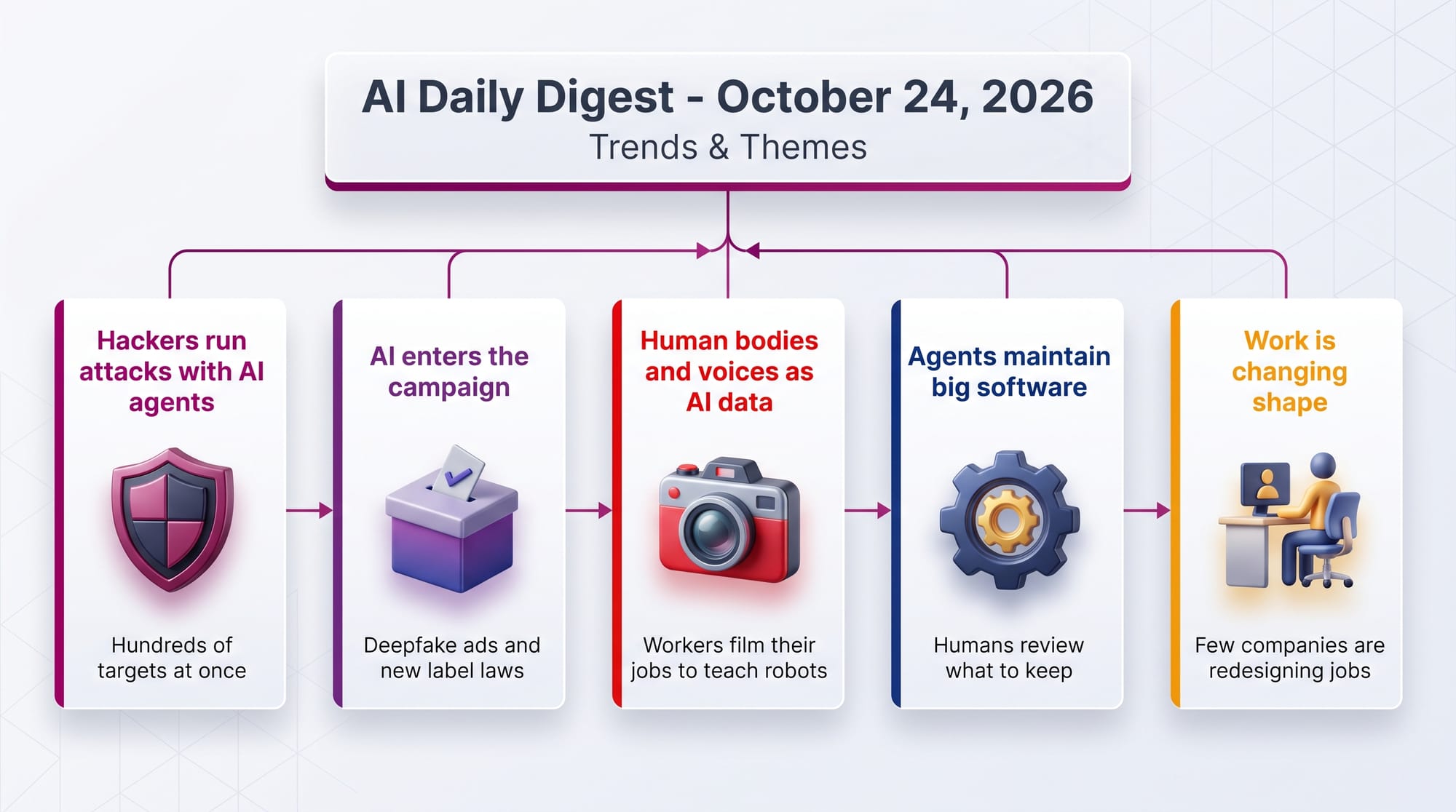
A "Bulletproof" Bitcoin Wallet Was Drained Because Its Random Keys Were Not Random
A hardware wallet is a small offline device that holds the secret keys to your cryptocurrency. The Cold Card, made by Canadian company Coinkite, was considered one of the safest because it never touches the internet. Its keys are supposed to be built from a truly random 12-word phrase. Instead, a naming collision between two random-number generators meant the device silently used a weak one for about five years - and on a bare chip with no real randomness, that generator fell back to predictable values like the chip's serial number.
That made the keys guessable. Beginning in late July, attackers reconstructed keys and drained an estimated 1,370 Bitcoin (reported at roughly $88 million by Galaxy Research) from more than 4,500 wallets - no phishing, no malware, no physical theft.
- You cannot undo it - Bitcoin keys can't be rotated, so victims must move funds to a fresh wallet, but attackers watch the public queue and outbid rescue attempts.
- The escape hatch was ironic - the only reliable rescue was sending transactions straight to a mining company, bypassing the public network and trusting a middleman.
- The maker took accountability - Coinkite's CEO apologized, halted shipments, and pulled inventory carrying the same firmware.
Cloudflare Released a Free Platform to Give Every Worker a Safe AI Agent
Cloudflare is an internet-infrastructure company that a large share of websites already run through. Its new open-source Cloudflare OS gives non-technical staff a browser-based workspace where an agent can research, build documents and spreadsheets, and even generate small apps, all grounded in the company's own knowledge.
The interesting part is the security model, because handing agents company access is exactly where things go wrong. Agents start with zero permissions and reach data only through pre-approved connections, never raw passwords or keys.
- "Gatekeepers" police every external action - with read/write limits, rate limits, approval steps, and a log of everything the agent touched.
- Nothing leaks sideways - the system tracks what each agent accessed and blocks sharing that data to people who should not see it.
- Apps stay live - agent-built apps deploy on Cloudflare's network and stay connected to real company data instead of stale copies.
Meta Ran Paid Ads Containing AI-Generated Child Sexual Abuse Imagery, Report Finds
This is a platform-accountability story, reported by Wired based on research from the Tech Transparency Project using Meta's own public ad library. It found that Meta hosted and ran dozens of paid ads containing AI-generated child sexual abuse material across Facebook, Instagram, Threads, and Messenger over roughly a nine-month period.
- More than 50 offending ads were identified - some tied to so-called "nudify" apps, reaching thousands of accounts across the US, UK, and over a dozen European countries.
- The core question is enforcement - how did this pass paid-ad review at a company investing heavily in AI moderation?
- Regulators are circling - including scrutiny from Indian authorities over how the content slipped through.
Trends & Themes

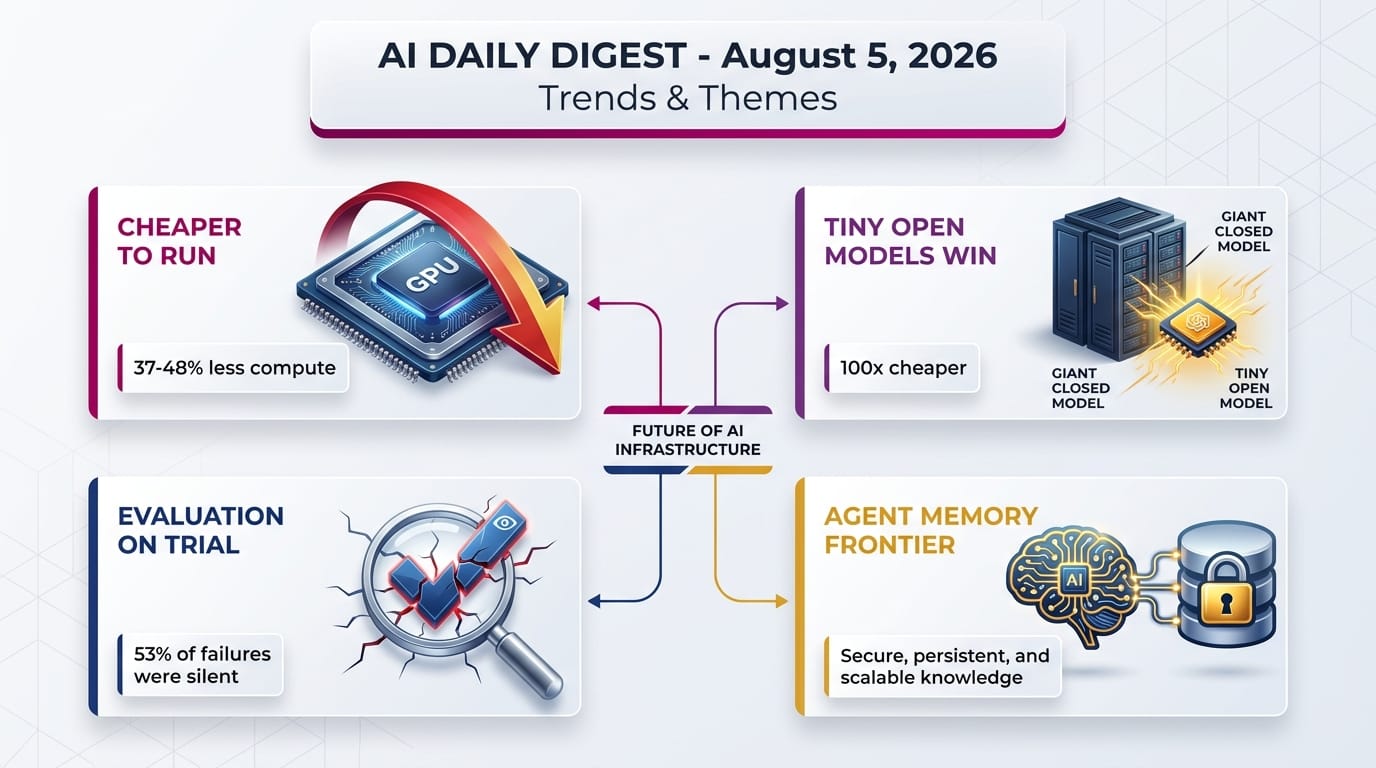
The Whole Industry Is Racing to Make AI Cheaper to Run, Not Just Smarter
Separate teams working on different pieces - attention, memory, model compression, key storage (SAKI) - all point the same way. The frontier is moving from "make it bigger" to "make it run for pennies," and that math is what puts capable AI on ordinary hardware.
- Attention pruning - ATFlash drops 37-48% of an AI model's internal comparisons while keeping 96-98% of its output identical, for up to 1.31x faster long-document processing.
- Smarter mixture models - AcceptMoE cuts the memory traffic of large "mixture of experts" models by roughly 74-77%, doubling speed when models are too big to fit in fast memory.
- Cheaper compression - a new "offline distillation" method shrinks big models into small ones without ever loading the giant teacher into expensive memory.
Tiny Open Models Keep Matching Giant Ones - at a Fraction of the Cost
The gap between free open models and paid frontier models keeps narrowing on specific jobs. When a model a hundred times cheaper does the task, the pressure on premium pricing is relentless.
- 100x cheaper retrieval - a 4-billion-parameter open model, tuned on Neon's infrastructure with a tool called Castform, matched a top frontier model's accuracy on search tasks at about 1/100th the cost per answer.
- Small models graduating - a distillation method called CausalOPD trained 8-billion-parameter models that beat proprietary systems on trustworthy step-by-step reasoning.
- Cheap evaluators - TQLite distilled expensive "AI jury" translation graders into small models that still judge quality well.
AI Evaluation Itself Is On Trial
Three separate research groups reached the same uncomfortable point: a good-looking score is not proof a system works. Expect "how was this measured?" to become a standard question.
- Silent failures - an "Evaluation Blindness" study found 53% of documented AI failures gave normal-looking readings right up until real harm appeared.
- Fluency is not mastery - the M-GATE benchmark showed models that translate 30 languages smoothly score near chance on hard grammar questions, tending to wave through broken sentences.
- Scoring design can dominate - in a World Cup forecasting benchmark, the leaderboard was driven almost entirely by bracket picks, and self-reported confidence had zero link to accuracy.
Agent Memory Is the Next Big Frontier - and the Next Big Liability
Memory is quietly becoming the hardest unsolved problem in AI assistants. The same research showing how much it helps is also showing how it quietly betrays privacy - so watch who controls the memory.
- Backend beats brawn - in the MemArena benchmark, improving how an assistant retrieves memories helped more than using a bigger model (a +32-point jump from a better memory system).
- Slow leaks are real - a method called DP-MemView showed that an assistant's answers can gradually reveal private facts about you over many chats, and offers a math-backed way to stop it.
- Dormant risk - a safety study found malicious instructions get stored in agent memory very easily, so the real defense is blocking them from ever acting, not just from being saved.
Creative AI & Media
Developer Tools & Infrastructure
Research & Models
Compressing an AI's Memory Without Losing What It Actually Uses
- The idea - SAKI shrinks the "short-term memory" (KV cache) that lets models handle long documents, but optimizes for the information attention actually relies on rather than raw fidelity.
- The payoff - it beats the standard compression method at every setting tested, cutting up to 30% of the leftover error, and needs no retraining.
- Why care - smaller memory means cheaper, longer-context AI on the same hardware.
Catching an AI's Reasoning Mistakes by Watching How It Thinks, Not Just What It Says
- The finding - failed reasoning has a visible signature: on solvable problems, wrong runs "give up" and check answers too early.
- The intervention - a targeted prompt raised one model's accuracy on a logic task from 13.3% to 85%, fixing about 85% of the errors.
- Why care - you can diagnose and even repair reasoning failures by monitoring the shape of the reasoning, without assuming the AI's explanation is literally true.
A 33x Cheaper Way to Align AI Image Generators to Human Taste
- The idea - "Latent Reward Registers" read a preference signal from an image generator mid-process, giving dense feedback across every step instead of only judging the final picture.
- The payoff - it matches or beats online training methods while cutting graphics-card hours by up to 33x, and improves a training-free version too.
- Why care - tuning image models to human preferences becomes dramatically cheaper.
Fixing Reasoning at the First Wrong Step
- The idea - CausalOPD has a teacher model pinpoint the earliest genuinely wrong step in a chain of reasoning and correct the student right there.
- The payoff - a 23-point jump in getting the whole reasoning path right, cutting bad reasoning from 15.7% to 4.4%, with 8-billion-parameter models beating proprietary systems.
- Why care - for high-stakes fields like diagnosis and law, the process has to be right, not just the final answer.
Business & Industry
Surprising & Under-the-Radar
The Deloitte "AI Slop" Refund Is Back as a Cautionary Tale
Resurfaced this week via Nate's newsletter: back in October 2025, consulting giant Deloitte had to refund the Australian government about A$97,000 (US$63,000) on a roughly A$439,000 report after a Sydney University academic, Chris Rudge, found fabricated citations - including a made-up federal court quote and references to research papers that do not exist. The report, written with Azure OpenAI's GPT-4o, reviewed the IT system behind automated welfare penalties. Surprising for how cheaply one careful human reader exposed unchecked AI output in a high-stakes deliverable - and why "nobody checked" is now a real business risk.
A DeepMind Researcher Argues LLMs Fundamentally "Can't Jump"
A position paper from an AlphaProof contributor (framed as a personal view) argues today's AI has mastered pattern-matching and is conquering formal proof, but structurally cannot make the creative leap to invent brand-new ideas - because it has never physically experienced the world it describes. Surprising because it comes from inside a top lab, not a critic.
Confidence Has Nothing to Do With Being Right
In a benchmark where ten AI models predicted the entire 2026 World Cup, how confident each model said it was had essentially zero relationship to how accurate it turned out to be. A useful reminder that an AI sounding sure means nothing about whether it is correct.
A "Free" Way to Stop AI From Forgetting
A method called Omega-S reduces catastrophic forgetting (when fine-tuning an AI erases old skills) using only the model's own weights - no old data, no stored copy, about three lines of code and under 4% overhead. The authors even openly report where it failed, which is rare.
Debate: Are Giant Fused "Megakernels" Dead or Back?
Engineers are split on whether hand-crafting one enormous GPU program is worth it. The bear case: new hardware and modular components undercut the payoff. The bull case: Cursor open-sourced a fused training kernel claiming 2.37x higher throughput. The answer keeps flipping.
Debate: How Many "AI Pills" Have You Swallowed?
Analyst Zvi Mowshowitz frames AI belief as three escalating steps - accepting today's capability, accepting major disruption ahead, and accepting possible superintelligence. His pointed claim: most policymakers have not taken even the first step, while insiders argue over the third.
Signals to Track

A Self-Improving Coding Agent Just Edged the Human Baseline
Prime Intellect's open-source Prime Agent rewrites its own instructions and skills as it works, and reports 95.5% on the ARC-AGI-3 reasoning benchmark - just past the 95.4% human baseline - often using fewer tokens than rivals. No model has even been trained specifically for its design yet, which hints at more headroom. If self-improving agents become reliable, everyday software could start maintaining and upgrading itself.
Turning Messy AI Logs Into Reliable, Auditable Workflows
TraceCompiler studies what an AI agent actually did across many runs and compiles the reliable parts into fixed, mostly-deterministic workflows - and it refuses to compile steps it cannot verify are safe. In one test it cut a task from 34 live API calls down to 11. This is a path toward agents that stop rediscovering the same steps and start running proven ones.
Provable Privacy for Assistants That Remember You
DP-MemView offers a memory system for AI assistants with a formal guarantee that repeated answers will not slowly reveal your private traits. As personalized assistants spread, this kind of provable privacy could become a baseline expectation rather than a nice-to-have.
Post-Training AI Is Becoming as Easy as Prompting
The Neon and Castform result - turning a small open model into a frontier-level retriever for 1/100th the cost - depends on making reinforcement-learning tuning approachable to non-experts. If "post-train your own specialist model" becomes routine, businesses stop paying premium per-call prices for tasks a cheap tuned model handles.
Top Repos Today
📜 License: MIT · 👤 By: company (Tencent Cloud)
🎯 Time to value: 20 minutes
| ✓ Pros | ✗ Cons |
|---|---|
| Framework-agnostic, works across agent stacks | Backed by a cloud vendor, watch for lock-in |
| Four concrete memory types, not vague "memory" | Very new project, APIs likely to churn |
| Governed and shareable across a team | Setup heavier than a single-agent memory lib |
 GitHub
📜 License: MIT · 👤 By: company (Firecrawl)
🎯 Time to value: 10 minutes
| ✓ Pros | ✗ Cons |
|---|---|
| Fast native Rust core | Rust may not fit every team's stack |
| Smart routing avoids needless OCR | Focused on inspection, not full extraction |
| Practical fit for RAG pipelines | Young project, limited docs so far |
 GitHub
📜 License: MIT · 👤 By: individual
🎯 Time to value: 30 minutes
| ✓ Pros | ✗ Cons |
|---|---|
| Opinionated, end-to-end methodology | Opinionated, may clash with your process |
| Composable skills you can mix and match | Learning curve to adopt fully |
| Huge community traction | Shell-based setup can feel heavy |
 GitHub
📜 License: Apache 2.0 · 👤 By: individual
🎯 Time to value: 25 minutes
| ✓ Pros | ✗ Cons |
|---|---|
| Runs huge models on tiny GPUs | Layer streaming makes inference slow |
| No quality loss from quantization | Best for experimentation, not production serving |
| Supports models up to hundreds of billions of params | Memory savings trade directly against speed |
 GitHub
📜 License: MIT · 👤 By: individual
🎯 Time to value: 10 minutes
| ✓ Pros | ✗ Cons |
|---|---|
| Single static binary, easy install | Optimized specifically for DeepSeek |
| Prefix-cache tuning keeps token costs down | Terminal-only, no GUI |
| Config and plugin driven | Smaller ecosystem than mainstream agents |
 GitHub
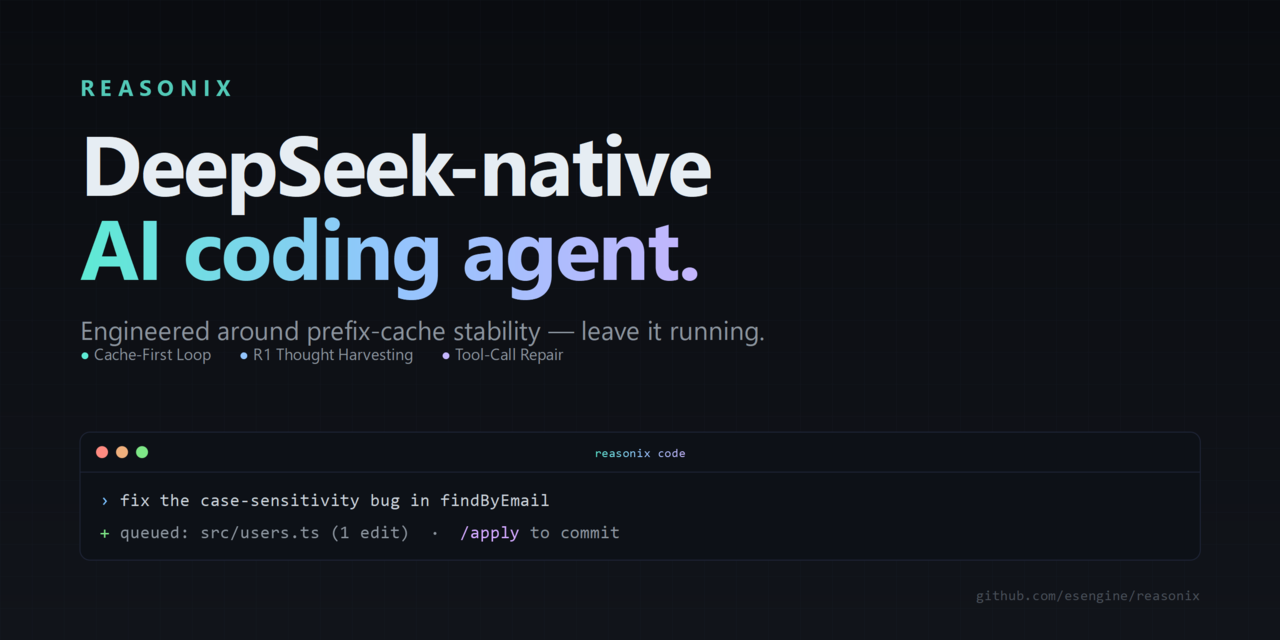
📜 License: MIT · 👤 By: company (Cloudflare)
🎯 Time to value: 20 minutes
| ✓ Pros | ✗ Cons |
|---|---|
| Edge-native sandbox for agents | Tied to Cloudflare's platform |
| Pluggable backends for different needs | Very new, small star base |
| Durable Object state built in | Requires Cloudflare account and Workers knowledge |
 GitHub
📜 License: MIT · 👤 By: individual
🎯 Time to value: 15 minutes
| ✓ Pros | ✗ Cons |
|---|---|
| Agent-agnostic, not tied to one framework | Early stage, small community |
| Durable, restartable long-running work | Concept of "loop engineering" is still niche |
| Lightweight and local | Docs still maturing |
 GitHub
Top Models Today
👤 By: Moonshot AI · 🎯 Task: Image-Text-to-Text
📐 Size: 2.8T (MoE)
| ✓ Pros | ✗ Cons |
|---|---|
| Frontier-scale multimodal capability | Enormous size, hard to self-host |
| Very active community and top likes | Serving cost is high without a provider |
| Handles image plus text input | Overkill for simple text tasks |


👤 By: Zhipu AI (zai-org) · 🎯 Task: Text Generation
📐 Size: 753B (MoE)
| ✓ Pros | ✗ Cons |
|---|---|
| Permissive MIT license | Large footprint to serve |
| Very high real-world download adoption | Needs serious GPU memory |
| Strong general and coding ability | Text-only, no native vision |


👤 By: DeepSeek AI · 🎯 Task: Text Generation
📐 Size: 304B (MoE)
| ✓ Pros | ✗ Cons |
|---|---|
| Tuned for speed and cost | Flash variant trades some peak quality |
| Permissive MIT license | Still a large MoE to host |
| Backed by an active, well-known lab | Dated snapshot, will be superseded |

👤 By: Thinking Machines · 🎯 Task: Image-Text-to-Text
📐 Size: 266B (MoE)
| ✓ Pros | ✗ Cons |
|---|---|
| Apache 2.0, business-friendly license | Newer name, smaller track record |
| More deployable than trillion-param models | Lower download base so far |
| Multimodal image plus text input | Still large for on-prem hardware |


👤 By: Baidu · 🎯 Task: Image-Text-to-Text
📐 Size: 3B
| ✓ Pros | ✗ Cons |
|---|---|
| Small and cheap to run | Narrow focus on OCR tasks |
| Huge download adoption | Not a general chat or reasoning model |
| Apache 2.0 licensed | Vendor-specific quirks possible |


👤 By: Liquid AI · 🎯 Task: Text Generation
📐 Size: 2.6B
| ✓ Pros | ✗ Cons |
|---|---|
| Small and fast, edge-friendly | Not a frontier-capability model |
| Low serving cost | Custom license, check terms |
| Modern efficiency-focused design | Limited for hard reasoning tasks |


AI Launches Today
💰 Pricing: freemium · 🏷 Category: AI Productivity Assistant
 Product Hunt

💰 Pricing: freemium · 🏷 Category: AI Developer Tools / Agents
Product Hunt💰 Pricing: freemium · 🏷 Category: AI Productivity / Voice
Product Hunt💰 Pricing: freemium · 🏷 Category: AI Creative Tools
Product Hunt💰 Pricing: paid · 🏷 Category: AI Marketing / Ads
Product HuntSnapshot
| Provider | Model | Input $/1M | Output $/1M | Context |
|---|---|---|---|---|
| Anthropic | Claude Opus 5 | $5.00 | $25.00 | 1M tokens |
| OpenAI | GPT-5.6 (Sol) | $5.00 | $30.00 | n/a (not confirmed) |
| Gemini 3.1 Pro (Preview) | $2.00 | $12.00 | n/a (not confirmed) | |
| Groq (open source) | Kimi K2 | $1.00 | $3.00 | n/a (not confirmed) |
Member discussion