GenAI Secret Sauce Daily Digest - 2026-04-09

Most Workers Are Quietly Ignoring Their Company's AI Tools · First US Conviction for AI-Generated Deepfake Images · Google Gemini Now Answers Questions With Interactive 3D Models
GenAI Secret Sauce Daily Digest - 2026-04-09

Watch today's digest as a video summary (generated by NotebookLM)

Statistically Speaking

$54.2 million per organization on average for AI
Most Workers Are Quietly Ignoring Their Company's AI Tools
Top Story
2,400 additional images flagged for nudity, morphed content,
First US Conviction for AI-Generated Deepfake Images
48 hours of a report
First US Conviction for AI-Generated Deepfake Images
3 D models sometimes prioritize aesthetics over scientific
Google Gemini Now Answers Questions With Interactive 3D Mode
18 months
NASDAQ Rewrote the Rules So AI IPOs Will Enter Your Retireme
62% of its 2024 revenue
Meta Committed $21 Billion More to CoreWeave for AI Computin

One Thing to Tell Your Friends

Iran submitted a nuclear deal proposal to the US that JD Vance said was "probably written by ChatGPT" - and it was immediately thrown in the trash.

TL;DR

Trends
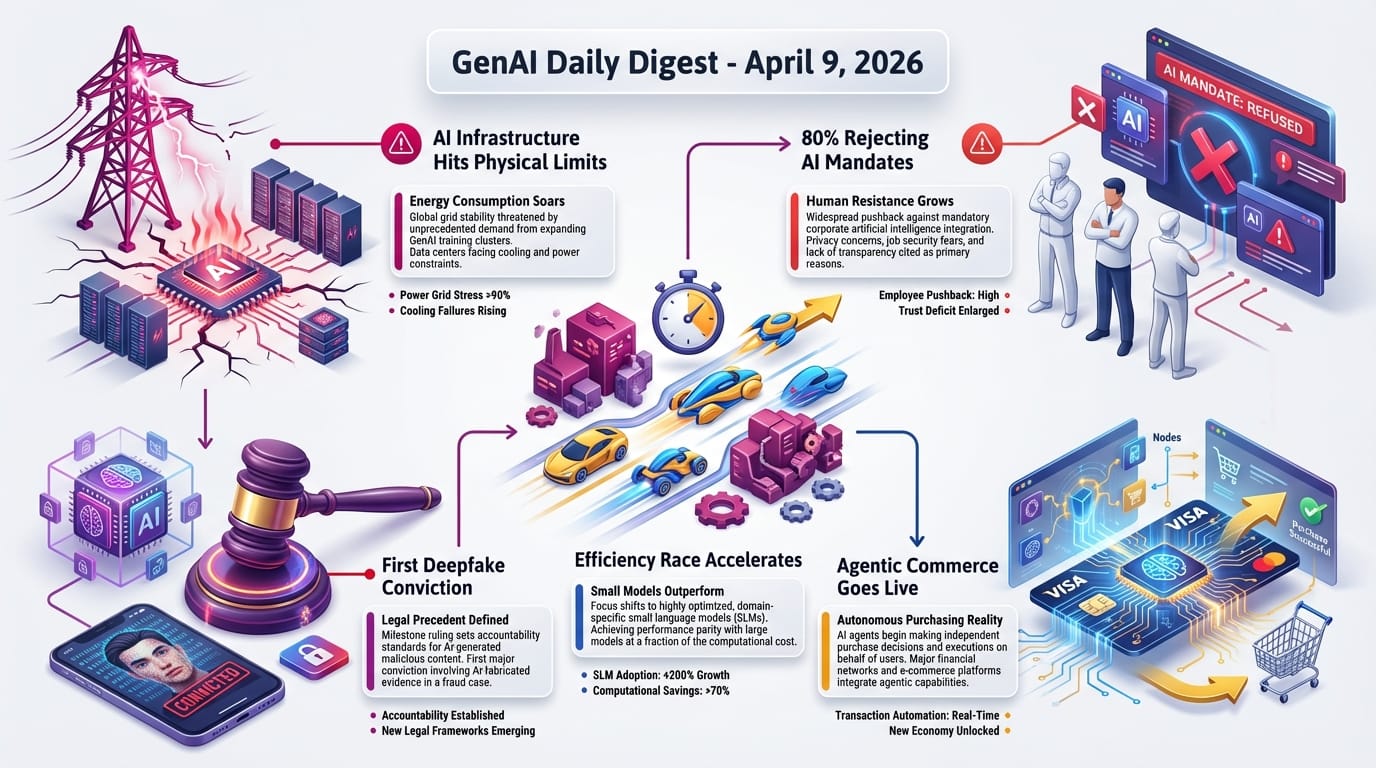
AI Infrastructure Is Running Into Physical Limits, AI Is Entering the Legal Enforcement Era, and The Model Efficiency Race Is Accelerating.
Creative AI
Google Gemini Turns Questions Into Interactive Simulations and AI CEO vs Engineer: A Satirical Video That Hits Too Close.
Surprising
The Claude Mythos Meme That Got 2,800 Upvotes, Bad Grammar Is Now Proof You're Human, and Gemma 4 Is Terrible With System Prompts.
Worth Watching
Visa's Agentic Commerce Infrastructure Is Live, Maine's Data Center Ban Could Spread to Other States, and Research.

Hot off the Presses

01

Most Workers Are Quietly Ignoring Their Company's AI Tools

What this means for you: If your company mandated AI adoption and it feels like nobody is actually using it, you're not alone - and the data says the tools are usually the problem, not the people.

A survey of 3,750 workers across 14 countries found that 54% bypassed their company's AI systems in the past month and did tasks manually instead. Another 33% haven't used AI at all. Combined, roughly 80% of enterprise workers are either rejecting or ignoring AI adoption mandates from their employers.

The gap between executive and employee reality is striking. While 88% of executives say workers have adequate AI tools, only 21% of employees agree. Just 9% of workers trust AI for critical business decisions, compared to 61% of executives. Workers are losing 51 working days per year to technology friction - nearly canceling out the 40-60 minutes daily that skilled AI users actually save.

  • Companies are spending $54.2 million per organization on average for AI tools, yet 40% of that spending underperforms due to adoption failures
  • The core problem isn't capability - it's that workers lack training, context, and confidence to use AI effectively
  • Experts compare it to giving everyone a Ferrari but no driving lessons - the car isn't wrong, the rollout is
02

First US Conviction for AI-Generated Deepfake Images

What this means for you: If you've worried about AI being used to create fake explicit images of you or someone you know, this conviction marks the moment that concern became legally actionable with real prison time.

James Strahler II of Columbus, Ohio pleaded guilty to three federal charges - becoming the first person in the United States convicted under the Take It Down Act, a law championed by First Lady Melania Trump that President Trump signed in May 2025. The law criminalizes nonconsensual sharing of intimate imagery, including AI-generated deepfakes.

Strahler had installed more than 24 AI platforms and over 100 web-based AI models on his phone, using them between December 2024 and June 2025 to generate sexually explicit images of real people without their consent.

  • Investigators recovered 2,400 additional images flagged for nudity, morphed content, or violence on his phone
  • Penalties: Up to two years in prison for adult victims, up to three years for minor victims
  • The law also requires online platforms to remove reported nonconsensual material within 48 hours of a report
03

Google Gemini Now Answers Questions With Interactive 3D Models

What this means for you: Instead of reading a description of how a molecule works or how gravity affects orbits, you can now ask Gemini to show you - and then grab and rotate the model yourself.

Google announced that the Gemini app can now build interactive 3D models and functional simulations directly inside your chat window. The feature runs on the Pro-tier Gemini model. Users can ask to visualize any complex concept and then interact with the result in real time.

The system generates live WebGL and Three.js code - the same rendering stack Google's Android XR (extended reality) team uses - to produce physically interactive outputs rather than static diagrams.

  • Practical examples include: rotating molecular structures, adjusting gravity and speed sliders on a Moon orbit simulation, and exploring the double-slit physics experiment
  • One limitation: A benchmark found the AI-generated 3D models sometimes prioritize aesthetics over scientific accuracy, which matters in classroom and research contexts
  • How to use it: Select the Pro model in Gemini's prompt bar, phrase requests as "show me" or "help me visualize"
04

NASDAQ Rewrote the Rules So AI IPOs Will Enter Your Retirement Account Automatically

What this means for you: When OpenAI, SpaceX, and Anthropic go public in the next 12 months, your 401(k) or index fund will likely buy their stock automatically - whether or not you think they're worth the price.

Three tech companies collectively worth over $3 trillion - SpaceX, OpenAI, and Anthropic - plan to go public within the next year and raise between $170-195 billion combined. That's nearly four times the total IPO market from last year. NASDAQ changed its index rules so these mega-stocks will be automatically added to index funds and retirement accounts within three weeks of going public.

The deeper problem: these companies plan to sell only around 3% of their stock at IPO while insiders keep the rest. That artificially limits supply and drives prices up based on scarcity, not value. One investment fund with tiny stakes in SpaceX and Anthropic saw its bid price jump 1,500% above actual holdings value in just four days.

  • When insider lock-ups expire, the 97% of stock held internally will flood the market while average investors have already bought at inflated prices
  • Retirement investors won't choose to buy these stocks - the index system does it automatically
  • The timing ripple: Wall Street's attention may be redirected away from smaller companies for the next 18 months
05

Meta Committed $21 Billion More to CoreWeave for AI Computing

What this means for you: The AI infrastructure buildout is accelerating to a scale most people can't picture - major companies are locking in computing capacity years in advance because the demand is far ahead of supply.

Meta and CoreWeave announced a $21 billion expanded AI infrastructure deal, with CoreWeave supplying computing capacity from multiple data centers through 2032. This builds on a $14.2 billion deal signed just six months earlier, bringing Meta's total contracts with CoreWeave to $35 billion.

The data centers will be powered in part by Nvidia's next-generation Rubin GPU (graphics processing unit - the chips that power AI training) systems. CoreWeave will raise $3 billion in fresh debt to support the expansion.

  • Diversification benefit for CoreWeave: Microsoft represented 62% of its 2024 revenue - now no single customer exceeds 35% of total sales
  • The deal signals that even well-funded companies like Meta aren't building all their own computing infrastructure anymore
  • Context: This comes as OpenAI simultaneously paused its UK Stargate project over energy costs - the same infrastructure category, opposite direction

Trends & Themes

Trends & Themes

AI Infrastructure Is Running Into Physical Limits

Why this matters to you: The AI tools you use every day are powered by data centers that need enormous amounts of electricity and space - and both are becoming harder to secure.

The physical infrastructure that makes AI possible is bumping into electricity grids, regulatory frameworks, and communities that weren't built for this scale. If the pattern spreads, AI service costs will rise as construction slows.

  • OpenAI paused its UK Stargate data center - citing high electricity prices and unresolved AI copyright regulations. The project would have purchased up to 31,000 Nvidia GPUs
  • Maine is advancing a statewide moratorium on large data centers (over 20 megawatts of power) until November 2027 - the first state-level ban in the US
  • Counties in Michigan and Indiana have already implemented similar pauses, suggesting a possible domino effect
  • Data centers currently use 4% of US electricity, with projections suggesting that figure could double by 2030

AI Is Entering the Legal Enforcement Era

Why this matters to you: For years, concerns about AI misuse were largely theoretical. This week, a court handed down the first federal conviction under an AI-specific law - signaling that enforcement has begun.
  • The Take It Down Act's first conviction (covered above) came roughly 11 months after the law was signed
  • The law has teeth: up to two years in prison for adult victims, three for minors, plus mandatory 48-hour removal requirements for platforms
  • JD Vance publicly claimed Iran submitted a ChatGPT-written nuclear proposal to the US - the first time AI-generated diplomatic content became an official controversy in high-stakes international negotiations
  • The AI agent security incident database (90 incidents, 2024-2026) shows attacks are already routine - courts and regulators are catching up

The Model Efficiency Race Is Accelerating

Why this matters to you: The best AI doesn't have to mean the most expensive AI - a wave of ultra-efficient models means capable AI is getting dramatically cheaper to run.
  • Alibaba's Marco-Mini activates only 0.86 billion of its 17.3 billion total parameters per query - making it roughly 20x cheaper to run than its size implies, while outperforming models with up to 12 billion active parameters
  • LG released EXAONE 4.5, a 33-billion parameter multimodal (text + vision) model - their first capable of understanding images and documents
  • AISLE found that a 3.6-billion parameter model costing $0.11 per million tokens identified the same cybersecurity vulnerabilities that Anthropic's ultra-powerful Mythos model (covered April 7) found in its showcase
  • The Mamba 3 upgrade tool lets researchers convert older Mamba models to the new architecture without retraining from scratch - preserving months of existing compute investment

AI Adoption Has a People Problem, Not a Technology Problem

Why this matters to you: Companies keep buying AI tools that don't get used - and the pattern suggests the problem is how these tools are rolled out, not whether AI works.
  • 80% of enterprise workers are refusing or ignoring AI mandates despite massive corporate investment
  • Enterprise AI agent failure rates exceeded 80% in 2025 - mostly due to poor quality assurance, not technical limitations, per Dr. Philippa Hardman's research on AI evals for learning and development
  • Developers are leaving Claude Code subscriptions for more flexible alternatives like Zed plus OpenRouter, specifically because fixed monthly rate limits don't match bursty real-world usage patterns
  • The trust gap is the core issue: workers don't trust AI output, executives don't understand this gap, and neither side has good tools for measuring quality

Agentic AI Is Moving From Concept to Infrastructure

Why this matters to you: AI "agents" that take actions on your behalf - booking things, buying things, filing things - are moving from demos into the actual financial system.
  • Visa launched Intelligent Commerce Connect - a global platform letting AI agents browse, select, and pay for goods autonomously, with over 100 partners and pilots running in Asia Pacific and Europe
  • Visa predicts millions of consumers will use AI agents for purchases by the 2026 holiday season
  • Research-driven agents that read academic papers before coding produced 15% speed improvements in llama.cpp for $29 in compute costs - showing agents with context outperform agents without it
  • OpenWork's relicensing controversy signals that the business models around AI agent tools are still unsettled, with communities pushing back against commercial pivots

Creative AI & Media

Google Gemini Turns Questions Into Interactive Simulations

What this means for you: You can now learn by doing instead of reading - ask Gemini to show you how something works and manipulate it yourself.

Try it (requires Gemini Pro) · Theverge

  • What it does: Generates interactive 3D models and physics simulations inside the Gemini chat window
  • Technology: WebGL and Three.js rendering, same stack used in Google's Android XR experiences
  • Examples: Rotating molecular structures, live orbital mechanics with adjustable gravity, double-pendulum physics demos
  • One caveat: Accuracy can vary - generated models sometimes look convincing but have scientific inaccuracies

AI CEO vs Engineer: A Satirical Video That Hits Too Close

What this means for you: If you've ever sat through an AI strategy meeting where executives kept inventing new terms while engineers stayed quiet, this five-minute video is going to feel familiar.
  • What it is: "AI CEO vs Engineer (2026)" - a satirical sketch contrasting corporate AI buzzword-speak with engineering reality
  • Best moment: The CEO announces "zero shot transformation" - then reveals it required five people to manually check every output
  • Second best: An AI agent is hired as an employee and immediately fires half the management
  • Why it resonates: Captures the real cultural tension between AI hype at the leadership level and day-to-day implementation reality

Developer Tools & Infrastructure

Research-Driven Agents: Teach the Agent to Read Before It Codes

What this means for you: AI coding agents that look up academic papers and study competitors before attempting optimizations produce significantly better results than agents working only from source code.
  • The experiment: SkyPilot researchers added a literature search phase to an autonomous code optimization loop using Claude, then aimed it at llama.cpp
  • What changed: The agent initially tried micro-optimizations that failed because it didn't know the workload was memory-bound. After researching academic papers, it pivoted to kernel fusions that actually reduced memory traffic
  • Results: Five optimizations making text generation 15% faster on x86, 5% faster on ARM, for roughly $29 in cloud compute costs
  • Key lesson: When the answer lives in academic papers or competing projects, an agent working only from source code generates shallow guesses

Instant 1.0: A Backend Built for AI-Coded Apps

What this means for you: Building a full app with real-time sync, offline support, and authentication used to take weeks - InstantDB makes it 25 lines of code.
  • What it is: A backend platform combining database, auth, storage, and real-time sync in one product, designed for apps built with AI coding tools
  • Technical architecture: Multi-tenant database on PostgreSQL, sync engine for offline support and real-time updates, client SDK with local Datalog engine
  • Why it matters for AI-assisted development: AI agents can programmatically create entire applications through APIs, and integrated services eliminate the "multiple sources of truth" problem that trips up generated code
  • Cost: Creating unlimited apps costs virtually nothing since new apps are just database rows, not separate servers

Catapult: A Desktop App for Running AI Models Locally

What this means for you: Running AI models on your own hardware has been a command-line-only experience - Catapult gives it a full desktop interface that anyone can use.
  • What it does: Manages llama.cpp (the most popular local AI model runner) through a graphical or terminal interface
  • Key features: Automatic hardware detection and backend selection (CUDA for Nvidia, Metal for Mac), model download from HuggingFace with resume support, 50+ configuration options without touching command-line syntax
  • First-launch wizard: Detects your hardware and recommends appropriate models and settings
  • Built with: Rust, React, and TypeScript; cross-platform on Linux, macOS, and Windows

llama.cpp Gets Multi-GPU Support

What this means for you: If you have two or more GPUs, llama.cpp can now split AI model computations across them simultaneously, potentially doubling your inference speed.
  • What merged: Experimental backend-agnostic tensor parallelism - splitting AI calculations across multiple graphics cards at the same time
  • Performance benchmark: Two RTX 4090 GPUs running a 70B parameter model saw up to 2.5x speedup in some scenarios
  • Current limitations: Many model architectures aren't yet supported, and only Nvidia's CUDA backend achieves production-quality results
  • Works with: Any backend (CUDA, Metal, Vulkan) since it operates at the underlying ggml framework level

LLM (Large Language Model) Wiki Compiler: Implementing Karpathy's "Compiled Knowledge" Idea

What this means for you: Instead of asking your AI assistant the same questions repeatedly, you can build a persistent wiki of compiled knowledge that grows and cross-references itself.
  • The concept: Andrej Karpathy proposed converting raw knowledge sources into persistent, compiled artifacts rather than rediscovering information during every query
  • What this tool does: Transforms articles, documents, and web pages into an interconnected markdown wiki through concept extraction then wiki page generation, with automatic cross-references
  • Key advantage over RAG (retrieval-augmented generation): Sources are processed upfront, not searched at query time - resulting in richer, pre-connected context
  • Output format: Obsidian-compatible wiki with concept pages, saved queries, and an auto-generated index

OpenWork Quietly Changes Its License - Community Pushes Back

What this means for you: If you build on open-source AI tools, this is a reminder to check the license before depending on them - popular projects can change terms after launch.
  • What happened: OpenWork, an AI agent platform launched as MIT-licensed open-source in January 2026, introduced a $99/year paywall on Windows builds and moved enterprise features to a commercial license
  • Community reaction: Confusion and frustration at 78 upvotes on r/LocalLLaMA - users felt the commercial pivot wasn't communicated transparently
  • The team's response: The core desktop app remains MIT-licensed; cloud features use Fair Source License (FSL) that converts to MIT after two years; Windows paywall was due to platform-specific bugs requiring dedicated support
  • The broader pattern: Reflects growing tension between open-source AI community expectations and the commercial sustainability of AI tooling projects

Research & Models

Alibaba Releases Two Ultra-Efficient Open Models: Marco-Mini and Marco-Nano

What this means for you: Two new models from Alibaba are as capable as much larger competitors but use only a fraction of the computing resources, making them cheaper to run for apps and APIs.
  • Marco-Mini: 17.3 billion total parameters, but only 0.86 billion active per query - a sparse Mixture of Experts (MoE, a design where only a fraction of the model activates per request) architecture
  • Marco-Nano: 8 billion total parameters, only 0.6 billion active per query
  • Performance: Marco-Mini outperforms models with up to 12 billion activated parameters on English benchmarks, multilingual tasks (29 languages), and cultural knowledge
  • Benchmark scores: 83.4 MMLU (a broad knowledge test), 93.1 GSM8K (math reasoning)
  • License: Apache 2.0 - free to use commercially

LG Releases First Multimodal EXAONE: Sees Images, Understands Documents

What this means for you: LG's AI research division released a 33-billion parameter model that can understand images alongside text - their first model with visual capabilities.
  • What's new: EXAONE 4.5-33B adds a 1.29-billion parameter visual encoder to LG's existing language model framework
  • Strengths: Document understanding, Korean language reasoning, agentic tool use - outperforms similar-sized models on document benchmarks
  • Context length: 262,144 tokens - long enough to process entire large documents in one pass
  • Hardware: Can run on a single H200 GPU or four A100-40GB GPUs using standard frameworks (vLLM, SGLang)
  • License: Non-commercial (EXAONE AI Model License 1.2 NC)

Small AI Models Match Anthropic's Mythos on Cybersecurity Tasks

What this means for you: Anthropic's decision to withhold Claude Mythos (covered April 7) - citing its unique ability to find software vulnerabilities - may overstate how unique that capability is.
  • The finding: AISLE tested 8 different AI models against the same vulnerabilities Mythos showcased - a 3.6-billion parameter model costing $0.11 per million tokens found the same FreeBSD vulnerability
  • What this means: The real competitive advantage in AI cybersecurity isn't the model - it's the system around it: targeting strategies, validation processes, and expert guidance
  • Practical implication: Organizations don't need to wait for restricted access to expensive models to start building AI-powered security tools
  • The nuance: Smaller models also sometimes failed trivial tests that expensive models passed - performance doesn't scale predictably

Researchers Reverse-Engineered Google's AI Image Watermark

What this means for you: Google embeds invisible watermarks in Gemini-generated images to identify them as AI-created - researchers have now figured out how those watermarks work and built a tool to remove them.
  • What SynthID is: Google's invisible watermarking system that embeds imperceptible markers in Gemini-generated images using specific frequency patterns
  • What researchers found: SynthID uses resolution-dependent carrier frequencies in the frequency domain with fixed phase patterns - making it reverse-engineerable
  • The removal tool: Achieved 43+ dB PSNR (a measure of image quality - higher is better) while reducing the watermark's signal by 76%
  • Why it matters: Raises fundamental questions about whether AI content watermarks can ever reliably identify AI-generated images if they can be surgically removed

Upgrade Mamba 1 and 2 Models to Mamba 3 Without Retraining

What this means for you: Researchers who trained Mamba models (an alternative to transformers for efficient AI) can now upgrade them to the newer Mamba 3 architecture without throwing away months of compute.
  • The problem it solves: Mamba 3 has three mathematical incompatibilities with earlier versions that would normally require full retraining
  • The solution: A two-phase pipeline - first calibrate new gates with 99% of weights frozen, then inject adapter layers to restore reasoning capacity
  • Hardware requirement: Designed to fit within a strict 12GB VRAM budget - accessible on consumer hardware
  • Who benefits: Researchers and developers with existing trained Mamba 1 or 2 models who want Mamba 3's performance improvements

Business & Industry

OpenAI Pauses UK Stargate Data Center Over Energy Costs

What this means for you: AI companies are discovering that energy is the new rate-limiting factor for growth - and the UK's electricity prices may cost it a major AI infrastructure investment.
  • What happened: OpenAI paused its planned UK Stargate data center, which would have initially purchased 8,000 Nvidia GPUs and scaled to 31,000
  • The reason: UK industrial electricity prices plus unresolved AI training copyright regulations made the economics unworkable
  • OpenAI called it a pause, leaving the door open if the UK provides support for new renewable generation or grid upgrades
  • Context: This comes the same day Maine advanced a ban on new large data centers - a pattern of physical infrastructure limits constraining AI expansion

Visa Launches AI Agent Payment Infrastructure Globally

What this means for you: The financial infrastructure for AI agents to spend money on your behalf - shopping, booking, paying recurring bills - is now actively being built by Visa.
  • What launched: Visa Intelligent Commerce Connect - a platform allowing AI agents to browse, select, and pay for goods autonomously with spend controls and authentication
  • Scale: Over 100 partners worldwide; over 30 actively building in the sandbox; over 20 agents integrating directly
  • Timeline: Pilot programs running in Asia Pacific and Europe now; broader global rollout later in 2026; Visa predicts millions of consumers using AI agents for purchases by the 2026 holiday season
  • What's new about this: Visa's platform is "network, protocol, and token vault-agnostic" - designed to work with any AI agent, not just one ecosystem

Developer Dumps $100/Month Claude Code Subscription for Zed + OpenRouter

What this means for you: Fixed monthly AI tool subscriptions with hard rate limits may not fit how developers actually work - and the market is starting to offer alternatives.
  • What happened: A developer stopped using Claude Code after hitting rate limits too frequently despite paying $100/month, frustrated by unused credits expiring in fixed windows
  • What they switched to: Zed editor ($10/month) plus OpenRouter API (application programming interface - the pay-per-use access layer) credits ($90/month top-up) - where unused credits roll over for 365 days
  • The appeal: Access to multiple models (Gemini, Qwen, Claude Opus when needed) rather than being locked to one vendor
  • The signal: This post reached 291 points on Hacker News with 198 comments - resonating widely with developers

Maine Advances First US State Ban on Large Data Centers

What this means for you: If this becomes a trend, AI service costs could rise as companies face construction delays and reduced options for where to build computing infrastructure.
  • What advanced: Bill LD 307, blocking permits for data centers requiring over 20 megawatts of power until November 2027
  • Why: Maine already has some of America's highest residential electricity rates; AI data centers strain the aging grid and use large amounts of water
  • Projects at risk: Planned facilities in Jay, Sanford, and Loring Air Force Base now face uncertainty
  • Precedent: Counties in Michigan and Indiana have similar pauses already - Maine's move could accelerate a national pattern

Microsoft's Dark Patterns Are Costing Users Their Family Photos

What this means for you: Windows 11 automatically backs up your files to Microsoft's OneDrive cloud storage without clear consent - and when the free storage fills up, it stops working in ways that confuse non-technical users into deleting their own files.
  • What's happening: Windows 11 silently syncs desktop files to OneDrive; when the 5GB free quota fills, applications like Outlook stop working
  • The dark pattern: Error messages suggest purchasing more storage rather than explaining the underlying problem
  • Real-world harm: One user deleted family photos trying to fix an unexplained error
  • The bigger issue: This is a deliberate design choice that prioritizes subscription revenue over user understanding - and most computer users trust their devices to be transparent

JD Vance Says Iran's First Nuclear Proposal Was "Written by ChatGPT"

What this means for you: AI-generated text is now entering high-stakes international diplomacy - and when it's obvious enough for the other side to notice, it undermines credibility rather than helping.
  • What happened: During US-Iran nuclear negotiations, Iran submitted three versions of a 10-point proposal; Vice President Vance said the first was "probably written by ChatGPT" and was immediately rejected
  • What was rejected: A proposal President Trump called "ridiculous" and "totally unserious"
  • What worked: A second, more substantive version developed through back-and-forth with Pakistani intermediaries formed the basis for the current two-week ceasefire
  • The implication: AI-drafted diplomatic documents are now a real thing - and distinguishable enough that they can damage negotiations

GenAI in Education

Your AI-Generated Learning Content Probably Has Quality Problems You Can't See

What this means for you: If you're using AI to create training materials, quizzes, or feedback for learners, there's a good chance those materials have systematic errors - and a simple spreadsheet-based testing process can catch them.
  • The problem: Enterprise AI agent failure rates exceeded 80% in 2025, largely due to poor quality assurance, not technical failures
  • The solution - "evals": A structured testing method where you generate 10 outputs, create 3-5 binary quality checks, score them, identify failure patterns, fix the prompt, retest, and document
  • Real example: Initial AI-generated training questions failed 70% of quality checks - mostly testing recall instead of real-world application - until prompt revision boosted the pass rate to 90%
  • Why it compounds: Wrong quiz questions build false confidence; misleading feedback reinforces misconceptions; unrealistic scenarios teach gaming rather than thinking

Small Private Colleges Are Disappearing in a Winner-Take-All Market

What this means for you: Smaller colleges - often more affordable and personalized than large research universities - are closing faster as students concentrate at a handful of brand-name institutions.
  • What's happening: Declining enrollment, rising costs, and competition from large research universities and online programs are accelerating closures
  • AI's role: Not directly addressed in this piece, but AI-powered online learning is one factor concentrating students at large institutions that can invest in technology
  • Who's affected: Students who rely on small private colleges for geographic access, specialized programs, or lower costs face fewer options

Surprising & Under-the-Radar

The Claude Mythos Meme That Got 2,800 Upvotes

The top post on r/ClaudeAI today was a joke claiming Anthropic's new Mythos model "reportedly found the One Piece before the Straw Hats" - a reference to the legendary treasure in the anime One Piece that no one has found in decades of story. It hit 2,804 upvotes. The fact that a joke about a model's supposed superhuman capabilities outperformed every serious discussion by a factor of ten is itself a commentary on how the community processes AI announcements: with absurdist humor as a coping mechanism for claims that are hard to evaluate seriously.

Bad Grammar Is Now Proof You're Human

A Reddit post with surprising traction: typos, bad grammar, and "ur" instead of "your" in text messages have become one of the last reliable signals that a message was written by a human rather than an AI. As AI writing becomes indistinguishable from polished text, informal grammar serves as an authenticity marker. This is a genuine cultural shift - people are starting to value imperfect writing as a signal of humanity, which would have seemed bizarre five years ago.

Gemma 4 Is Terrible With System Prompts - Despite Its Benchmarks

Gemma 4 scores impressively on public benchmarks but the LocalLLaMA community (489 upvotes on Llama.cpp stability alone) is reporting real problems: the model frequently ignores system prompt instructions, fails to properly format tool calls, and produces inconsistent results in agent workflows. This gap between benchmark performance and real-world usability is a pattern worth watching as Gemma 4 rolls out widely. Benchmarks measure what you can measure, not what developers actually encounter.

Google's AI Content Watermark Can Be Surgically Removed

Google built SynthID to invisibly watermark Gemini-generated images. Researchers reverse-engineered it in enough detail to remove the watermark while preserving 43+ dB of image quality - a level where the image looks essentially identical. This matters because content authentication (knowing whether an image was AI-generated) is increasingly important for journalism, courts, and social media platforms. If watermarks can be reliably removed, the authentication strategy doesn't hold.

A Private Discord Server Is Trying to Produce Frontier AI Research

A community experiment on r/MachineLearning (in discussion) is testing whether strangers collaborating in a Discord server can produce state-of-the-art AI research results - with no institutional affiliation, no funding, and no hierarchical structure. The experiment tests a core question in open science: does cutting-edge AI research require corporate labs and academic institutions, or can decentralized communities close the gap?

Iran Used ChatGPT for Nuclear Diplomacy - and Got Caught

JD Vance's claim that Iran's first nuclear proposal was "probably written by ChatGPT" is surprising not for what it implies about Iran's capabilities, but for what it implies about AI-generated text in high-stakes settings. If a proposal is distinguishable enough as AI-generated that the other side immediately rejects it as "ridiculous," the quality gap between AI diplomatic writing and human diplomatic writing is still very real - at least in formal government settings with experienced readers.

Signals to Track

Worth Watching
01

Visa's Agentic Commerce Infrastructure Is Live

Visa isn't just talking about AI agent payments - they have over 100 partners building, over 20 agents integrating directly, and pilots running now in Asia Pacific and Europe. When Visa's payment rails are ready for AI agents to spend money autonomously, the question of whether you trust your AI agent becomes a financial question, not just a productivity one. The "agentic economy" has a specific launch timeline: Visa expects millions of transactions by the 2026 holiday season. Ordinary people who never thought about AI agents will encounter them first through their bank statements.

02

Maine's Data Center Ban Could Spread to Other States

Maine's moratorium is the first state-level action, but county-level pauses in Michigan and Indiana already exist. If other high-electricity-cost states follow - particularly those with aging grids or strong environmental politics - the geography of AI computing shifts significantly. Companies like Google, Microsoft, and OpenAI that have already secured power agreements in compliant states gain a structural advantage over newer entrants. Watch which states copy Maine's language over the next six months.

03

Research-Driven Agents May Become the Standard Approach

The SkyPilot finding - that an AI agent reading academic papers before attempting optimizations produced 15% speed improvements at $29 of compute cost - is a specific, replicable demonstration of a broader principle. The next wave of agent frameworks may routinely include a literature search or competitor analysis phase before any implementation attempt. If this becomes a default pattern in coding agents and research tools, the gap between "just run the agent" and "run the agent with context" will drive a new category of agent tooling. Developers who internalize this now will build significantly more effective workflows.

04

The Claude Code Pricing Backlash Has Real Signal

A blog post about switching from Claude Code ($100/month) to Zed + OpenRouter hit 291 Hacker News points with 198 comments. That's not a fluke - it reflects a real tension between subscription pricing models and the actual usage patterns of technical power users. If Anthropic doesn't respond with more flexible pricing (rollover credits, usage-based tiers), they risk the same pattern that played out with other developer tools: power users leave first, taking their word-of-mouth influence with them. The community that builds on a tool is often the same community that recommends it to newcomers.

---

Sources: Ben's Bites | Zvi Mowshowitz | Alpha Signal | Fortune | The Guardian | The Verge | Nate's Newsletter | CNBC | Bloomberg | SkyPilot | InstantDB | AISLE | GadgetReview | Defiant | Dr. Philippa Hardman | braw.dev
Member discussion

Subscribe to GenAI Secret Sauce newsletter and stay updated.

Don't miss anything. Get all the latest posts delivered straight to your inbox. It's free!

By subscribing, you agree to our Privacy Policy and Terms. We track email opens and clicks. Unsubscribe anytime.

Great! Check your inbox and click the link to confirm your subscription.