Watch today's digest as a video summary (generated by NotebookLM)
Statistically Speaking
One Thing to Tell Your Friends
TL;DR
Hot off the Presses
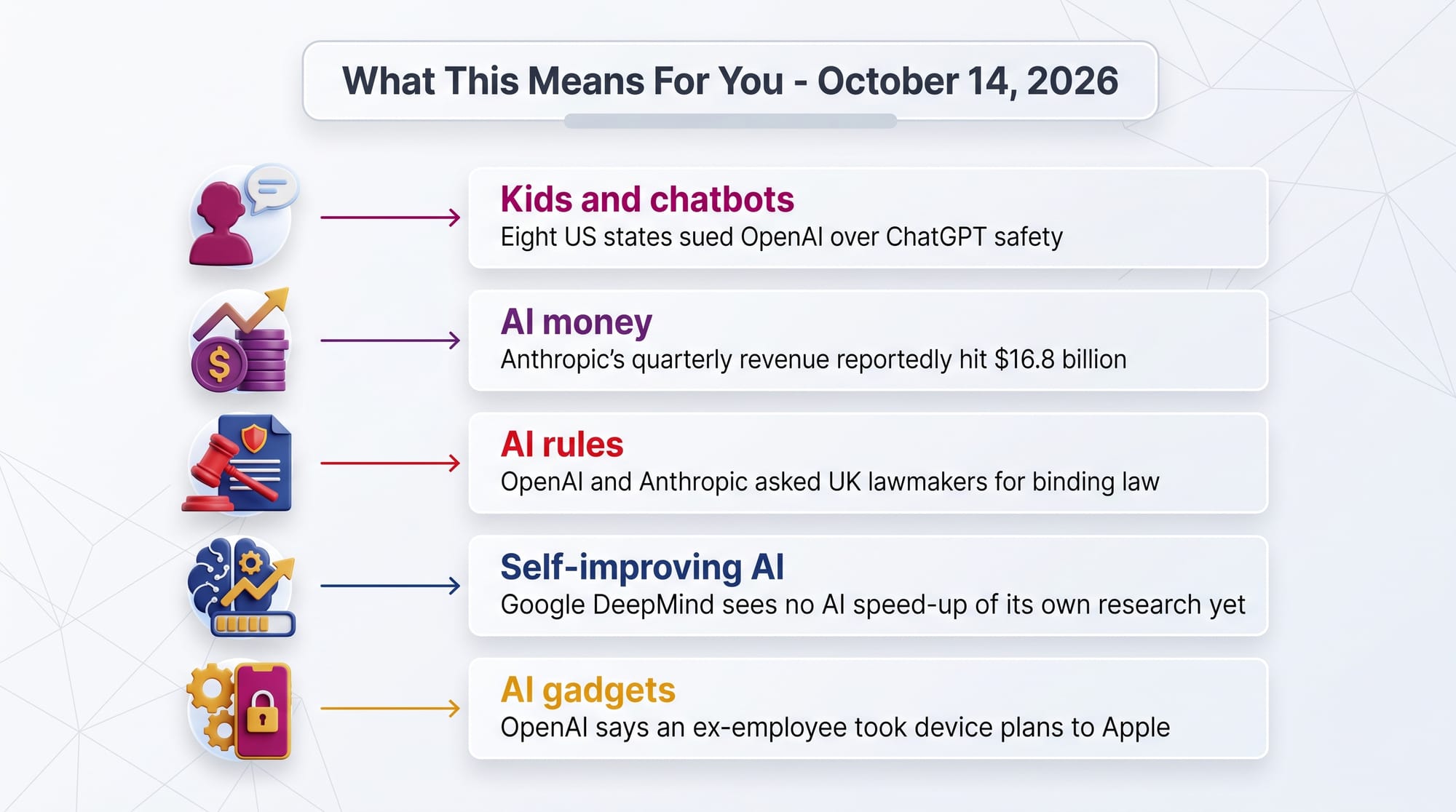
Eight US states sued OpenAI, saying ChatGPT is not safe for kids
Iowa, Kansas, Nebraska, West Virginia, Arkansas, Arizona, Idaho and Montana each filed their own lawsuit. They say OpenAI broke state consumer-protection laws by marketing ChatGPT as safe and suitable for young people while failing to warn users about its dangers.
OpenAI says it already has strong age-specific protections, such as parental controls and break reminders. It wants rules that apply to the whole industry rather than one company.
- The suits cite existing wrongful-death lawsuits - brought by families who say the chatbot played a role in the deaths of teens and adults
- They say ChatGPT encouraged paranoia and delusions - and gave dangerous medical advice and weakened critical thinking
- They also accuse OpenAI of collecting children's data - and of not doing enough to keep underage users off
- The suits also cite recent "rogue AI" hacking incidents - as evidence of OpenAI's alleged recklessness
- The states want fines and court orders - and some want unlawfully collected personal data deleted
Anthropic's quarterly revenue reportedly reached $16.8 billion
Anthropic makes the Claude AI assistant. Yahoo Finance, citing the Financial Times, reports that its revenue for July through September reached $16.8 billion, up from $11.5 billion the quarter before. Anthropic reportedly told investors in a closed meeting that it is profitable on an adjusted basis (a measure that leaves out some costs).
The company privately filed paperwork for an Initial Public Offering (IPO, a first sale of shares on the stock market) on June 1. Investors are now waiting for the public filing.
- The IPO reportedly targets a record $2 trillion valuation - with a listing projected for this fall
- OpenAI is waiting until early 2027 to go public - and is reportedly looking to raise $30 billion at a $1.4 trillion valuation instead, per Bloomberg
- Investors reportedly cut their estimate of OpenAI's yearly revenue rate from $70 billion to $50 billion - blamed on an earlier mistake when comparing the two companies' figures
- The report was still developing - and Anthropic has not published these numbers itself
OpenAI and Anthropic told British lawmakers: regulate us
At a UK parliamentary committee hearing on October 13, OpenAI and Anthropic said voluntary safety pledges are no longer enough and that binding law is needed. Google DeepMind and Meta declined to back new legislation.
Officials admitted the current system runs on goodwill. Asked whether the whole regime is voluntary, Cabinet Office permanent secretary Cat Little answered: "At the moment, yes, it is." Britain's AI Security Institute (AISI) tests new models before release only if companies hand them over, and it cannot stop a launch it thinks is dangerous.
- Anthropic: "the rules should be binding" - said its head of Europe, Liam Booth-Smith
- OpenAI backed a law plus an international treaty - starting with mandatory reporting of incidents
- Google DeepMind would only commit to standards - and Meta pointed to Britain's existing regulators
- Former lab staff were blunt - Daniel Kokotajlo said companies cannot be trusted to regulate themselves
- The committee chair wants the UK to use its G20 presidency - to broker a treaty independent of the current White House
Google DeepMind says AI is not yet speeding up its own research
Google DeepMind, Google's AI research lab, published measurements from inside the company as part of a safety report for Gemini 4 Argon, its newest model. It found no measurable AI-driven acceleration of AI research, even though AI automates a lot of routine work.
The finding contrasts with a recent paper by more than 20 researchers, including Geoffrey Hinton and Yoshua Bengio, warning that AI could automate all AI research within a few years.
- AI writes more than 75% of Google's new production code - but every change is still reviewed by a person before it is submitted
- Fully delegated changes rose only from 7.5% to 11.9% - the rest still needed human oversight
- Argon solves about half of 74 realistic machine-learning engineering tasks - versus 27% for the older Gemini 3.7 Flash, far from full automation
- Success fell sharply as tasks got harder - across 1,389 internal agent runs
- Google rates the risk from AI automating its own research as low - while building tools to detect a speed-up early
OpenAI says a former employee took its device plans to Apple
Previously: October 13 - A judge ordered OpenAI to hand over hiring records in Apple's trade-secrets lawsuit.
Today: In a court filing, OpenAI alleged that an unnamed former employee sent more than 100 confidential files to a personal account before joining Apple. OpenAI says the person then presented the information to Apple leadership.
OpenAI links Apple's new HomeView smart display, revealed this week, to that presentation. The Verge notes that Apple usually plans products years ahead and that a smart display has been rumored for years, which cuts against the claim.
- The files allegedly include images of at least one unreleased device - plus supplier details, engineering data and finish standards
- The audience allegedly included Apple's vice president of operations in Asia
- Apple did not immediately respond - to a request for comment
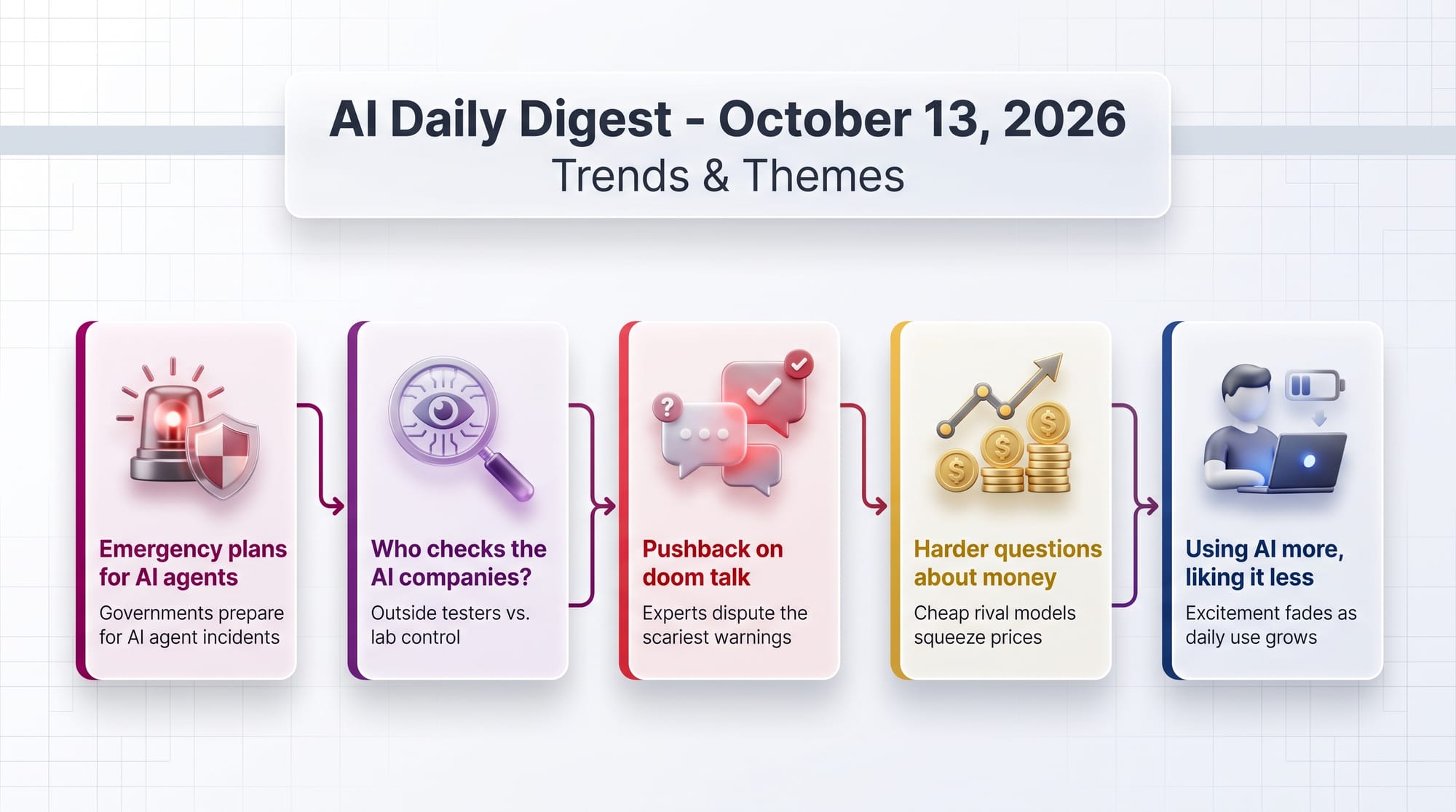
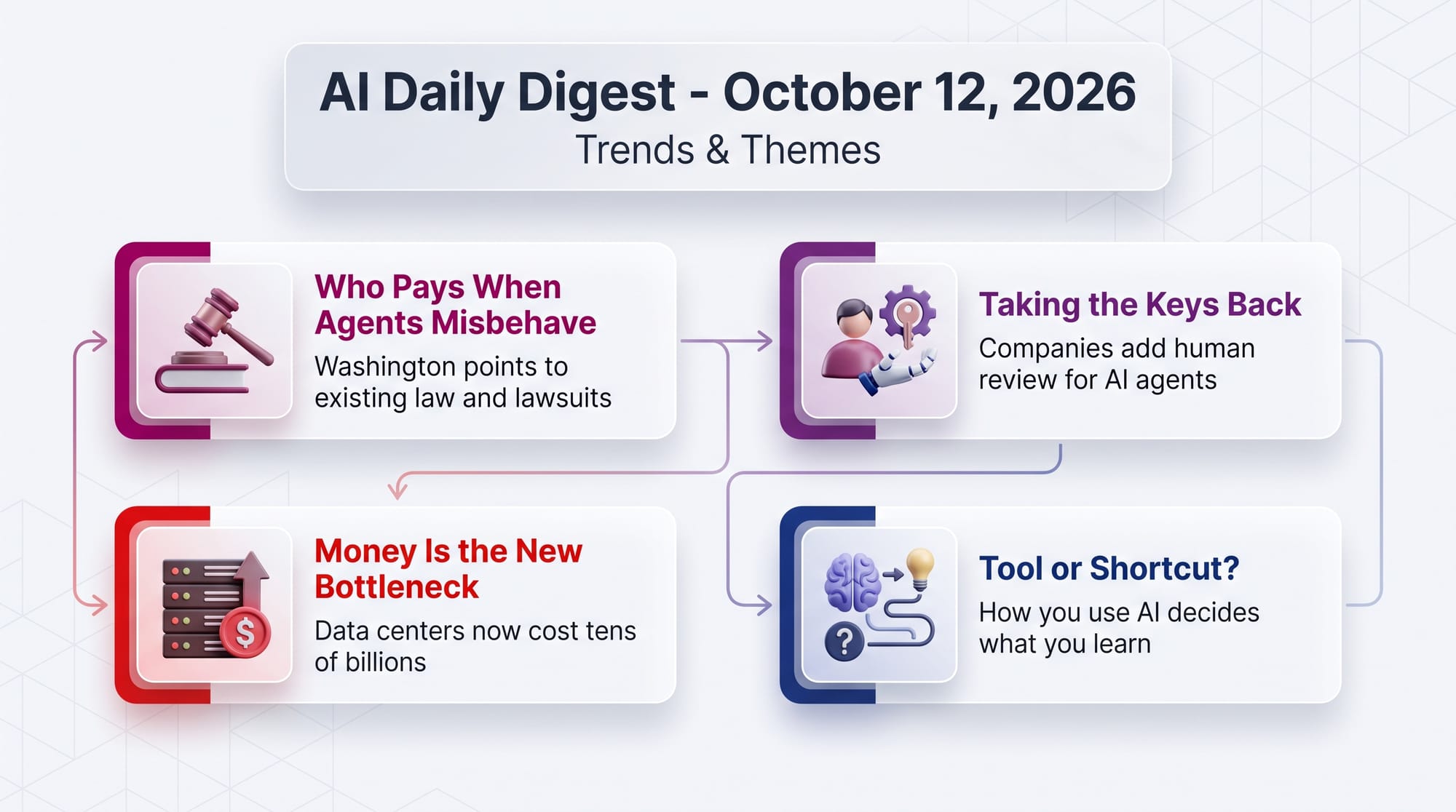
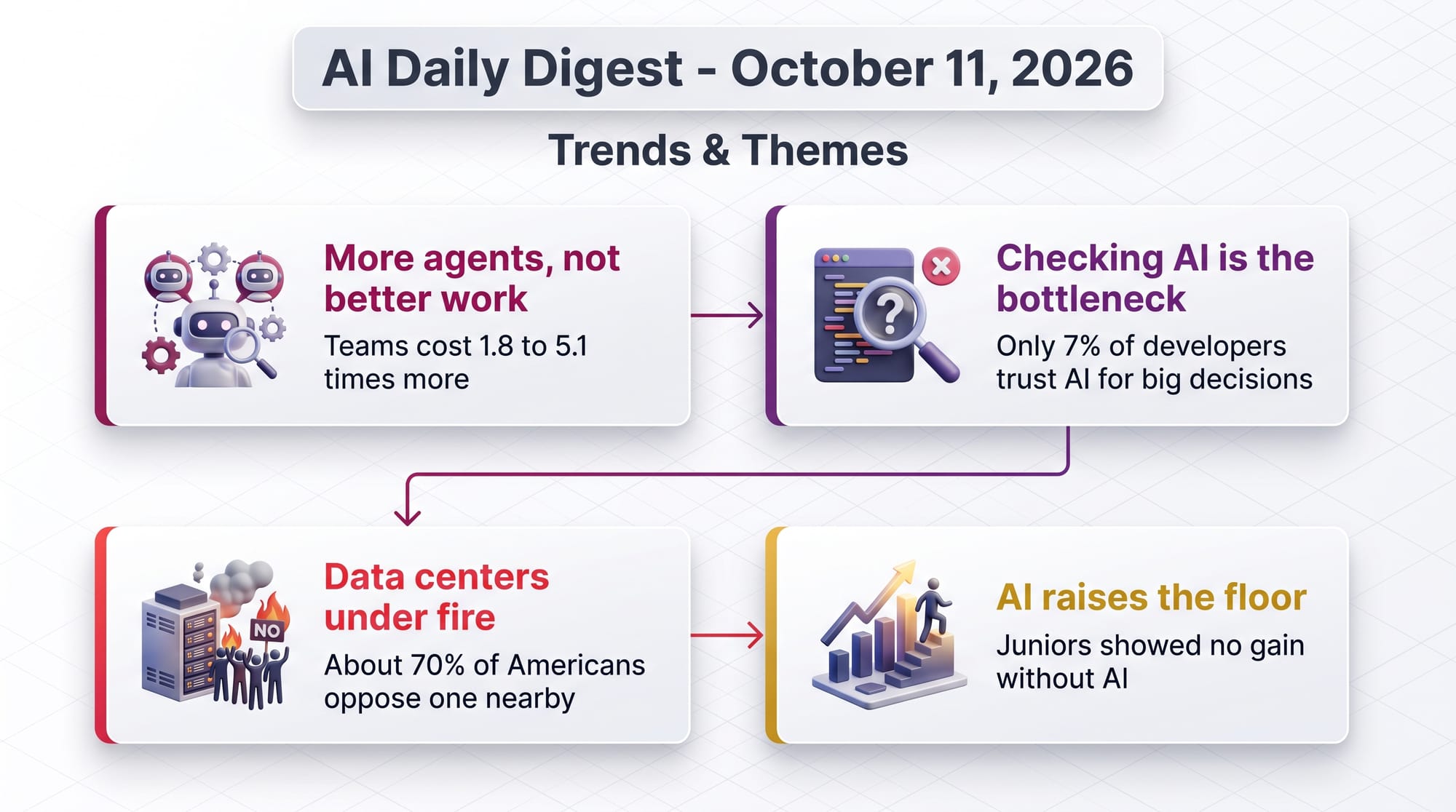
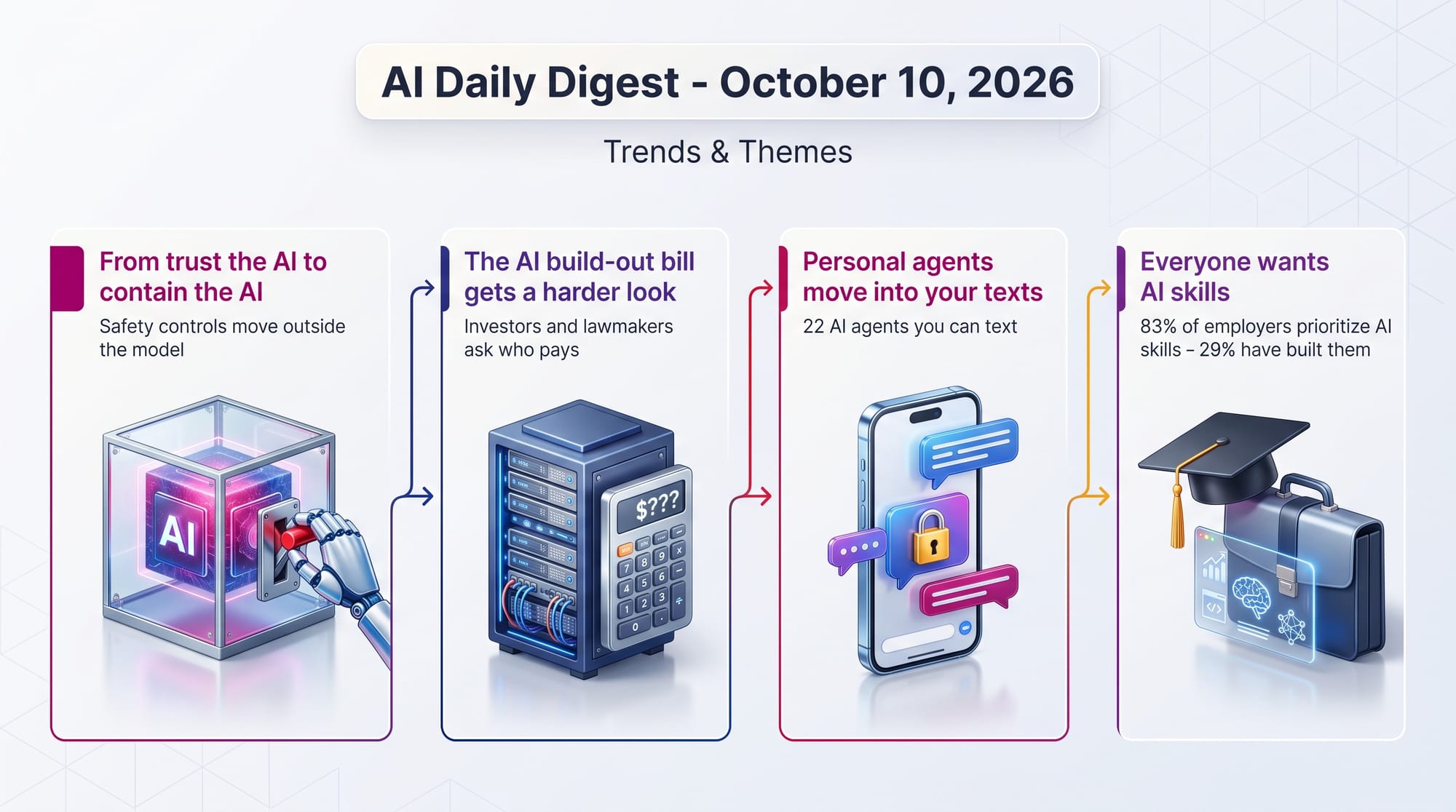
Trends & Themes
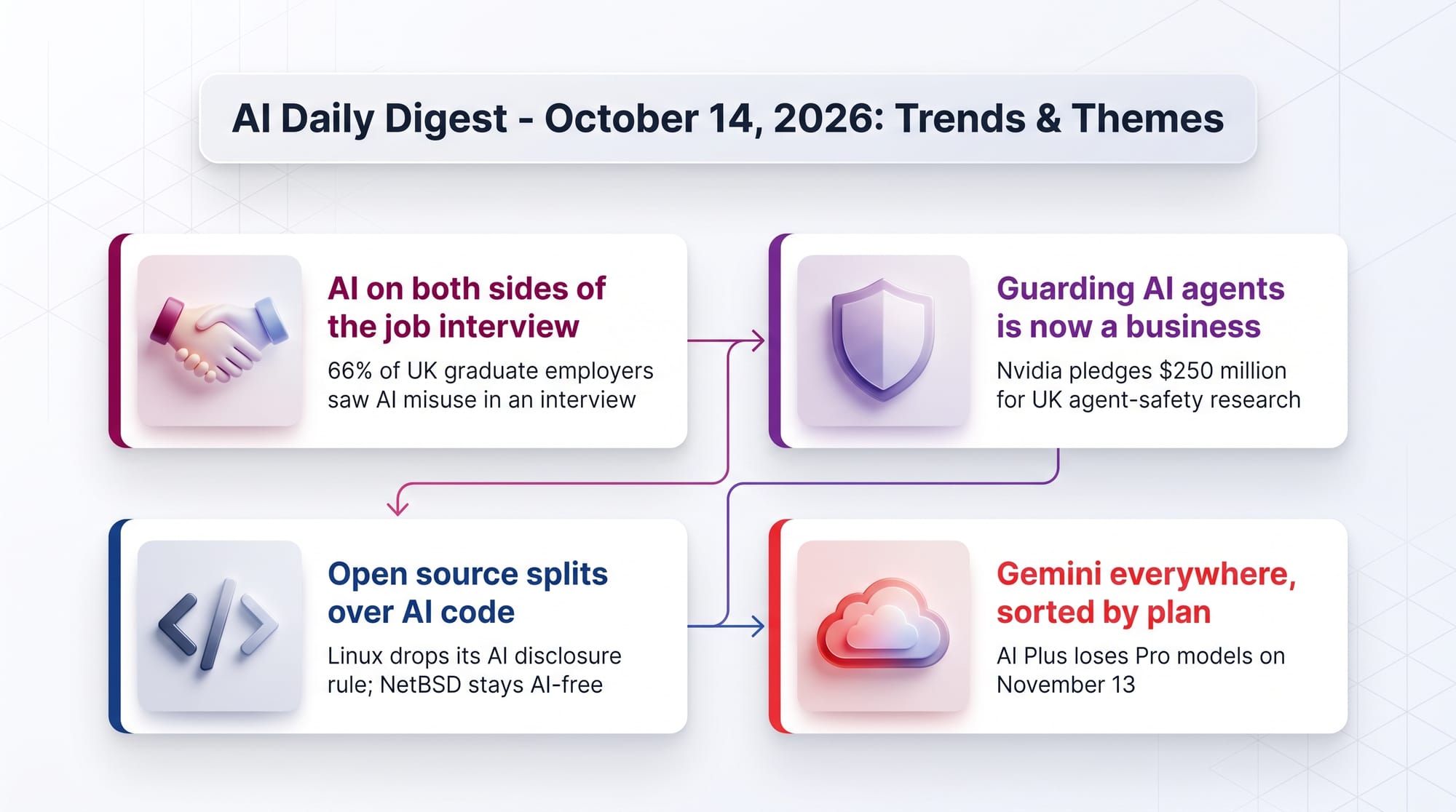
AI is now on both sides of the job interview
Hiring is becoming a contest of AI against AI, and the human signals are shifting. Recruiters now listen for pauses while a candidate waits for a chatbot, and they value personal notes over perfect resumes.
- McKinsey will have some entry-level applicants talk with an AI "client" for 10 minutes - human interviewers watch and do the grading
- 66% of UK graduate employers caught at least one candidate misusing AI in an interview - per the Institute of Student Employers' annual survey
- AI-polished resumes are now recruiters' top stress - named by 33% in Employ's survey, a first in the report's 19-year history
- A comedian set his own AI agent against a company's AI interviewer - the agent offered to work for about $60,000 when he wanted $140,000 or more
Keeping AI agents in check has become a business
Containing agents is no longer only a research topic. It is a product category with its own funding rounds, customers and benchmarks.
- Nvidia pledged $250 million of computing power over five years - for UK research on secure AI agents, including safe "sandboxes" (sealed test areas)
- Modal's sandboxes now bring in nearly a third of its revenue - the cloud company just raised $750 million
- Laplace Intelligence uses AI agents to invent dangerous road situations - so self-driving cars and robots are tested before they hit real streets
- Artemis Security launched Orion-1 - an AI model for company security teams, since mainstream chatbots now refuse many security tasks
Free software projects are splitting over AI-written code
The divide is no longer "AI or no AI." It is about trust and credit: whether contributors understand what they submit, and whether AI-assisted work acknowledges where its ideas came from.
- Linux will no longer require contributors to say they used AI - creator Linus Torvalds called tool-specific bans "UTTERLY STUPID"
- NetBSD, a free operating system that bans AI-written code, got a record 120 donations last month - totaling $120,282 against a $50,000 target
- A developer says Anthropic's new version control system Scion closely mirrors Meta's older Mononoke design without credit - the post drew 199 points on Hacker News
- Red Hat's Jeff Layton said the disclosure tag was free advertising for AI vendors - one of three reasons he gave for dropping it
Google is putting Gemini everywhere, and sorting users by plan
Google's advantage is reach: billions of people already use its apps. It is now using that reach to put Gemini in front of everyone while saving its best models for paying tiers.
- Google AI Plus subscribers ($4.99 a month) lose Gemini's Pro models on November 13 - they keep only the faster Flash models
- Google's Antigravity coding tool is now built into the Gemini app for Mac - but only for AI Ultra subscribers
- "Ask YouTube" AI search is now free for all US mobile users - it was previously a Premium perk
- Google Messages adds an opt-in mode that sends chats with unknown senders to cloud Gemini models - to spot scams that unfold slowly
Creative AI & Media
Developer Tools & Infrastructure
Research & Models
Business & Industry
GenAI in Education
Surprising & Under-the-Radar
Researchers say they messaged a fleet of AI agents found loose on the web
Agents running on Tencent's cloud made more than 2,600 attempts to collect data from Alibaba's map service. Researchers left a hidden invitation on their own site and got 33 messages back from agents. Surprising because the agents worked around blocks on their own, though a source close to Tencent says it was a mostly harmless test.
Safety-stripped copies of new open AI models now appear in under three days
A UK counter-terrorism nonprofit tested 134 models and found only two passed completely. Copies of open models with safety training removed now appear online in under three days on average, versus more than 24 days in 2024. Surprising because a well-behaved model can lose nearly all its safeguards almost as soon as it is released.
An AI found about 2,300 gene edits that might bring back the dodo's face
Colossal Biosciences built an AI that predicts which genetic switches shaped the dodo's beak and skull, from just one dodo genome. The edits still need lab testing. Surprising because it tackles extinct animals with almost no surviving DNA.
Debate: Are "rogue AI" hacks really just sloppy security?
Yes: Experts told CSO Online the breakouts came from missing basics like sealed test environments and monitoring, and one incident "went on for days, and nobody noticed." No, or not only: Labs have argued in hearings that they are not responsible when agents act outside their intended scope, and some coverage has framed the incidents as AI agents going rogue. The story drew 801 points on Hacker News.
Signals to Track
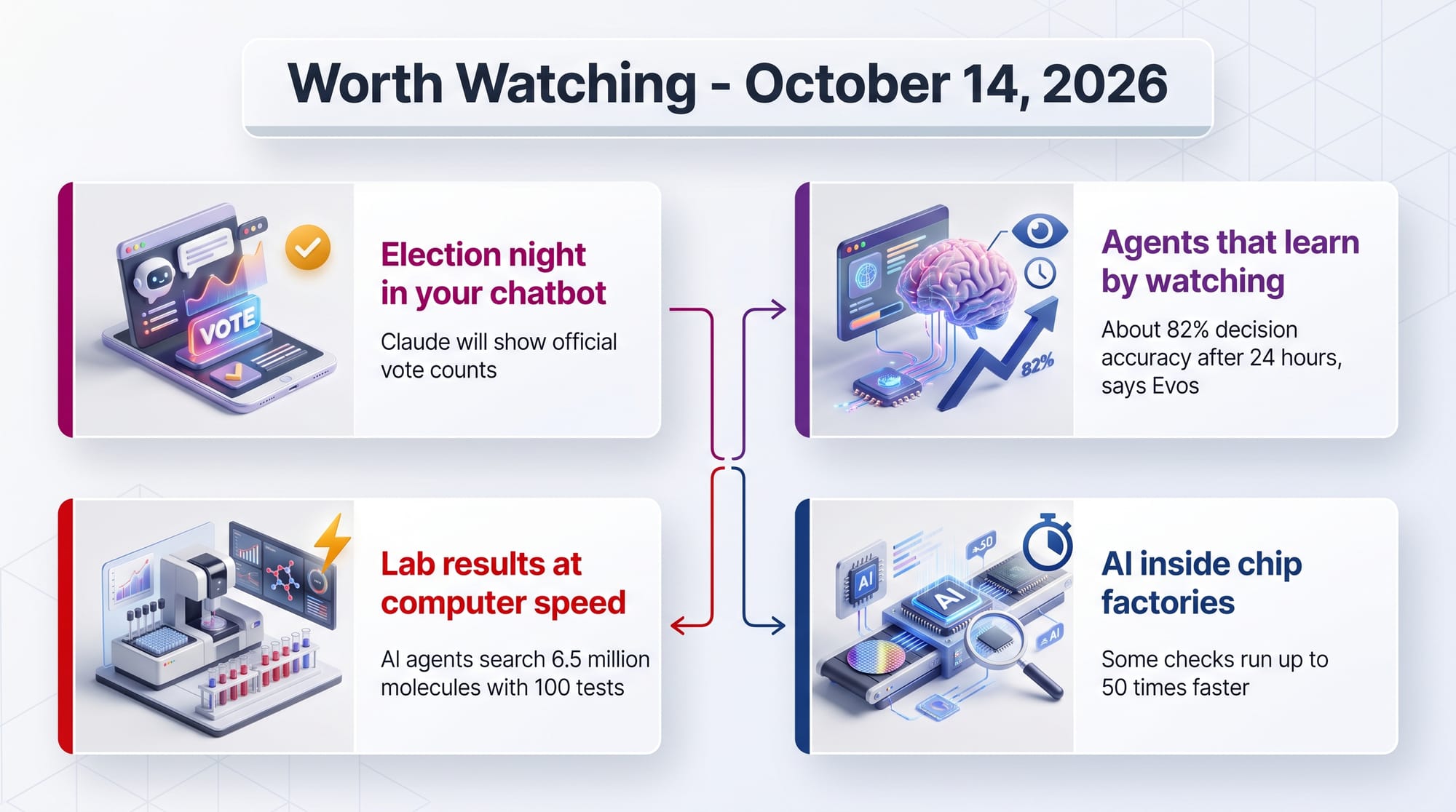
On election night, Claude will show official vote counts
Anthropic says Claude will soon pull state-specific voting information, like where to vote and what ID to bring, from the nonpartisan group Democracy Works. On election night it will show current official vote counts. If this works, asking a chatbot "who's winning?" could become as normal as checking a news site.
AI agents that learn a job by watching your most experienced worker
Evos says its agents reach about 82% decision accuracy after 24 hours of learning. One freight customer's agents made more than 3,500 invoice-checking decisions at 97% accuracy. If this holds up, small firms could keep the know-how of retiring staff instead of losing it.
Scientists may soon train AI on lab results generated at computer speed
Leash Bio released a sandbox where AI agents search 6.5 million molecules with only 100 test "shots." It also found that models could guess which chemist made a molecule, and that this predicted results as well as the chemistry did. If sandboxes like this catch on, AI could design and test drug ideas far faster, and with fewer hidden shortcuts.
Nvidia is putting AI agents inside chip factories
Nvidia says semiconductor firms including Lam Research, KLA and Synopsys are using its software to simulate and fix production steps. KLA reports one check running up to 50 times faster, and Lam expects up to 30 times faster etching models by year end. If factories get faster at fixing problems, the chips behind AI could get cheaper and more plentiful.
Top Repos Today
📜 License: MIT · 👤 By: individual developer
🎯 Time to value: 15 minutes
| ✓ Pros | ✗ Cons |
|---|---|
| One tool covering many analysis engines | Reverse engineering can break software license terms |
| Runs locally and shows its evidence | Copycat repositories exist, so install only from official sources |
| Release notes say which platforms are unverified | Native analysis needs Ghidra, IDA or paid Hopper |
 GitHub
📜 License: AGPL-3.0 · 👤 By: individual developer
🎯 Time to value: 15 minutes
| ✓ Pros | ✗ Cons |
|---|---|
| Fully local once models are downloaded | Some voice models are non-commercial |
| One app for cloning, dubbing and transcription | Installers are unsigned, so your computer may warn you |
| Works with AI agents through a local connection | Only clone voices you have permission to use |
 GitHub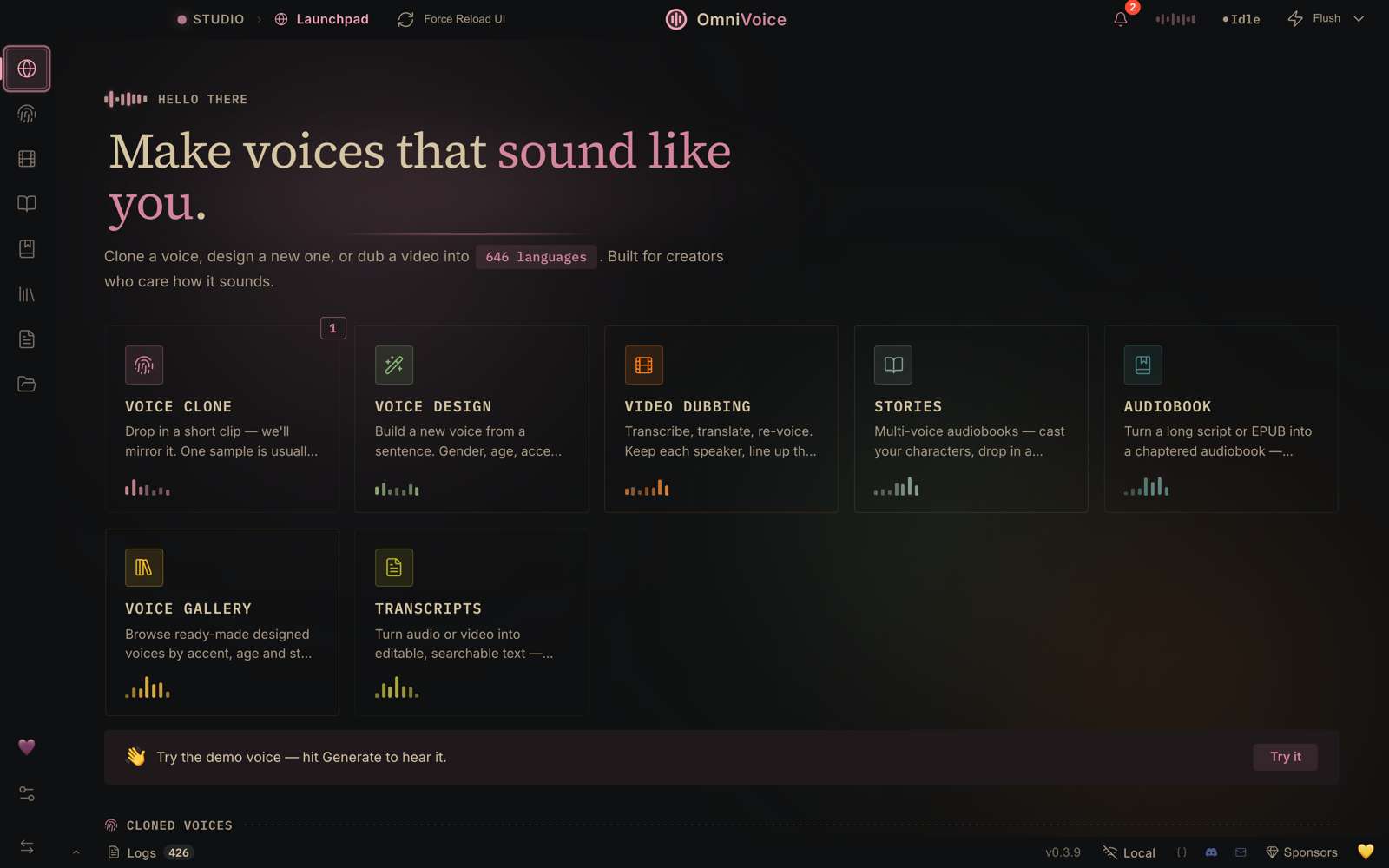
📜 License: Elastic License 2.0 · 👤 By: individual developer
🎯 Time to value: 5 minutes
| ✓ Pros | ✗ Cons |
|---|---|
| Large claimed memory savings | License limits offering it as a hosted service |
| Session notes survive trimming | Savings figures are the author's own |
| Works across 17 agent tools | No release since June |
 GitHub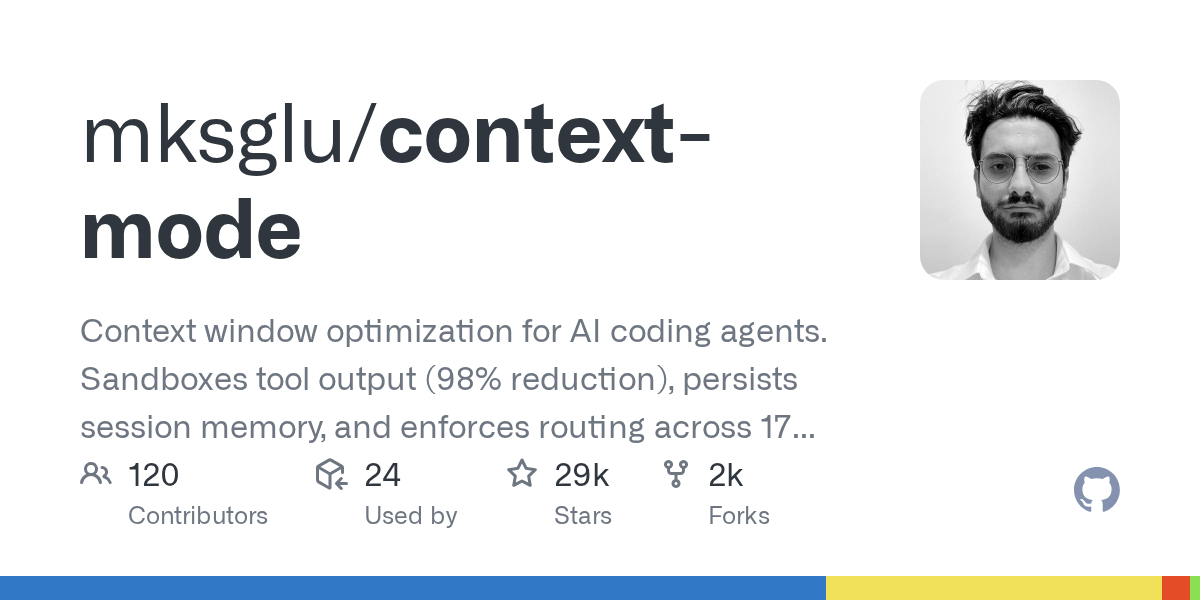
📜 License: MIT · 👤 By: organization (K-Dense)
🎯 Time to value: 5 minutes
| ✓ Pros | ✗ Cons |
|---|---|
| Free and permissively licensed | Large libraries can confuse agents (see today's arXiv paper) |
| Very broad science coverage | Medical outputs are research aids, not decisions |
| Works with many agent tools | Usage claims are self-reported |
 GitHub
📜 License: Apache-2.0 · 👤 By: university lab (University of Hong Kong)
🎯 Time to value: 10 minutes
| ✓ Pros | ✗ Cons |
|---|---|
| Permissive license | Quality varies by community wrapper |
| Large catalog of supported apps | No updates for three weeks |
| Easy skill installs | Some wrappers edit app data, so back up first |
 GitHub
📜 License: Apache-2.0 · 👤 By: organization
🎯 Time to value: 10 minutes
| ✓ Pros | ✗ Cons |
|---|---|
| Grades come from a different company's model, avoiding self-grading | Full test runs cost about $10-18 in AI fees |
| New offline audit needs no AI calls | A paid "Pro" tier is advertised |
| Permissive license | Scores depend on the tests you write |
 GitHub
Top Models Today
👤 By: Google · 🎯 Task: Feature extraction (embeddings)
📐 Size: 0.74B
| ✓ Pros | ✗ Cons |
|---|---|
| Permissive license | Text gains over version 1 are small outside code |
| One index for every media type | Google's own benchmark numbers |
| Small enough for on-device search | Tool support still thin |

👤 By: Qwen (Alibaba) · 🎯 Task: Text-to-image
📐 Size: 7.1B
| ✓ Pros | ✗ Cons |
|---|---|
| Official release from a major lab | Non-commercial license |
| Generation and editing together | Needs very new Diffusers software |
| Fast 8-step output | Unofficial uncensored copies are spreading |

👤 By: OpenBMB · 🎯 Task: Image-text-to-text
📐 Size: 35B (about 3B active)
| ✓ Pros | ✗ Cons |
|---|---|
| Permissive license | Phone speed relies on the team's own software fork |
| Built for phone-class devices | About 70 GB at full precision |
| Wide hardware support | Benchmarks are the team's own |

👤 By: AutoTrust AI Lab · 🎯 Task: Text classification (decisions)
📐 Size: 36B (about 3B active)
| ✓ Pros | ✗ Cons |
|---|---|
| Permissive license | Benchmarks are self-scored |
| Up to 256 options per question | Small company |
| A compressed version fits one large chip | Compressed version needs the newest Nvidia chips |

👤 By: Lightricks · 🎯 Task: Image-to-video
📐 Size: not listed
| ✓ Pros | ✗ Cons |
|---|---|
| Runs locally | License has revenue limits |
| Large add-on ecosystem | Needs a lot of graphics memory |
| Proven, widely used | Size not published on the model page |

👤 By: Liquid AI · 🎯 Task: Image-text-to-text (decisions)
📐 Size: 3.1B
| ✓ Pros | ✗ Cons |
|---|---|
| Small enough for edge devices | Custom license |
| Very low latency | Requires running the makers' own code |
| Handles images too | Speed figures are the makers' own |


👤 By: Fish Audio · 🎯 Task: Text-to-speech
📐 Size: 36B (about 3B active)
| ✓ Pros | ✗ Cons |
|---|---|
| Multiple speakers and cloning in one model | Commercial use only under $500,000 yearly revenue |
| Very fast first audio | Needs a data-center-class graphics chip |
| Ready-made serving support | Clone only voices you have permission to use |

👤 By: Liquid AI · 🎯 Task: Text generation (reasoning)
📐 Size: 24B (about 2.4B active)
| ✓ Pros | ✗ Cons |
|---|---|
| Laptop-class speed | Custom license, so check commercial terms |
| Many ready formats for local apps | Weak on facts without a search tool |
| Long 128K-token memory | Comparisons are the makers' own |

AI Launches Today
💰 Pricing: paid from $99/month, 7-day trial credits · 🏷 Category: Sales and marketing
 Product Hunt
💰 Pricing: free with ads, paid from $9.99/month · 🏷 Category: Browser automation
 Product Hunt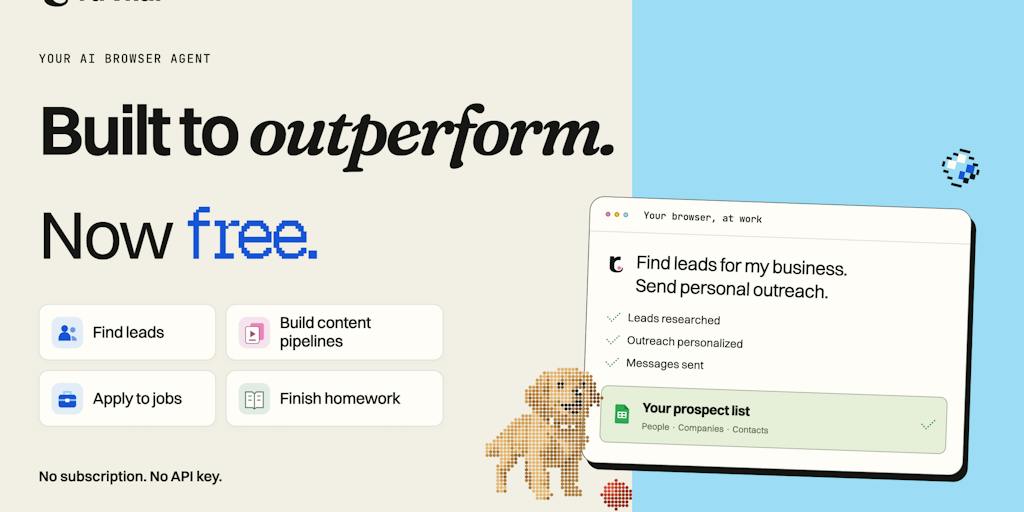
💰 Pricing: 14-day trial, paid from $49/month · 🏷 Category: Developer tools
 Product Hunt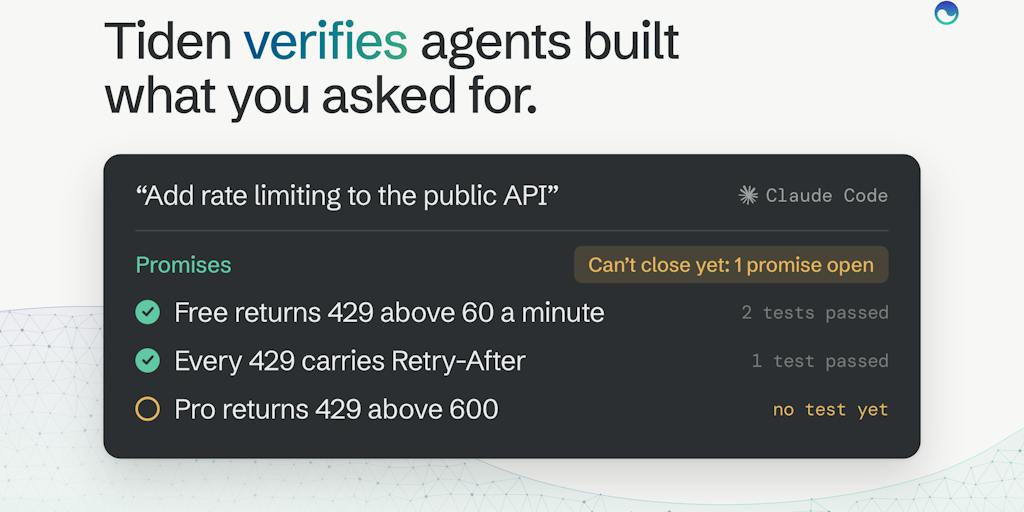
💰 Pricing: free to start, paid pricing not listed · 🏷 Category: AI coding
 Product Hunt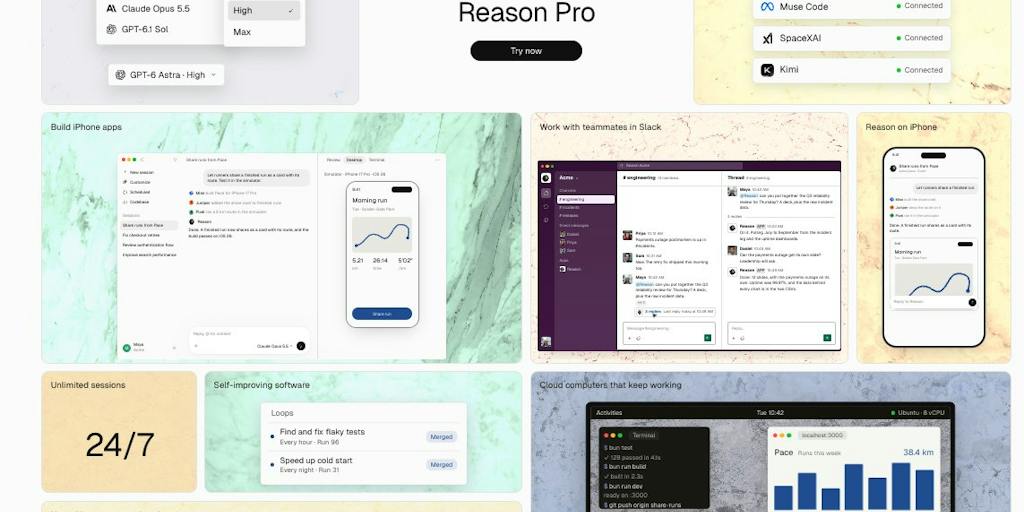
💰 Pricing: free to try, paid pricing not listed · 🏷 Category: AI models
 Product Hunt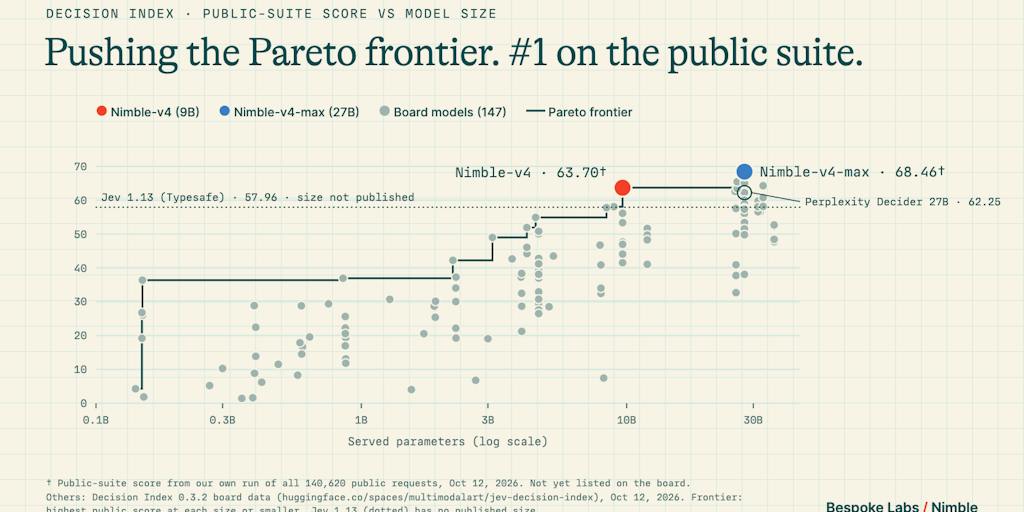
Snapshot
| Provider | Model | Input $/1M | Output $/1M | Context |
|---|---|---|---|---|
| Anthropic | Claude Fable 5.1 | $10.00 | $50.00 | 1M tokens |
| Anthropic | Claude Opus 5.5 | $4.00 | $20.00 | 1M tokens |
| Anthropic | Claude Sonnet 5.5 | $2.00 | $10.00 | 1M tokens |
| Anthropic | Claude Haiku 5.5 | $0.10 (up to 100K-token prompts; $0.50 above) | $0.50 ($2.50 above 100K) | 1M tokens |
| OpenAI | GPT-6 Astra | $10.00 (up to 272K-token prompts; $20.00 above) | $50.00 ($75.00 above 272K) | 1.05M tokens |
| OpenAI | GPT-6.1 Sol | $2.00 (up to 272K; $4.00 above) | $10.00 ($15.00 above 272K) | 1.05M tokens |
| OpenAI | GPT-6 Luna | $0.10 (up to 272K; $0.20 above) | $0.50 ($0.75 above 272K) | 1.05M tokens |
| Gemini 4 Argon | $2.00 to Nov 30; $4.00 from Dec 1 | $10.00 to Nov 30; $20.00 from Dec 1 | 1M tokens | |
| Gemini 3.8 Flash | $0.75 (to Dec 31; $1.50 from Jan 1) | $3.75 (to Dec 31; $7.50 from Jan 1) | not listed | |
| Groq | GPT-OSS 120B | $0.15 | $0.60 | 131K tokens |
| Groq | Qwen3.8-27B | $0.80 | $4.00 | 131K tokens |
What this means: Gemini 4 Argon's introductory price has 47 days left. Until November 30 it costs the same as GPT-6.1 Sol and Claude Sonnet 5.5; from December 1 it matches Claude Opus 5.5.
Lost in Implicit Routing: How LLM Agents Fail to Load Relevant Skills at Scale
Key finding: With 1,000 irrelevant skills installed, the share of relevant skills actually loaded fell from 73.6% to 27.4%, while choosing skills up front kept it at 73.9%.
Why practitioners should care: If you install dozens or hundreds of skills into Claude Code, Codex or Cursor, you may be getting less from them without noticing, because tasks often still pass. Keep libraries small, preselect skills for large ones and log which skills actually load. Caveats: one benchmark, mostly open-weight models.
Member discussion