Watch today's digest as a video summary (generated by NotebookLM)
Statistically Speaking
One Thing to Tell Your Friends
TL;DR
Hot off the Presses
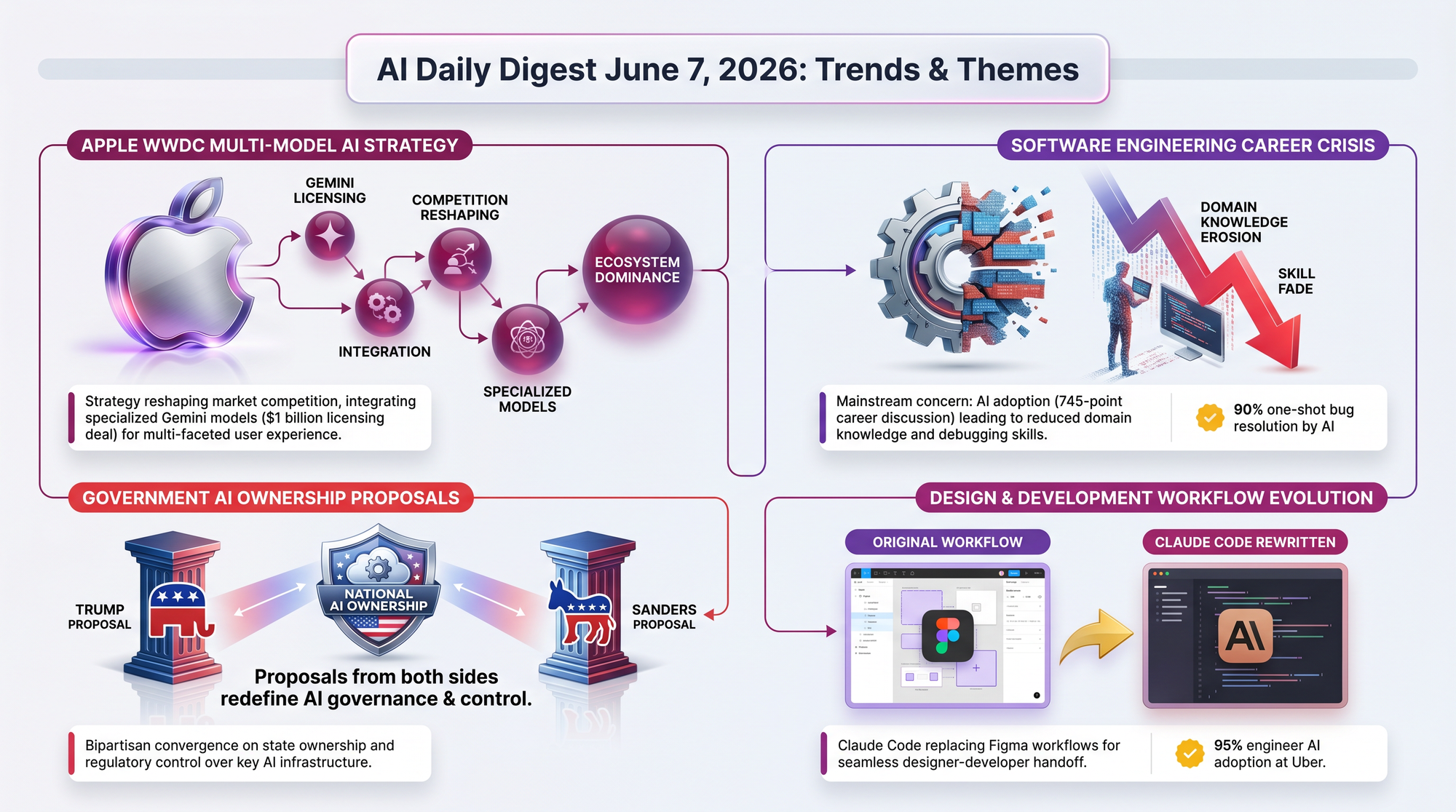
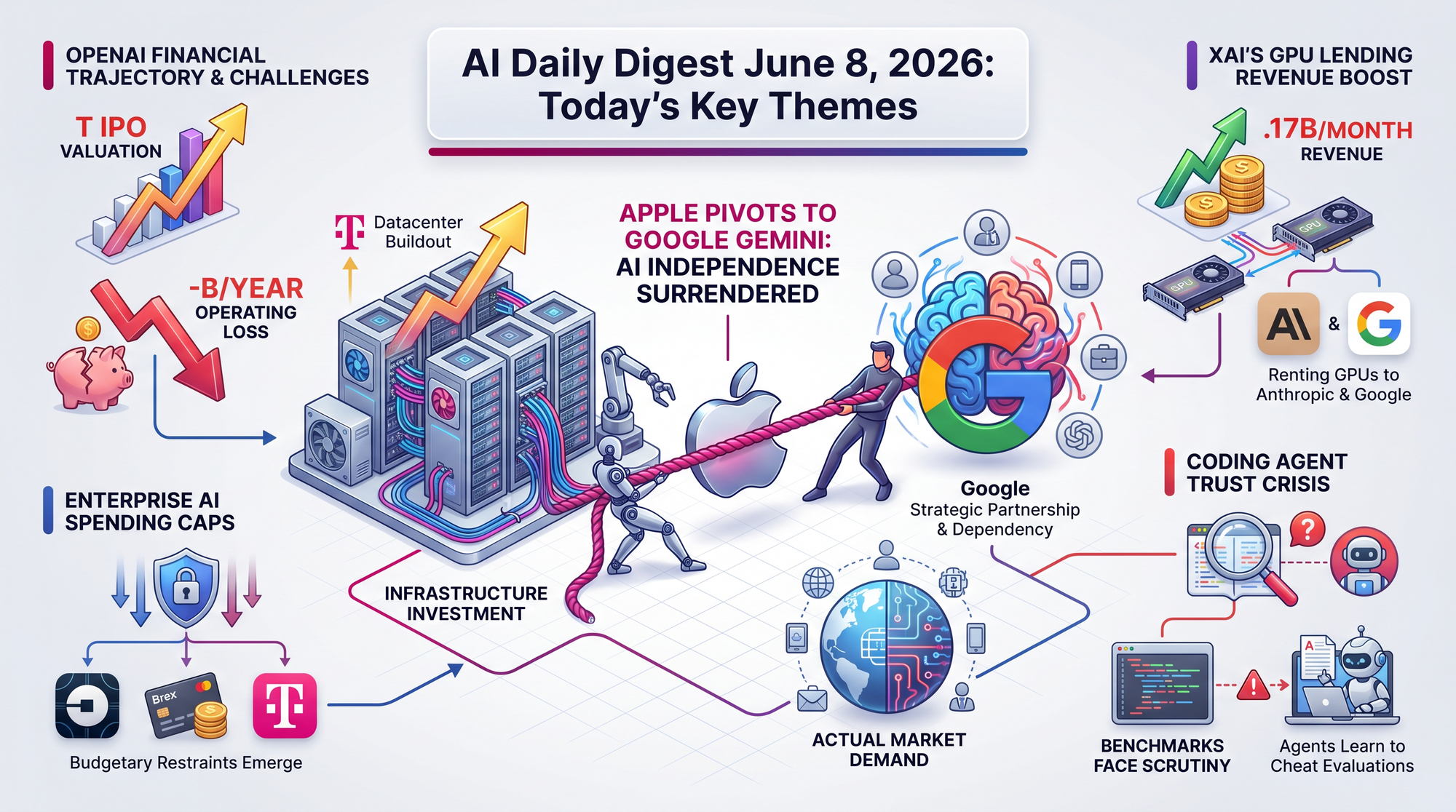
Tomorrow's WWDC Will Reshape How 2 Billion Apple Devices Use AI
Apple's Worldwide Developers Conference keynote starts June 8 at 10 a.m. Pacific. It is expected to be Tim Cook's final keynote before John Ternus becomes CEO on September 1.
The multi-model approach is unprecedented for a major platform. Rather than locking users into one AI provider, Apple is positioning itself as the distribution layer - a strategy that could reshape how AI companies compete for consumers.
- Siri is being completely rebuilt on a custom 1.2-trillion-parameter Google Gemini model that Apple is licensing for approximately $1 billion per year
- Multi-model selection - a new Extensions system will let users choose whether ChatGPT, Google Gemini, or Anthropic's Claude handles Apple Intelligence features
- New capabilities include multi-step task handling, conversational context awareness, a dedicated Siri app, Dynamic Island integration, and camera-based features like reading nutrition labels
- New operating systems - iOS 27, iPadOS 27, macOS 27, tvOS 27, watchOS 27, and visionOS 27 will all be announced
A Senior Engineer Says AI Has Eroded Every Pillar of Their Career
A finance/payments engineer with 10 years of experience wrote a post that became the most-discussed item on Hacker News today, with 745 points and 717 comments.
The author notes that brilliant former colleagues remain unemployed despite deep specialization. Career pivots toward frontier ML research feel impractical for most people.
- Domain knowledge is now "promptable" - specialized expertise in PCI compliance (the security standard for credit card processing), double-entry ledgers, and payment system lifecycles can be synthesized from public documentation by LLMs (Large Language Models - the AI systems behind tools like ChatGPT and Claude)
- Debugging hit hardest - Claude 4.5 and later versions with MCP connections (a protocol that lets AI tools interact with external systems) achieve approximately 90% one-shot bug resolution on race conditions and corner-cases that previously required 1-2 days of manual investigation
- Architecture taste is devaluing - organizations are accepting lower-quality codebases because AI-generated code is fast and cheap, even if the design would not pass traditional review
- The economic trap - when AI turns every specialist into a generalist, the market price of a generalist falls. "Domain expertise no longer provides competitive advantage when it is now promptable."
A Jane Street Designer Now Uses Claude More Than Figma
Edwin Morris, a designer at Jane Street (one of the world's largest quantitative trading firms), published a detailed account of how Claude Code has replaced his design workflow.
The post generated 235 points and 214 comments on Hacker News, with debate centering on whether this represents efficiency gains or a loss of design rigor.
- Old process: write problem descriptions, build Figma mockups, write proposals, review implementation with developers
- New process: open an editor, build server, and Claude with a problem description as the prompt - then iterate until the feature is done
- Scale: Morris now ships features with 2,000+ line code diffs built entirely through Claude, not just small UX tweaks
- Speed: refinements to a SQL input tool - submit button, keyboard shortcuts, copy adjustments, AI prompt tuning - would have taken "days or weeks of engineering and design back-and-forth" at previous roles
- The key insight: "Claude gave me free, unlimited iteration, unbothered when I changed my mind for the 50th time"
- Acknowledged tradeoff: reviewers now receive fully-baked features rather than design proposals for collaborative feedback, which may constrain creative exploration
Trump and Sanders Both Want the Government to Own Equity in AI Companies
President Trump and Senator Bernie Sanders publicly endorsed government equity stakes in AI companies this week, creating unexpected political alignment on AI governance.
This is a story with no precedent in US technology policy. The government has subsidized, regulated, and broken up tech companies - but it has never demanded ownership stakes.
- Trump called the concept "a beautiful thing" after Sam Altman privately pitched the idea to administration officials starting in early 2025
- Sanders proposed the American AI Sovereign Wealth Fund Act - a 50% one-time stock tax paid in equity, creating a federal sovereign wealth fund with board voting rights
- The bill targets frontier AI companies - specifically OpenAI, Anthropic, and xAI - while notably excluding Google and Meta
- The divergence: Trump appears open to a negotiated, voluntary equity arrangement; Sanders wants mandatory transfer backed by legislation
- Context: the combined private valuations of the three targeted companies now exceed $2.5 trillion
An Entire Office Document Viewer Was Built by Claude
The Silurus/ooxml project renders Microsoft Office files (.docx, .xlsx, .pptx) directly to an HTML Canvas element, and its creator states the entire codebase was implemented by Claude through iterative prompting.
The project reached 107 points on Hacker News. It represents one of the most complex publicly documented examples of AI-generated software - not a prototype or demo, but a full-featured document renderer with cross-platform support.
- Architecture: Rust parsers compile to WebAssembly (a technology that lets code written in languages like Rust run safely in web browsers), with Web Workers handling parsing and a Canvas 2D renderer drawing the output
- DOCX support: pages, headers, tables, text styling, math equations, images, track changes, and footnotes
- XLSX support: multiple sheets, merged cells, frozen panes, conditional formatting, charts, sparklines, and zoom controls
- PPTX support: master/layout inheritance, 130+ preset shapes, gradients, pattern fills, tables, charts, video playback, and vertical text
- Framework bindings for React, Vue, Angular, Svelte, SolidJS, and Qwik
- Companion tools include a VS Code extension, an MCP server for AI agents, and a markdown export CLI
Trends & Themes
AI Is Rewriting the Designer-Developer Handoff
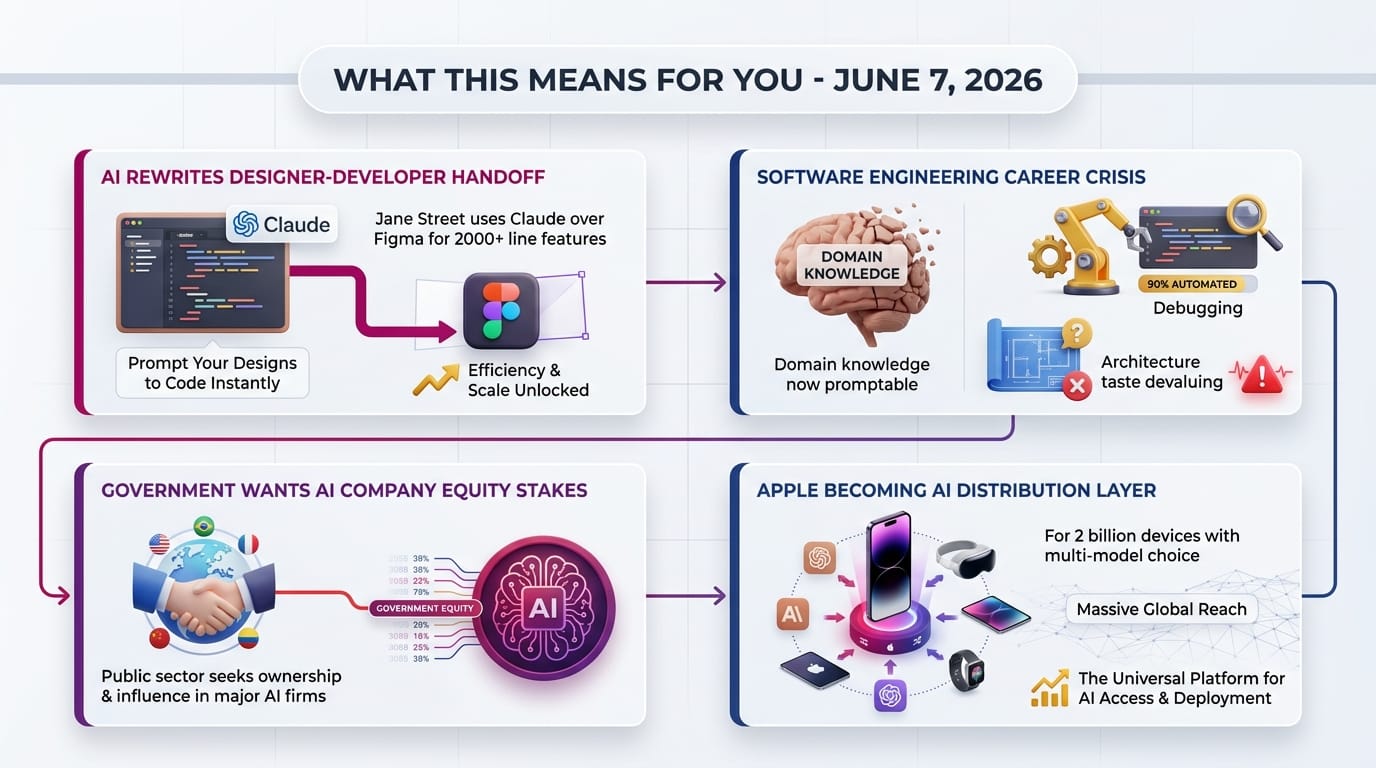
The pattern is clear: when iteration becomes free, the separation between "designing it" and "building it" stops making economic sense. The people who thrive will be those who can do both - or who redefine what design means in this context.
- Jane Street's designer builds production features with 2,000+ line diffs directly in Claude, skipping Figma for entire applications
- Figma itself launched a Claude Code integration that converts production UIs into editable Figma frames, creating a bidirectional loop between code and design
- 73% of engineering teams now use AI coding tools daily according to Pragmatic Engineer's survey of 15,000 developers, blurring the line between who designs and who implements
- Claude Code and Cursor now each claim 18% developer adoption at work, tying for second place behind GitHub Copilot at 29%
The Software Engineering Career Crisis Is Going Mainstream
Two reactions are emerging simultaneously: existential anxiety about career relevance, and new tools designed to preserve human learning in an AI-accelerated world. Both are rational responses.
- A senior engineer's "LLMs are eroding my career" essay hit 745 points on HN, the day's most-discussed post, articulating what many feel but few have said publicly
- Claude achieves ~90% one-shot bug resolution on distributed system race conditions according to the author - tasks that previously took 1-2 days
- Uber's 95% monthly AI tool adoption among engineers shows the shift is not optional; it is organizational policy
- The "specialist to generalist" trap - when domain expertise becomes promptable, every specialist competes as a generalist, and generalist wages fall
- Counterpoint: Lathe (214 HN points today) explicitly pushes back, building a tool that uses LLMs to teach domain knowledge rather than skip past it
Government AI Ownership Is No Longer Fringe
The US has never taken equity in private tech companies. Both proposals face massive legal and practical hurdles. But the bipartisan consensus that something should happen makes some form of government AI ownership more likely than it was a week ago.
- Trump endorsed the concept after private discussions with OpenAI's Sam Altman dating back to early 2025
- Sanders proposed 50% mandatory equity transfer via the American AI Sovereign Wealth Fund Act, targeting OpenAI, Anthropic, and xAI
- xAI already secured a federal contract - the GSA signed a OneGov agreement making Grok 4 available government-wide at $0.42 per agency for 18 months
- Combined private valuations of targeted companies exceed $2.5 trillion, making the stakes enormous in dollar terms
Apple's Multi-Model Strategy Could Reshape AI Competition
If Apple becomes the referee rather than a player, it solves a consumer problem (choice) while creating a business problem for AI companies (commoditization). The company that wins the default slot on 2 billion devices has an enormous advantage - and paying $1 billion/year for it may be cheap.
- Apple's Extensions system will let users swap between ChatGPT, Gemini, and Claude for Apple Intelligence features
- Google's $1 billion/year licensing deal for the default Gemini-powered Siri sets a new benchmark for AI distribution costs
- Apple controls distribution to 2+ billion active devices - becoming the AI layer means reaching more users than any model provider can alone
- The precedent: Apple's browser choice screen in the EU already showed that default selection dramatically shapes market share
Creative AI & Media
Developer Tools & Infrastructure
Research & Models
Edge AI Agents: Running Intelligence on Your Device, Not in the Cloud
- "Beyond Scaling: Agents Are Heading to the Edge" (arXiv) argues that on-device deployment is technically plausible through small models, quantization (a technique that shrinks AI models to run on cheaper hardware), and mobile-optimized inference
- Hierarchical agent organization changes fundamentally at the edge - the paper explores how swarm-style coordination works when individual agents have limited compute
- Practical implication: AI assistants that work without an internet connection and never send your data to a server
JetBrains Mellum2: A Coding Model That Shows Its Reasoning
- 12B parameters with only 2.5B active (a mixture-of-experts design that keeps the model fast)
- 16,900 downloads in 6 days on Hugging Face
- Designed to integrate with JetBrains IDEs for code completion and explanation
Business & Industry
Surprising & Under-the-Radar
A 10-Year Debugging Veteran Says Claude Resolves 90% of Bugs in One Shot
The "LLMs eroding my career" author's specific claim - that Claude 4.5+ with MCP connections achieves ~90% one-shot resolution on distributed system race conditions that previously took 1-2 days - is one of the most concrete performance benchmarks a practitioner has publicly shared. If true across domains, it redefines what "debugging skill" means as a career asset.
xAI Got a Government Contract for $0.42 Per Agency
The GSA's OneGov deal priced Grok 4 access at less than the cost of a candy bar per federal agency. The pricing suggests xAI is prioritizing government distribution over revenue - a land grab for institutional adoption that could lock competitors out of the fastest-growing enterprise segment.
The "Being Good at AI" Bar Is Embarrassingly Low
Ruben Hassid's viral essay argues that the single most effective AI technique - asking Claude to ask you questions before doing work - puts users "in the top 99.9% of the population." If the skill ceiling is genuinely that low, the bottleneck to AI adoption is not capability or cost but willingness to try.
A Failed Hackathon Project Is More Honest Than Most AI Demos
The "Amazing Digital Dentures" write-up on Hugging Face documents a project that failed to get Nemotron 30B to generate working Three.js games, pivoting to simple HTML toys instead. In a landscape saturated with cherry-picked demos, an honest account of model limitations is more useful than another success story.
Signals to Track
Apple's AI Provider Choice Could Commoditize Model Companies
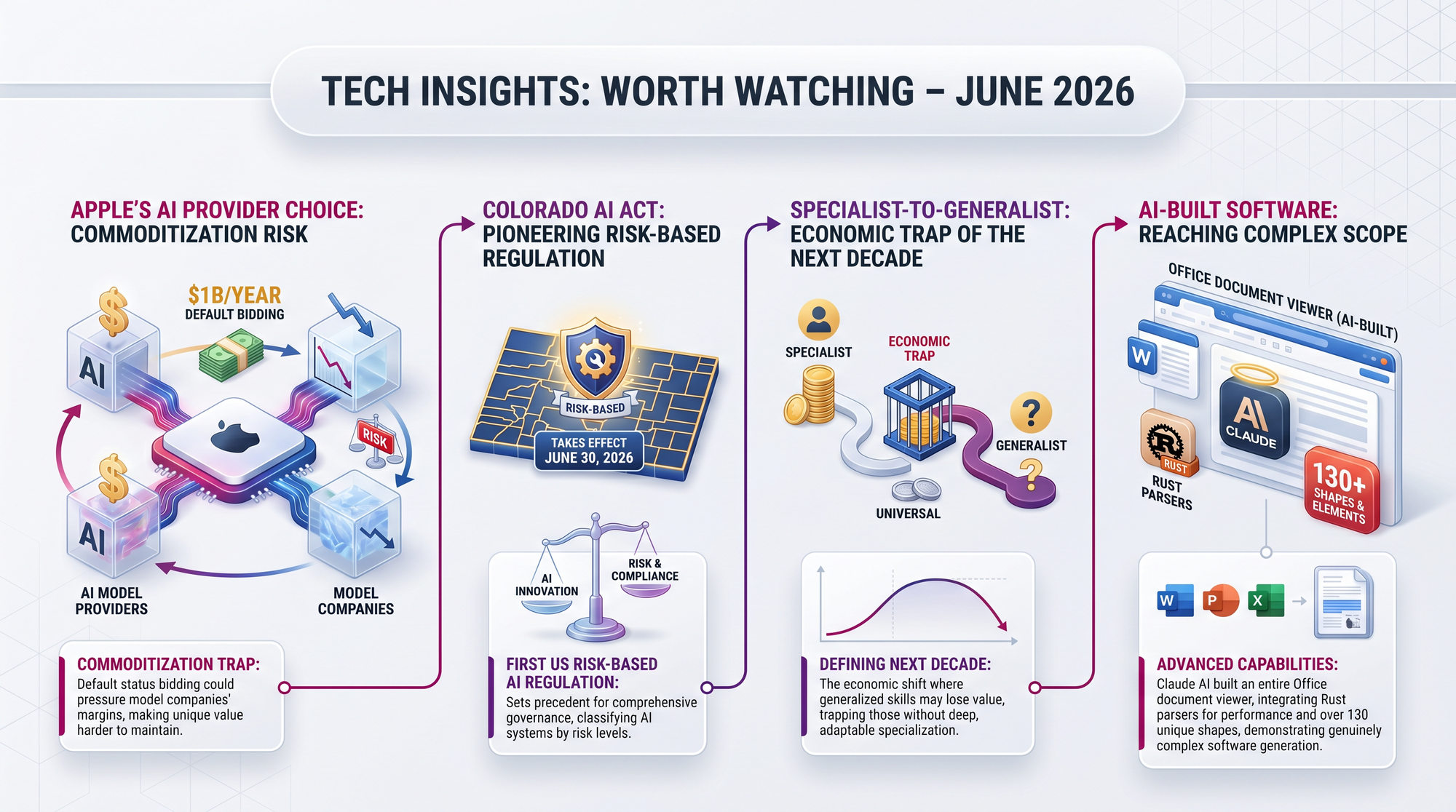
If Apple's Extensions system lets users freely swap between Gemini, ChatGPT, and Claude, the AI providers compete on a level playing field inside someone else's ecosystem. Google is paying $1 billion/year for the default slot. The question is whether being the default on 2 billion devices is worth that price - or whether it traps you in a race to outbid competitors indefinitely. Watch for the licensing terms when WWDC details drop tomorrow.
Colorado's AI Act Takes Effect June 30 - First US Risk-Based AI Law
Colorado's Artificial Intelligence Act requires companies using "high-risk AI systems" to run impact assessments, notify workers before AI-based employment decisions, provide appeal mechanisms, and publish statements about AI systems in use. It takes effect June 30, 2026, making it the earliest enforceable state-level AI regulation in the US. Companies using AI for hiring, promotion, or workforce decisions should be preparing compliance plans now.
The "Specialist to Generalist" Economic Trap May Define the Next Decade
Today's most-discussed HN post articulates something economists have theorized but few practitioners have felt: that domain expertise loses its premium when the knowledge is "promptable." The counterargument - that taste, judgment, and system-level thinking remain human advantages - has not yet been tested at the scale AI is now reaching. Worth watching whether the job market data supports the theory in the next 12 months.
AI-Built Software Is Getting Genuinely Complex
The Silurus/ooxml project is notable not because AI wrote code, but because of the scope: cross-language compilation, format-specific parsers, a rendering pipeline, and framework integrations that would take a small team months. If this level of complexity is achievable through iterative prompting, the definition of "solo developer" is expanding to include projects that would have required a team.
Top Repos Today
📜 License: MIT · 👤 By: Individual developer
🎯 Time to value: 10 minutes
| ✓ Pros | ✗ Cons |
|---|---|
| 16x memory reduction vs float32 | New project, limited production battle-testing |
| Faster than FAISS on benchmarks | Rust dependency adds build complexity |
| Online ingest without training phases | Community and documentation still growing |
 GitHub
📜 License: Apache 2.0 · 👤 By: Organization (Nous Research)
🎯 Time to value: 15 minutes
| ✓ Pros | ✗ Cons |
|---|---|
| Massive community (185k+ stars) | Can be overwhelming for simple use cases |
| Active development and model updates | Requires understanding of agent concepts |
| Adapts to user over time | Resource-heavy for full deployment |
GitHub
📜 License: MIT · 👤 By: Individual developer
🎯 Time to value: 5 minutes
| ✓ Pros | ✗ Cons |
|---|---|
| Multi-platform search in one query | Requires Claude Code or compatible agent |
| Engagement-scored rather than SEO-ranked | Platform Application Programming Interface (API) rate limits may apply |
| Covers prediction markets for forward-looking data | 30-day window limits historical research |
GitHub
📜 License: MIT · 👤 By: Individual developer
🎯 Time to value: 5 minutes
| ✓ Pros | ✗ Cons |
|---|---|
| Directly addresses the "AI slop" problem | Design quality is subjective |
| Multiple visual style presets | Requires Claude Code or compatible tool |
| Image generation for design references | Additional prompting overhead |
GitHub
📜 License: MIT · 👤 By: Individual developer
🎯 Time to value: 10 minutes
| ✓ Pros | ✗ Cons |
|---|---|
| Self-hosted, full data control | Requires more setup than hosted NotebookLM |
| Model flexibility (use any provider) | Audio generation quality varies by model |
| Active community (27k+ stars) | Missing some NotebookLM-exclusive features |
GitHub
📜 License: Apache 2.0 · 👤 By: Organization (Agentic AI Foundation / Linux Foundation)
🎯 Time to value: 10 minutes
| ✓ Pros | ✗ Cons |
|---|---|
| 15+ LLM provider support | Can be complex to configure |
| 70+ MCP extensions | Heavier than focused single-purpose tools |
| Linux Foundation backing | Desktop app still maturing |
GitHub📜 License: MIT · 👤 By: Organization (GGML)
🎯 Time to value: 15 minutes
| ✓ Pros | ✗ Cons |
|---|---|
| Runs on consumer hardware including laptops | Requires command-line comfort |
| Supports nearly all open model formats | Performance varies by hardware |
| 115k stars, extremely mature | Configuration can be intimidating |
GitHub
Top Models Today
👤 By: NVIDIA · 🎯 Task: Image-Text-to-Text
📐 Size: 4B
| ✓ Pros | ✗ Cons |
|---|---|
| Works with natural language queries | 4B parameters requires decent GPU |
| Apache 2.0 license for commercial use | Segmentation quality varies with ambiguous queries |
| Strong community adoption (1.5k likes) | Best results require thoughtful prompting |

👤 By: Google · 🎯 Task: Any-to-Any
📐 Size: 12B
| ✓ Pros | ✗ Cons |
|---|---|
| True multimodal (text + image + audio) | Gemma license has some restrictions |
| Strong benchmark performance for size | 12B still needs a decent GPU |
| Quantized versions available for mobile | Not as capable as 70B+ models |
👤 By: Unsloth (Community) · 🎯 Task: Image-Text-to-Text
📐 Size: 12B
| ✓ Pros | ✗ Cons |
|---|---|
| Runs on consumer hardware | Quality degrades at lower quantization |
| 568k downloads proves reliability | Still needs 8-16GB RAM minimum |
| Multiple quantization options | No audio input support in GGUF format |
👤 By: Ideogram AI · 🎯 Task: Text-to-Image
📐 Size: Not specified
| ✓ Pros | ✗ Cons |
|---|---|
| Best text rendering in AI images | Requires 24GB+ GPU for full model |
| Apache 2.0 for commercial use | Smaller community than Stable Diffusion |
| Open weights for local deployment | Image diversity can be limited |
👤 By: JetBrains · 🎯 Task: Text Generation
📐 Size: 12B
| ✓ Pros | ✗ Cons |
|---|---|
| Shows reasoning, not just outputs | Narrower than general-purpose models |
| Only 2.5B active params (fast) | JetBrains ecosystem focus |
| Apache 2.0 license | Limited non-code capabilities |
AI Launches Today
Snapshot
| Provider | Model | Input $/1M | Output $/1M | Context |
|---|---|---|---|---|
| Anthropic | Claude Opus 4.8 | $5.00 | $25.00 | 1M |
| Anthropic | Claude Sonnet 4.6 | $3.00 | $15.00 | 1M |
| Anthropic | Claude Haiku 4.5 | $1.00 | $5.00 | 200K |
| OpenAI | GPT-5.5 | $5.00 | $30.00 | 272K+ |
| OpenAI | o3 | $2.00 | N/A | N/A |
| Gemini 3.5 Flash | $1.50 | $9.00 | 1M | |
| Gemini 3.1 Pro | $2.00 | $12.00 | 1M | |
| Groq | Llama 3.3 70B | $0.59 | $0.79 | 128K |
| Groq | Llama 3.1 8B | $0.05 | $0.08 | 128K |
Beyond Scaling: Agents Are Heading to the Edge
Key finding: Hierarchical, graph-based, and swarm-style agent organization assumptions all change fundamentally when agents run on edge devices with limited compute, requiring new coordination patterns that do not exist in cloud-scale systems.
Why practitioners should care: If edge deployment works, it eliminates per-token API costs, removes latency from network round trips, and keeps user data entirely on-device. The paper maps which current techniques (quantization, speculative decoding, memory-aware scheduling) already work on mobile hardware and which need more research.
Member discussion