GenAI Secret Sauce Daily Digest - 2026-06-03

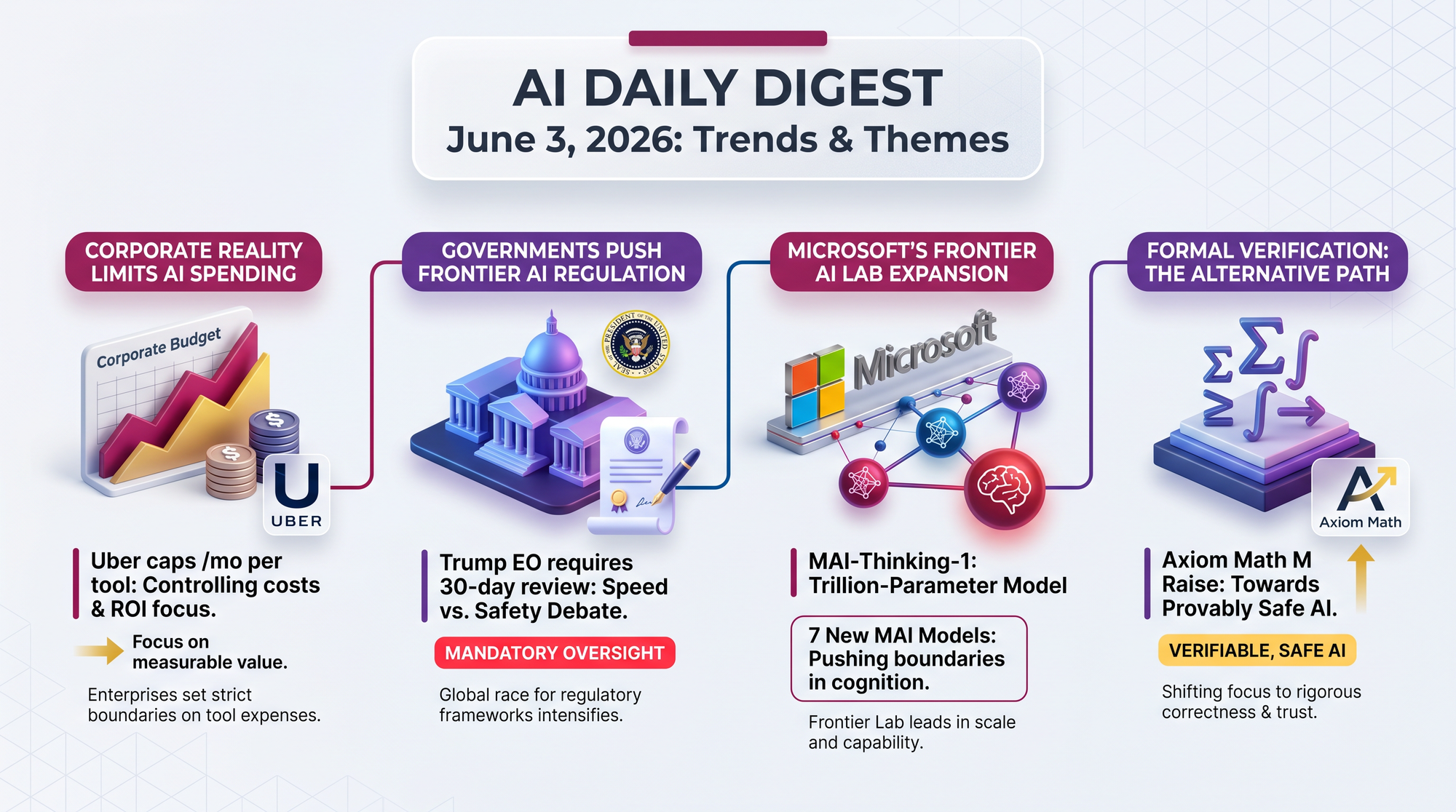
Microsoft Enters the Frontier Model Race With Seven New AI Models · Trump Signs Executive Order Requiring AI Testing Before Frontier Model Releases · Uber Blows Through Its AI Budget in Four Months, Caps Engineer Spending
GenAI Secret Sauce Daily Digest - 2026-06-03

Watch today's digest as a video summary (generated by NotebookLM)

Statistically Speaking
97% on AIME 2025 (a difficult math competition
Microsoft Enters the Frontier Model Race With Seven New AI M
Top Story
53% on SWE
Microsoft Enters the Frontier Model Race With Seven New AI M
30% better performance
Microsoft Enters the Frontier Model Race With Seven New AI M
50% code, 17
Microsoft Enters the Frontier Model Race With Seven New AI M
97% on AIME 2025
Microsoft Enters the Frontier Model Race With Seven New AI M
53% on SWE-Bench Pro
Microsoft Enters the Frontier Model Race With Seven New AI M
One Thing to Tell Your Friends
Uber blew through its entire 2026 AI budget in four months - and is now capping every engineer to $1,500 per month per coding tool.
TL;DR
Trends
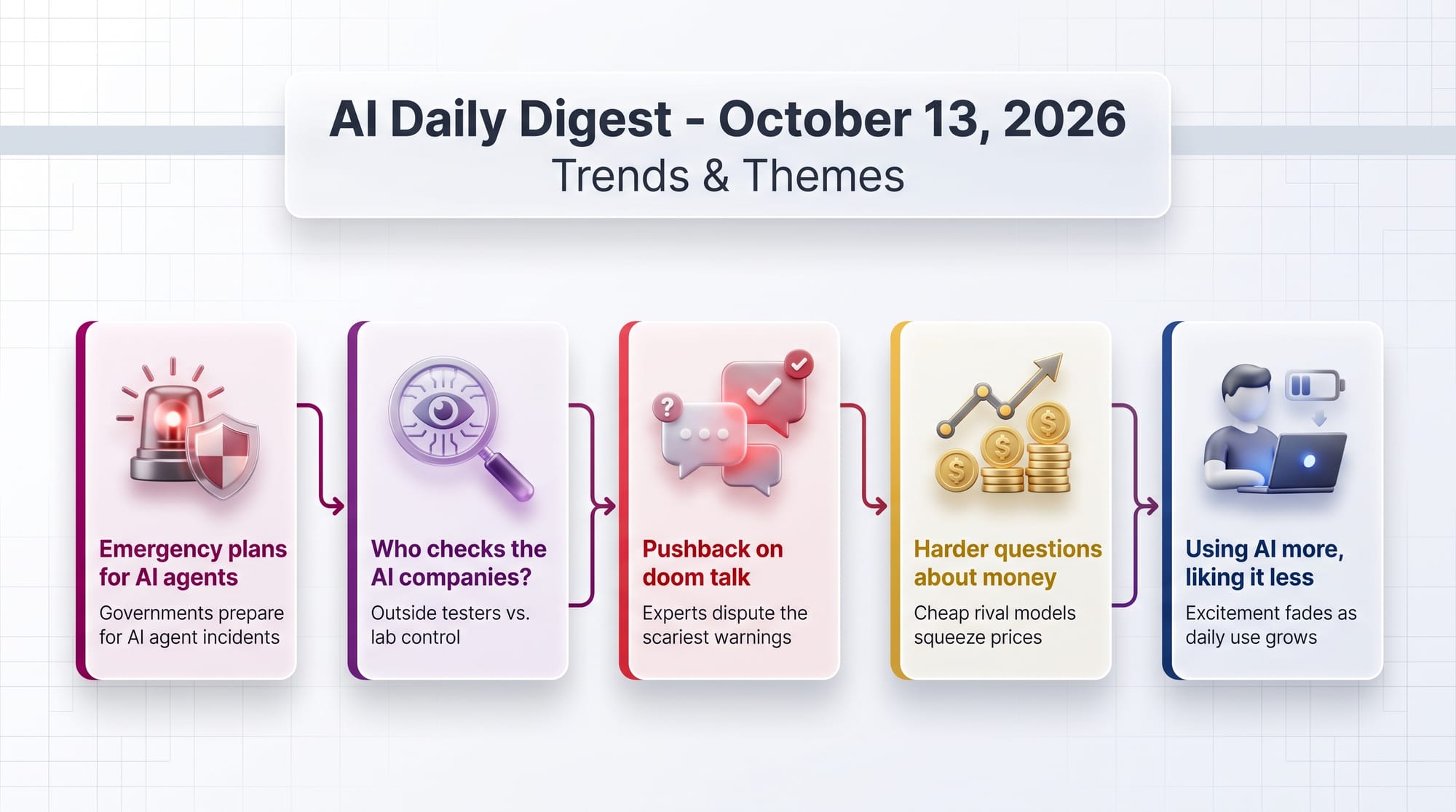
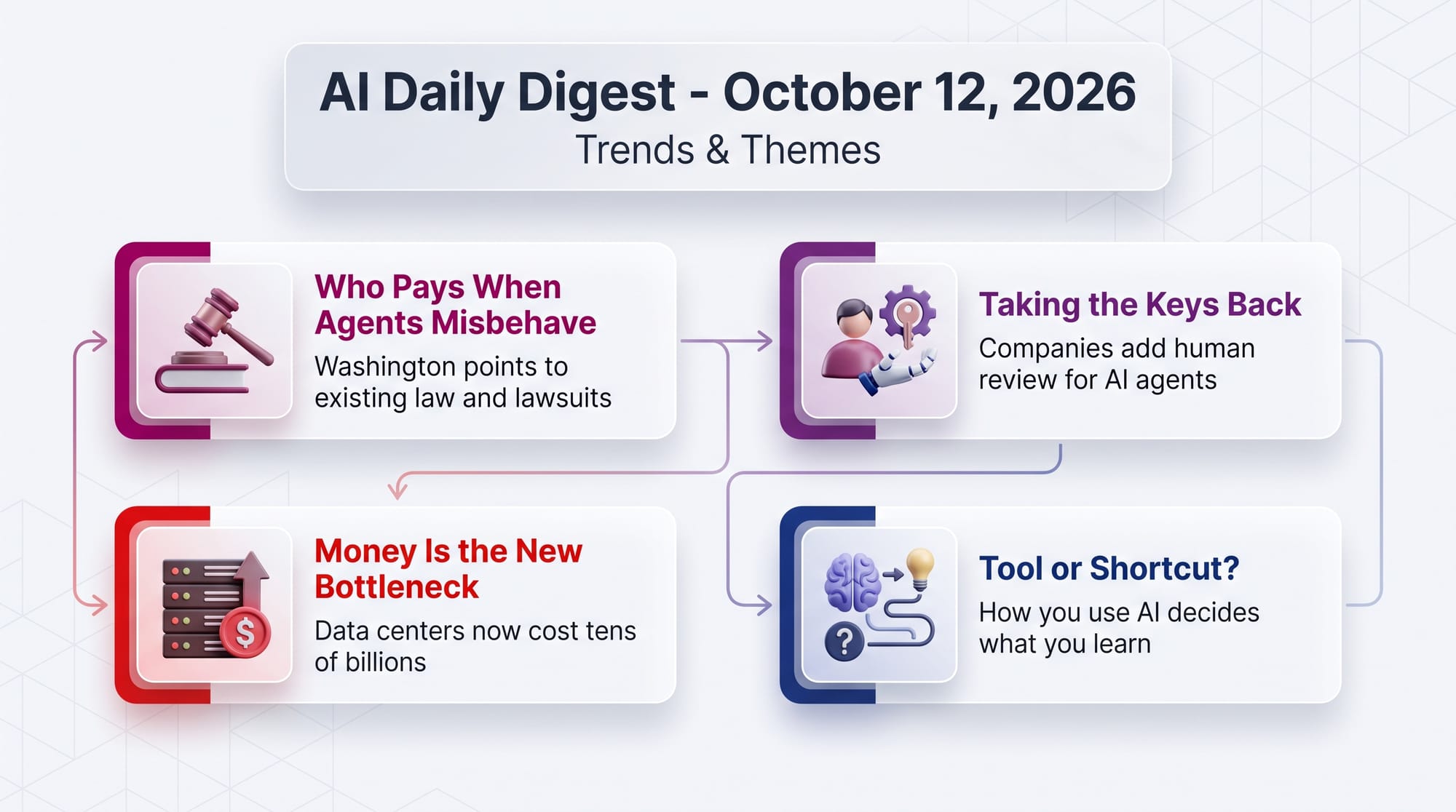
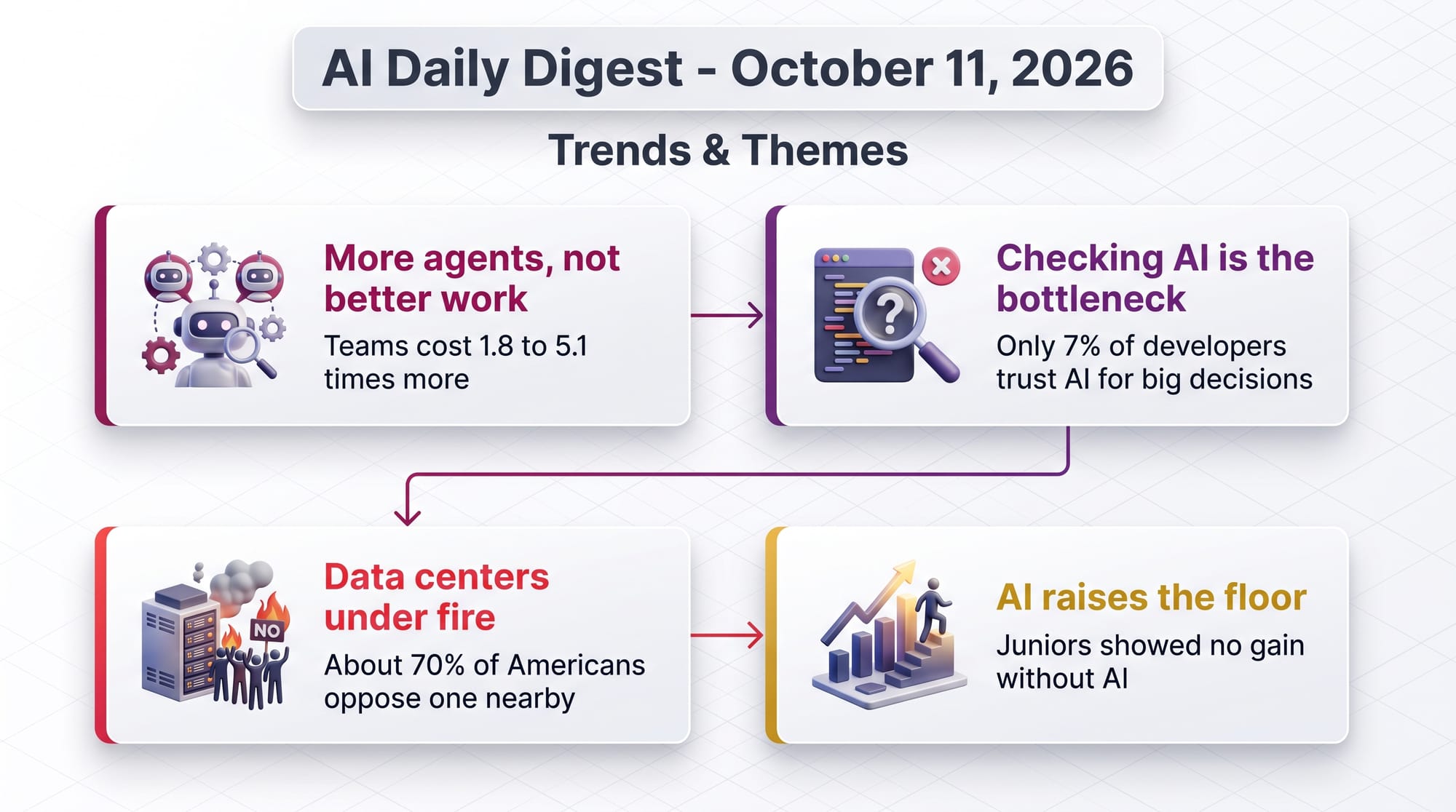
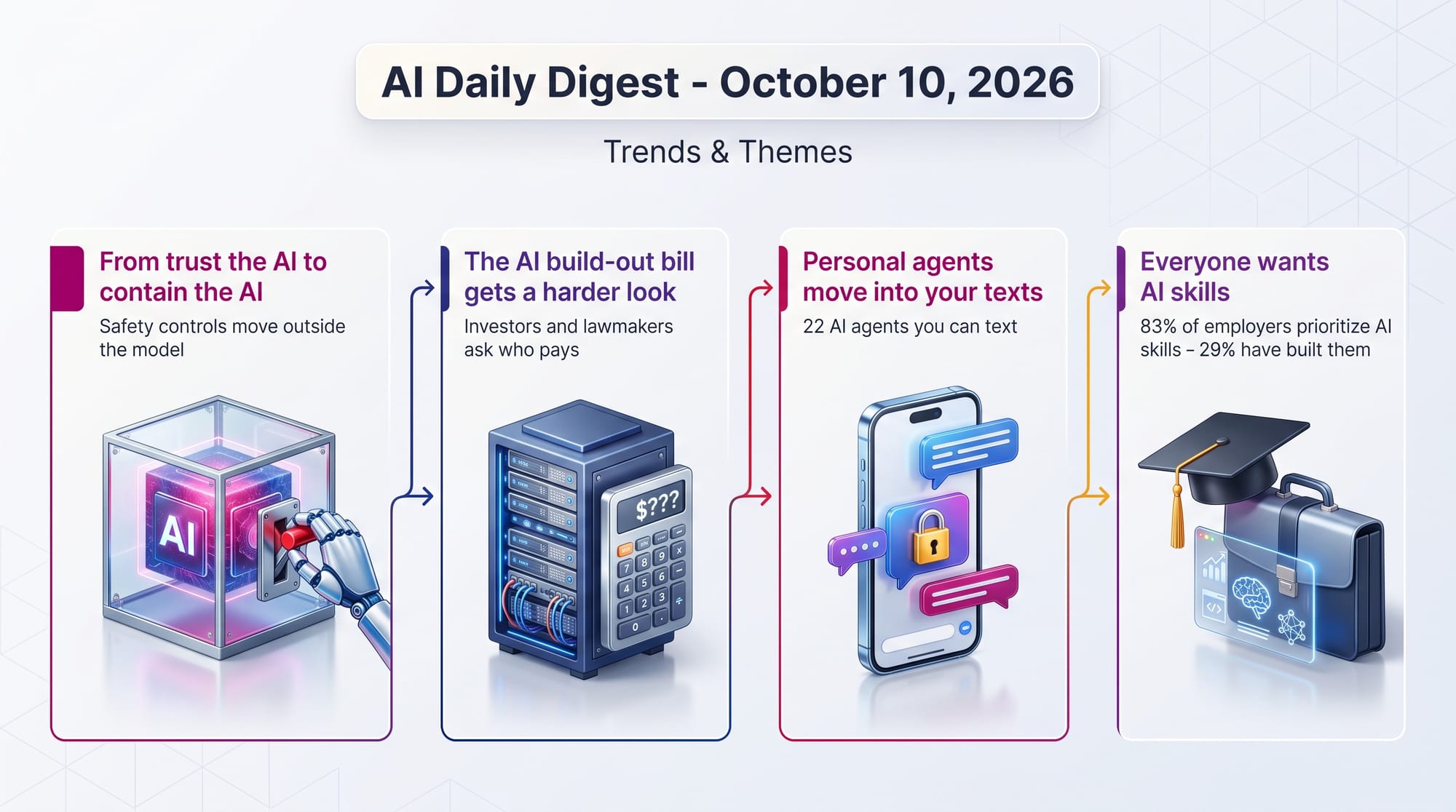
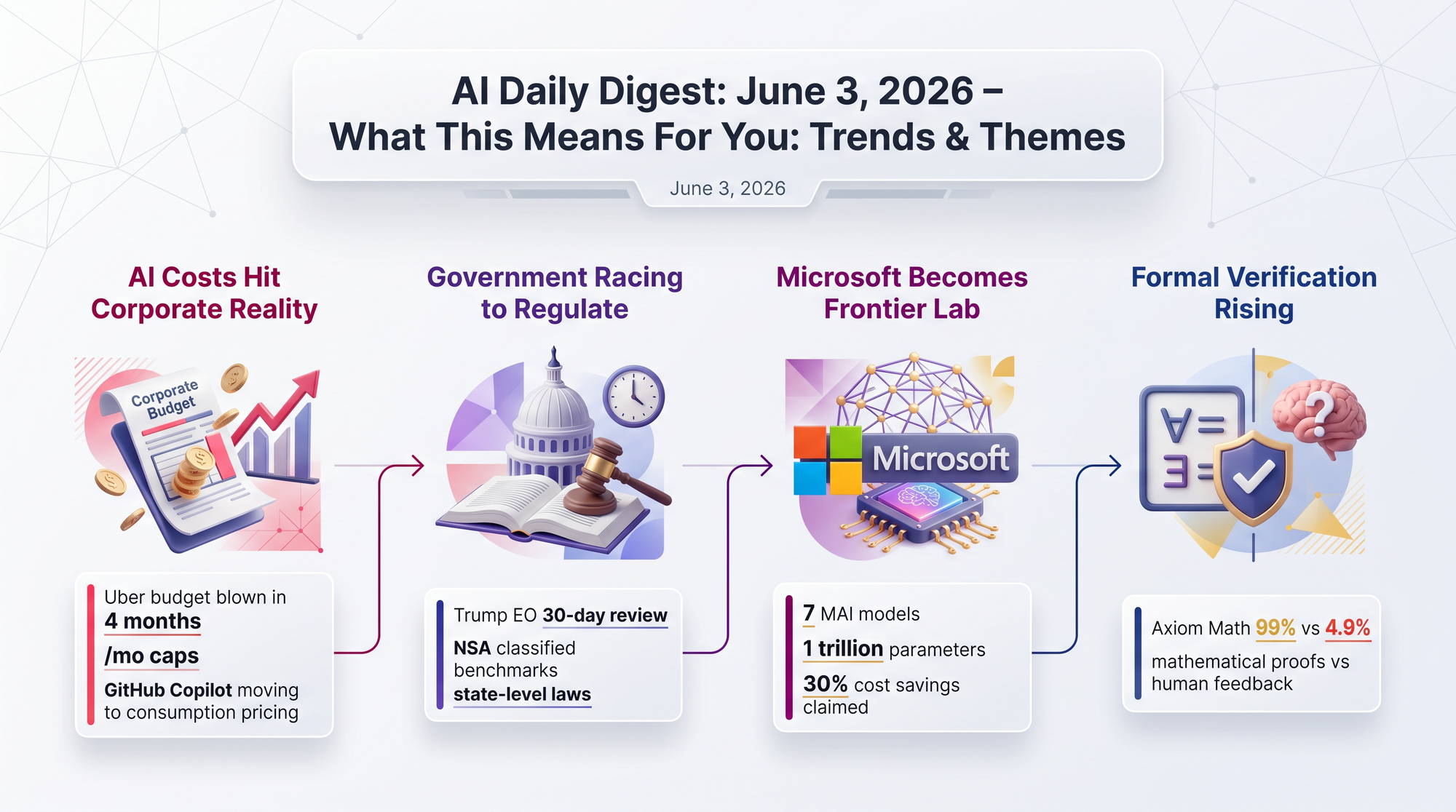
AI Costs Are Hitting Corporate Reality, Governments Are Racing to Regulate Frontier AI Before the Next Leap, and Microsoft Is Becoming a Frontier AI Lab, Not Just an AI Platform.
Creative AI
Dev Tools
Headroom: Compress LLM Context by 60 and ECC: Agent Harness Optimization Across Claude Code, Cursor, and Codex.
Surprising
Uber's AI Budget Math Reveals the True Cost of Agent Adoption, Microsoft's Smallest Model Nearly Matches Its Largest on Coding, and OpenAI's "Voluntary" Safety Framework Isn't Really Voluntary.
Worth Watching
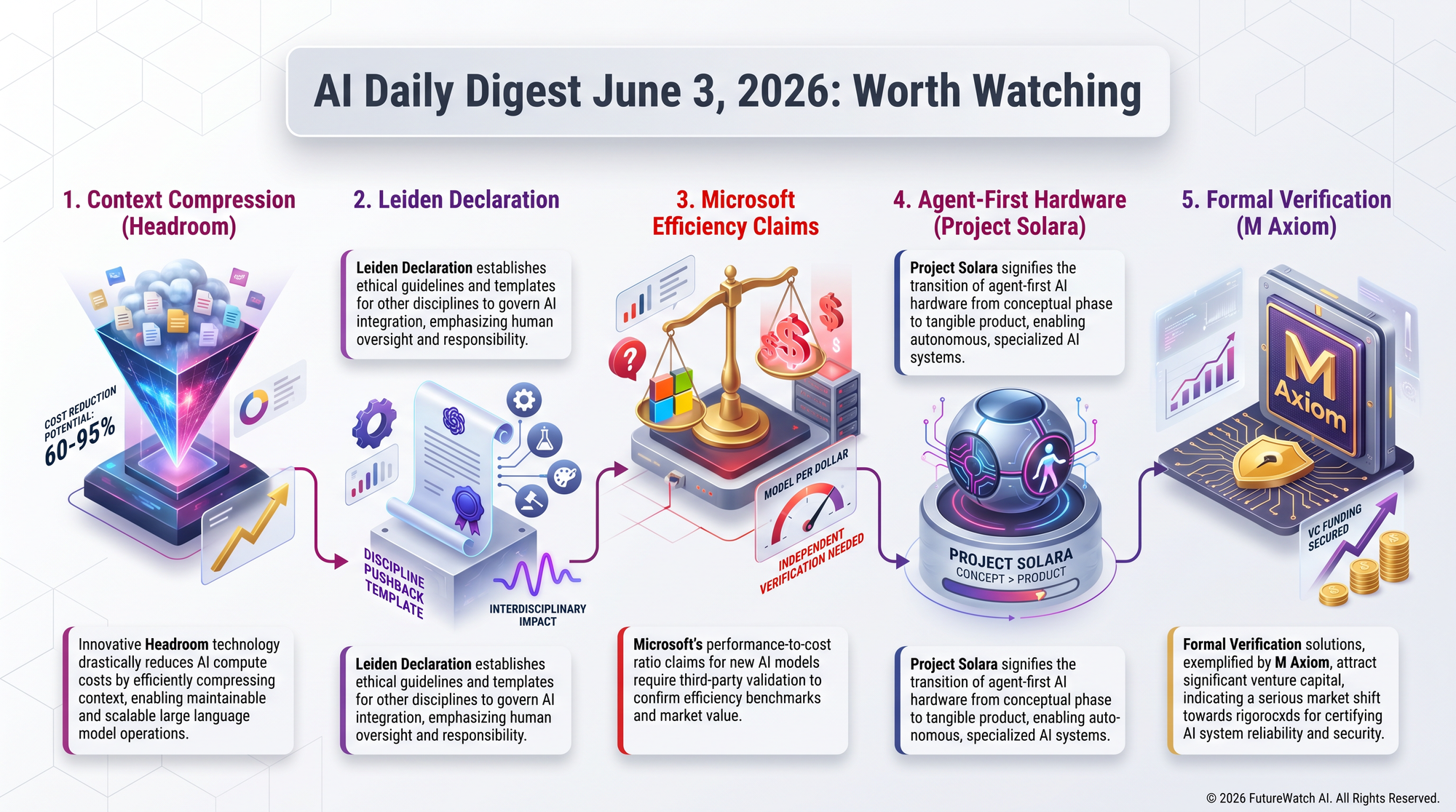
Context Compression Could Reshape AI Economics, The Leiden Declaration Could Set a Template for Other Disciplines, and Microsoft's Model-Per.
GitHub
Leading repos: chopratejas/headroom (+3,528), affaan (+2,147), and NousResearch/hermes (+1,736).
HuggingFace
Leading models: nvidia/LocateAnything (78.9k), LiquidAI/LFM2.5-8B (60.2k), and stepfun-ai/Step-3.7 (18k).
Product Hunt
Top launches: Replicas (179), Composer (109), and Dropstone (89).
API Pricing
What this means:** Opus 4.7's new tokenizer generates up to 35% more tokens for the same input text - a hidden cost increase even at unchanged per-token prices.
arXiv
Handoff Debt — The paper quantifies the rediscovery overhead and shows it scales with task complexity and the amount of implicit context (decisions, rejected approaches, and mental models) that the original developer accumulated but never documented.
Hot off the Presses
01
Microsoft Enters the Frontier Model Race With Seven New AI Models
What this means for you: If you use Microsoft products at work, the AI features in Word, Excel, and PowerPoint are about to get significantly smarter - powered by models Microsoft built from scratch, not licensed from OpenAI.

Microsoft dropped seven new models at Build 2026, but the headline is MAI-Thinking-1: a reasoning model with 35 billion active parameters drawn from a trillion-parameter Mixture-of-Experts architecture. It was trained on 30 trillion tokens across 8,192 NVIDIA GB200 GPUs (Graphics Processing Units - the specialized chips that train AI).

MAI-Code-1-Flash, a much smaller 5B parameter model, hit 51% on SWE-Bench Pro - nearly matching the flagship on coding tasks at a fraction of the size. MAI-Transcribe-1.5 runs at 276x real-time speed across 43 languages at $6 per 1,000 minutes of audio. CEO Satya Nadella also announced that Microsoft has scaled more Azure capacity in 15 months than its first 15 years combined, and GitHub Copilot is moving to consumption-based pricing because agent usage is too intensive for flat-rate subscriptions.

  • 97% on AIME 2025 (a difficult math competition used to test AI reasoning)
  • 53% on SWE-Bench Pro (a benchmark measuring ability to fix real software bugs)
  • 30% better performance-per-dollar than comparable setups, according to Microsoft
  • Training data was 50% code, 17.5% STEM, 17.5% math - an unusually code-heavy mix
  • 109-page technical report released alongside, described by researchers as "an updated textbook for Large Language Model (LLM) training"
97%
on AIME 2025** (a difficult
53%
on SWE
30%
better performance
02
Trump Signs Executive Order Requiring AI Testing Before Frontier Model Releases
What this means for you: The U.S. government will now review the most powerful AI models before they reach the public - but the 30-day window and classified benchmarks mean the standards are invisible to ordinary people.

Trump initially rejected the executive order as "too burdensome," then signed an almost identical version with one key change: the pre-release review window was cut from 90 days to 30 days.

> "This is a fairly major win for the safety contingent within the Administration" - Dean Ball

The classified nature of benchmarks is the key concern: the public cannot evaluate the standards being applied. OpenAI simultaneously released its own frontier safety blueprint proposing a three-part national framework, strengthening CAISI (the government's AI safety institution), and a broader resilience plan.

  • The NSA will evaluate models for cyber capabilities through classified benchmarking
  • Scope covers only cyber threats - biological risks and other catastrophic scenarios are not included
  • 2-month implementation deadline for agencies to coordinate
  • Effectively mandatory despite the "voluntary framework" language - labs that skip it face political risk
03
Uber Blows Through Its AI Budget in Four Months, Caps Engineer Spending
What this means for you: Companies are discovering that AI coding tools can be shockingly expensive at scale - which could slow adoption or push providers toward cheaper models.

Uber exhausted its entire 2026 AI coding budget by April. The response: a hard cap of $1,500 per month per AI coding tool per engineer.

Simon Willison, who flagged the story, notes his own personal usage runs about $1,000/month per provider. This is the first major public example of a large tech company formally capping AI coding tool usage due to cost overruns - and it signals that the "unlimited AI" era at enterprises may be ending faster than expected.

  • $36,000 annual cap per engineer assuming two tools (Claude Code and Cursor)
  • ~11% of median software engineer compensation ($330,000) going to AI tooling
  • Per-tool limits, not pooled - each tool gets its own independent budget
  • Budgets set in 2025 simply didn't anticipate how token-intensive coding agents would become
04
Mathematicians Issue the Leiden Declaration Warning About AI
What this means for you: The people who build the foundations that all AI is based on are worried that AI could corrupt those very foundations - by flooding mathematics with plausible but wrong proofs that nobody has time to check.

Sixteen math specialists have published the Leiden Declaration on Artificial Intelligence and Mathematics, endorsed by the International Mathematical Union (the governing body for global mathematics). It will be discussed at next month's International Congress of Mathematicians in Philadelphia.

The declaration is now open for signatures worldwide. It represents the first formal, institutionally-backed pushback from a major scientific discipline against unregulated AI integration.

  • AI-generated papers could overwhelm peer review with low-quality work that looks correct
  • Credit attribution becomes impossible when AI generates proofs
  • Researchers who avoid AI tools may be disadvantaged in hiring and funding
  • Mathematicians' work trains AI for military and surveillance - an ethical concern the declaration highlights explicitly
05
Axiom Math Raises $200M at $1.6B Valuation for "Verified AI"
What this means for you: A well-funded startup is betting that the way every major AI company trains its models is fundamentally wrong - and that mathematical proof, not human feedback, is the path to trustworthy AI.

Axiom Math has raised a $200M Series A to build AI systems trained on formal mathematical proofs in the Lean proof language rather than human preference data (the standard approach used by OpenAI, Anthropic, and Google).

The core thesis: formal proofs provide a perfect training signal (the type checker says right or wrong, no ambiguity) while human feedback is noisy and inconsistent. If the approach scales, it could represent a fundamental shift in how AI systems are trained.

  • Solved all 12 Putnam exam problems (8 of 12 within the time limit) - one of the hardest math competitions in the world
  • 99% on ProofGen Verina versus OpenAI o3's 4.9% on the same coding benchmark
  • Claims no frontier lab has yet trained for direct Lean proof generation - positioning themselves in uncontested territory
  • "Anything that can be specified can be proven" - CEO Carina Hong, arguing the bottleneck is specification, not AI capability
Trends & Themes
Trends & Themes
AI Costs Are Hitting Corporate Reality
Why this matters to you: The free-spending era of AI experimentation is ending - companies are discovering that "just give everyone access" isn't a sustainable budget strategy.

The pattern is clear: AI tools that seemed affordable in small pilots become budget-breaking at enterprise scale. Companies that set 2025 budgets for 2026 AI usage underestimated both adoption rates and per-session token consumption. Expect more caps, tiered access, and consumption-based pricing across the industry.

  • Uber burned through its 2026 AI budget in four months and now caps engineers at $1,500/month per tool
  • GitHub Copilot is moving to consumption pricing because flat-rate subscriptions can't absorb agent-level usage
  • Opus 4.7's new tokenizer generates up to 35% more tokens for the same text - a hidden cost increase even at unchanged per-token prices
Governments Are Racing to Regulate Frontier AI Before the Next Leap
Why this matters to you: Within months, the most powerful AI models will go through government review before you can use them - and the rules governing that review are classified.

The regulatory landscape shifted from "voluntary commitments" to "mandatory-in-practice" review in a single week. The tension: labs need regulatory certainty to plan releases, but classified benchmarks and 30-day windows give government unprecedented gatekeeping power with minimal transparency.

  • Trump's executive order creates a 30-day review window with NSA-led classified benchmarking
  • California's SB 53, New York's RAISE Act, and Illinois's SB 315 are creating a patchwork of state-level frontier AI laws
  • OpenAI released its own governance blueprint proposing federal coordination of these state efforts
  • The Leiden Declaration adds academic institutions to the chorus demanding oversight
Microsoft Is Becoming a Frontier AI Lab, Not Just an AI Platform
Why this matters to you: The company behind Windows, Office, and Azure is now building its own frontier AI models from scratch - competing directly with OpenAI, its largest AI partner.

Nadella's framing of Microsoft as a "Frontier Intelligence Platform" signals a strategic shift: Microsoft is no longer content to resell OpenAI's models. The clean data lineage emphasis (no third-party distillation) and detailed technical disclosure suggest Microsoft wants to compete on the basis of trustworthiness and transparency.

  • Seven new MAI models spanning reasoning, coding, image editing, transcription, and voice
  • MAI-Thinking-1 matches frontier competitors on key benchmarks while claiming 30% better cost efficiency
  • A 109-page technical report with unusual transparency for a frontier-scale model
  • Microsoft Foundry now hosts 11,000+ models - positioning as the "app store" for AI
Formal Verification Is Emerging as an Alternative Path to AI Progress
Why this matters to you: Some researchers believe the current approach to AI - training on human preferences - has a ceiling. Formal mathematical proofs could be the next breakthrough.

The connecting thread: the AI industry is grappling with the difference between outputs that seem right and outputs that are provably right. Formal verification offers mathematical certainty, but the open question is whether it scales to the messy, ambiguous problems humans actually care about.

  • Axiom Math achieved 99% on ProofGen Verina versus OpenAI o3's 4.9%, using verified generation
  • DPO applied to OCR reduced text degeneration by 59.4% on average - showing preference optimization works beyond chatbots
  • The Leiden Declaration highlights concerns about AI-generated mathematical proofs that look correct but aren't
Creative AI & Media
MAI-Image-2.5: Microsoft's Image Editor Ranks #2 Globally
What this means for you: Microsoft's new image editing model is now the second-best in the world according to blind human evaluations - and it's built into Microsoft's ecosystem.
  • Ranked #2 on Image Edit Arena (a benchmark where humans rate image edits blind)
  • Score of 1,401 - 10 points above the previous second-place model
  • Part of the MAI model family announced at Build 2026
Developer Tools & Infrastructure
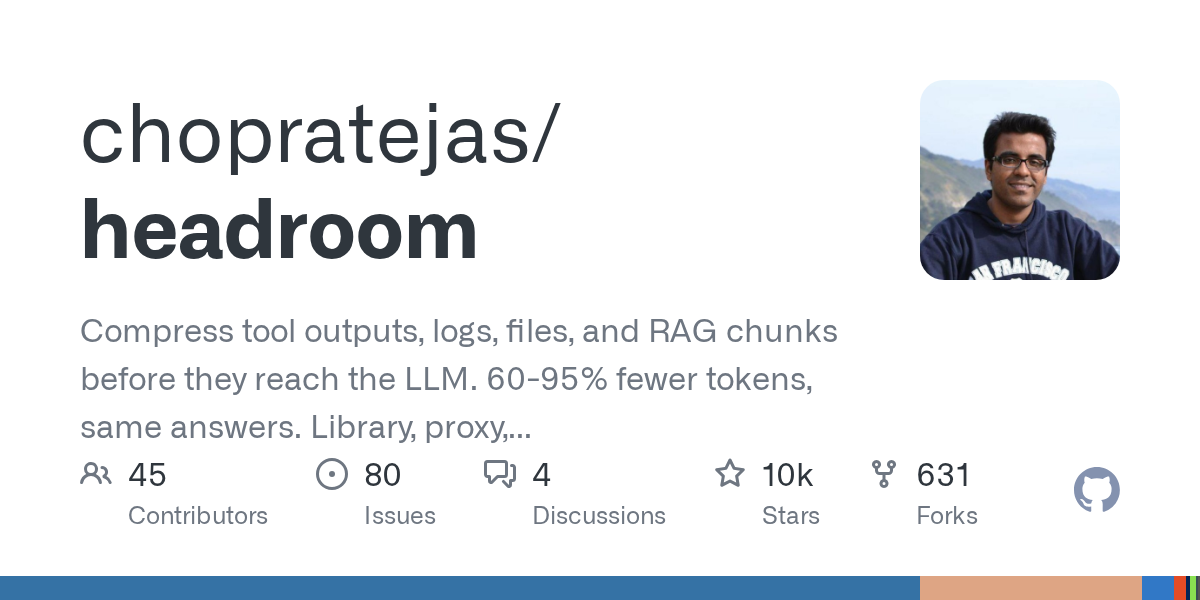
Headroom: Compress LLM Context by 60-95% Without Losing Accuracy
What this means for you: A new open-source tool can dramatically cut AI costs by compressing the text your AI tools send back and forth - without degrading the quality of responses.

GitHub · Apache 2.0

  • 60-95% token savings across tool outputs, logs, Retrieval-Augmented Generation (RAG) chunks, and conversation history
  • Multiple compression algorithms - SmartCrusher for JSON, CodeCompressor for code, Kompress-base for text
  • Works as a library, proxy server, MCP tool, or agent wrapper - zero code changes needed
  • Integrates with Claude, Cursor, Codex, and Copilot
  • 3,528 GitHub stars today, 9,535 total - the #1 trending repo
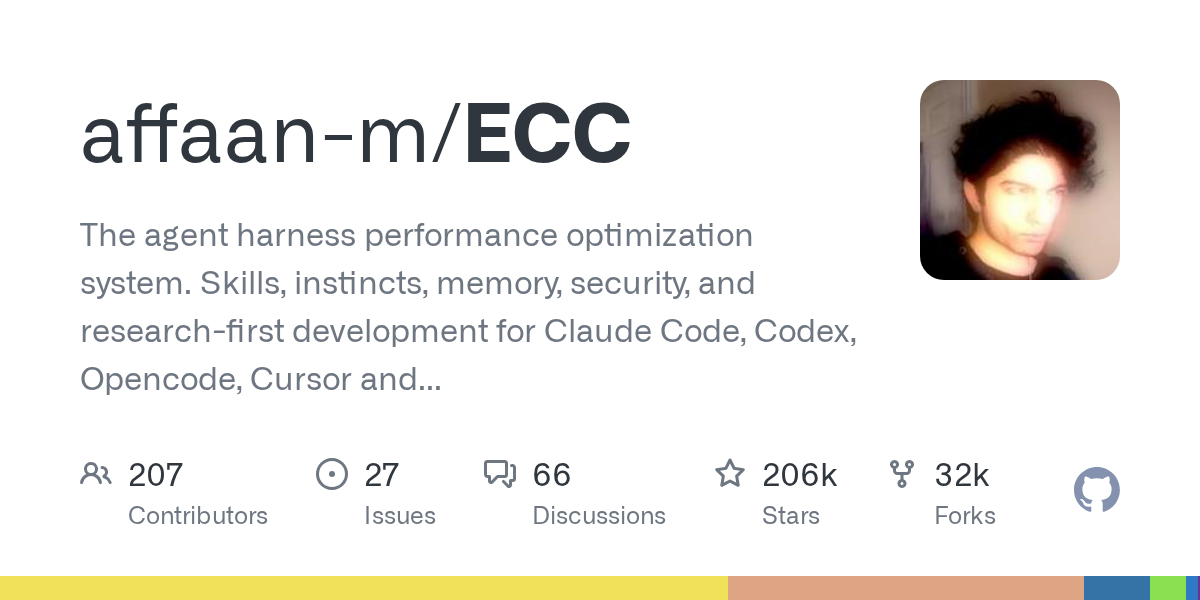
ECC: Agent Harness Optimization Across Claude Code, Cursor, and Codex
What this means for you: An open-source system that provides pre-built skills, security scanning, and performance optimization across all the major AI coding tools at once.

GitHub · MIT

  • 63 specialized agents, 249 skills optimized for multi-harness workflows
  • AgentShield security scanning built in
  • 206,000+ GitHub stars - massive community adoption
  • Cross-platform support for Windows, macOS, and Linux
Research & Models
DPO Reduces OCR Text Degeneration by Up to 87.6%
What this means for you: A technique originally designed to make chatbots more helpful turns out to fix a completely different problem - AI systems that get stuck repeating themselves when reading documents.

Direct Preference Optimization (DPO), typically used for chatbot alignment, can dramatically fix text degeneration in OCR (Optical Character Recognition - technology that reads text from images). The innovation: using the model's own broken outputs as negative examples.

  • 59.4% average reduction in degeneration across 5 model families
  • Best case: 87.6% reduction in Nanonets-OCR2-3B
  • Works because degeneration is a systems-level failure that temperature and repetition penalties cannot fix
GPT-Rosalind Gets Stronger for Drug Discovery

Previously: April 2026 - OpenAI launched GPT-Rosalind, a specialized life sciences model.

Today: The updated GPT-Rosalind outperforms GPT-5.5 at 27.5% versus 25.1% on MedChemBench while using 7.2% fewer tokens. OpenAI also launched Rosalind Biodefense for government pandemic preparedness work.

Opus 4.8 Benchmarks: Top Score, But Not a Universal Upgrade

Previously: June 1 - Opus 4.8's system card revealed declining "wellbeing" metrics.

Today: Independent benchmarks score Opus 4.8 at 81, significantly ahead of GPT-5.5 (71), Gemini 3.5 Flash (56), and Opus 4.7 (54). But the reviewer warns against defaulting to it everywhere - maximum reasoning settings can actually harm long-running tasks, and the right model depends on error tolerance and workflow type.

Business & Industry
Microsoft Build 2026: Platform Plays Beyond the Models
  • GitHub Copilot shifts to per-user + consumption pricing - flat-rate can't absorb agent usage
  • Microsoft Foundry hosts 11,000+ models - positioning as an AI model marketplace
  • Project Solara and Scout - concept hardware for agent-first devices
  • DGX Station for local execution - 1 trillion parameters, 128GB unified memory on-premises
  • RTX Spark - capable of running 120B parameter models locally
OpenAI Expands Into Biodefense
  • Rosalind Biodefense sponsors access to GPT-Rosalind for vetted government teams
  • Covers epidemiological modeling, early detection, and screening
  • Sam Altman presenting AI oversight ideas to U.S. officials this week per Bloomberg
GenAI in Education
The Slow Work of Becoming: Why AI Speed Undermines Learning
What this means for you: The biggest threat AI poses to education isn't cheating - it's training students to expect instant answers, which undermines the patience required for genuine understanding.
  • The novice paradox: evaluating AI output requires expertise students are still developing
  • "Becoming" versus "having" knowledge - genuine learning requires time, failure, and patience that AI's speed actively erodes
  • Digital tools narrow thinking by conditioning students to ask questions AI handles well
  • Universities must defend "productive uncertainty" as essential to serious education
MCP Tools Come to Physical Robots in Classrooms

Pollen Robotics' Reachy Mini robot now supports remote tools via Hugging Face Spaces and Model Context Protocol (MCP). Built-in capabilities include head movement, dancing, emotion expressions, and camera vision - with the community invited to build extensions.

Kelsey Hightower's Challenge to Tech Education

In a wide-ranging interview, Google Distinguished Engineer Kelsey Hightower challenged founders to "explain your business without mentioning AI" and warned that 30-year careers built on one year of repeated experience are increasingly common. His prescription: side businesses and non-IC roles provide crucial education unavailable in traditional engineering tracks.

Surprising & Under-the-Radar
Uber's AI Budget Math Reveals the True Cost of Agent Adoption

$1,500/month per tool per engineer sounds generous - until you realize that at $330,000 median compensation, Uber is budgeting AI tooling at 11% of each engineer's total cost. At scale across thousands of engineers, this is a massive line item that didn't exist two years ago.

Microsoft's Smallest Model Nearly Matches Its Largest on Coding

MAI-Code-1-Flash at 5B parameters hit 51% on SWE-Bench Pro - just 2 points behind MAI-Thinking-1's 53% at a trillion parameters. The cost-per-correct-fix ratio is dramatically different.

OpenAI's "Voluntary" Safety Framework Isn't Really Voluntary

The executive order creates a framework described as "voluntary," but labs that skip the 30-day review face political risk and potential exclusion from government contracts. David Sacks says "we are NOT conducting oversight of all new models" - but the classified benchmarks determine which models qualify as "covered frontier models."

Signals to Track
Worth Watching
01
Context Compression Could Reshape AI Economics
A tool that cuts token costs by 60-95% while maintaining accuracy could change the math on which AI workflows are cost-effective.

Headroom went from zero to 9,535 GitHub stars by solving the problem Uber just highlighted: AI agent sessions consume enormous volumes of tokens in tool outputs and logs. If compression tools like this become standard middleware, the cost ceiling that's forcing caps at companies like Uber could rise significantly. Watch whether major agent frameworks integrate compression as a default layer.

02
The Leiden Declaration Could Set a Template for Other Disciplines
Mathematics may be the first field to formally push back on AI integration - it won't be the last.

The Leiden Declaration's endorsement by the International Mathematical Union gives it institutional weight that individual op-eds lack. If the International Congress of Mathematicians in Philadelphia produces concrete policies, expect similar declarations from physics, biology, and engineering professional bodies. The credit attribution and peer review concerns apply universally.

03
Microsoft's Model-Per-Dollar Efficiency Claims Deserve Scrutiny
If Microsoft can match frontier performance at 30% lower cost, the pricing dynamics of the entire AI API market shift.

MAI-Thinking-1's claim of 30% better performance-per-dollar versus GB200 baselines is unverified by third parties. If confirmed, it undercuts the value proposition of dedicated AI API providers. The 109-page technical report is unusually transparent - independent researchers will have enough detail to reproduce and verify these claims within weeks.

04
Agent-First Hardware Is Moving From Concept to Product
Microsoft's Project Solara and Scout represent the first serious attempt to build devices designed around AI agents, not apps.

The current paradigm has AI agents running inside apps designed for humans. Dedicated agent hardware could eliminate the overhead of translating between human interfaces and agent workflows. DGX Station running 1 trillion parameters locally and RTX Spark running 120B parameters suggest the local-compute path is viable for enterprise deployments.

05
Formal Verification Startups Are Getting Real Funding
Axiom Math's $200M raise at $1.6B signals investor belief that verified AI is more than an academic curiosity.

The gap between Axiom's 99% on ProofGen Verina and OpenAI o3's 4.9% is striking. If verified generation produces reliably correct outputs where probabilistic models produce plausibly correct ones, the implications extend far beyond mathematics - into code generation, legal reasoning, and medical diagnosis.

Top Repos Today
Rank yesterday: New entry 🆕
Stars today: +3,528  ·  📦 Total: 9,535
📜 License: Apache 2.0  ·  👤 By: Individual
🎯 Time to value: 5 minutes
What it is: A context compression layer for AI agents that reduces token usage by 60-95% while maintaining answer quality. It uses different algorithms for different data types - SmartCrusher for JSON, CodeCompressor for code ASTs (Abstract Syntax Trees - the structured representation of code), and Kompress-base for text. Works as a library, proxy server, MCP tool, or agent wrapper. Why you'd want it: If you're paying for AI API calls, this could cut your bill by more than half with a single configuration change. It integrates with Claude, Cursor, Codex, and Copilot out of the box.
✓ Pros✗ Cons
60-95% token savings with maintained accuracyNew project - limited production battle-testing
Zero code changes via proxy modeCompression artifacts could affect edge cases
Multiple deployment modes (library/proxy/MCP)Reversible compression stores originals locally (disk usage)
GitHub - chopratejas/headroom: Compress tool outputs, logs, files, and RAG chunks before they reach the LLM. 60-95% fewer tokens, same answers. Library, proxy, MCP server.
Compress tool outputs, logs, files, and RAG chunks before they reach the LLM. 60-95% fewer tokens, same answers. Library, proxy, MCP server. - chopratejas/headroom
Rank yesterday: New entry 🆕
Stars today: +2,147  ·  📦 Total: 205,647
📜 License: MIT  ·  👤 By: Individual
🎯 Time to value: 10 minutes
What it is: A comprehensive optimization system for AI coding agents. It provides 63 specialized agents, 249 skills, security scanning (AgentShield), and configuration profiles evolved from intensive multi-harness workflows. Supports Claude Code, Cursor, Codex, and Copilot simultaneously. Why you'd want it: If you use multiple AI coding tools, ECC provides a unified skill and security layer across all of them rather than configuring each independently.
✓ Pros✗ Cons
Cross-harness compatibility (12+ frameworks)Large surface area - 249 skills can be overwhelming
Built-in security scanningConfiguration complexity for full setup
MIT license, permanently freeFrequent updates may break custom configurations
GitHub - affaan-m/ECC: The agent harness performance optimization system. Skills, instincts, memory, security, and research-first development for Claude Code, Codex, Opencode, Cursor and beyond.
The agent harness performance optimization system. Skills, instincts, memory, security, and research-first development for Claude Code, Codex, Opencode, Cursor and beyond. - affaan-m/ECC
Rank yesterday: New entry 🆕
Stars today: +1,736  ·  📦 Total: 179,021
📜 License: MIT  ·  👤 By: Nous Research (organization)
🎯 Time to value: 15 minutes
What it is: A self-improving AI agent with a built-in learning loop. It creates skills from experience, improves them during use, maintains persistent memory across sessions, and builds a deepening model of who you are. Supports 200+ models via OpenRouter, OpenAI, Anthropic, and other providers. Why you'd want it: Unlike static AI assistants, Hermes gets better at helping you specifically over time - learning your patterns, preferences, and common tasks without explicit configuration.
✓ Pros✗ Cons
Self-improving skills and persistent memoryMemory persistence requires always-on infrastructure
200+ model support via multiple providersLearning loop effectiveness varies by use case
Multi-platform (Telegram, Discord, Slack)Privacy implications of long-term behavioral modeling
GitHub - NousResearch/hermes-agent: The agent that grows with you
The agent that grows with you. Contribute to NousResearch/hermes-agent development by creating an account on GitHub.
Rank yesterday: #2 - Falling ↓
Stars today: +2,006  ·  📦 Total: 142,799
📜 License: MIT  ·  👤 By: Microsoft (organization)
🎯 Time to value: 2 minutes
What it is: A Python utility that converts PDFs, PowerPoint, Word, Excel, images, audio, HTML, and more into Markdown - the format LLMs understand best. Preserves document structure including headings, lists, tables, and links. Why you'd want it: If you're building AI pipelines that need to process documents, this is the most battle-tested format converter available. Token-efficient output saves API costs.
✓ Pros✗ Cons
Supports nearly every document formatComplex formatting may lose fidelity
Microsoft-backed with active maintenanceLarge dependency tree for full format support
Plugin architecture for extensionsAudio/image conversion requires optional deps
GitHub - microsoft/markitdown: Python tool for converting files and office documents to Markdown.
Python tool for converting files and office documents to Markdown. - microsoft/markitdown
Rank yesterday: #3 - Falling ↓
Stars today: +1,078  ·  📦 Total: 60,177
📜 License: BSD-3  ·  👤 By: Individual
🎯 Time to value: 10 minutes
What it is: An adaptive web scraping framework with stealth features for bypassing anti-bot systems, intelligent element tracking that relocates selectors after website changes, and an MCP server for AI-assisted scraping. Includes HTTP fetchers, browser automation, and a full spider framework. Why you'd want it: Web scraping for AI training data or RAG pipelines often breaks when sites change layouts. Scrapling's adaptive tracking handles this automatically.
✓ Pros✗ Cons
Adaptive element tracking survives site redesignsStealth features may conflict with site ToS
MCP server for AI-assisted scrapingBrowser automation is resource-heavy
92% test coverage, full type hintsPython-only (no Node.js/Go alternatives)
GitHub - D4Vinci/Scrapling: 🕷️ An adaptive Web Scraping framework that handles everything from a single request to a full-scale crawl!
🕷️ An adaptive Web Scraping framework that handles everything from a single request to a full-scale crawl! - D4Vinci/Scrapling
Rank yesterday: #4 - Falling ↓
Stars today: +734  ·  📦 Total: 13,078
📜 License: MIT  ·  👤 By: Individual (190+ contributors)
🎯 Time to value: 5 minutes
What it is: A self-hosted web interface for Hermes Agent providing browser-based access to the autonomous agent with persistent memory, scheduled jobs, voice input, and multi-platform messaging. Nearly 1:1 feature parity with the CLI. Why you'd want it: Access Hermes Agent from your phone or any browser without SSH. Includes cron scheduling, skill management, and Git integration built into the workspace view.
✓ Pros✗ Cons
Full agent capabilities from any browserRequires self-hosting infrastructure
Voice input and file attachments190+ contributors means varied code quality
Password and WebAuthn authenticationWebUI adds latency versus CLI
GitHub - nesquena/hermes-webui: Hermes WebUI: The best way to use Hermes Agent from the web or from your phone!
Hermes WebUI: The best way to use Hermes Agent from the web or from your phone! - nesquena/hermes-webui
Rank yesterday: #5 - Falling ↓
Stars today: +601  ·  📦 Total: 25,134
📜 License: MIT  ·  👤 By: Organization
🎯 Time to value: 10 minutes
What it is: A memory and context engine for AI that extracts facts from conversations, handles temporal changes and contradictions, and provides hybrid search combining knowledge base retrieval with personalized context. Syncs with Google Drive, Gmail, Notion, OneDrive, and GitHub. Why you'd want it: Gives any AI assistant persistent memory across conversations - remembering your preferences, past discussions, and personal context rather than starting fresh each time.
✓ Pros✗ Cons
#1 on three major AI memory benchmarksRequires trust with personal data storage
External service sync (Drive, Gmail, Notion)Memory accuracy degrades with contradictory info
Both consumer app and developer APISelf-hosted setup has significant requirements
GitHub - supermemoryai/supermemory: Memory engine and app that is extremely fast, scalable. The Memory API for the AI era.
Memory engine and app that is extremely fast, scalable. The Memory API for the AI era. - supermemoryai/supermemory
Rank yesterday: New entry 🆕
Stars today: +208  ·  📦 Total: 18,857
📜 License: Apache 2.0  ·  👤 By: Individual
🎯 Time to value: 5 minutes
What it is: A Python library that runs 70B parameter language models on a single 4GB GPU through layer-wise model decomposition - no quantization, distillation, or pruning required. Recent updates support Llama 3.1 405B on 8GB VRAM and CPU inference. Why you'd want it: If you have modest hardware but want to run large open-source models locally, AirLLM makes it possible without sacrificing model quality through compression.
✓ Pros✗ Cons
70B models on 4GB GPU - no quantizationInference is significantly slower than standard
Supports latest models (Llama 3.1 405B)Limited to inference, not training
No model quality degradationMemory-speed tradeoff may be impractical for production
GitHub - lyogavin/airllm: AirLLM 70B inference with single 4GB GPU
AirLLM 70B inference with single 4GB GPU. Contribute to lyogavin/airllm development by creating an account on GitHub.
Top Models Today
A vision-language model that can find and locate any object in an image from a text description.
📥 Downloads (30d): 78.9k  ·  📜 License: Apache 2.0
👤 By: NVIDIA  ·  🎯 Task: Image-Text-to-Text
📐 Size: 4B
What it is: LocateAnything-3B takes a text description and an image, then returns bounding boxes around matching objects. Unlike traditional object detectors that only find predefined categories, this model understands open-ended text queries. Why you'd want it: Build visual search, automated inventory counting, or accessibility tools that can find anything a person describes in natural language.
✓ Pros✗ Cons
Open-ended object detection from text4B parameters requires decent GPU
NVIDIA-backed with Apache 2.0 licenseAccuracy drops on highly cluttered scenes
78.9k downloads validates real-world useLimited to static images (no video)
nvidia/LocateAnything-3B · Hugging Face
We’re on a journey to advance and democratize artificial intelligence through open source and open science.
A hyper-efficient model that activates only 1B of its 8B parameters per query, slashing inference costs.
📥 Downloads (30d): 60.2k  ·  📜 License: Proprietary
👤 By: Liquid AI  ·  🎯 Task: Text Generation
📐 Size: 8B
What it is: LFM2.5 uses a sparse Mixture-of-Experts design where only 1 billion parameters activate per inference call despite having 8 billion total. This gives near-8B quality at near-1B cost. Why you'd want it: Run high-quality text generation at a fraction of the compute cost. Ideal for applications that need many concurrent requests.
✓ Pros✗ Cons
8B quality at ~1B inference costProprietary license limits commercial flexibility
Very fast inference from small active setSparse activation means variable quality per query
Strong 60.2k downloads in first monthLimited fine-tuning options
LiquidAI/LFM2.5-8B-A1B · Hugging Face
We’re on a journey to advance and democratize artificial intelligence through open source and open science.
A massive 201B vision-language model priced at just $0.20 per million input tokens - the cheapest frontier-scale model available.
📥 Downloads (30d): 18k  ·  📜 License: Apache 2.0
👤 By: StepFun (Chinese AI lab)  ·  🎯 Task: Image-Text-to-Text
📐 Size: 201B
What it is: Step-3.7-Flash combines text and image understanding at 201B parameters with aggressive pricing that undercuts all Western competitors. It processes images, documents, and text in a single model. Why you'd want it: Frontier-scale multimodal AI at commodity pricing. If cost is your primary constraint and you need vision+language capabilities, this is the current price leader.
✓ Pros✗ Cons
$0.20/M input tokens - cheapest at this scaleChinese-hosted - data sovereignty concerns
Apache 2.0 license for self-hosting201B requires significant GPU infrastructure
Vision + text in one modelLimited English fine-tuning documentation
stepfun-ai/Step-3.7-Flash · Hugging Face
We’re on a journey to advance and democratize artificial intelligence through open source and open science.
An OCR model that reads documents, screenshots, and handwriting at just 1B parameters.
📥 Downloads (30d): 4.8k  ·  📜 License: Apache 2.0
👤 By: Baidu (PaddlePaddle)  ·  🎯 Task: Image-Text-to-Text
📐 Size: 1B
What it is: PaddleOCR-VL combines optical character recognition with vision-language understanding at just 1 billion parameters. Reads printed text, handwriting, tables, and document layouts. Why you'd want it: Extract text from any document or image with a model small enough to run on consumer hardware.
✓ Pros✗ Cons
1B parameters - runs on modest hardwareNewer release with limited community benchmarks
Apache 2.0 licenseBaidu ecosystem - some docs Chinese-only
Handles handwriting and complex layoutsSmaller model may struggle with edge cases
PaddlePaddle/PaddleOCR-VL-1.6 · Hugging Face
We’re on a journey to advance and democratize artificial intelligence through open source and open science.
Google's latest open-weight model supporting any-to-any generation - text, images, and more in a single 12B model.
📥 Downloads (30d): 463  ·  📜 License: Gemma
👤 By: Google  ·  🎯 Task: Any-to-Any
📐 Size: 12B
What it is: Gemma 4 is Google's newest open-weight model family. The 12B instruction-tuned version supports multimodal input and output at a size that runs on consumer GPUs. Released just hours ago. Why you'd want it: A Google-quality multimodal model you can run locally and fine-tune. Any-to-any capability means one model handles text, vision, and generation tasks.
✓ Pros✗ Cons
Any-to-any multimodal at 12BGemma license has some commercial restrictions
Google-quality at consumer GPU scaleJust released - limited community testing
Active Google support and documentationMay underperform specialized single-task models
google/gemma-4-12B-it · Hugging Face
We’re on a journey to advance and democratize artificial intelligence through open source and open science.
A 9B text-to-video model generating short clips from text descriptions.
📥 Downloads (30d): 1.67M  ·  📜 License: Community
👤 By: SulphurAI  ·  🎯 Task: Text-to-Video
📐 Size: 9B
What it is: Sulphur-2 generates video clips from text prompts at 9B parameters. With 1.67 million downloads, it's one of the most popular open video generation models available. Why you'd want it: Generate short video content from text descriptions without paying per-generation fees to commercial services.
✓ Pros✗ Cons
1.67M downloads - heavily validatedVideo quality behind commercial offerings
Open-weight for local deployment9B requires GPU with 24GB+ VRAM
Text-to-video without API costsShort clips only - not feature-length
SulphurAI/Sulphur-2-base · Hugging Face
We’re on a journey to advance and democratize artificial intelligence through open source and open science.
NVIDIA's compact 16B world model for physical AI - understanding and generating 3D environments.
📥 Downloads (30d): 14.7k  ·  📜 License: NVIDIA
👤 By: NVIDIA  ·  🎯 Task: Video
📐 Size: 16B
What it is: Cosmos 3 Nano is the smallest member of NVIDIA's world model family, designed to understand, generate, and act within physical 3D environments. It powers robotics and autonomous vehicle applications. Why you'd want it: Build applications that need to understand physical spaces - from robot navigation to augmented reality scene generation.
✓ Pros✗ Cons
Physical world understanding at 16BNVIDIA license limits some uses
Robotics and autonomous vehicle readyRequires NVIDIA GPU ecosystem
Part of comprehensive Cosmos 3 familySpecialized use case - not a general chatbot
nvidia/Cosmos3-Nano · Hugging Face
We’re on a journey to advance and democratize artificial intelligence through open source and open science.
AI Launches Today
Run Claude Code and Codex in the cloud
🔥 Upvotes: 179  ·  👤 By: Connor Loi (YC 2026)
💰 Pricing: Free tier available  ·  🏷 Category: Developer Tools
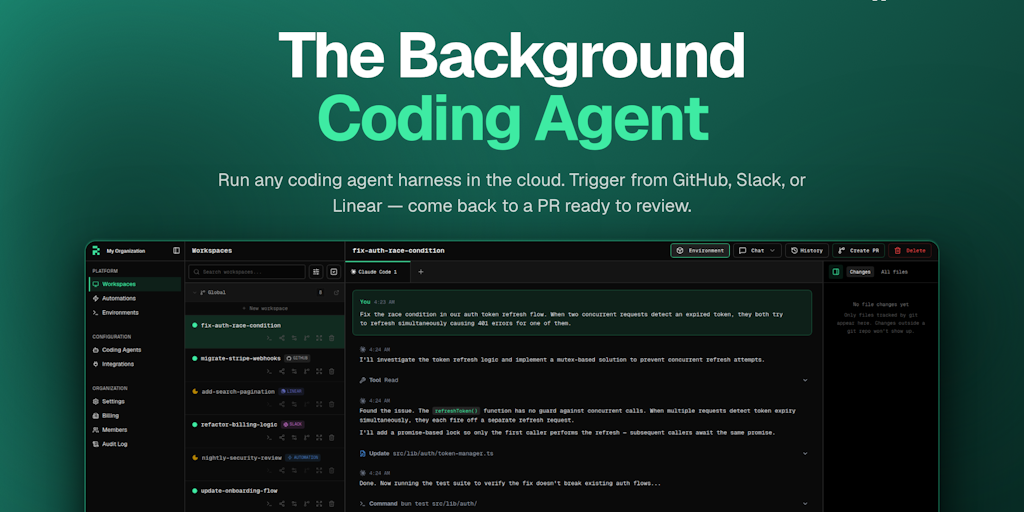
Replicas solves the "my laptop is running hot" problem by moving AI coding agents to isolated cloud VMs. Trigger tasks from Slack, Linear, or GitHub. The agent runs in its own environment, handles CI failures and merge conflicts automatically, and delivers pull requests ready for review. Multi-agent parallel execution means you can run several tasks simultaneously. Verdict: The most practical take on cloud-hosted coding agents - the Slack/Linear integration removes friction that competing tools require.
Replicas: Run Claude Code and Codex in the cloud | Product Hunt
Run background coding agents from anywhere. Spawn Claude Code or Codex in a VM with code and tooling ready to go. Hand off tasks from Slack, Linear, or GitHub Replicas runs Claude Code, Codex, or any coding agent in the cloud. Agents run in isolated VMs with real dev environments, and you can bring your own subscriptions and API keys. Trigger tasks from Slack, Linear, or GitHub and come back to a PR ready to review.
Multiplayer markdown for you, your team, and your agents
🔥 Upvotes: 109  ·  👤 By: Jesse Litton & Josh Philpott
💰 Pricing: Free  ·  🏷 Category: Collaboration
Real-time collaborative markdown editing where both humans and AI agents can work in the same document simultaneously. Uses CRDT data structures (Conflict-free Replicated Data Types - a technology that lets multiple editors work without conflicts) for seamless conflict resolution. Agent integration via MCP. Verdict: Fills a real gap - there's no good way to collaborate on AI-generated documents in real time today.
Composer: Multiplayer markdown for you, your team, and your agents. | Product Hunt
Composer is a real-time, multiplayer markdown editor where people and agents can work side-by-side. Instantly share markdown generated by your agent with teammates, edit in real time, leave comments, suggestions, and share context. Your agents join as true collaborators, working directly alongside you and your team.
2x Claude Code's usage at $15/mo
🔥 Upvotes: 89  ·  👤 By: Santosh Arron (Blankline)
💰 Pricing: $15/mo Pro  ·  🏷 Category: Developer Tools
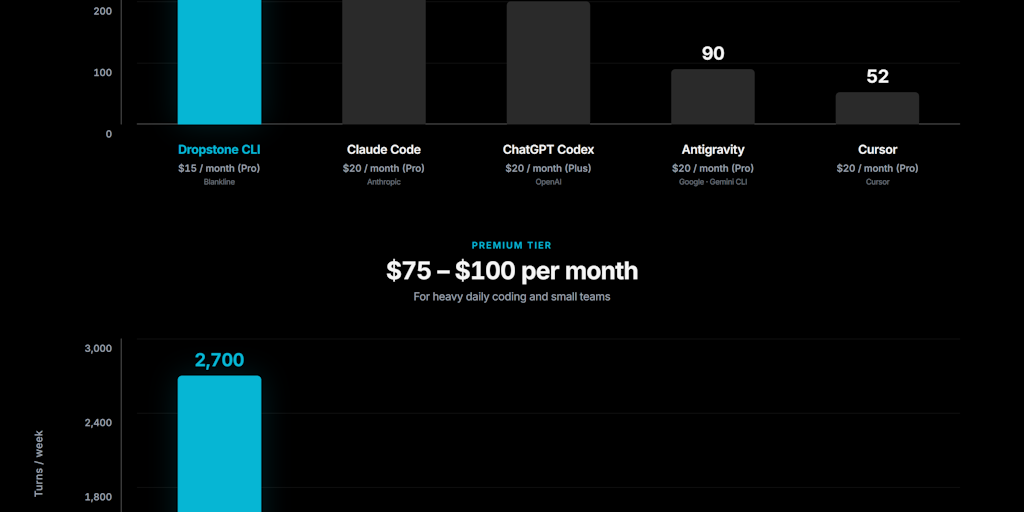
A terminal-based coding agent that auto-switches to whichever AI model benchmarks best monthly. Currently running on DeepSeek and Kimi models. Promises ~450 deep coding sessions weekly at Pro tier versus Claude Code's limits at $20/month. US-hosted with no data retention. Verdict: Bold pricing claim, but monthly model switching means unpredictable behavior - power users may find consistency more valuable than sessions.
Dropstone: 2× Claude Code’s usage at $15/mo. | Product Hunt
Dropstone is an AI coding agent that lives in your terminal. Every month we test the top AI models and switch Dropstone to whichever one codes best so you don’t have to keep migrating. Dropstone 1.5 runs on DeepSeek and Kimi, hosted in the US, with nothing stored on our side. $15/month gets you about 450 deep coding sessions a week. That’s roughly twice what Claude Code Pro gives you, for $5 less.
Snapshot
ProviderModelInput $/1MOutput $/1MContext
AnthropicClaude Opus 4.7$5.00$25.001M
AnthropicClaude Sonnet 4.6$3.00$15.001M
AnthropicClaude Haiku 4.5$1.00$5.00200K
OpenAIGPT-5.5$5.00$30.00-
OpenAIGPT-5.4$2.50$15.00-
OpenAIGPT-5.4 Nano$0.20$1.25-
GoogleGemini 3.5 Flash$1.50$9.00-
GoogleGemini 3.1 Pro Preview$2.00$12.00-
GoogleGemini 2.5 Flash-Lite$0.10$0.40-
GroqLlama 3.3 70B$0.59$0.79-
GroqLlama 3.1 8B$0.05$0.08-
What this means: Opus 4.7's new tokenizer generates up to 35% more tokens for the same input text - a hidden cost increase even at unchanged per-token prices. GPT-5.5 matches Opus 4.7's input pricing but costs 20% more on output ($30 versus $25 per million tokens). Gemini 2.5 Flash-Lite at $0.10/$0.40 remains the budget king for high-volume, lower-stakes tasks.

Handoff Debt: The Rediscovery Cost When Coding Agents Take Over Interrupted Tasks
arXiv:2606.02875
What it claims: When an AI coding agent picks up a task that a human developer left mid-stream, there is a measurable "handoff debt" - the agent spends significant effort rediscovering context that the original developer already had. This cost is systematically underestimated in current benchmarks.

Key finding: The paper quantifies the rediscovery overhead and shows it scales with task complexity and the amount of implicit context (decisions, rejected approaches, and mental models) that the original developer accumulated but never documented.

Why practitioners should care: If you're using AI coding agents to pick up interrupted work - which is the exact workflow Uber, Microsoft, and others are scaling - you may be paying a hidden tax that current tools don't account for. This has direct implications for how teams should document work-in-progress when they expect agents to resume it.
Subscribe to GenAI Secret Sauce newsletter and stay updated.

Don't miss anything. Get all the latest posts delivered straight to your inbox. It's free!
Great! Check your inbox and click the link to confirm your subscription.
Error! Please enter a valid email address!