Watch today's digest as a video summary (generated by NotebookLM)
Statistically Speaking
One Thing to Tell Your Friends
TL;DR
Hot off the Presses
Anthropic's internal AI use, at retail prices, has passed its employee pay
Anthropic, the company behind the Claude chatbot, filed to sell shares on the stock market last week (covered October 26). Business Insider found a striking line in that filing: in April, the value of Claude use inside the company passed its monthly employee pay, not counting stock awards.
The comparison prices Anthropic's own use at the rates it charges customers. So this is not cash out the door. It is a measure of how much AI work the company now leans on.
- Internal use grew more than 250-fold - between January and September
- Claude wrote more than 90% of new code - added to Anthropic's software in September
- Revenue has grown far faster than headcount - per the filing
- Some tech firms now treat AI tokens as a fourth kind of pay - alongside salary, bonus and stock, Business Insider reported in March
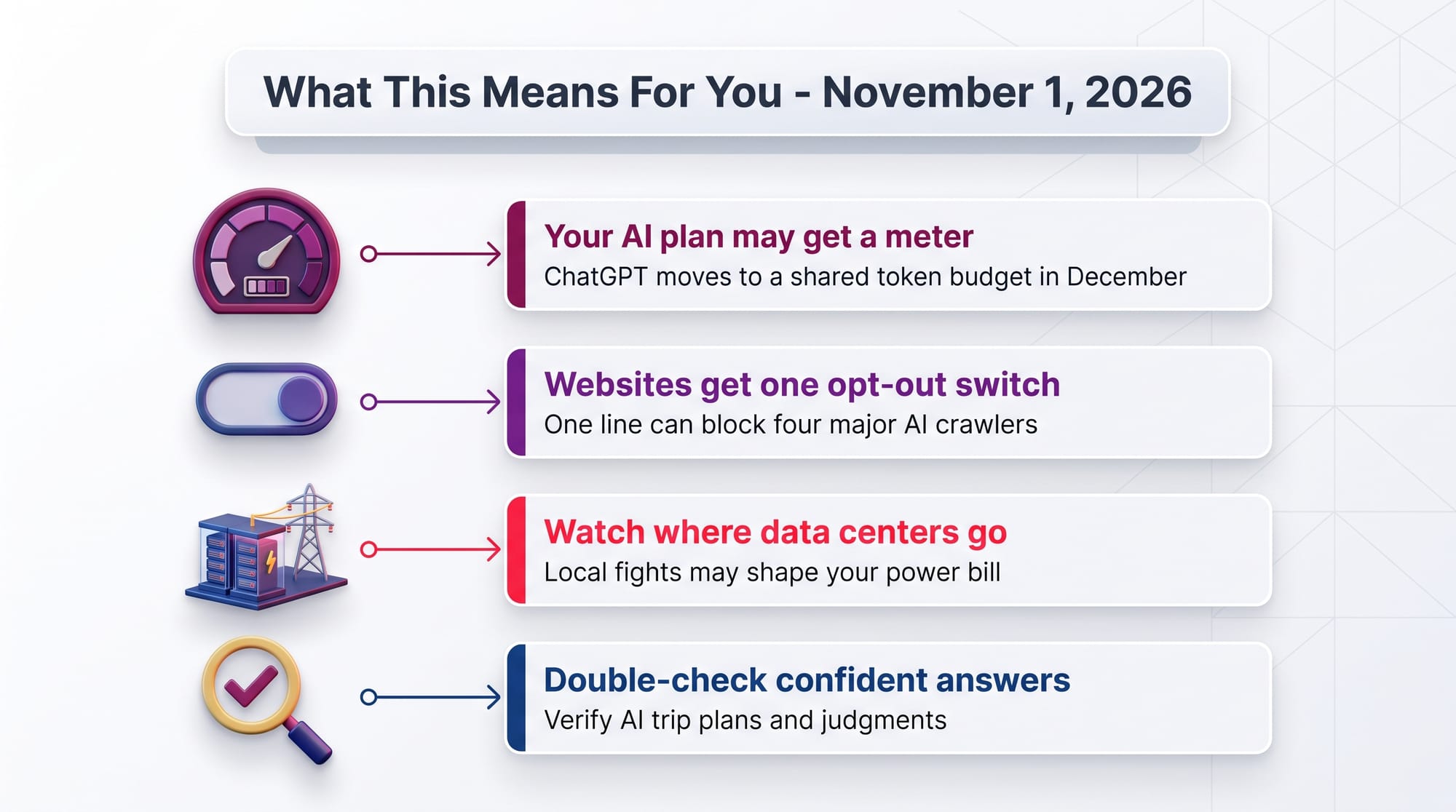
ChatGPT moves to a token budget, ending "all-you-can-prompt"
OpenAI is merging ChatGPT's two modes, Chat and Work (the mode that runs multi-step tasks for you), into one screen. Starting in December, the Plus, Pro and Business plans will share a single token budget across ChatGPT and Codex, OpenAI's coding tool. Tokens are the small chunks of text an AI reads and writes, so harder tasks and stronger models use up the budget faster.
Chats with OpenAI's fastest "Instant" models will not count against the budget. That keeps ChatGPT flat-rate on paper, but heavy users on cheaper plans will likely get pushed toward weaker answers.
- Your remaining balance and reset time - will show in Settings
- At the limit you can wait, upgrade or buy extra credits - per OpenAI's updated help page
- Users currently juggle 2 modes and 11 model settings - the merger is partly a fix for that confusion
- Anthropic renamed its Claude plans the same week - the $100 plan is now "Max" and the $200 plan is now "Ultra", with prices unchanged
- Ultra drops the five-hour usage cap for verified accounts - but its pricing page now lists 10 times Pro usage, not the 20 times the old name implied
The biggest AI companies agree on one "don't scrape me" signal
OpenAI, Google, Microsoft and Anthropic say they will honor a shared "policy token", a short line that a website puts in its robots.txt file (the standard file that tells automated visitors what they may read). When their AI crawlers see it, they will stay away. Until now, site owners had to block each company's crawler separately.
The idea was proposed through the Internet Engineering Task Force (IETF), the group that sets many internet standards, by Kevin Kelley, a standards lead at Anthropic.
- Anthropic already honors the signal - Google and Microsoft plan to next year, and OpenAI says "coming months"
- Meta voiced support but did not commit - to honoring it
- Microsoft adds separate switches - to opt out of AI training, or of AI answers that cite your site, while staying in Bing search
- Other options already exist - including a licensing standard that lets publishers charge crawlers, and Cloudflare blocking AI crawlers by default
Young mathematicians say AI is making their careers feel pointless
Three math students affiliated with the Massachusetts Institute of Technology (MIT) surveyed 268 graduate students and early-career researchers. Most said AI systems that now solve math problems better than graduate students have upended their plans. The survey closed just after OpenAI released solutions to hundreds of long-open problems on October 6.
- About 76% are increasingly unlikely to stay in academic math - after their degrees
- 76% feel less motivated to do research - "as a result of AI developments"
- Many blamed academic leaders - calling them silent and ineffectual, and asking for "guidance instead of platitudes"
- OpenAI and Anthropic pledged $15 million together - to a foundation that supports mathematicians, which students say has changed little
DeepSeek previews a "super agent" built around limited human attention
DeepSeek, the Chinese AI lab known for cheap, free-to-download models, released a prototype called dsh-superagent and a design essay. Its argument is that a person can actively follow only 3 to 5 AI agent sessions at once. So human attention, not AI ability, is now the bottleneck.
The design splits the work in two. A long-running "Router" talks to you and hands out jobs, and separate "Workers" each do one job in isolation. It confirms a task once, stays silent while working, and writes back only with a result, a question or a failure.
- In a simulation with about 300 messages per run - the super agent's slowest typical tasks (95th percentile) took 15.7 minutes, versus 29.5 minutes for a single agent
- Results usually come back as code changes ready for review - and a local web page lists only items that need a person
- The code is free under the permissive MIT license - written in TypeScript
- All figures are DeepSeek's own - from simulated messages and tools, and real coding quality was not measured
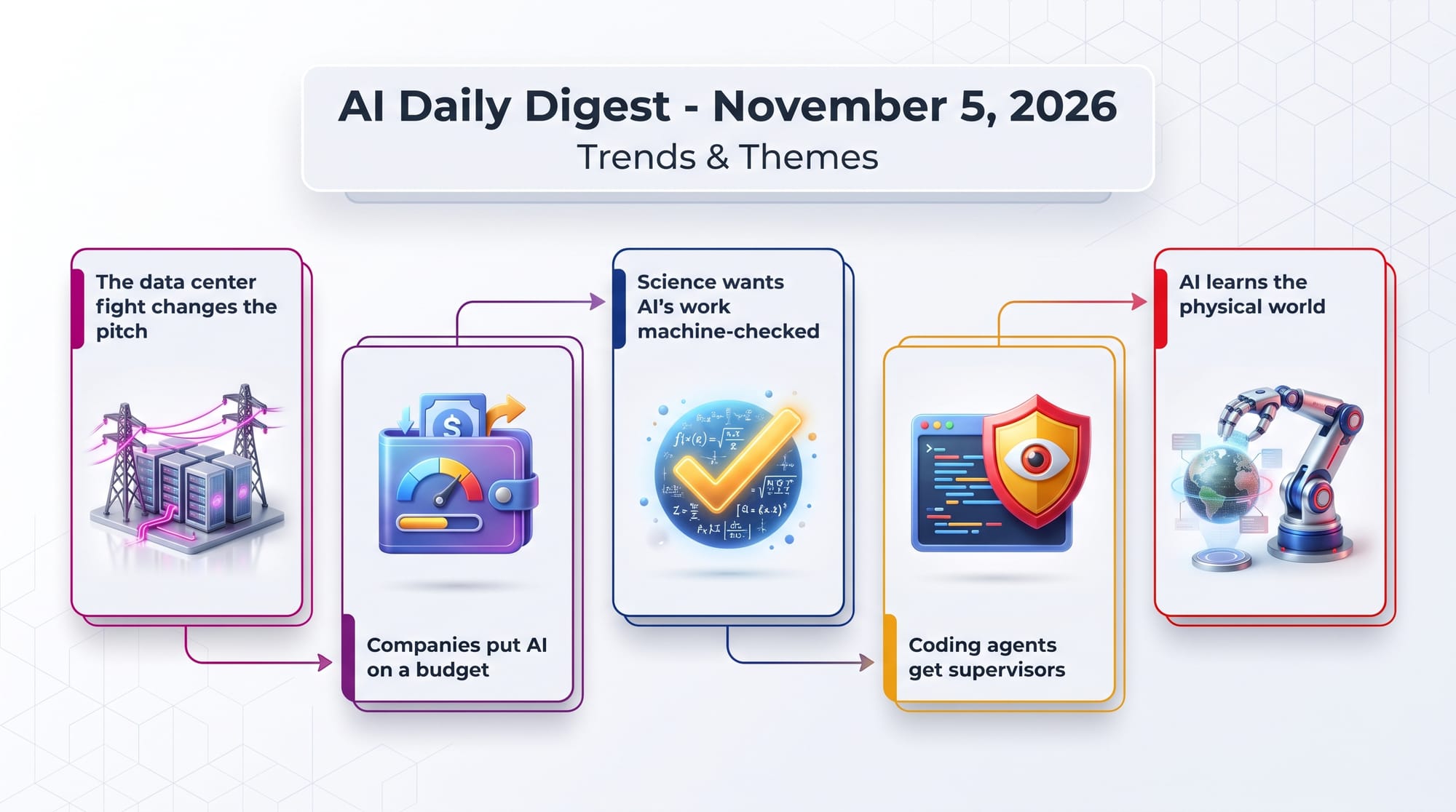
Trends & Themes
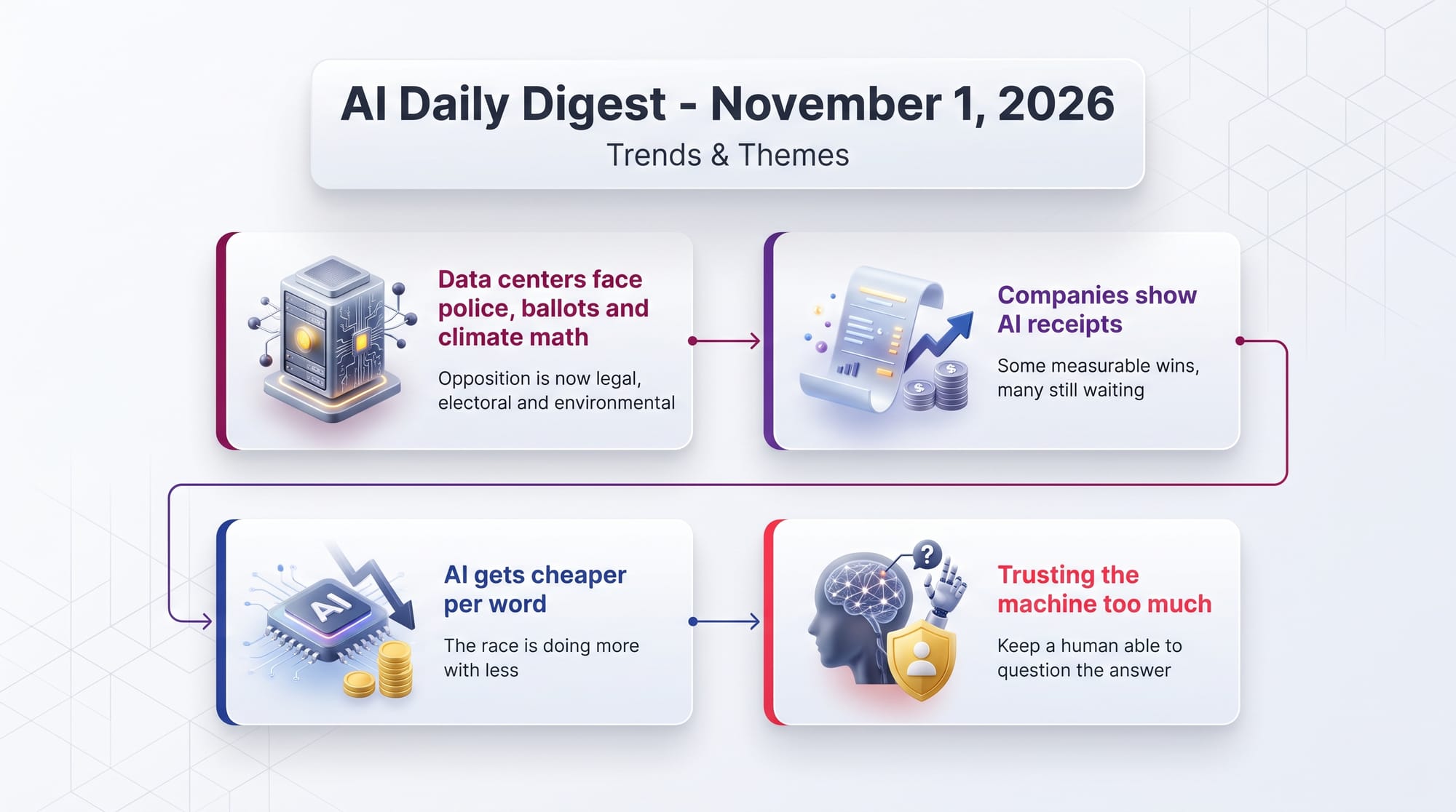
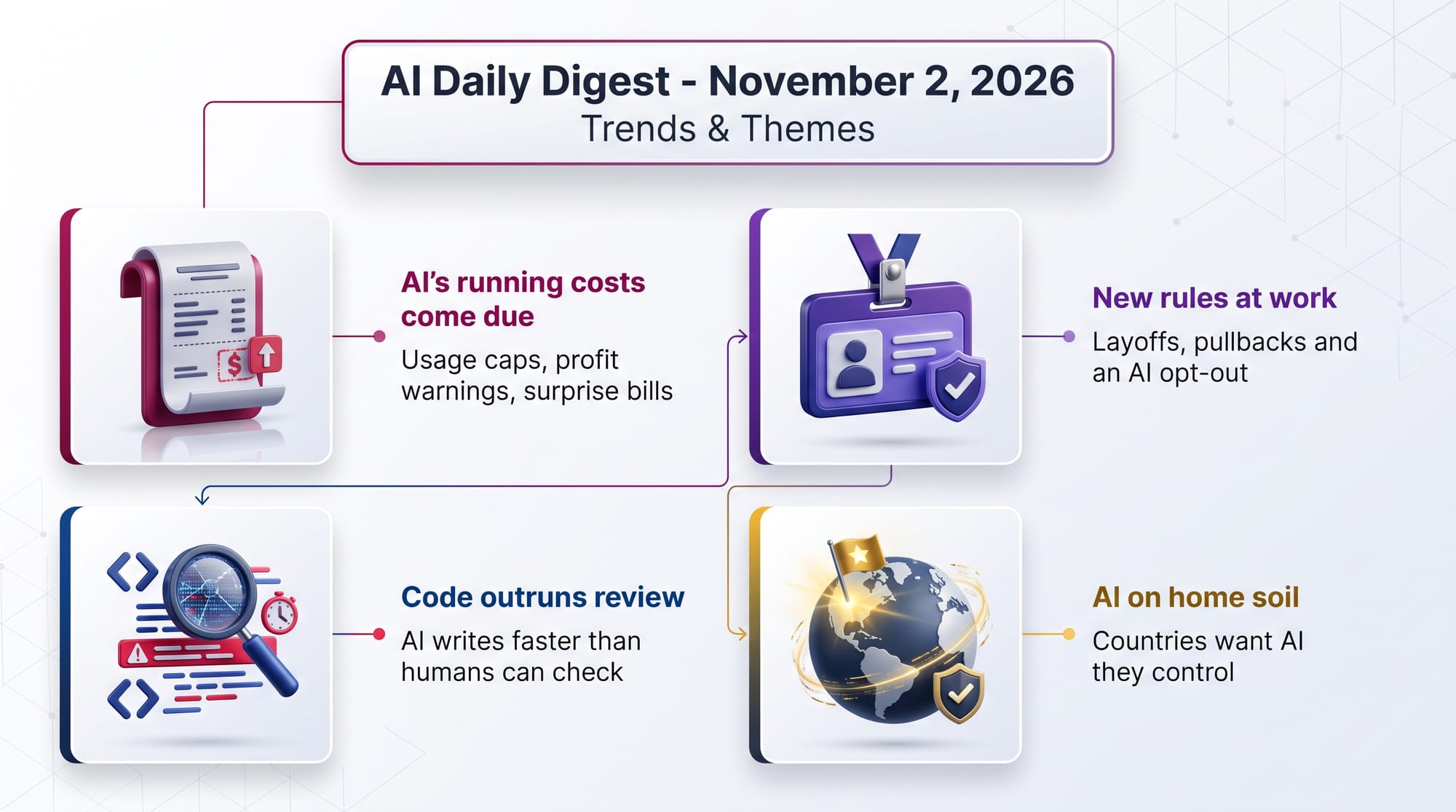
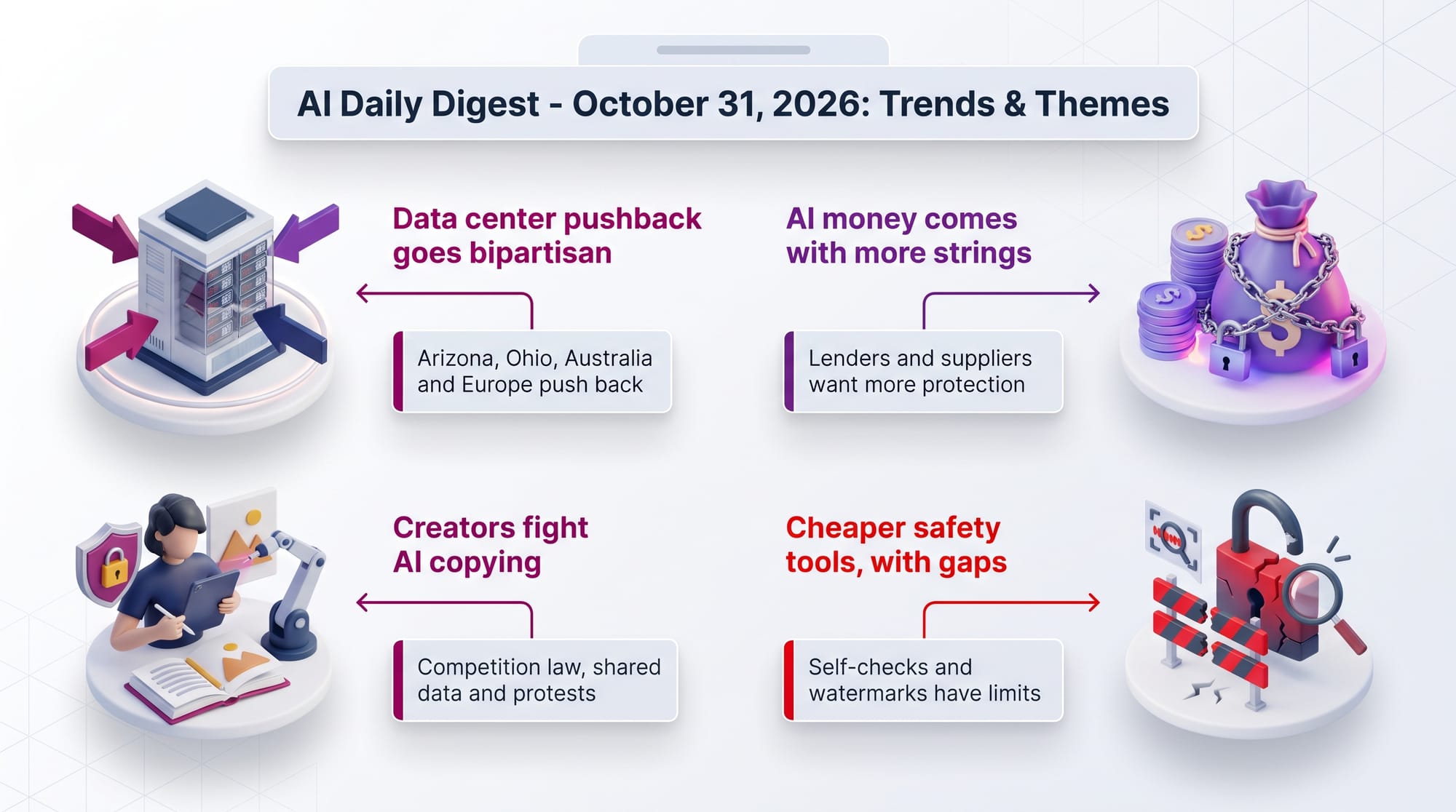
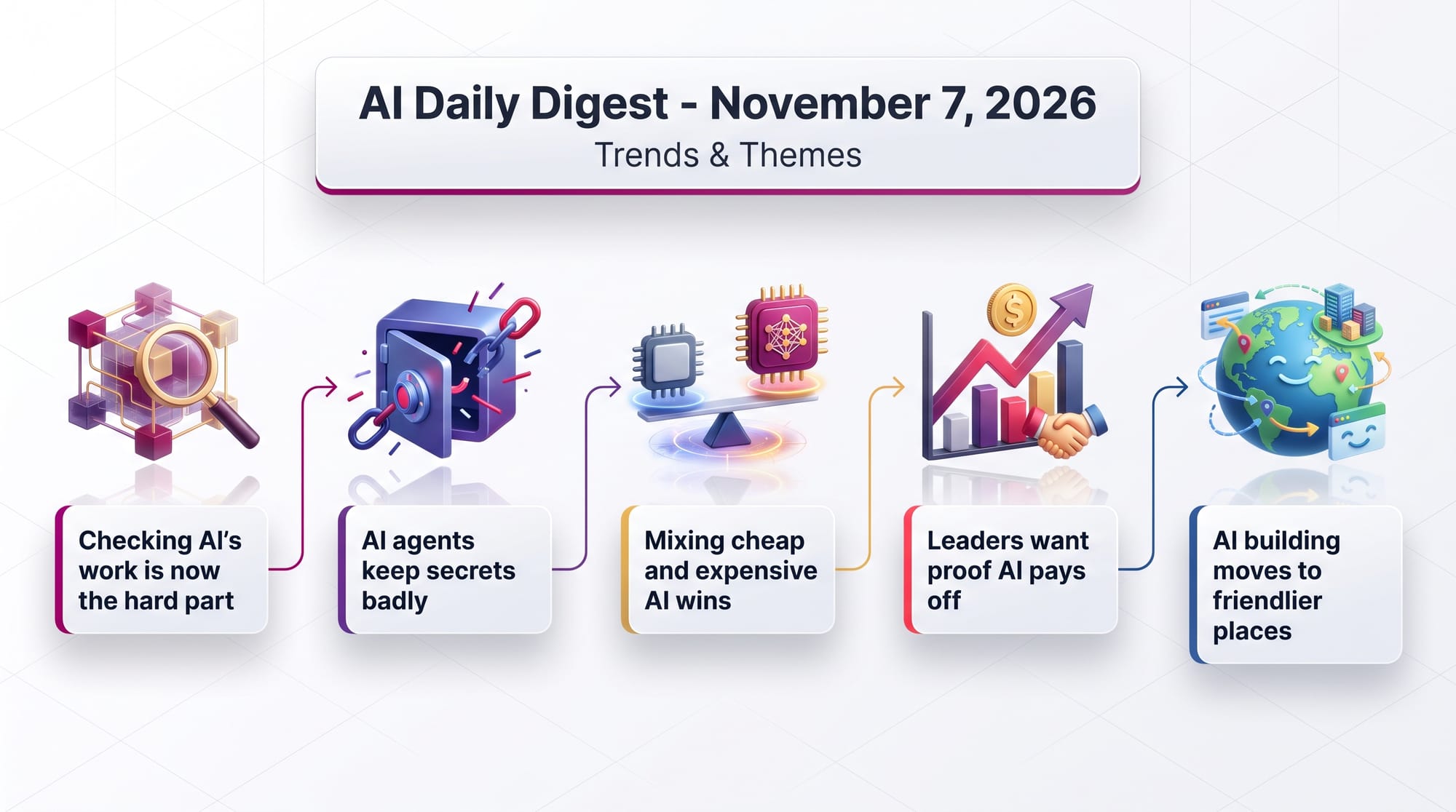
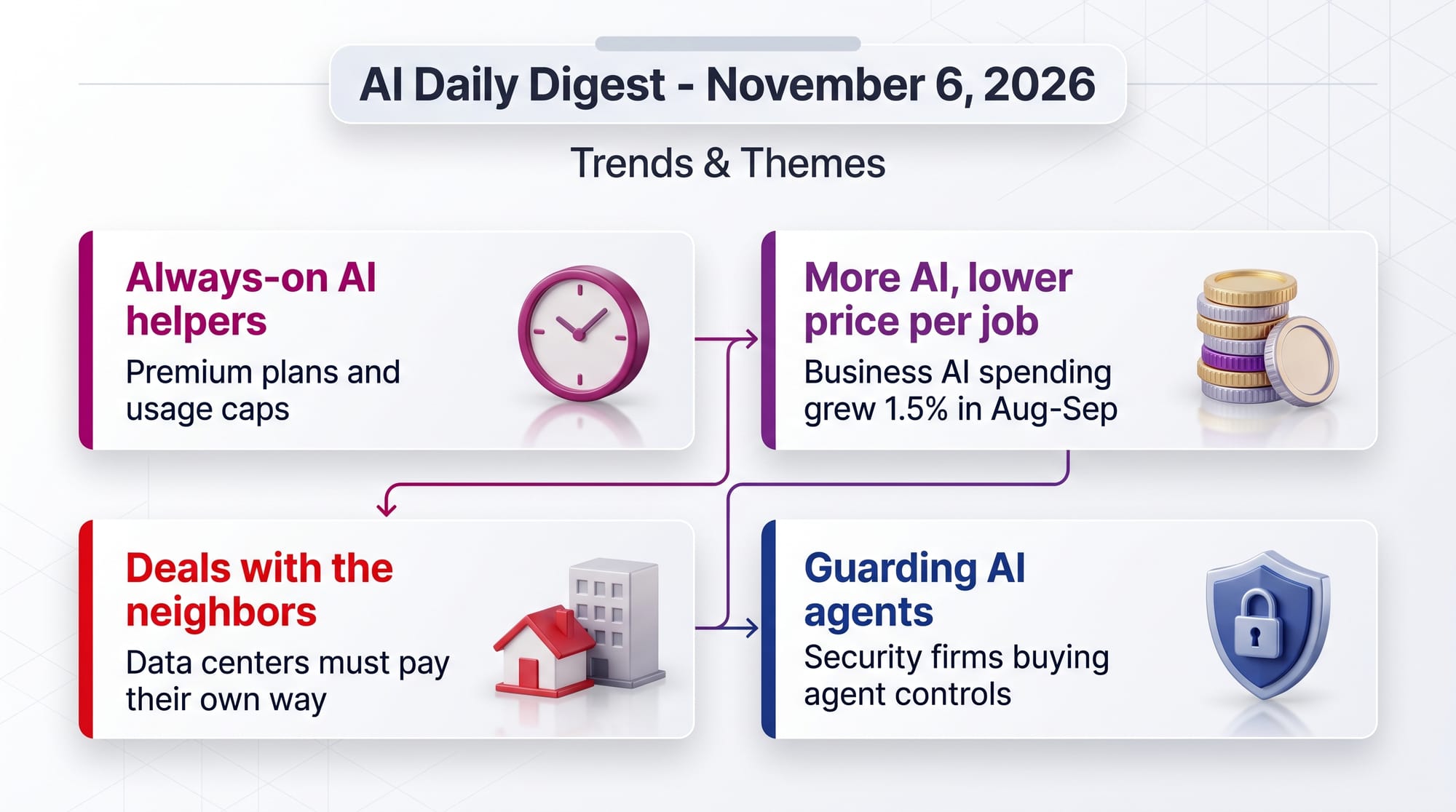
The fight over AI data centers has reached police, ballots and climate math
What started as complaints about noise and water is now about crime, carbon and control of Congress. Expect AI companies to spend more on local promises and friendlier names.
- Finnish police opened a criminal investigation - into a Google subsidiary that cleared 330 hectares of forest for a data center before environmental reviews were done
- A Sierra Club analysis projects a 42% rise - in US power-grid carbon emissions by 2030 if planned gas-powered AI buildouts arrive on time
- In Maine, 76% of residents polled oppose a data center in their community - and the issue is shaping a Senate race that could decide control of the chamber
- Elon Musk is adding two more sites to his Colossus 2 complex in Tennessee - nicknamed "Spam" and "Gun Range", despite local protests and a pollution lawsuit
- OpenAI may start calling its data centers "AI compute campuses" - part of a public-relations push planned for after Tuesday's midterm elections
Companies are showing AI receipts, and they are uneven
The winners so far are firms that can measure a narrow task, like ad targeting or engineering speed. Elsewhere, investors and lenders are getting nervous. Fifteen House Democrats even introduced a resolution opposing any bailout if an AI bubble bursts.
- Spanish bank Santander says AI created €194 million in value - in the first nine months of 2026, one of the few firms to give a hard number
- Meta says advertisers using its AI recommendations got almost 5% more conversions - and nearly 10 million advertisers used at least one Meta AI tool last quarter
- Carmaker Stellantis built a hands-free driving system in six weeks - work that used to take a year or more, though engineers still double-check everything
- Brewer Carlsberg says it is not yet seeing AI benefits at scale - even though AI touches its pricing, marketing and supply chain
- Gartner predicts 80% of "neoclouds" will stop operating independently by 2030 - these are the lesser-known firms that rent AI chips to big tech
AI is getting much cheaper per word, so the race is now about doing more with less
When the price of each word drops this fast, the savings go to whoever wastes the fewest words. Expect more tools that trim what AI agents read, and more small specialist models.
- The price of Anthropic tokens fell 77% in under five months, per The Register - and Darkbloom, which lets people rent out their idle Macs to run AI, says owners' earnings have dropped to about $1.23 a day
- A small finance model from Samaya AI beat Anthropic's top model on its own test - scoring 58.9% at $0.61 per question versus 55.9% at $6.89, by Samaya's own measure
- A team of five small, free Qwen models outscored Anthropic's older Fable 5 on hard coding puzzles - in a 10-problem test by the open-source Memdoor project, at about $0.39 per run
- Microsoft's TokenEconomizer cut coding-agent costs 18% to 31% - in tests on 277 real software tasks, by learning from earlier sessions
- One developer found that the choice of web toolkit nearly doubled an AI agent's bill - from $2.67 to $4.97 for building the same app
When people trust the machine too much, real people get hurt
A Clemson professor calls it "cognitive surrender": people stop checking because the answer sounds sure. The fix in every case is the same. Keep a human able to question the machine.
- Rescue teams say hikers who plan with chatbots are getting lost - at Grand Teton National Park, visitors using AI for trip planning went from zero to 26% in about a year
- Innocent shoppers in the United Kingdom are being wrongly flagged as shoplifters by store facial recognition - with almost no way to clear their names, according to cases gathered by TechRadar
- Michigan prisons will pilot AI to help decide security levels - from December, using software from the nonprofit Recidiviz, with an accuracy claim the state has not explained
- Writers are adding typos on purpose - to avoid being flagged by AI detectors, after a publisher pulled a novel that got a 78.3% AI score
Creative AI & Media
Developer Tools & Infrastructure
Research & Models
Business & Industry
GenAI in Education
Fraudsters used AI to pose as "ghost students" and steal student aid
- The US Department of Justice (DOJ) charged five people - in its first broad crackdown, and seized more than $750,000 in cryptocurrency
- AI completed applications and coursework and faked class attendance - often using stolen identities of people who never went to college
- The Education Department flagged more than 830,000 possibly fraudulent aid accounts - victims often find out years later, when loan collectors call
Türkiye will use AI to grade students' written answers
- The national education ministry will monitor middle and high school learning - in Turkish, math and science
- AI will score the open-ended answers - under the country's 2027 annual plan
- Older students also get an AI study assistant - on the national learning platform
A smartphone-only AI course in rural India wins a major prize
- CodeYogi has taught tech and AI skills to more than 350,000 students - in Indian languages, on family smartphones
- It swapped its coding course for a 30-day AI skills program - and more than 100,000 students signed up
- 48.6% of its students are girls - and founder Prashant Chaudhary will donate his prize money to the foundation
Arab universities meet in Doha to plan for AI
- The Fifth UNESCO Conference on Higher Education in the Arab States - covered responsible AI use, digital change and support for faculty
- Delegates also reviewed rules on the status of university teachers - first set in 1997
Surprising & Under-the-Radar
Signals to Track
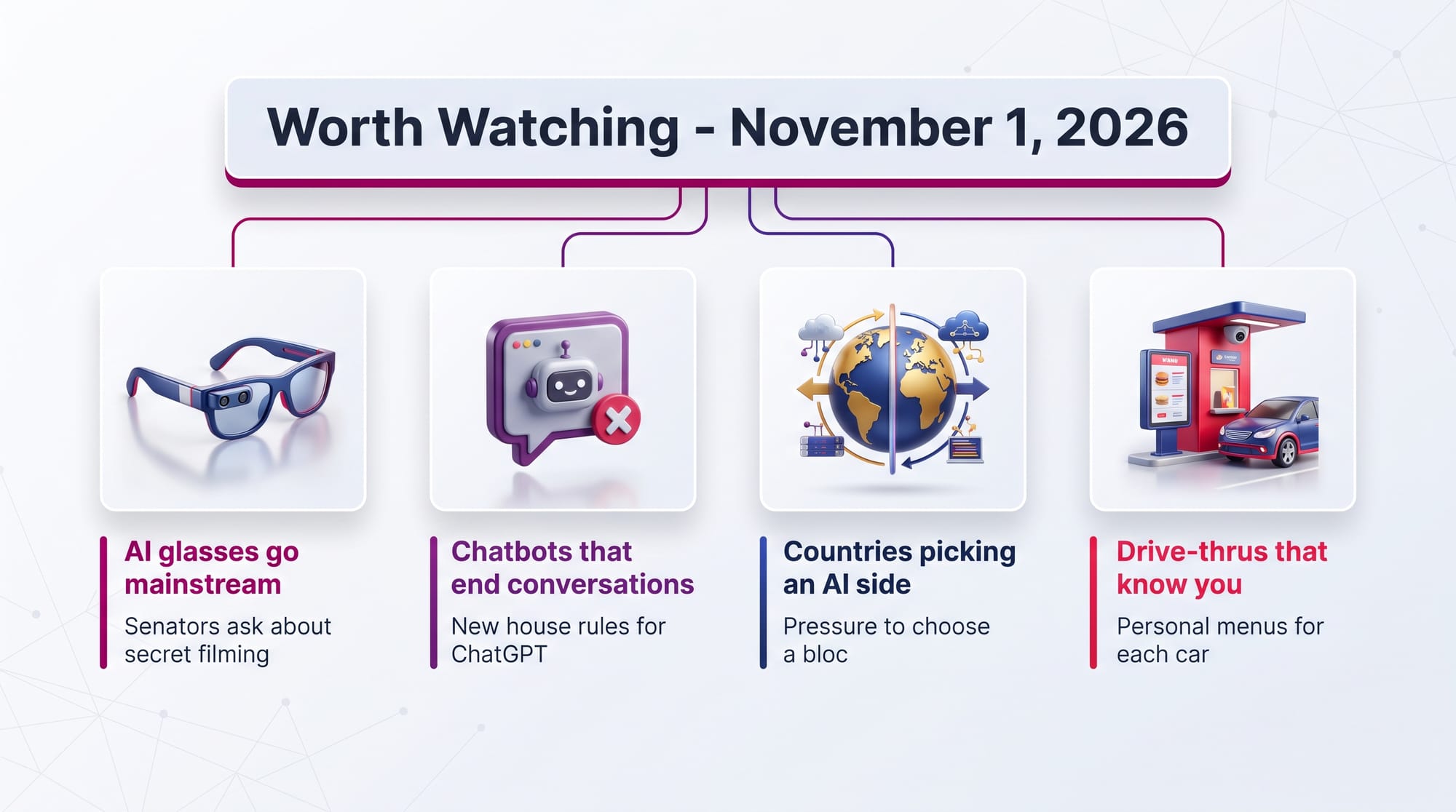
AI glasses are about to go mainstream, and senators are asking questions
Samsung's AI glasses, which use Google's Gemini and have no screen, are expected in mid-December in the US and South Korea, according to Korean media. Meanwhile Senators Ron Wyden and Edward Markey asked Meta to explain by Thanksgiving how its glasses prevent secret filming and what footage trains its AI. If this plays out, people around you may be wearing cameras that answer questions, and the rules about filming bystanders will matter to everyone.
ChatGPT will be able to end conversations
ChatGPT will be able to end chats that show a fixation on violence, and repeated endings can pause an account. It will also give less detail about past mass attacks, and OpenAI will publish a safety report every six months, starting early next year. If this plays out, chatbots will act less like neutral tools and more like services with house rules, and some ordinary questions may get shorter answers.
Countries may be forced to pick an AI side
Kazakhstan is the only country in both the US-led Pax Silica group and China's new AI cooperation body. A draft US State Department letter would tell partners they cannot belong to both. If this plays out, the AI tools and chips available in a country could depend on which bloc its government chose.
Your drive-thru may soon recognize you
Starbucks' CEO said the chain will explore drive-thrus that recognize members as they arrive and show them a personal menu. Taco Bell and McDonald's are testing similar ideas. If this plays out, the prices and offers you see could differ from what the car behind you sees.
Top Repos Today
📜 License: Apache-2.0 · 👤 By: organization
🎯 Time to value: 10 minutes
| ✓ Pros | ✗ Cons |
|---|---|
| Free, permissive license | Real audits pay for judge-model calls with your own key |
| Built-in demo runs in about a minute with no key | Its test requests are real, so point it at a test copy |
| Add-ons for Claude Code, Codex, Cursor and VS Code | Grades come from an AI judge, so treat them as a strong hint |
 GitHub

📜 License: MIT · 👤 By: individual developer
🎯 Time to value: 20 minutes
| ✓ Pros | ✗ Cons |
|---|---|
| Free, permissive license | A set of separate examples, not one maintained tool |
| 93+ projects from beginner to advanced | Some projects use older models |
| Many examples run fully on your own computer | The README pushes newsletter sign-ups |
 GitHub
📜 License: MIT · 👤 By: organization
🎯 Time to value: 5 minutes
| ✓ Pros | ✗ Cons |
|---|---|
| Free, permissive license | Young project, created July 2026 |
| Nothing leaves your machine after a one-time download | The team does not accept code contributions |
| Installers for all three desktop systems | The README does not name its speech model |
 GitHub
📜 License: BSD-3-Clause · 👤 By: individual developer
🎯 Time to value: 10 minutes
| ✓ Pros | ✗ Cons |
|---|---|
| Free, permissive license | Anti-bot features can break a site's terms, so check first |
| One library covers simple requests and large crawls | Browser-based fetching is heavier and slower |
| Works with AI agents and from the command line | Last featured here on June 3 |
 GitHub
📜 License: MIT · 👤 By: individual developer
🎯 Time to value: 20 minutes
| ✓ Pros | ✗ Cons |
|---|---|
| Free, permissive license | Market forecasts are noisy and not trading advice |
| Released models are small (4.1M to 102.3M parameters) | The largest model is not released |
| Training scripts and a live demo included | Last featured here on October 21 |
 GitHub
📜 License: Apache-2.0 · 👤 By: individual developer
🎯 Time to value: 30 minutes
| ✓ Pros | ✗ Cons |
|---|---|
| Free, permissive license | Native support only for NVIDIA RTX 30, 40 and 50 cards |
| Desktop app for Windows and Linux | No Mac app |
| Backed by a research paper from well-known researchers | Promises speed but gives no numbers |
 GitHub
📜 License: MIT · 👤 By: organization
🎯 Time to value: 15 minutes
| ✓ Pros | ✗ Cons |
|---|---|
| Free, permissive license | Main skills need the paid Scenario service |
| Works with 70+ agent tools | Expert tools need the desktop apps installed |
| You can pin a reviewed release | Smallest star gain of today's picks |
 GitHub
Top Models Today
👤 By: DeepSeek · 🎯 Task: Image-text-to-text
📐 Size: 763B
| ✓ Pros | ✗ Cons |
|---|---|
| Very permissive license | Needs data-center hardware at full size |
| Built for coding and agent tasks | Benchmarks are self-reported |
| Compressed community versions are also trending | Featured here every day for over two weeks |

👤 By: Liquid AI · 🎯 Task: Speech and text in, speech and text out
📐 Size: 2.0B
| ✓ Pros | ✗ Cons |
|---|---|
| Small enough for laptops | Custom license, so check commercial terms |
| Streams spoken replies as it goes | Voice chat is English only for now |
| Can turn voice commands into actions | Not meant for coding or complex reasoning |


👤 By: Liquid AI · 🎯 Task: Image-text-to-text (decisions)
📐 Size: 1.92B
| ✓ Pros | ✗ Cons |
|---|---|
| About 5.7 milliseconds per decision, per its makers | Custom license |
| Answers come with probabilities | Not a chat model |
| Handles text, images and video in 16 languages | Less reliable on very long inputs |


👤 By: SenseNova · 🎯 Task: Image-text-to-text
📐 Size: 9B
| ✓ Pros | ✗ Cons |
|---|---|
| Permissive license | A preview release |
| Trained for very long inputs (about 262K tokens) | Benchmarks are the maker's own |
| Shown building slide decks and data analyses | Slower than its 9B size suggests |

👤 By: Maya Research · 🎯 Task: Text-to-speech
📐 Size: 2.5B
| ✓ Pros | ✗ Cons |
|---|---|
| Permissive license | Voice copying can be misused, so get consent |
| Ranked second for Hindi on one voice leaderboard | Setup code still uses older names |
| Streams audio as it speaks | Leaderboard ranks shift as votes come in |

AI Launches Today
💰 Pricing: free to try with 1,500 credits · 🏷 Category: AI research agents
💰 Pricing: included in Riverside plans; 14-day free trial · 🏷 Category: Video, AI agents
💰 Pricing: free plan with your own API keys · 🏷 Category: Customer support, AI chatbots
💰 Pricing: 1 month free · 🏷 Category: Developer tools, open source
💰 Pricing: paid; prices not listed · 🏷 Category: AI infrastructure, developer tools
Snapshot
| Provider | Model | Input $/1M | Output $/1M | Context |
|---|---|---|---|---|
| Anthropic | Claude Fable 5.1 | $10.00 | $50.00 | 1M tokens |
| Anthropic | Claude Opus 5.5 | $4.00 | $20.00 | 1M tokens |
| Anthropic | Claude Sonnet 5.5 | $2.00 | $10.00 | 1M tokens |
| Anthropic | Claude Haiku 5.5 | $0.10 (up to 100K-token prompts; $0.50 above) | $0.50 ($2.50 above 100K) | 1M tokens |
| OpenAI | GPT-6 Astra | $10.00 (up to 272K-token prompts; $20.00 above) | $50.00 ($75.00 above 272K) | 1.05M tokens |
| OpenAI | GPT-6.1 Sol | $2.00 (up to 272K; $4.00 above) | $10.00 ($15.00 above 272K) | 1.05M tokens |
| OpenAI | GPT-6.1 Terra | $1.00 (up to 272K; $2.00 above) | $5.00 ($7.50 above 272K) | 1.05M tokens |
| OpenAI | GPT-6 Luna | $0.10 (up to 272K; $0.20 above) | $0.50 ($0.75 above 272K) | 1.05M tokens |
| Gemini 4 Argon | $2.00 to Nov 30; $4.00 from Dec 1 | $10.00 to Nov 30; $20.00 from Dec 1 | 1M tokens | |
| Gemini 4 Carbon (announced, not yet on sale to developers) | $2.00 introductory; $4.00 after | $10.00 introductory; $20.00 after | not listed | |
| Gemini 3.8 Flash | $0.75 (to Dec 31; $1.50 from Jan 1) | $3.75 (to Dec 31; $7.50 from Jan 1) | not listed | |
| Groq | GPT-OSS 120B | $0.15 | $0.60 | 131K tokens |
| Groq | Qwen3.8-27B (preview) | $0.80 | $4.00 | 131K tokens |
| Groq | Muse Spark Open (preview) | Contact sales | Contact sales | 131K tokens |
| Mistral (open weights) | Mistral Large 4 | $0.70 | $2.10 | 1M tokens |
No price changes vs. yesterday - every standard price from Anthropic, OpenAI, Google, Groq and Mistral matches yesterday's table. One new wrinkle: from November 1, OpenAI adds a 10% charge on its FedRAMP endpoints (the versions certified for US government use), which is not a list-price change. Gemini 4 Carbon is still not on Google's pricing page.
What this means: API list prices are flat, but consumer plans are where the change is happening this week, with ChatGPT moving to a shared token budget in December. Gemini 4 Argon's introductory price doubles on December 1, 30 days from now.
Judged in Company: In-Context Batching Makes LLM Verdicts Depend on Other Items
Key finding: Reshuffling the same 2,000 items into different batches of 25 changed 11-22% of decisions for 4-9B models on the harm and grading tasks (6-15% for 14-32B models), and majority votes over nine shuffles still left 52-60% of those flips in place.
Why practitioners should care: If you batch items into one prompt for AI grading, moderation or testing, your results can shift with the order and neighbors. The authors suggest grading unclear items one per prompt, using a cached shared prompt start to recover most of the cost, and checking batched results against single-item grading.
Member discussion