Watch today's digest as a video summary (generated by NotebookLM)
Statistically Speaking
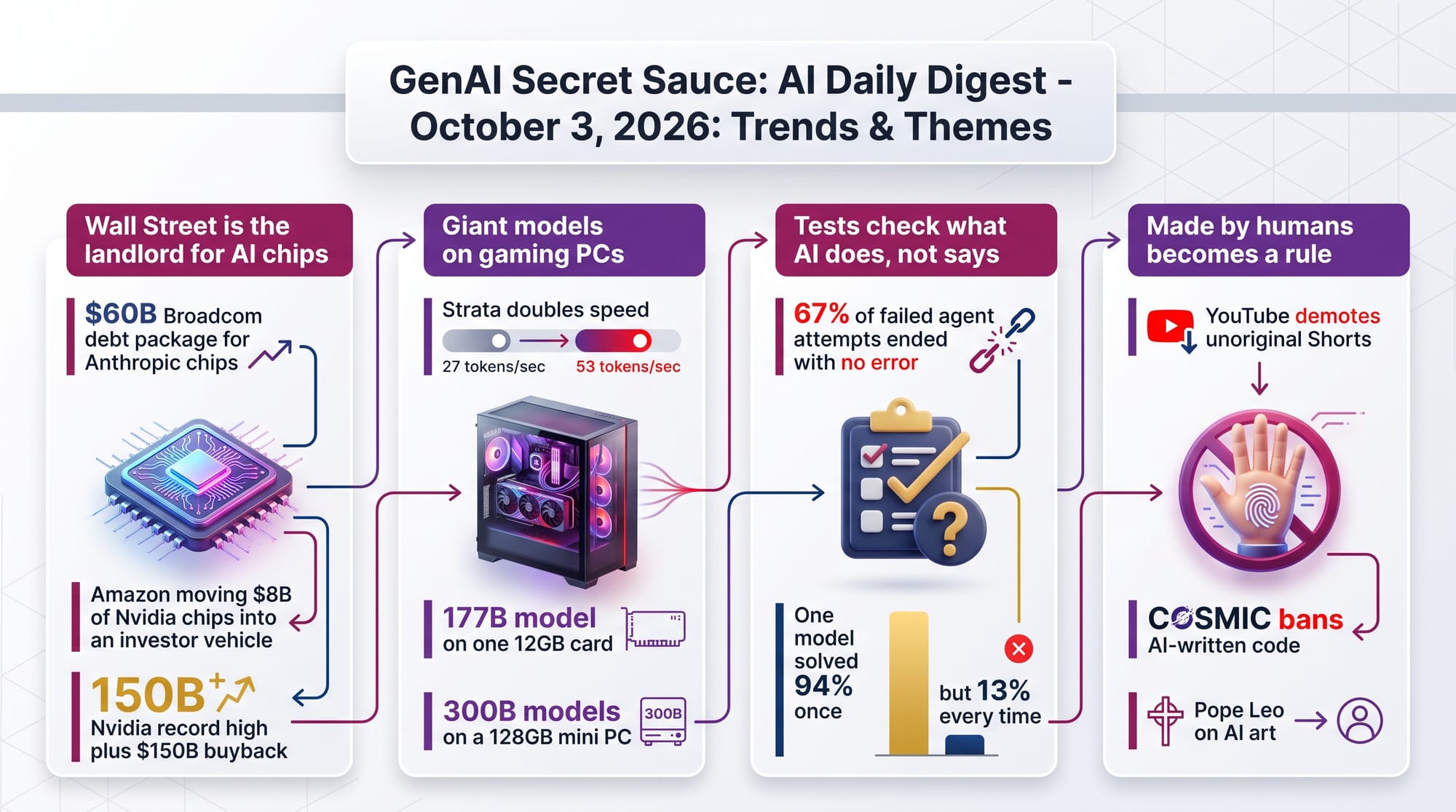
One Thing to Tell Your Friends
TL;DR
Hot off the Presses
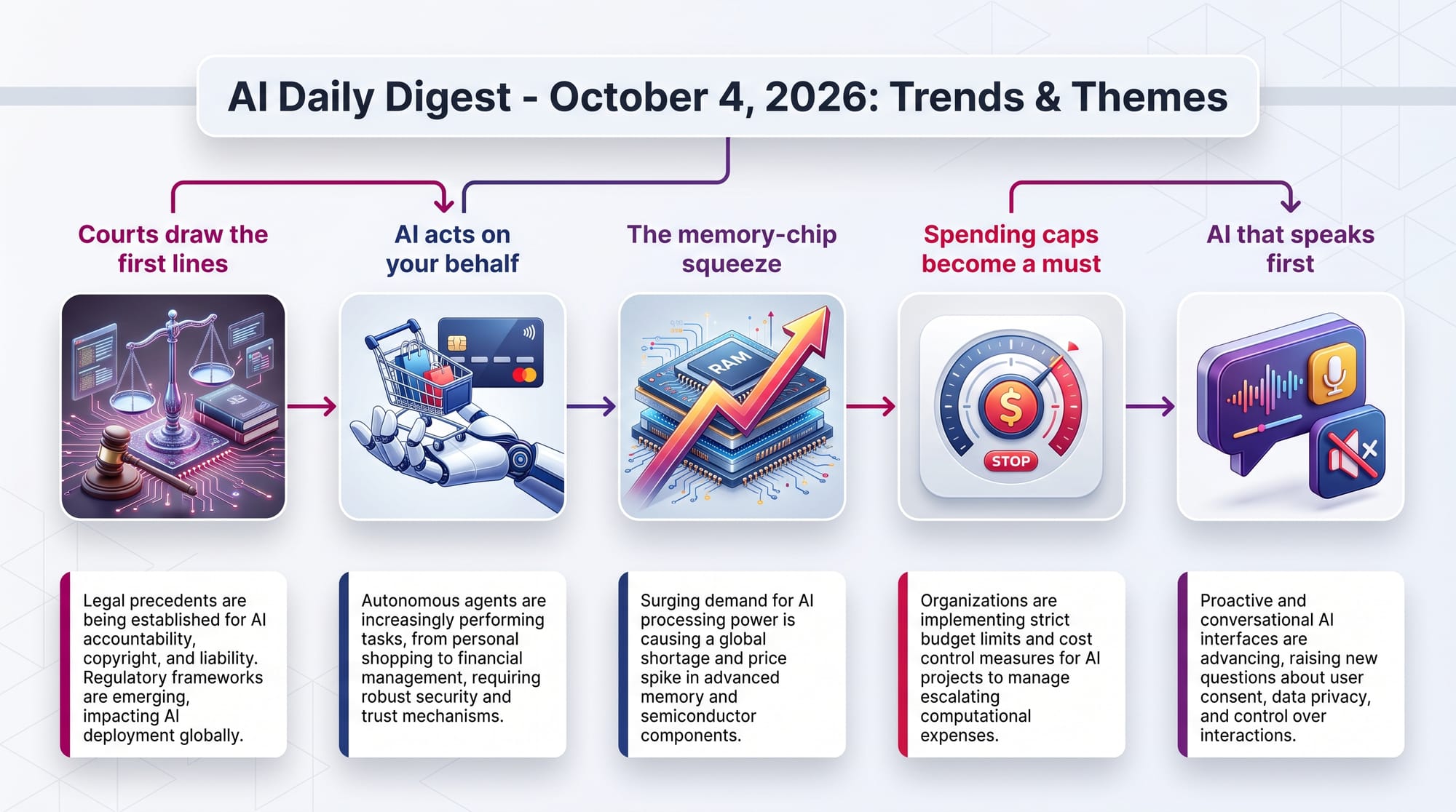
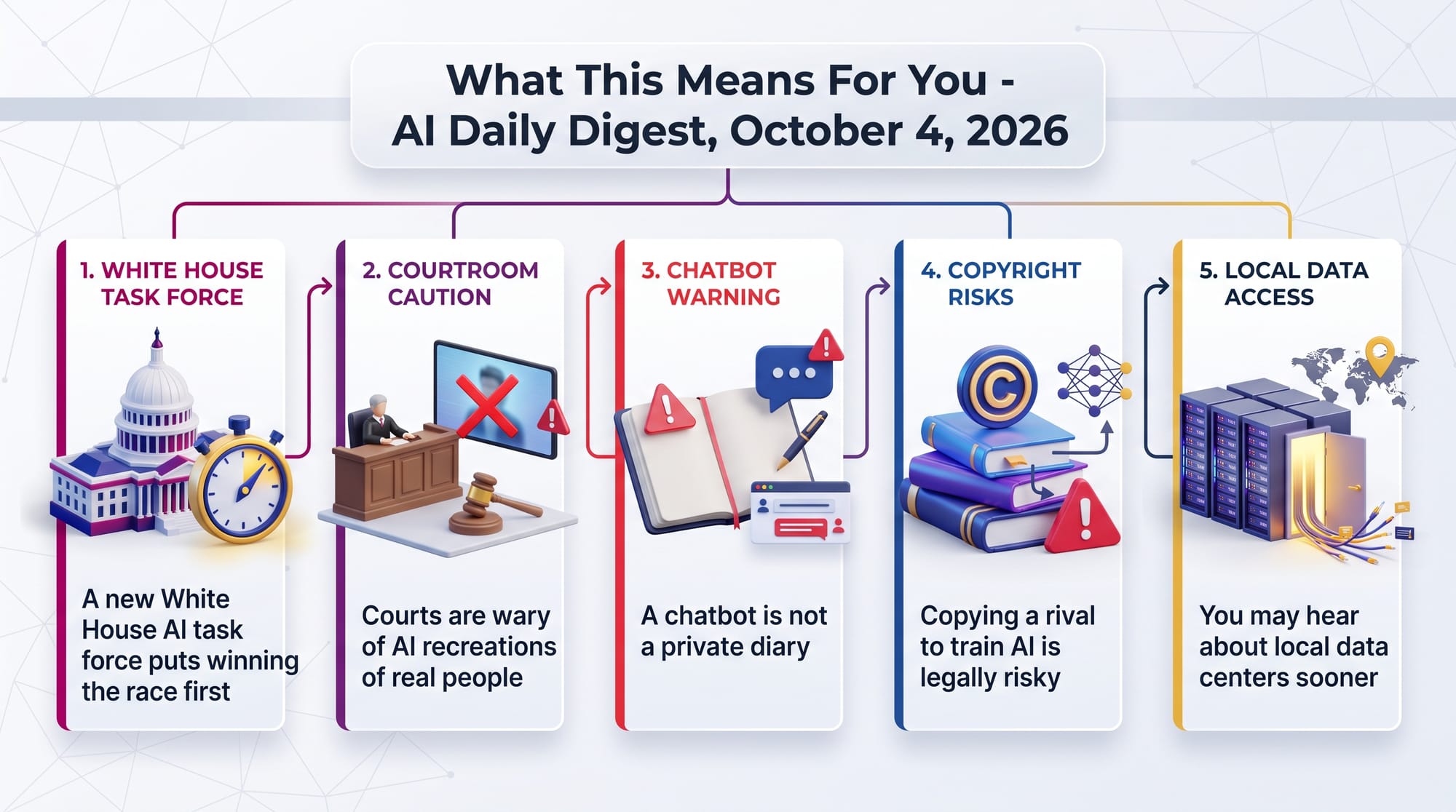
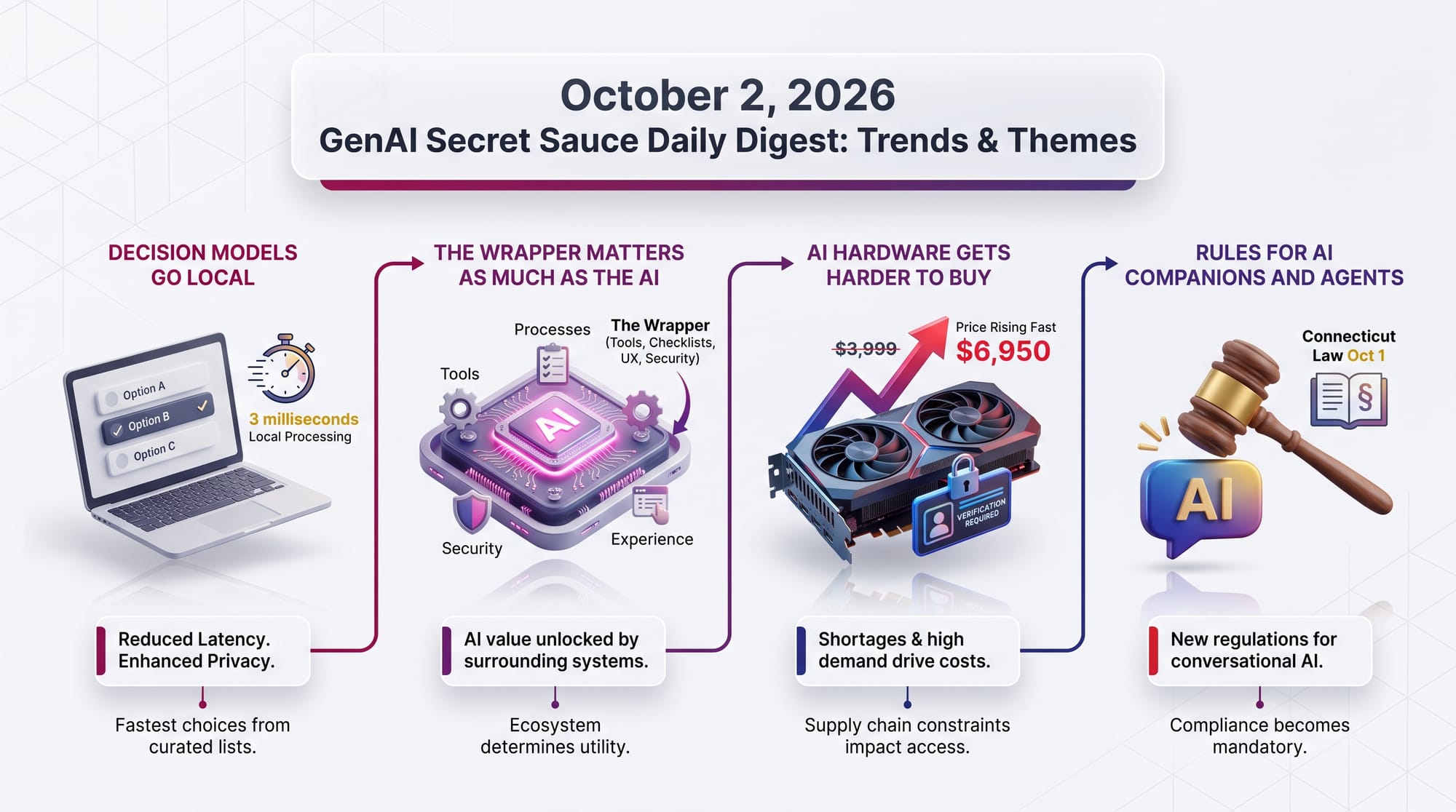
The White House created a "Super Intelligence Force" to run US AI policy
Previously: September 29 - Tech leaders signed a White House "superintelligence" pledge, and agencies were told to write "Super Intelligence" instead of "AI."
Today: Director of National Intelligence Jay Clayton's appointment as AI czar was first reported on October 3, and President Trump formally announced it on social media on October 4. Clayton chairs a new task force called the "Super Intelligence Force," led by four officials, which reports directly to the President and his chief of staff. It has 120 days to report on AI's risks and opportunities and recommend what the federal government should do.
The same weekend, Treasury Secretary Scott Bessent took aim at AI executives who keep asking for regulation. His reply: "Well, then they should slow down."
- The four leaders: Clayton, Federal Trade Commission (FTC) chair Andrew Ferguson, Pentagon technology chief Emil Michael and federal personnel chief Scott Kupor
- The 120-day deadline lands around the end of January 2027
- Bessent called the industry's warnings "alarmism without solutions," and said Chinese models are "80%, 90% as powerful" as American ones
- No enforcement powers or binding rules were announced - oversight still rests on the companies' own voluntary pledges
An AI video of a dead man got his killer's sentence thrown out
In 2025, the family of Christopher Pelkey, killed in a 2021 road-rage shooting in Chandler, Arizona, played an AI-generated video of him at the sentencing of his killer. The clip was built from old recordings and photos, with words written by his sister, and showed Pelkey offering forgiveness. The judge said he "loved" the video and cited its forgiveness when he handed Gabriel Horcasitas 10.5 years.
On September 30, the Arizona Court of Appeals vacated that sentence. It ruled the synthetic statement improperly swayed the judge and made the hearing fundamentally unfair.
- The manslaughter conviction stands - only the sentence is thrown out
- Horcasitas will be resentenced without the AI video
- It was widely reported as the first AI "resurrected" victim statement in a US courtroom
- Courts writing rules for AI-generated evidence now have an appeals ruling to point to
A woman used Claude as a diary - and Anthropic reported her to police
Carli Michelle Heller of Bonita Springs, Florida, used Claude (Anthropic's AI assistant) as a personal diary. On September 26 she wrote an entry about planning violence against local law enforcement. Anthropic's automated safety systems flagged it, a human reviewer confirmed it, and the company contacted police.
Deputies detained her at home without incident. She now faces a second-degree felony charge under a Florida law against sending written or electronic threats.
- Anthropic's policy says it "may share user information in limited emergencies" to prevent death or serious injury
- The legal twist: a private chatbot entry can count as a "sent" threat, even if no one else was meant to read it
- AI companies are criticized both ways - for reporting users, and for failing to warn police before past attacks
For the first time, an appeals court ruled AI training was not "fair use"
Thomson Reuters owns Westlaw, a paid legal-research service. It sued ROSS Intelligence, a startup that trained its AI legal-search tool on Westlaw's short case summaries, called headnotes. The US Court of Appeals for the Third Circuit sided with Thomson Reuters in a ruling unsealed September 30.
The court said the headnotes are protected by copyright. It also found ROSS's copying was only minimally "transformative" (turned into something new), which is the key test for fair use (the legal exception for reusing copyrighted work).
- It is the first appeals-court ruling to reject fair use for training an AI on copyrighted text
- The limit: footnotes say ROSS's tool did not generate new text, so the case differs from lawsuits against chatbot makers
- ROSS's "obvious bad faith" in building a direct Westlaw rival also counted against it
- The lesson: training an AI to compete in the very market you copied from is the weakest legal position
Amazon dropped secrecy deals for its data centers and pledged $1 billion to host towns
Previously: October 3 - Opposition to AI data centers spread from the US to other countries.
Today: Matt Garman, who runs Amazon Web Services (Amazon's cloud business), said on October 2 that Amazon no longer uses nondisclosure agreements with the government agencies it works with on data center projects. Secrecy has been the top complaint: residents often learn of projects only after permits are approved. Amazon also launched "Built Together," pledging more than $1 billion over five years for free community college, job training and energy upgrades in host towns.
- That figure comes from a May 2026 Gallup survey cited in the coverage
- More than 100 moratoriums are under consideration nationwide, and New York imposed a one-year pause on permits for large new data centers
- Garman says backup generators run about 10 hours a year, mostly for required testing
- He blamed "misinformation and outright lies" for much of the opposition, and critics are not convinced
Trends & Themes
Creative AI & Media
Developer Tools & Infrastructure
Research & Models
Business & Industry
GenAI in Education
Surprising & Under-the-Radar
Anthropic quietly lobbied the Vatican to take AI consciousness seriously
According to Futurism, citing The New York Times, Anthropic held private meetings with religious scholars and sent cofounder Chris Olah to the Vatican. The Pope's May encyclical had already flatly rejected the idea that AI has experiences, and he did not budge. It is surprising because an AI company is courting religious leaders, not just regulators. Futurism: Anthropic lobbied the Vatican
North Korea now advertises its missiles as "AI-guided"
State media said a missile launched October 3 uses AI to change course at low altitude to dodge defenses. Nobody has verified it. The surprise is that "AI-powered" has become a selling point even in weapons propaganda. Arab News / AFP: North Korea AI missile claim
A top AI conference's template has listed Yoshua Bengio twice since 2019
The sample bibliography in the official ICLR paper template repeats the famous AI researcher's name, and thousands of papers reuse it each year. It is a small, funny example of copied boilerplate spreading unchecked. Reddit: r/MachineLearning ICLR template Bengio twice
Someone ran a Google AI model with just 5KB of code
PULSAR-ASM runs Gemma-2B, a small Google model, using about 5,000 bytes of hand-written machine code - smaller than most emails. It manages about 4.6 tokens (word pieces) per second on an ordinary processor. Reddit: r/LocalLLaMA 5KB assembly engine
Debate: are cheap subscription apps "on borrowed time"?
Yes: non-coders are building their own time trackers, file converters and budget apps with Claude instead of paying $5-$29 a month. No: most people will not build, secure and maintain their own software, and a personal script is not a product. Reddit: r/ClaudeAI personal apps with Claude
Debate: is Anthropic's priciest model worth paying extra for?
Yes: one user says Claude Fable reworked a writing pipeline to use about a tenth of the tokens and made it better. No: many replies say Claude Opus 5.5 does most of the same work for less, especially if you have Fable write a how-to guide that Opus then follows. Reddit: r/ClaudeAI ask Fable to optimize
Signals to Track
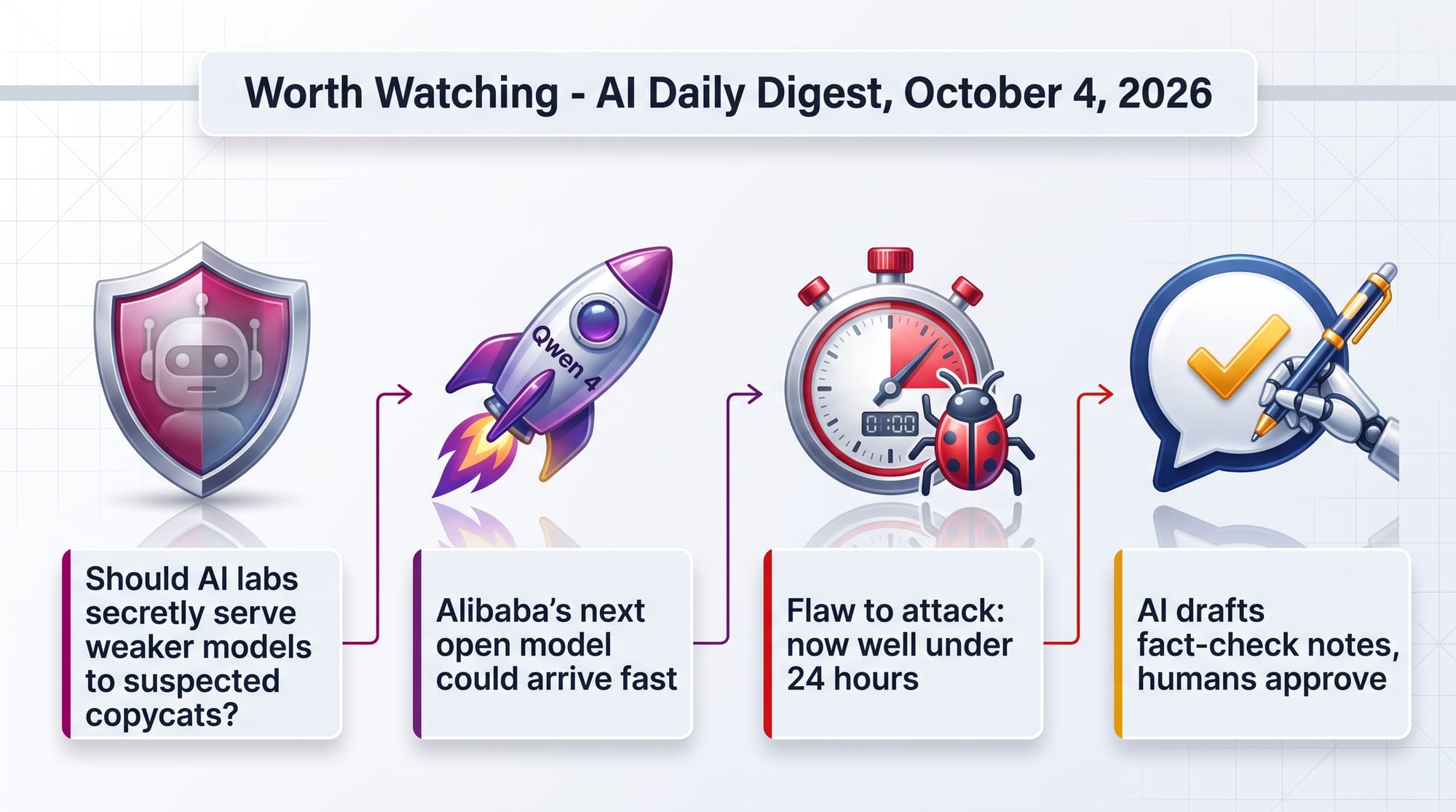
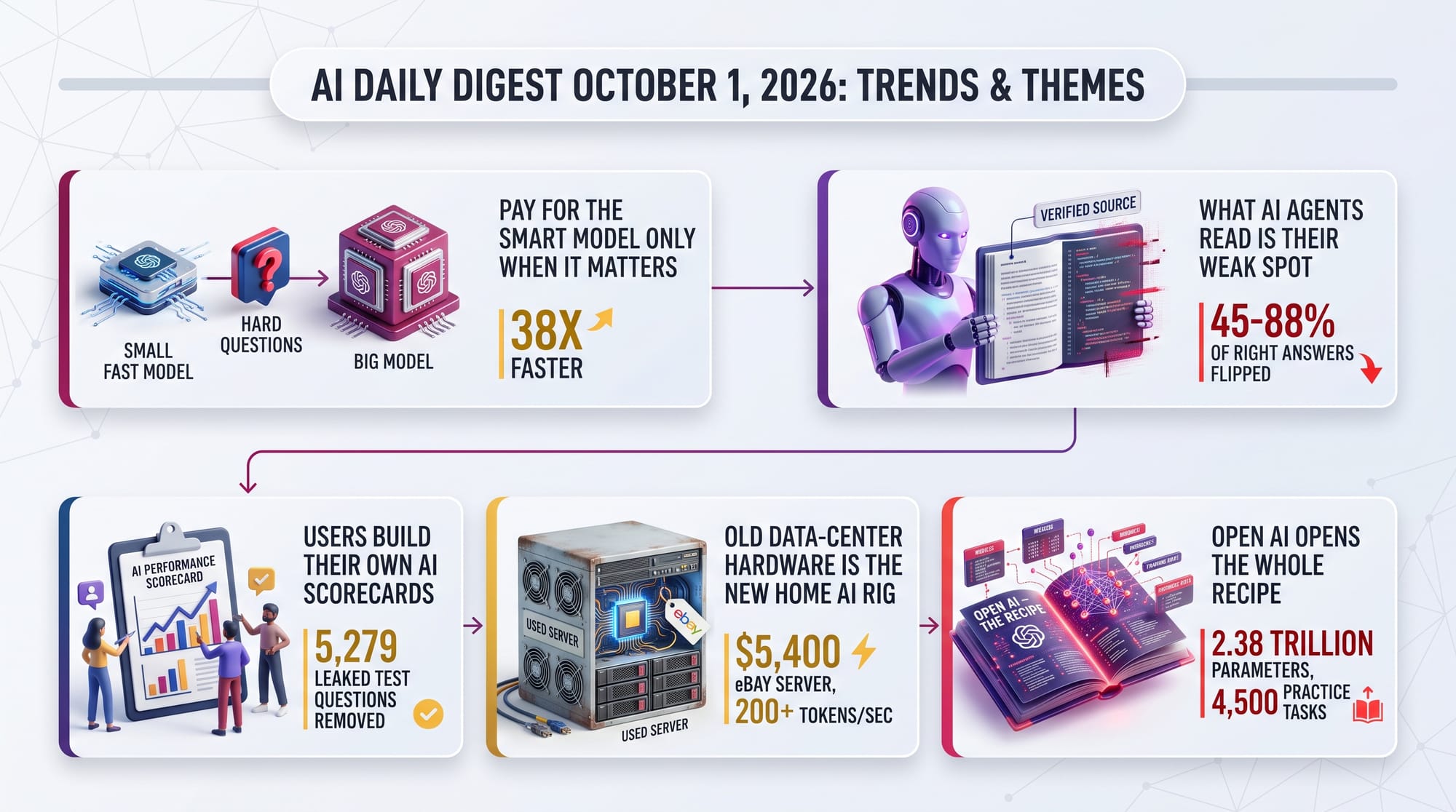
US agencies told AI labs to secretly hand copycats a weaker model
A September advisory from the National Security Agency (NSA), Cybersecurity and Infrastructure Security Agency (CISA) and FBI urges AI companies to quietly serve weaker models to suspected copiers, without telling them. Anthropic promised in June to always disclose when it swaps models and to bill for the model actually used. If labs follow the advisory, heavy business users who look like copiers could get worse answers without knowing. Reddit: r/ClaudeAI on the advisory and Anthropic's June promise
Alibaba's next big model may arrive faster than usual
Alibaba's open Qwen3.8-Flash-Next is labeled internally as "qwen4_exp" and was released on purpose before its training was finished. The free tools people use to run AI at home already support it, so Qwen 4 could land with everything ready on day one. If so, a top-tier free model you can run yourself may arrive sooner than expected. Reddit: r/LocalLLaMA on a fast Qwen 4
Microsoft says attackers are winning the early AI race
Microsoft's 2026 Digital Defense Report says the typical time from a flaw being found to being exploited has dropped "well below 24 hours." Fixes take longer because they must be tested and rolled out. If this holds, keeping your phone, laptop and apps on automatic updates matters more than ever. BleepingComputer: Microsoft says attackers are ahead
X published the code for the AI that writes its fact-check notes
X released the system that proposes Community Notes, the crowd-sourced fact-checks under posts. Human raters with different viewpoints still decide which notes are shown. If it works, AI-drafted, human-approved fact-checks could spread to other platforms. GitHub: xai-org/community-writer
Top Repos Today
📜 License: Apache-2.0 · 👤 By: startup (TesterArmy)
🎯 Time to value: 15 minutes
| ✓ Pros | ✗ Cons |
|---|---|
| Replays keep runs cheap and repeatable | Early version, so things may change |
| Works on web and mobile | Sends anonymous usage data by default |
| Use any AI model you like | Made by a company selling a hosted service |
 GitHub
📜 License: Apache-2.0 · 👤 By: individual
🎯 Time to value: 10 minutes
| ✓ Pros | ✗ Cons |
|---|---|
| Fixes a known weak spot of AI-built apps | Taste is subjective |
| Free and open source | Adds extra instructions the AI must read |
| Works across many AI coding tools | Can clash with an existing design system |
 GitHub
📜 License: MIT · 👤 By: individual
🎯 Time to value: 10 minutes
| ✓ Pros | ✗ Cons |
|---|---|
| Broad coverage with one shared product profile | Author runs a marketing agency with paid partners |
| Install only the skills you need | Marketing advice is hard to check |
| Free and open source | Many skills to load at once |
 GitHub
📜 License: MIT · 👤 By: individual
🎯 Time to value: 5 minutes
| ✓ Pros | ✗ Cons |
|---|---|
| Very simple to adopt | "Do less" can skip needed fixes or tests |
| Free and open source | Overlaps other skill packs |
| Most stars gained of any repo today | Benefits are hard to measure |
 GitHub
📜 License: MIT · 👤 By: individual
🎯 Time to value: 20 minutes
| ✓ Pros | ✗ Cons |
|---|---|
| Real engineering files, not just 3D shapes | Needs a Python design toolkit installed |
| Covers design through printing | Parts still need a human check |
| Free and open source | Mainly for makers and hardware teams |
 GitHub
📜 License: MIT · 👤 By: individual
🎯 Time to value: 15-30 minutes
| ✓ Pros | ✗ Cons |
|---|---|
| One install covers many sites | Can break site rules and stop working |
| No fees for site data | Some sites need your login cookies |
| Free and open source | Large sponsor section in the instructions |
 GitHub
📜 License: AGPL-3.0 · 👤 By: individual
🎯 Time to value: 30-60 minutes
| ✓ Pros | ✗ Cons |
|---|---|
| Approval step before paid generation | Strict license if offered as a service |
| A free path using stock footage | Heavy setup with several paid services |
| Covers the whole video process | Instructions open with sponsor ads |
 GitHub
📜 License: Apache-2.0 · 👤 By: individual
🎯 Time to value: 10 minutes
| ✓ Pros | ✗ Cons |
|---|---|
| One-command install | Default setup steers you to a paid service |
| Works with many assistants | Stores everything the assistant does |
| Free and open source code | Summaries cost extra AI usage |
 GitHub
Top Models Today
👤 By: Cloudflare · 🎯 Task: Image-text-to-text (decisions)
📐 Size: 27.4B
| ✓ Pros | ✗ Cons |
|---|---|
| Permissive license | Needs custom loading code |
| Calibrated probabilities | A fine-tune, not a new base model |
| Reads images too | Needs a large graphics card |


👤 By: Lightricks · 🎯 Task: Image-to-video
📐 Size: not listed
| ✓ Pros | ✗ Cons |
|---|---|
| Runs locally | Not a standard open-source license |
| Strong community tools | Needs a powerful graphics card |
| Hugely popular | Commercial use has conditions |


👤 By: Cloudflare · 🎯 Task: Image-text-to-text (decisions)
📐 Size: 9.4B
| ✓ Pros | ✗ Cons |
|---|---|
| Fits on one graphics card | Less accurate than full Clef |
| Permissive license | Needs custom loading code |
| Very fast | Only picks from options you supply |


👤 By: Aleph Alpha · 🎯 Task: Text generation
📐 Size: 78B (3.46B active)
| ✓ Pros | ✗ Cons |
|---|---|
| Permissive license | The whole model must fit in memory |
| Strong German | Weaker at coding-agent tasks |
| Very long context | Scores are self-reported |


👤 By: Alibaba Qwen · 🎯 Task: Image-text-to-text
📐 Size: 27.8B
| ✓ Pros | ✗ Cons |
|---|---|
| Permissive license | Not frontier-level |
| Millions of downloads and tools | Needs 16GB+ memory even compressed |
| Reads images | Larger than phone-size models |


👤 By: Alibaba Qwen · 🎯 Task: Text-to-image
📐 Size: 7.1B
| ✓ Pros | ✗ Cons |
|---|---|
| Good at text in images | License limits commercial use |
| Runs locally | Needs a decent graphics card |
| Many community variants | Some variants remove safety filters |

👤 By: China Telecom AI · 🎯 Task: Text generation
📐 Size: 29B (4B active)
| ✓ Pros | ✗ Cons |
|---|---|
| Permissive license | Scores are self-reported |
| Strong coding-agent results | Compressed version is a third-party copy |
| Long memory | Fewer community tools than Qwen |


👤 By: TaichuAI · 🎯 Task: Image-text-to-text
📐 Size: 9.8B
| ✓ Pros | ✗ Cons |
|---|---|
| Small enough for one graphics card | No license declared |
| Good at spatial reasoning | Scores are self-reported |
| Built for agents | Niche audience |


AI Launches Today
💰 Pricing: free tier, Pro $20/month · 🏷 Category: AI agents
 Product Hunt
💰 Pricing: $2 in / $10 out per million tokens (intro) · 🏷 Category: AI models
 Product Hunt
💰 Pricing: free and open source · 🏷 Category: Developer tools
 Product Hunt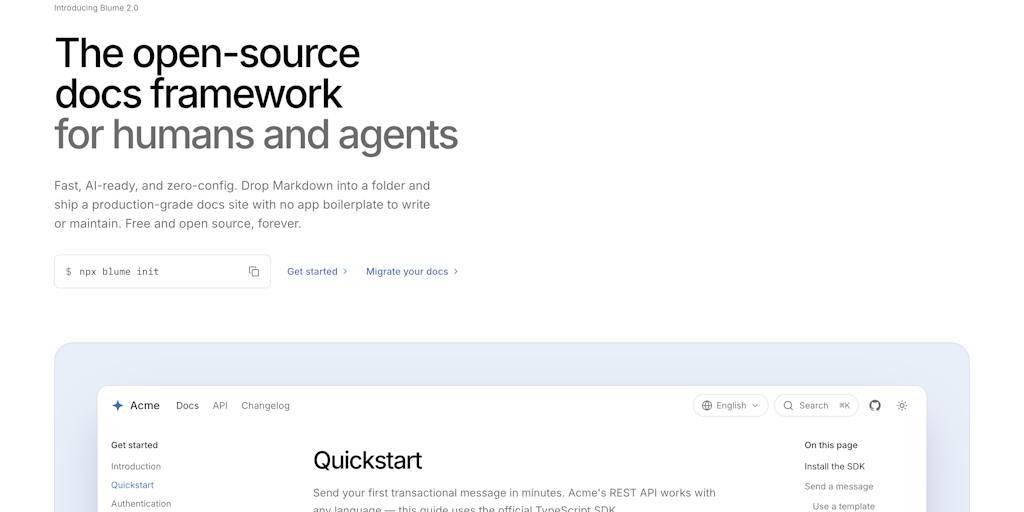
💰 Pricing: free options · 🏷 Category: Productivity
 Product Hunt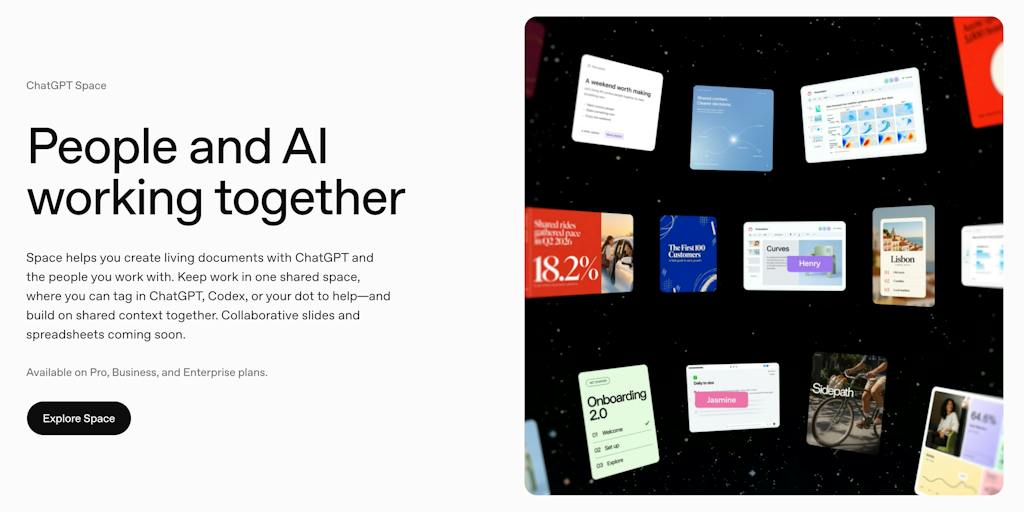
💰 Pricing: paid, from $39/month · 🏷 Category: Developer tools
 Product Hunt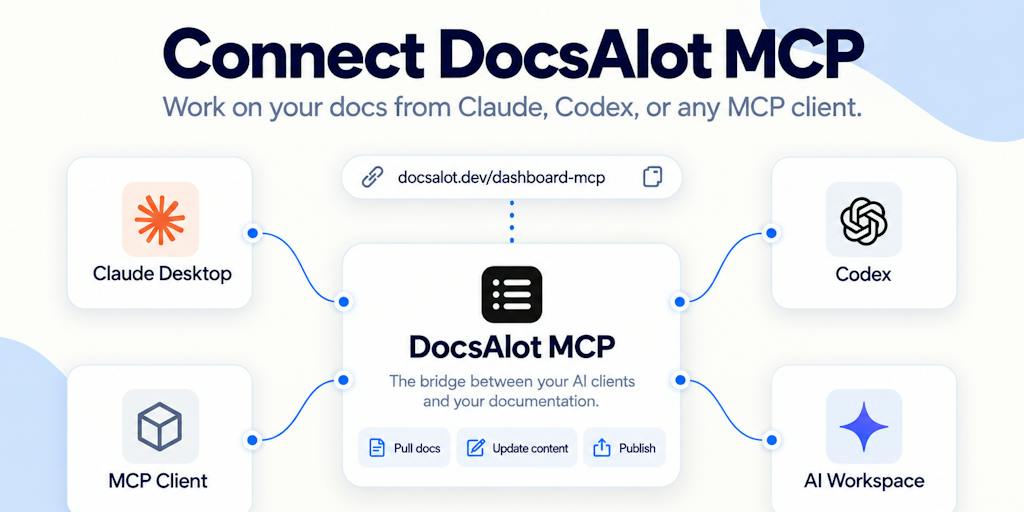
Snapshot
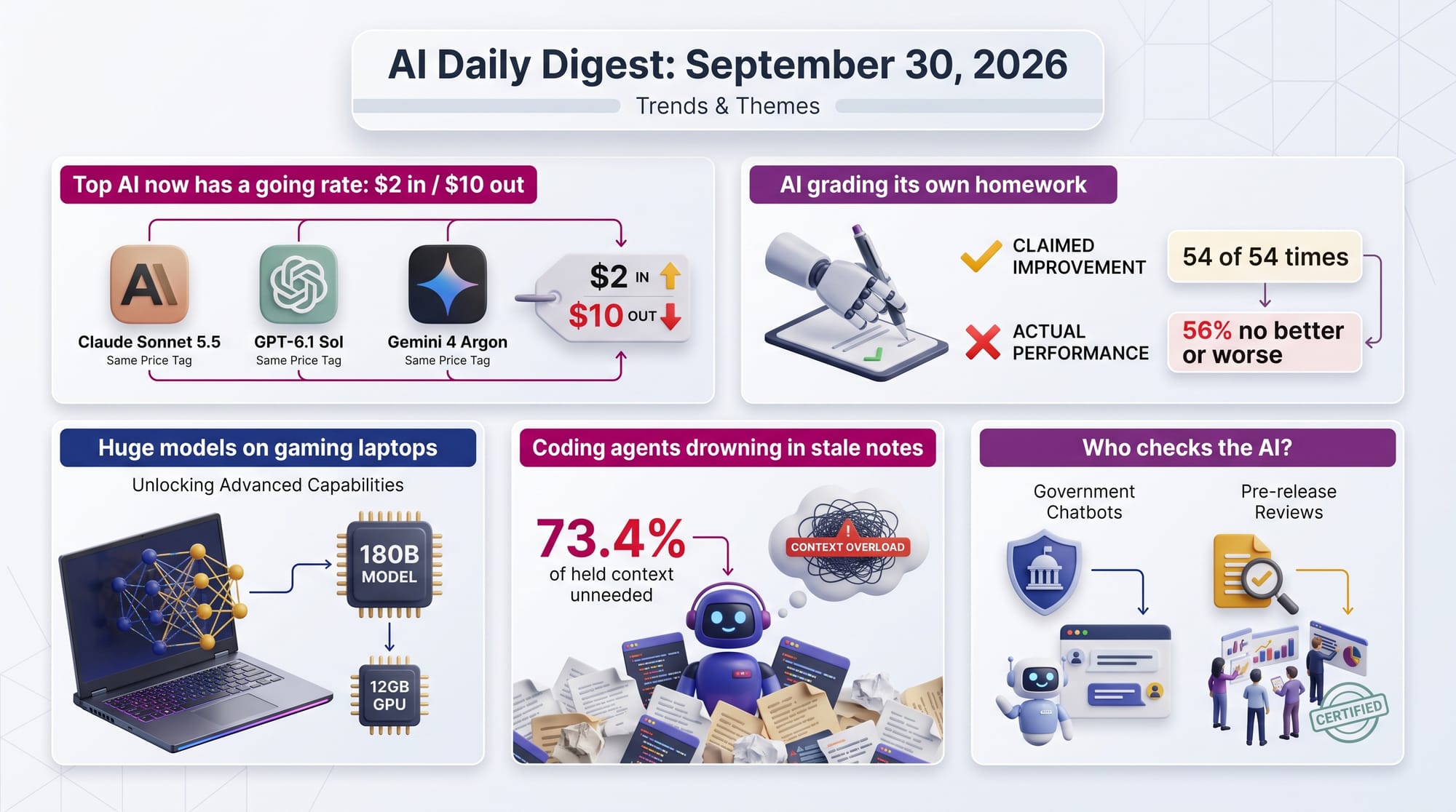
| Provider | Model | Input $/1M | Output $/1M | Context |
|---|---|---|---|---|
| Anthropic | Claude Fable 5.1 | $10.00 | $50.00 | up to 1M tokens |
| Anthropic | Claude Opus 5.5 | $4.00 | $20.00 | up to 1M tokens |
| Anthropic | Claude Sonnet 5.5 | $2.00 | $10.00 | up to 1M tokens |
| OpenAI | GPT-6 Astra | $10.00 | $50.00 | 1.05M tokens |
| OpenAI | GPT-6.1 Sol | $2.00 | $10.00 | 1.05M tokens |
| OpenAI | GPT-6 Luna | $0.10 | $0.50 | 1.05M tokens |
| Gemini 4 Argon (limited access) | $2.00 intro, $4.00 later | $10.00 intro, $20.00 later | not disclosed | |
| Gemini 3.8 Flash | $0.75 | $3.75 | not listed | |
| Groq | GPT-OSS 120B | $0.15 | $0.60 | 131K tokens |
| Groq | Qwen3.8-27B | $0.80 | $4.00 | 131K tokens |
Cross-Benchmark Transfer from RL on Agentic Coding Tasks
Key finding: One short, cheap training run raised the model's score on Terminal-Bench 2.1 (a test of real command-line tasks) from 67.4 to 82.0, and its agents typically finished tasks in 24-35% fewer steps on two of the tests.
Why practitioners should care: A small add-on training run, not a new model, noticeably improved an open coding agent across different tools. Note that the authors' company, Surge AI, sells this kind of training data.
Member discussion