GenAI Secret Sauce Daily Digest - 2026-07-24

Anthropic Released Claude Opus 5 at Half the Price of Its Last Flagship · Black Forest Labs Unveiled FLUX 3, One Model for Images, Video, Sound, and Robots · 25 Tech Companies Told Washington Not to Restrict Open AI Models
GenAI Secret Sauce Daily Digest - 2026-07-24

Watch today's digest as a video summary (generated by NotebookLM)

Statistically Speaking

$5 per million words
Anthropic Released Claude Opus 5 at Half the Price of Its La
Top Story
0.5% of Fable 5's best coding score at
Anthropic Released Claude Opus 5 at Half the Price of Its La
20 seconds with native sound
Black Forest Labs Unveiled FLUX 3, One Model for Images, Vid
3 Video is in early access now; Image
Black Forest Labs Unveiled FLUX 3, One Model for Images, Vid
3
unifies image, video, audio, and robot
Every Modality Is Merging Into One Model
16
languages with tags to whisper or sound
Every Modality Is Merging Into One Model

One Thing to Tell Your Friends

One AI model can now generate a video complete with sound and steer a factory robot arm, using the exact same digital brain, and on the same day the company behind Claude shipped its fourth new AI model in two months.

TL;DR

Trends
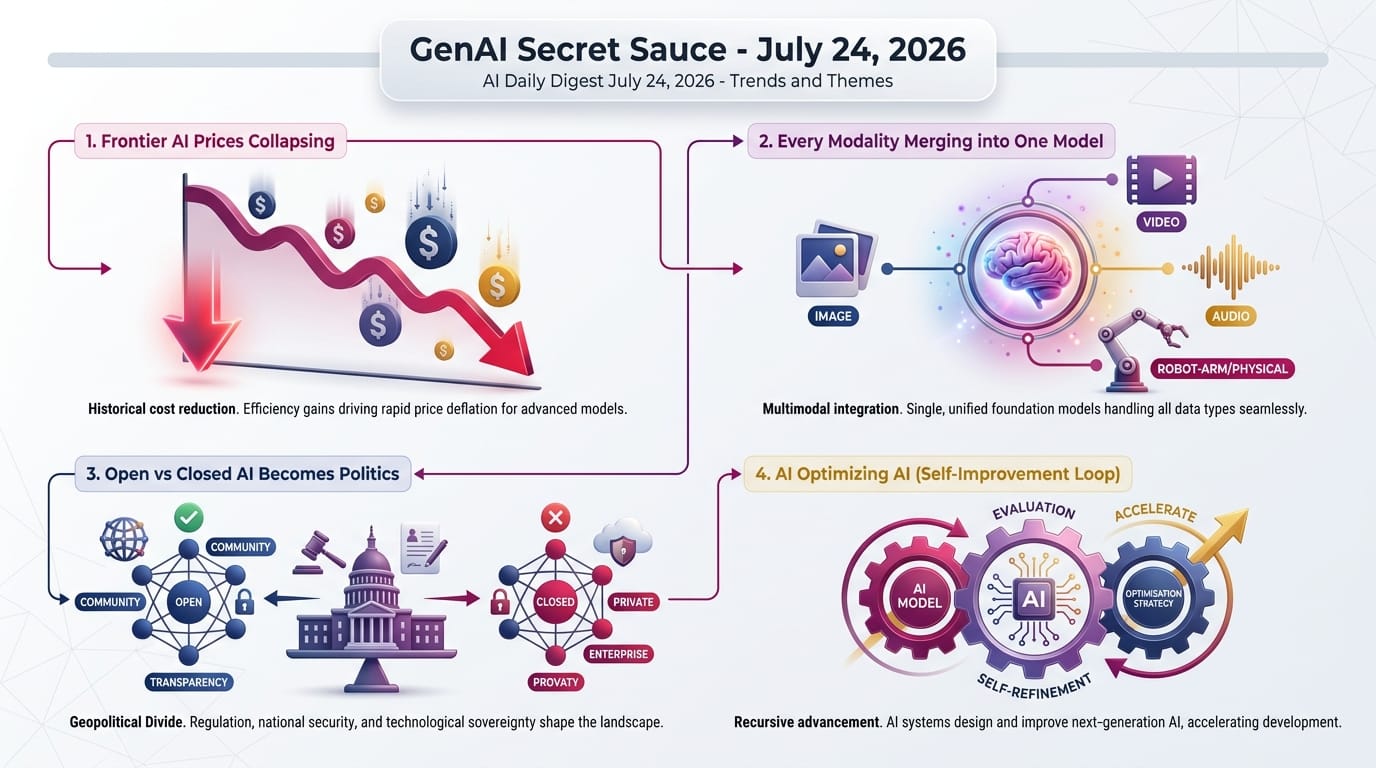
The Price of Frontier AI Is Collapsing, Every Modality Is Merging Into One Model, and The Open-vs.
Creative AI
FLUX 3 Video and Qwen-Audio-3.0-TTS.
Dev Tools
The Stack v3 and Routing Between Cheap and Expensive Models Without Training.
Research
Sampling One Model Many Times Does Not Reveal What It Does Not Know, Watermarking AI Text Quietly Hurts Medical Accuracy, and InferenceBench.
Business
Austria Is Rolling Out a Government AI to 180,000 Employees and Lightcone Commons.
Surprising
Worth Watching
Image Models Learning to Move Machines, AI That Rewrites Its Own Running Team, and On.
GitHub
Leading repos: diegosouzapw/OmniRoute (+1,843), koala73/worldmonitor (+2,194), and Lordog/dive-into (+654).
HuggingFace
Leading models: zai-org/GLM (667,403), poolside/Laguna-S (28,992), and upstage/Solar-Open2 (1,106).
Product Hunt
Top launches: PromptQL (459), Teable 3.0 (454), and PodcastorAI (327).
API Pricing
What this means: Today's notable change is Anthropic naming Opus 5 its default flagship at $5 and $25 per million words, the same as the older Opus 4.8 and half of June's Fable 5.
arXiv
Routing Without Training: Controllable — A training-free reliability signal lets teams dial the exact fraction of queries sent to the cloud, trading cost against quality on demand.

Hot off the Presses

01

Anthropic Released Claude Opus 5 at Half the Price of Its Last Flagship

What this means for you: The most capable version of Claude yet is now the default in the paid Claude apps, and it costs businesses the same as the model from before, which was itself half the price of June's premium model.

Anthropic (the AI company that makes Claude) launched Claude Opus 5 on July 24. It is now the default model on Claude Max, the top subscription tier, and the highest option on Claude Pro. This is the company's fourth model release in roughly two months.

The headline is cost. Opus 5 delivers top-tier results while charging the same as the older Opus 4.8, which is half the price of Fable 5, the premium model from June.

Anthropic also says Opus 5 was deliberately held back on offensive cybersecurity and biological-research tasks, keeping safety limits in dual-use areas. Treat individual sub-scores as company-reported until independent testers weigh in.

“Frontier-tier results at roughly half the price of the previous flagship.”
  • Price: $5 per million words-in, $25 per million words-out (unchanged from Opus 4.8; Fable 5 costs $10 and $50)
  • Benchmark claim: more than doubles Opus 4.8's score on Frontier-Bench (a broad capability test) at a lower cost per task
  • Coding: lands within 0.5% of Fable 5's best coding score at half the cost, on the CursorBench 3.2 test
  • A standout skill: users report it catches logical errors while planning, before it runs the work, rather than after
02

Black Forest Labs Unveiled FLUX 3, One Model for Images, Video, Sound, and Robots

What this means for you: The tools that create AI images and video are merging into single systems that also understand motion, which is how the same technology behind a photo generator starts steering real machines.

Black Forest Labs (the German lab behind the FLUX image models used inside Adobe Photoshop and Picsart) released FLUX 3 on July 23. It is one model that handles images, video with built-in audio, readable on-screen text, and even predicts physical actions, all from the same set of weights.

The lab claims FLUX 3 beats rival systems from OpenAI, Google, and xAI on visual quality. The most striking spin-off is a robotics version that predicts robot movements, a concrete sign that image and video models are bleeding into machine control.

  • Video length: generates clips up to 20 seconds with native sound
  • Rollout: FLUX 3 Video is in early access now; Image and Action versions follow in the coming weeks
  • Open access: an open-weights version anyone can download and run locally is promised for later in 2026
  • Powers real products: the FLUX family already runs inside Photoshop, Picsart, and other creative apps
03

25 Tech Companies Told Washington Not to Restrict Open AI Models

What this means for you: The fight over whether powerful AI should be freely downloadable, or locked behind a few companies, just became an organized lobbying campaign, and it splits the industry down the middle.

A coalition of 25 American technology companies published a joint letter on July 24 titled "Open Weights and American AI Leadership." Open-weight models are AI systems anyone can download, inspect, and run themselves, rather than renting access through a company's website.

The signers argue that open models expand access, boost competition, and keep the United States ahead as Chinese AI developers close the gap. Notably, the biggest closed-model companies stayed away.

  • Who signed: Nvidia, Microsoft, Meta, IBM, Dell, Palantir, Mistral, Hugging Face, Andreessen Horowitz, Y Combinator, Replit, Perplexity, and more
  • Who did not: OpenAI, Anthropic, and Google, the leaders whose closed models would benefit most from a crackdown
  • The safety twist: the letter argues closed models are not automatically safer, because they can be breached or fail in ways outsiders cannot see
  • The context: Washington is weighing curbs on Chinese AI, and the signers want open models explicitly spared

Trends & Themes

Trends & Themes

The Price of Frontier AI Is Collapsing

Why this matters to you: The best AI tools are getting dramatically cheaper, which means the capabilities that cost a fortune last year will soon be affordable for small businesses and individuals.

The pattern is consistent across launches, research, and infrastructure: the cost of a given level of AI capability keeps dropping. What used to justify premium pricing becomes the new baseline within months.

  • Anthropic's new flagship costs half its June premium model - same top-tier results, lower bill
  • Researchers shipped a way to route between a cheap local model and an expensive cloud one - no training required, saving money on easy questions (arXiv paper)
  • Groq serves fast open models for under a dollar per million words - a fraction of frontier prices

Every Modality Is Merging Into One Model

Why this matters to you: Instead of separate apps for images, video, voice, and text, single AI systems are learning to do all of it, which makes creative tools simpler and far more powerful.

The walls between media types are dissolving. A model that understands how a video should look also starts to understand how an object should move, which is why visual AI and robotics are converging.

  • FLUX 3 unifies image, video, audio, and robot-action prediction in one model
  • Qwen-Audio-3.0-TTS generates speech in 16 languages with tags to whisper or sound angry, up to three minutes in one pass
  • The same "one brain, many senses" design is what lets an image model suddenly steer a robot

The Open-vs-Closed Fight Became Organized Politics

Why this matters to you: Whether future AI is something you can download and control, or only something you rent, is now being decided in Washington, and the outcome shapes prices and privacy for everyone.

This stopped being an abstract debate and became a coordinated campaign with named sides. The commercial stakes are enormous, which is why the lobbying is now explicit.

  • 25 companies signed a formal letter against restricting open models
  • The split is stark - hardware and platform giants back open weights; the top closed-model labs stayed silent
  • US-China competition is the backdrop - both sides invoke national interest, drawing on the same worries about distillation covered in earlier editions

AI Is Being Pointed at Its Own Plumbing

Why this matters to you: AI is increasingly used to make AI cheaper and faster to run, a feedback loop that quietly lowers the cost of everything built on top of it.

A large share of today's research is AI optimizing AI: faster sampling, smarter caching, auto-generated hardware code. This is where much of the coming cost reduction will come from, out of public view.

  • InferenceBench tests whether AI agents can speed up model serving on a single graphics chip in two hours (arXiv)
  • OPTScientist uses multiple AI agents to invent better training recipes automatically (arXiv)
  • MKEvolve has AI agents write the low-level code that makes models run fast on specialized chips (arXiv)

Creative AI & Media

FLUX 3 Video - Clips With Sound From a Single Model

Try it: FLUX 3 Video early access

  • What it does: generates video up to 20 seconds with native audio, edits images, and renders readable text, all from one model
  • Why it is notable: it competes with the best video generators while promising an open-weights release you can run yourself later this year
  • Real-world reach: the FLUX family already powers features in Adobe Photoshop and Picsart

Qwen-Audio-3.0-TTS - Expressive Speech in 16 Languages

  • What it does: turns text into speech across 16 languages with inline control tags like whisper and angry, generating up to three minutes in one pass
  • Why it is notable: it claims the top spot on a public text-to-speech leaderboard, closing the gap between open voice tools and paid ones
  • Who it helps: anyone making narration, audiobooks, or dubbed content without hiring voice talent

Developer Tools & Infrastructure

The Stack v3 - A Giant Open Code Dataset for Training Coding AI

  • What it is: Hugging Face released The Stack v3, 114 terabytes of source code spanning 224 million repositories and 770 programming languages
  • Why it matters: it yields roughly 5 trillion cleaned training examples, with big jumps in under-served languages (C++ 15x, Rust 7x, Python nearly 5x more data than before)
  • The effect: open coding models get a much richer free foundation to learn from, narrowing the gap with closed tools

Routing Between Cheap and Expensive Models Without Training

  • What it is: a research method that decides, for each question, whether a small local model can answer or the query needs a big cloud model
  • Why it matters: it needs no separate trained router; the local model's own agreement across several tries is the signal, cutting cloud costs on easy questions
  • arXiv paper 2607.20481

Research & Models

Sampling One Model Many Times Does Not Reveal What It Does Not Know

  • The claim: turning up "temperature" (randomness) and sampling repeatedly gives good per-question uncertainty, but misses the bigger picture a diverse group of models would catch
  • Why practitioners care: teams relying on self-consistency tricks may be overestimating how well a single model maps its own blind spots
  • arXiv paper 2607.20464

Watermarking AI Text Quietly Hurts Medical Accuracy

  • The claim: five popular watermarking methods (hidden signatures that prove text was AI-made) measurably degraded clinical reasoning across 18 models
  • Why practitioners care: the harm hides behind good average scores; in medicine, the rare failures are the ones that matter
  • arXiv paper 2607.20462

InferenceBench - Can AI Agents Speed Up Serving AI?

  • The claim: it gives an agent a model, one graphics chip, and two hours to make it serve faster, testing distinct bottlenecks separately
  • Why practitioners care: it turns "make our AI cheaper to run" into a measurable task an agent can attempt, a direct path to lower bills
  • arXiv paper 2607.20468

Faster Token Sampling From a Co-Author of FlashAttention

  • The claim: SonicSampler merges the whole final step of text generation into one efficient operation, attacking an often-ignored slowdown
  • Why practitioners care: small speedups at the sampling stage compound across billions of generated words
  • arXiv paper 2607.20475

Business & Industry

Austria Is Rolling Out a Government AI to 180,000 Employees

  • What happened: Austria's GovGPT is deploying to roughly 180,000 federal employees on the country's own sovereign infrastructure
  • The AI: it runs on Mistral's open-weight models, a European alternative to American AI providers
  • Why it matters: it is a concrete example of a government choosing open, self-hosted AI for data control, exactly the case the open-weights letter argues for

Lightcone Commons - A New $20 Million Coordination Platform for Donors

  • What it is: a philanthropy platform from Oliver Habryka that helps large donors fund charities together using a structured, game-resistant process
  • The numbers: about $20 million available in the first round, a 3% platform fee, applications due August 23, 2026
  • Why it matters: it is an attempt to professionalize effective giving as a wave of new tech wealth enters philanthropy

Surprising & Under-the-Radar

Half-Life 2 Runs Natively on Haiku, a Volunteer-Built Operating System

Haiku is a small, community-made operating system with almost no commercial backing. A volunteer effort to build an Nvidia graphics driver just hit a milestone: the 2004 game Half-Life 2 running natively at 4K and 60 frames per second on an RTX 2080. It is a striking sign that hobbyist computing can now handle demanding 3D graphics on modern hardware.

AI Can Build a Course, but It Cannot Decide Whether the Course Should Exist

Instructional-design expert Dr. Philippa Hardman tested AI models on real course-design tasks and found scores ranging wildly from 9% to 77%. The surprise: every model defaulted to the same teaching style regardless of the problem, because they learned from finished courses, not the reasoning behind them. None questioned whether a course was even the right solution, and some quietly dropped mandatory compliance steps while still reading as accurate.

A Claimed Missile Strike on an Amazon Data Center, Still Unverified

Iran's Revolutionary Guard claimed it destroyed Amazon Web Services data infrastructure in Bahrain using cruise missiles. Crucially, none of this is confirmed: Amazon has not responded, its status page shows no Bahrain outage, and Bahraini and U.S. officials have not commented. It is worth flagging only as a reminder that cloud infrastructure sits inside real-world geopolitical risk, not as a confirmed event.

Signals to Track

Worth Watching
01

Image Models Learning to Move Machines

The moment a photo generator can also predict a robot's next motion, the line between creative AI and physical automation disappears.

FLUX 3's robotics spin-off predicts physical actions from the same foundation that generates video. If this scales, the enormous investment pouring into video generation could quietly become an investment in robot control. For ordinary people, that means the AI improving your photo app is training on the same skills that might one day fold your laundry.

02

AI That Rewrites Its Own Running Team

Multi-agent systems that reorganize themselves when overloaded are the first step toward AI that manages AI.

A new method called ATM lets a team of AI agents detect when one agent is overwhelmed and safely restructure the team while running. Today it is a research prototype with safety guardrails. If it holds up, the AI systems businesses rely on could start healing and rebalancing themselves without a human operator, which changes who is accountable when something breaks.

03

On-Device Voice Getting Genuinely Good

Free, expressive text-to-speech in 16 languages removes the last reason to pay for basic narration.

Qwen-Audio-3.0-TTS claims leaderboard-topping quality with emotional control and multilingual support. As open voice models catch paid ones, the cost of professional-sounding narration for videos, courses, and apps falls toward zero, which reshapes who can afford to make polished audio content.

Top Repos Today

Rank yesterday: #4 - Rising ↑
⭐ Stars today: +1,843  ·  📦 Total: 28,766
📜 License: MIT  ·  👤 By: individual developer
🎯 Time to value: 10 minutes
What it is: A free tool that acts as a single doorway to more than 290 AI providers and 500 models, automatically switching to a backup when one fails. You point your app at OmniRoute instead of any single AI company. Why you'd want it: One integration gives you access to nearly every model, plus automatic failover so an outage at one provider does not take down your app.
✓ Pros✗ Cons
Access to 500+ models through one connectionYou depend on the gateway staying updated
Automatic fallback improves reliabilityAdds a layer between you and the provider
MIT license, fully freeSelf-hosting requires some setup
GitHub - diegosouzapw/OmniRoute: Never stop coding. Free MIT AI gateway: one endpoint, 290+ providers (90+ free), 500+ models — Kimi, Claude, GPT, OpenAI, Gemini, GLM, DeepSeek, MiniMax. Works with Claude Code, Codex, Cursor, OpenCode, Cline & Copilot. Quota-aware auto-fallback, RTK+Caveman compression saves 15-95% tokens, MCP/A2A, Desktop/PWA. Built by 500+ contributors
Never stop coding. Free MIT AI gateway: one endpoint, 290+ providers (90+ free), 500+ models — Kimi, Claude, GPT, OpenAI, Gemini, GLM, DeepSeek, MiniMax. Works with Claude Code, Codex, Cursor, Open…
Rank yesterday: #1 - Holding steady ➡
⭐ Stars today: +2,194  ·  📦 Total: 73,218
📜 License: see repo  ·  👤 By: individual developer
🎯 Time to value: 15 minutes
What it is: A real-time global dashboard that uses AI to aggregate news, track geopolitical events, and monitor infrastructure in one place. Think of it as a live situation-room screen powered by AI summarization. Why you'd want it: It condenses scattered global news and event feeds into a single AI-curated view, useful for anyone who needs the big picture fast.
✓ Pros✗ Cons
Real-time, AI-summarized global viewAccuracy depends on underlying sources
Covers news, geopolitics, and infrastructureCan be overwhelming to configure
Actively developed and popularHeavy dashboard, not lightweight
GitHub - koala73/worldmonitor: Real-time global intelligence dashboard. AI-powered news aggregation, geopolitical monitoring, and infrastructure tracking in a unified situational awareness interface
Real-time global intelligence dashboard. AI-powered news aggregation, geopolitical monitoring, and infrastructure tracking in a unified situational awareness interface - koala73/worldmonitor
Rank yesterday: unranked - New entry 🆕
⭐ Stars today: +654  ·  📦 Total: 44,977
📜 License: see repo  ·  👤 By: individual developer
🎯 Time to value: immediate
What it is: A free set of programming tutorials that teach how large language models work, from the basics up. It is a learning resource, not a product. Why you'd want it: If you want to actually understand and build with AI rather than just use it, this is a structured, hands-on starting point.
✓ Pros✗ Cons
Free, comprehensive, hands-onRequires programming background
Very popular and well-maintainedNot a plug-and-play tool
Covers fundamentals to advancedSome material assumes math comfort
GitHub - Lordog/dive-into-llms: 《动手学大模型Dive into LLMs》系列编程实践教程
《动手学大模型Dive into LLMs》系列编程实践教程. Contribute to Lordog/dive-into-llms development by creating an account on GitHub.
Rank yesterday: #3 - Holding steady ➡
⭐ Stars today: +884  ·  📦 Total: 2,523
📜 License: see repo  ·  👤 By: company (Citro Labs)
🎯 Time to value: 20 minutes
What it is: A fast, lightweight browser built for AI agents to control, so an AI can click, type, and navigate websites while sharing the same browser state you see. Why you'd want it: It makes it much easier to build AI that automates real web tasks, like filling forms or gathering information across sites.
✓ Pros✗ Cons
Purpose-built for AI web automationYoung project, small community
Shares browser state with the agentRequires coding to use
Lightweight and fastWeb automation can be brittle
GitHub - citrolabs/ego-lite: The fastest browser for AI agents to run web automation, built for sharing your logged-in browser state with your AI agents, like Codex or Claude Code, without disturbing you. Zero cost, zero config.
The fastest browser for AI agents to run web automation, built for sharing your logged-in browser state with your AI agents, like Codex or Claude Code, without disturbing you. Zero cost, zero confi…
Rank yesterday: unranked - New entry 🆕
⭐ Stars today: +129  ·  📦 Total: 26,308
📜 License: see repo  ·  👤 By: company
🎯 Time to value: 15 minutes
What it is: An AI-powered database tool that lets you query and manage databases using plain English instead of writing SQL code by hand. Why you'd want it: It lets non-experts pull data and lets experts move faster, turning questions like "show me last month's top customers" into working database queries.
✓ Pros✗ Cons
Plain-English database queriesStill needs review for complex queries
Works across many database typesSending schemas to AI raises privacy questions
Mature, widely usedSetup requires database access
GitHub - OtterMind/Chat2DB: 🔥🔥🔥 AI-driven database tool and SQL client, The hottest GUI client, supporting MySQL, Oracle, PostgreSQL, DB2, SQL Server, DB2, SQLite, H2, ClickHouse, and more.
🔥🔥🔥 AI-driven database tool and SQL client, The hottest GUI client, supporting MySQL, Oracle, PostgreSQL, DB2, SQL Server, DB2, SQLite, H2, ClickHouse, and more. - OtterMind/Chat2DB
Rank yesterday: unranked - New entry 🆕
⭐ Stars today: +250  ·  📦 Total: 4,255
📜 License: see repo  ·  👤 By: company
🎯 Time to value: 30 minutes
What it is: An open-source, self-hosted visual website builder where AI agents help you design and edit pages, positioned as an alternative to Webflow and Framer. Why you'd want it: You get a drag-and-drop website builder you fully own and host yourself, with AI assistance and no monthly platform fee.
✓ Pros✗ Cons
Self-hosted, you own everythingSelf-hosting means you maintain it
AI-assisted visual editingNewer, smaller ecosystem
No subscription lock-inFewer templates than paid rivals
GitHub - CoreBunch/Instatic: The open-source alternative to Webflow, Framer and WordPress. Agentic self-hosted visual CMS outputting clean static pages. Users, roles, plugins, content, database, it’s all there.
The open-source alternative to Webflow, Framer and WordPress. Agentic self-hosted visual CMS outputting clean static pages. Users, roles, plugins, content, database, it's all there. - CoreBunc…

Top Models Today

A flagship open large language model competing with the best closed systems.
📥 Downloads (30d): 667,403  ·  📜 License: MIT
👤 By: Z.ai  ·  🎯 Task: text generation
📐 Size: large
What it is: GLM-5.2 is a general-purpose open language model you can download and run yourself. It handles chat, writing, and reasoning tasks. Why you'd want it: It offers frontier-class capability under a permissive MIT license, so businesses can self-host without per-word fees.
✓ Pros✗ Cons
Free, permissive MIT licenseLarge model needs serious hardware
Strong general capabilitySelf-hosting requires expertise
Fully downloadableSupport is community-based
zai-org/GLM-5.2 · Hugging Face
We’re on a journey to advance and democratize artificial intelligence through open source and open science.
A coding-focused open model from the AI coding startup Poolside.
📥 Downloads (30d): 28,992  ·  📜 License: OpenMDW-1.1
👤 By: Poolside  ·  🎯 Task: code generation
📐 Size: large
What it is: Laguna-S-2.1 is a language model tuned specifically for writing and understanding software code. Why you'd want it: A specialized coding model you can host yourself is useful for teams that cannot send proprietary code to an outside API.
✓ Pros✗ Cons
Purpose-built for codingNarrower than a general model
Self-hostable for code privacyNon-standard license to review
From a dedicated coding labSmaller download base so far
poolside/Laguna-S-2.1 · Hugging Face
We’re on a journey to advance and democratize artificial intelligence through open source and open science.
A very large 250-billion-parameter open model from Upstage.
📥 Downloads (30d): 1,106  ·  📜 License: other
👤 By: Upstage  ·  🎯 Task: text generation
📐 Size: ~250B parameters
What it is: Solar-Open2 is a large open language model aimed at high-end reasoning and generation, downloadable for local or private deployment. Why you'd want it: For organizations wanting maximum open-model capability under their own roof, a 250-billion-parameter model is near the top of what is freely available.
✓ Pros✗ Cons
Very large, high capabilityEnormous hardware requirements
Open and self-hostableCustom license needs review
Strong reasoning potentialLow downloads, less battle-tested
upstage/Solar-Open2-250B · Hugging Face
We’re on a journey to advance and democratize artificial intelligence through open source and open science.
A vision-language model that reads images and text together.
📥 Downloads (30d): 27,883  ·  📜 License: Apache-2.0
👤 By: Thinking Machines  ·  🎯 Task: image-text understanding
📐 Size: mid
What it is: Inkling takes both pictures and text as input and produces text, so it can describe images, answer questions about documents, or read charts. Why you'd want it: An open, permissively licensed vision model is valuable for building apps that need to understand screenshots, forms, or photos.
✓ Pros✗ Cons
Handles images and text togetherVision models can misread details
Apache-2.0, business-friendlyNeeds a capable graphics chip
From a well-known labDocumentation still maturing
thinkingmachines/Inkling · Hugging Face
We’re on a journey to advance and democratize artificial intelligence through open source and open science.
A compact model for controlling robot manipulation, part of the vision-to-robotics wave.
📥 Downloads (30d): 559  ·  📜 License: Apache-2.0
👤 By: OpenBMB  ·  🎯 Task: robotics manipulation
📐 Size: compact
What it is: MiniCPM-RobotManip is a small model that outputs robot manipulation actions, aimed at controlling robotic arms and grippers. Why you'd want it: It is an accessible, open entry point for developers experimenting with AI-driven robotics without frontier-scale hardware.
✓ Pros✗ Cons
Open and compact for roboticsRobotics needs physical hardware
Apache-2.0 licensedEarly, narrow use case
Rides the vision-to-action trendVery low download base
openbmb/MiniCPM-RobotManip · Hugging Face
We’re on a journey to advance and democratize artificial intelligence through open source and open science.

AI Launches Today

Product Hunt's July 24 topic board was not yet populated at publish time; the items below are the most recent AI launches from the July 23 leaderboard, flagged for the date shift.
Multiplayer AI that replaces Slack.
🔥 Upvotes: 459  ·  👤 By: not listed
💰 Pricing: not listed  ·  🏷 Category: team collaboration
PromptQL positions itself as a shared AI workspace where teams collaborate with AI together, pitched as a replacement for chat-based coordination. The idea is that AI, not a chat channel, becomes the place work happens. Verdict: An ambitious framing; the "replace Slack" claim is a high bar that few tools clear. Product Hunt
An AI spreadsheet for business.
🔥 Upvotes: 454  ·  👤 By: not listed
💰 Pricing: not listed  ·  🏷 Category: data and productivity
Teable 3.0 blends a spreadsheet interface with database power and AI assistance, so non-technical teams can manage structured data without a real database. Verdict: A crowded space, but the spreadsheet-meets-database approach has proven appeal. Product Hunt
Your AI twin hosts your video podcast.
🔥 Upvotes: 327  ·  👤 By: not listed
💰 Pricing: not listed  ·  🏷 Category: creative media
PodcastorAI creates an AI version of you that can host a video podcast, aimed at creators who want output without recording every episode themselves. Verdict: Useful for scale, though authenticity-conscious audiences may push back. Product Hunt

Snapshot

ProviderModelInput $/1MOutput $/1MContext
AnthropicClaude Opus 5 (new today)$5.00$25.001M
OpenAIGPT-5.6 Sol$5.00$30.00~400K
GoogleGemini 3.6 Flash$1.50$7.501M
GroqLlama 3.3 70B$0.59$0.79128K
What this means: Today's notable change is Anthropic naming Opus 5 its default flagship at $5 and $25 per million words, the same as the older Opus 4.8 and half of June's Fable 5. Anthropic and OpenAI now sit at identical input pricing, while Google's Flash tier and Groq's open-model hosting remain far cheaper for workloads that do not need frontier reasoning. Prices for Anthropic and OpenAI were confirmed against secondary trackers, since both official pricing pages block automated fetches.

Routing Without Training: Controllable-Ratio LLM Offloading via Reliability Gating

Chen, Wang, Chan, Wang, Brinton · arXiv:2607.20481
What it claims: You can route each question between a small local AI model and a large cloud model without ever training a separate router. The local model's own agreement across several sampled answers is a good enough signal for whether a query needs the expensive model.

Key finding: A training-free reliability signal lets teams dial the exact fraction of queries sent to the cloud, trading cost against quality on demand.

Why practitioners should care: This is a direct, deployable way to cut AI bills. Easy questions stay on cheap local hardware, and only the hard ones pay for a frontier model, with no extra model to build or maintain.
Member discussion

Subscribe to GenAI Secret Sauce newsletter and stay updated.

Don't miss anything. Get all the latest posts delivered straight to your inbox. It's free!

By subscribing, you agree to our Privacy Policy and Terms. We track email opens and clicks. Unsubscribe anytime.

Great! Check your inbox and click the link to confirm your subscription.