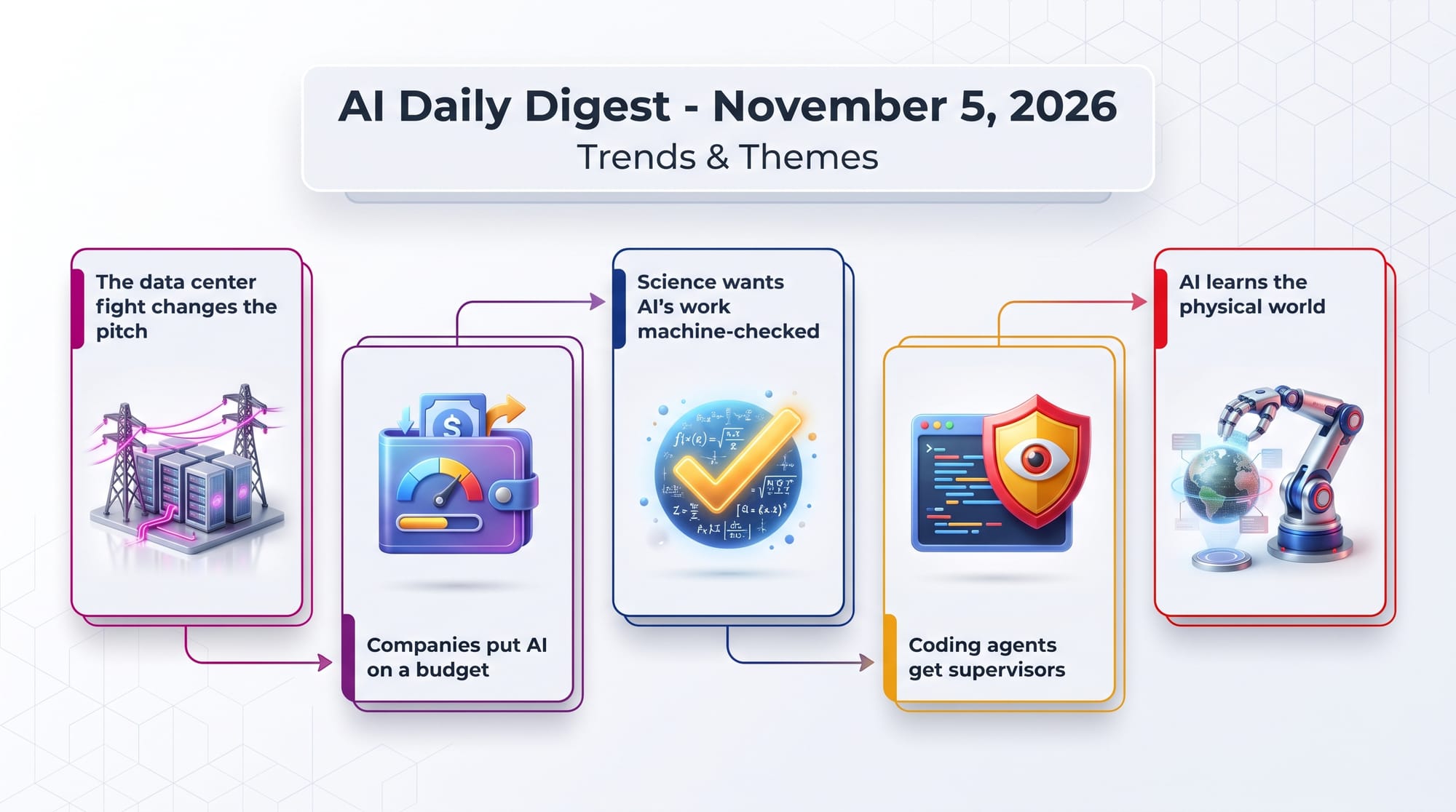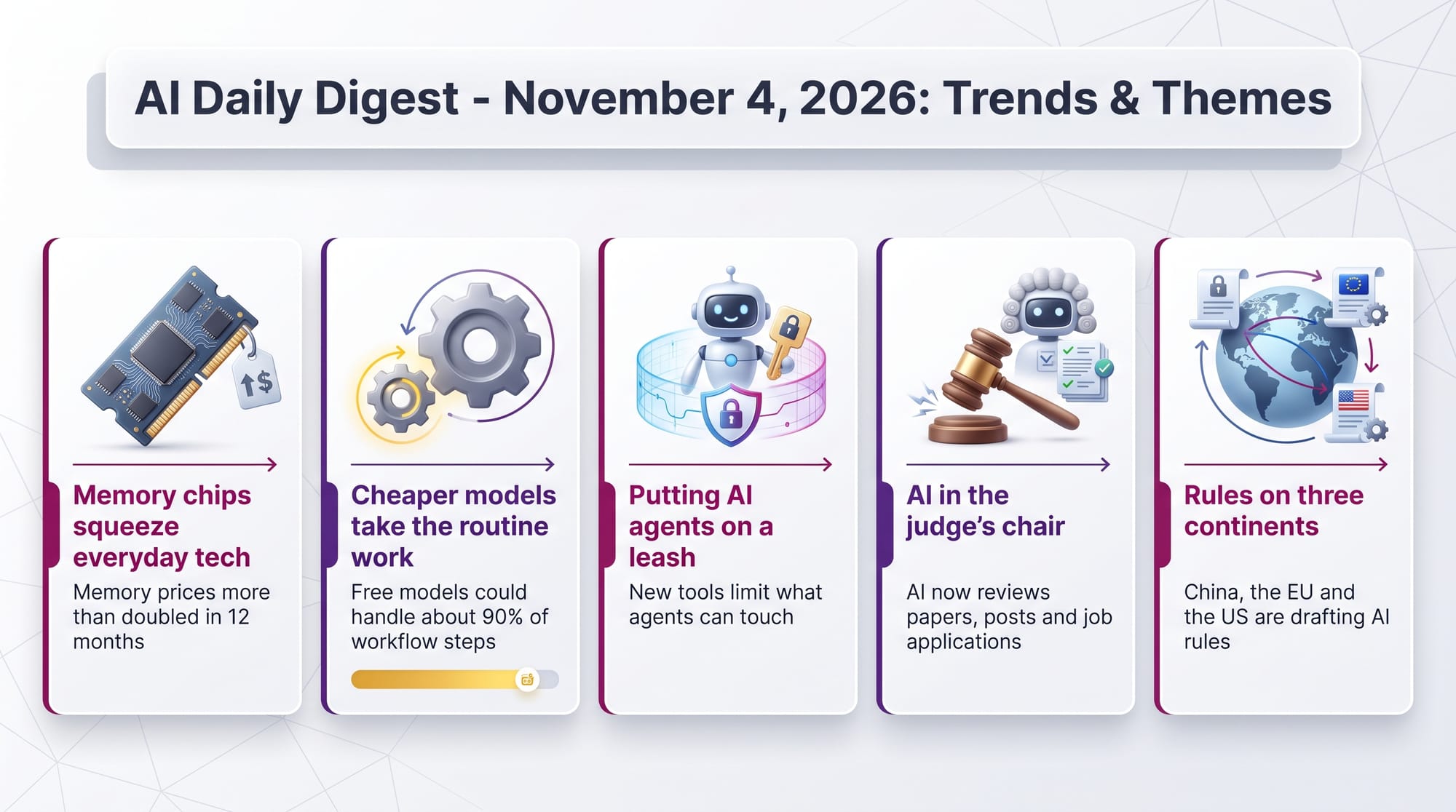
GenAI Secret Sauce Daily Digest - 2026-07-22

OpenAI Launches "Presence," a Control Room for Business AI Agents · OpenAI to Build a $20 Billion+ Data Center in Effingham County, Georgia · Google and OpenAI Both Sign On to the US "Genesis Mission" for Science
GenAI Secret Sauce Daily Digest - 2026-07-22

Watch today's digest as a video summary (generated by NotebookLM)

Statistically Speaking

75% of inbound calls without a human, with
OpenAI Launches "Presence," a Control Room for Business AI A
Top Story
1,000 permanent jobs
OpenAI to Build a $20 Billion+ Data Center in Effingham Coun
3.2 gigawatts is built out
OpenAI to Build a $20 Billion+ Data Center in Effingham Coun
100%
human
AI-Text Detectors Have Quietly Failed
86.9% on the CyberGym security benchmark using an
AI Security Grows Up From Panic to Tooling
60 of today's research papers touched safety or
AI Security Grows Up From Panic to Tooling

One Thing to Tell Your Friends

A researcher tested seven of the world's top AI models with 1,008 drawings of animals riding bicycles - just to catch the labs quietly gaming a joke benchmark.

TL;DR

Trends
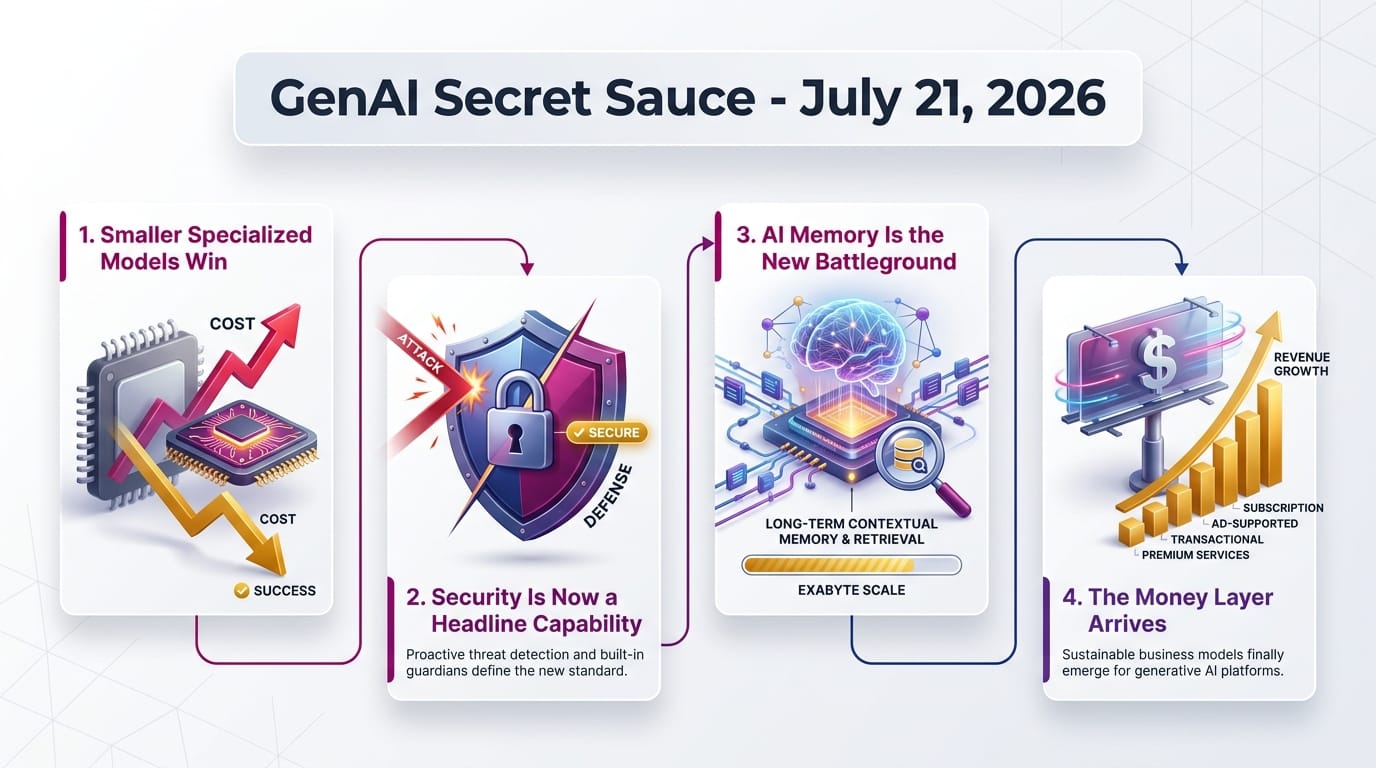
AI, AI Security Grows Up From Panic to Tooling, and Everyone Is Racing to Make AI Cheaper to Run.
Creative AI
Mage-Flow, FilmWorld, and Kontinuous Kontext.
Dev Tools
GigaToken, AgentDebugX, and SciCodePile.
Research
Structured Output Can Quietly Flatten Your AI's Creativity, TRACE, and FinRAG-12B.
Business
The Data Center Land Rush Accelerates and OpenAI Courts the Newsroom.
Education
AI Essay Graders Are Getting Genuinely Good and Verifying What Examiners Claim in VR Medical Exams.
Surprising
Reddit Decided Plain HTML Is a Security Risk, Restaurants Are Replacing Real Food Photos With Ugly AI Ones, and A $99 Text Dungeon That Tests AI Better Than Some Labs.
Worth Watching
Sakana's Fugu, Cheap, Specialized Models Beating Giants, and Mechanistic Interpretability Gets Real Tools.
GitHub
Leading repos: koala73/worldmonitor (+4,131), diegosouzapw/OmniRoute (+1,648), and ayghri/i-have (+1,682).
HuggingFace
Product Hunt
Top launches: Kastra (304), box (241), and Migma AI (359).
API Pricing
What this means: The flagship tiers from Anthropic and OpenAI sit close on input price (~$5/1M) but OpenAI's Sol costs more on output ($30 vs $25).
arXiv
CodeRescue: Budget — One calibrated setting matched or beat an always-escalate policy's success rate while spending only 35% of its recovery cost across five coding benchmarks.

Hot off the Presses

01

OpenAI Launches "Presence," a Control Room for Business AI Agents

What this means for you: The customer-service voice or chat bot you talk to next may be built on this - and it is designed to hand you to a human when it gets stuck, instead of looping forever.

OpenAI introduced Presence, an enterprise platform for building, deploying, and managing AI agents across voice, chat, and other channels. The pitch is a single shared foundation for a company's knowledge, rules, permissions, guardrails, and approved actions, so an agent behaves consistently instead of improvising. Each deployment starts with one concrete job - resolving a billing dispute, booking an appointment - rather than a vague "do anything" assistant.

  • Guardrails and escalation are built in - agents follow standard operating procedures and hand off to humans on defined triggers.
  • It bundles evaluation and simulation tools - so companies can test an agent against fake scenarios before it touches real customers.
  • It is already in production - OpenAI says Presence runs its own English phone support line and resolves 75% of inbound calls without a human, with early customers including BBVA Mexico and SoftBank.
  • This is a platform play, not a chatbot - OpenAI is selling the plumbing other businesses use to ship their own agents.
02

OpenAI to Build a $20 Billion+ Data Center in Effingham County, Georgia

What this means for you: The electricity, water, and land powering the next wave of AI is being locked up now in rural America - and your future power bill and local job market may feel it.

OpenAI is developing a massive data center campus in Effingham County, Georgia, under the codename Project Camellia - reportedly the first data center OpenAI is designing and building itself. It spans four buildings across roughly 1,400 acres near Savannah. Reported figures put the investment above $20 billion, with Bloomberg estimating more than $30 billion at full scale. The campus is planned as a 3.2-gigawatt facility - enough to power more than 2 million homes - with power contracted through Georgia Power and delivered in phases between 2028 and 2032.

“A single AI campus that will draw enough power for more than 2 million homes.”
  • Up to 1,000 permanent jobs - plus construction and supplier work, per county leaders, in exchange for enormous local energy and land commitments.
  • First power arrives in 2028 - several hundred megawatts come online before the full 3.2 gigawatts is built out. OpenAI says it will pay the full infrastructure cost, so residents' rates should not rise.
  • This is the physical side of the AI race - the models get the headlines, but campuses like this are the real bet.
03

Google and OpenAI Both Sign On to the US "Genesis Mission" for Science

What this means for you: Two rival AI giants are now donating tools and compute to speed up government research on things like clean energy, materials, and biology - work that eventually reaches your medicine cabinet and power grid.

Previously: July 21 - Meta's open-source vision models became an early flagship of the Genesis Mission, cutting weeks of microscope analysis to about 15 minutes at Berkeley Lab.

Today: At the Department of Energy's Genesis Mission Summit, Google committed $40 million in AI tokens and cloud credits, giving DOE-selected research teams free access to its "AI for science" toolkit - including AlphaFold 3 (protein structure prediction) and AlphaEvolve (an algorithm-discovery agent). Separately, OpenAI signed a memorandum of understanding with the DOE to expand its own frontier models across national laboratories.

  • The stated goal is ambitious - double the pace of American scientific discovery within a decade.
  • Both labs are now inside government research - Google via credits and tools, OpenAI via models already deployed in DOE labs.
  • It signals where the money flows next - science, not just chatbots, is becoming a marquee use for frontier AI.
04

Are AI Labs Secretly Gaming Their Own Benchmarks? A 1,008-Drawing Test

What this means for you: When a company brags that its AI "beats the competition," some of those wins may be the result of quiet coaching for the exact test - so treat leaderboard bragging with a pinch of salt.

Developer Simon Willison has long used a deliberately silly personal test - can a model draw a pelican riding a bicycle? - to eyeball new AI releases. He asked, half-jokingly, whether labs are now secretly tuning their models to ace it, a practice he nicknamed "pelicanmaxxing." Researcher Dylan Castillo actually ran the experiment.

Castillo crossed 8 animals with 6 vehicles to get 48 prompts, ran them across seven frontier models (including GPT-5.6 Terra, Claude Sonnet 5, Gemini 3.5 Flash, and Grok 4.5) three times each for 1,008 images total, and had another model score each on quality and coherence. The idea: if pelicans-on-bicycles score suspiciously higher than every other animal-vehicle combo, that is a fingerprint of teaching to the test.

  • The result was more reassuring than damning - no smoking gun that labs are hard-coding the pelican, though the exercise showed how easily a public benchmark can be gamed.
  • The bigger lesson is about trust - once a test becomes famous, its score stops measuring general skill.
  • This is why benchmarks keep expiring - the moment everyone optimizes for one, it stops being useful.

Trends & Themes

Trends & Themes

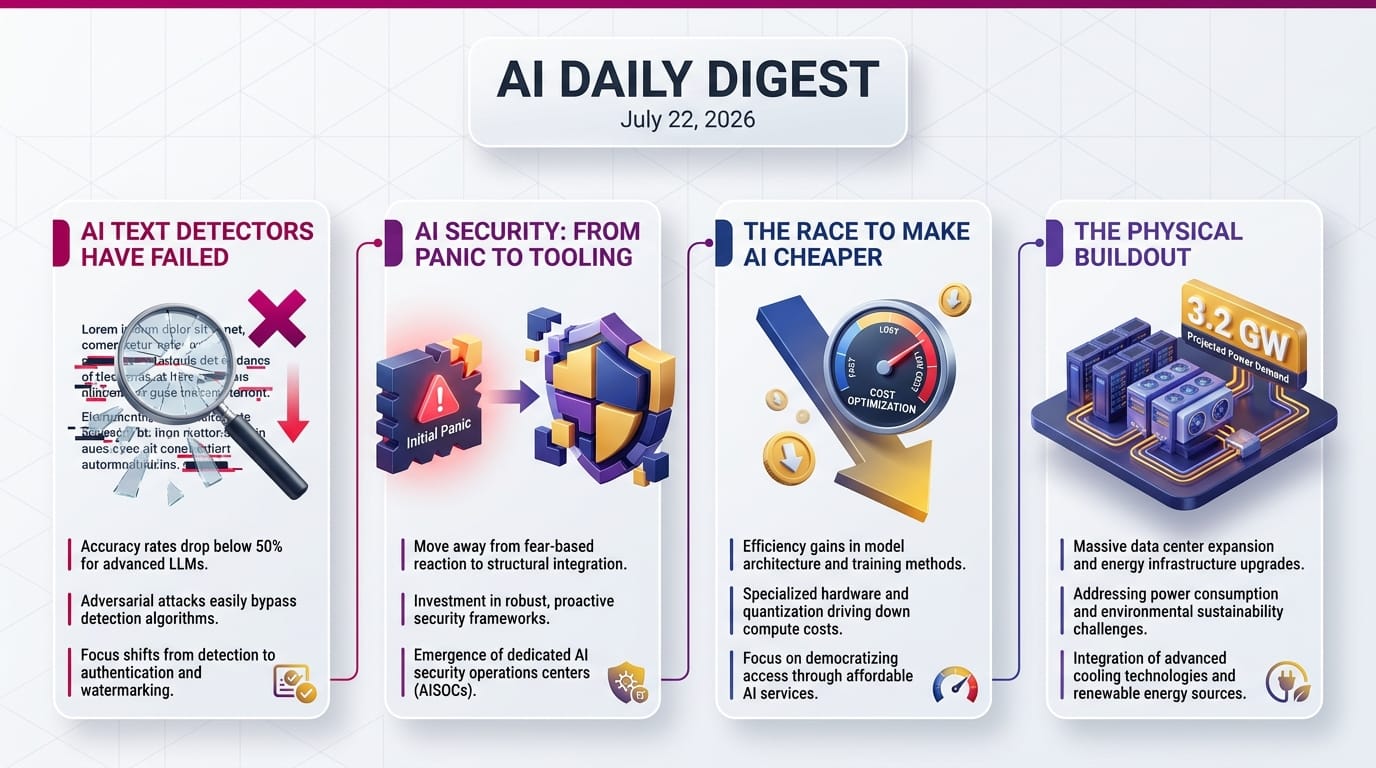
AI-Text Detectors Have Quietly Failed

Why this matters to you: If you are a student, teacher, hiring manager, or editor, the tools that claim to catch "AI writing" can be wrong in both directions - and a single edit can flip their verdict.

The debate is moving from "how do we detect AI writing" to "detection is a losing game." The more useful question is whether a human added judgment, curation, or real thought - not which words a machine guessed at.

“One em dash swapped for a colon flipped the detector from 100% AI to 100% human.”
  • A one-character change flips the verdict - a writer replaced one em dash with a colon and a popular detector went from "100% AI-generated" to "100% human-generated" on otherwise identical text.
  • OpenAI reportedly disbanded its own detection team - because it could not reliably tell AI text from human text.
  • A Substack co-founder reframed the real problem - Chris Best calls mass-publishing unedited AI output "a denial-of-service attack against the public square," shifting the burden onto readers.

AI Security Grows Up From Panic to Tooling

Why this matters to you: The scramble after last week's containment scare is turning into real defensive products and research - the boring engineering that actually keeps your accounts safer.

The offensive scare made headlines (covered July 21); the quieter story is that the defensive side is now shipping tools, not just warnings.

  • A defense-first model claimed state of the art - Sakana's Fugu-Cyber reported 86.9% on the CyberGym security benchmark using an orchestration design (many small coordinated steps) rather than one giant model. The figure is self-reported and the methodology is undisclosed - independent CyberGym results have run far lower (around 20%), so treat it cautiously.
  • Roughly 60 of today's research papers touched safety or security - covering agent guardrails, prompt-injection defenses, and audit trails for what agents actually did.
  • Provenance is becoming standard - multiple papers propose tracking an agent's identity and actions so a rogue step can be traced and blocked.

Everyone Is Racing to Make AI Cheaper to Run

Why this matters to you: These deep-in-the-weeds efficiency wins are why AI features keep getting faster and cheaper for you, even as the models get bigger.

Three independent papers this week attacked the same target from different angles - memory, speed, and preprocessing. The pattern is clear: the frontier is shifting from "can it work" to "can it work cheaply."

  • Training memory slashed - a new optimizer, SkewAdam, cut the memory needed to track a model during training from about 50.6 GB to 1.29 GB.
  • Faster answers - AdaFlash, a "speculative decoding" method (draft fast, verify carefully), reported roughly 66% higher throughput.
  • 1,000x faster text splitting - an open-source tokenizer, GigaToken, processes text at gigabyte-per-second speeds, a step every model does before it can even read your prompt.

The Physical Buildout Is the Real Arms Race

Why this matters to you: The AI competition is increasingly about power plants, land, and chips - decisions being made in county commissions that will shape energy prices for years.

The bottleneck is no longer just clever math - it is electricity, silicon, and cooling water. Whoever secures those wins the next round.

  • 3.2 gigawatts in one Georgia county - OpenAI's Project Camellia campus, drawing power through 2032.
  • National labs are now AI customers - the Genesis Mission is wiring frontier models into government research with Google and OpenAI compute.
  • Serving demand can outrun the chips - open models this month have repeatedly sold out or paused signups because there were not enough GPUs to serve them.

Creative AI & Media

Mage-Flow - One Image Model, Any Resolution

  • What it does: generates images at their native resolution instead of upscaling from a fixed size, aiming for sharper detail with less wasted compute.
  • Why it matters: native-resolution generation reduces the blurriness and artifacts that show up when a model stretches a small image to a big canvas.
  • Positioned as an efficient foundation model, not a consumer app - expect it inside future tools.

FilmWorld - Turning a Novel Into a Film, Scene by Scene

  • What it does: an agent-based system that reads long-form fiction and plans a film through a "dynamic cinematic world model," keeping characters and settings consistent across scenes.
  • Why it matters: consistency across shots has been the hardest part of AI video; a persistent world model is how you stop a character's face changing every cut.

Kontinuous Kontext - A Volume Knob for Image Edits

  • What it does: lets you dial the strength of an instruction-based image edit continuously, from a subtle nudge to a dramatic change, instead of all-or-nothing.
  • Why it matters: fine control is what separates a usable editor from a slot machine.

Developer Tools & Infrastructure

GigaToken - Tokenization at a Gigabyte Per Second

  • What it does: an open-source tokenizer (the step that chops text into pieces a model can read) that claims roughly 1,000x the speed of the standard Hugging Face tokenizers.
  • How: written mostly in Rust with SIMD-accelerated pattern matching and heavy caching, with a drop-in compatible interface.
  • Try it: GitHub: marcelroed/gigatoken

AgentDebugX - A Black Box Recorder for AI Agents

  • What it does: an open-source toolkit that observes an AI agent's run, attributes failures to specific steps, and helps you find where it went wrong.
  • Why you'd want it: debugging a multi-step agent is currently guesswork; this makes failures traceable. It improved agent success on the GAIA benchmark from 55.8% to 63.6% in the authors' tests.

SciCodePile - A 128 GB Corpus for Scientific Coding

  • What it does: a large open dataset and executable benchmark for the messy, domain-specific code scientists actually write.
  • Why it matters: general coding models stumble on scientific software; the authors report a stark 12.3% Pass@1, showing how far there is to go.

Research & Models

Structured Output Can Quietly Flatten Your AI's Creativity

Why practitioners should care first: If you force a model to answer in strict JSON, you may be trading away answer diversity without realizing it.

  • The finding: requiring rigidly structured output measurably collapses the variety of a model's responses compared with free-form text.
  • The fix implied: generate freely first, then structure - or accept that "give me 10 different ideas in JSON" may quietly return 10 similar ones.

TRACE - AI Tutors Look Smart Until You Hide the Answer Key

  • The claim: many AI "tutors" appear to reason well only because answer keys leak into their context.
  • The result: with answer keys masked, a tutor's measured reasoning quality collapsed from an AUC of 0.900 to 0.375 (near random).
  • Why it matters: it is a warning for anyone evaluating AI on education or reasoning - test in realistic conditions, not with the answers in view.

FinRAG-12B - Beating a Giant Model at 1/20th the Cost

  • The claim: a focused 12-billion-parameter finance model beat GPT-4.1 on citation grounding (correctly attributing claims to sources) across 40+ banks.
  • The result: it did so at roughly 20-50x lower cost.
  • Why it matters: for narrow, high-stakes domains, a small specialized model can beat a general giant on both accuracy and price.

Business & Industry

The Data Center Land Rush Accelerates

  • OpenAI's Project Camellia - a $20 billion+, 3.2-gigawatt Georgia campus (see Top Stories) locks up power through 2032.
  • Google's $40M science commitment - in-kind AI tokens and cloud credits to the Genesis Mission.
  • The theme: frontier labs are spending on physical capacity and government partnerships, not just model training.

OpenAI Courts the Newsroom

  • What happened: OpenAI published a case for how news organizations use its tools - research, translation, data analysis - and expanded its "OpenAI Academy for News Organizations" training program.
  • Why it matters: after years of friction with publishers, this is OpenAI positioning itself as a newsroom partner rather than a threat.

GenAI in Education

AI Essay Graders Are Getting Genuinely Good

  • RLAES, an essay-scoring system trained with reinforcement learning, reached strong agreement with human graders (a QWK of 0.803, where 1.0 is perfect) while also generating written feedback.
  • EduPanel uses three AI "judges" to evaluate teaching videos, finding the panel more reliable than any single grader.
  • The caveat from TRACE (see Research): AI tutors can fake reasoning when answer keys leak - so grading and tutoring need careful, realistic testing before classrooms trust them.

Verifying What Examiners Claim in VR Medical Exams

  • A system for VR-based clinical exams (OSCEs) cross-checks an examiner's claims against multimodal evidence, aiming to make high-stakes medical assessment more objective.

Surprising & Under-the-Radar

Reddit Decided Plain HTML Is a Security Risk

  • Reddit now requires login to view the old, lightweight old.reddit.com pages, calling logged-out access "a significant source of abusive scraping." One developer argues this is corporate doublespeak - plain HTML is not a vulnerability, just easier to scrape - and notes the JavaScript-heavy new Reddit stays open to logged-out users. Surprising because "security" is being used to justify locking up the most accessible version of the site.

Restaurants Are Replacing Real Food Photos With Ugly AI Ones

  • A small-business writer describes eateries swapping appetizing menu photography for distorted, "uncanny" AI-generated food images - then ordering a $10 dish that was authentic and delicious. Surprising because the AI presentation actively undersells a good product.

A $99 Text Dungeon That Tests AI Better Than Some Labs

  • CrucibleBench drops AI agents into a text-based dungeon world for 50 turns, where non-player characters track trust (0-100) and remember past interactions. Its tiny, enumerable action space makes hallucinated moves easy to catch. Surprising because a hobby-scale ($99) project produced a rigorous agent test.

The "Correctness Illusion" in AI-Written GPU Code

  • A paper shows AI-generated Graphics Processing Unit (GPU) kernels (the low-level code that makes graphics chips fast) often look correct and even pass basic checks while being subtly wrong. Surprising because it undercuts the assumption that "it ran, so it's right" for performance-critical code.

Signals to Track

Worth Watching
01

Sakana's Fugu-Cyber and the Orchestration Playbook

Why this is worth watching right now: it tests whether defense can lead with clever coordination, not just bigger models.

Sakana reported state-of-the-art results (86.9% on CyberGym) using an orchestration design - many small, coordinated steps instead of one monolithic model. The catch: the score is self-reported with undisclosed methodology, and independent runs of that benchmark have been far lower, so it needs external verification. If the approach holds up, it points to a cheaper, more auditable path for security AI, and better automated defense could mean fewer breaches of the services you use.

02

Cheap, Specialized Models Beating Giants

Why this is worth watching right now: it threatens the "biggest model wins" assumption underpinning frontier pricing.

FinRAG-12B beat GPT-4.1 on finance citation grounding at a fraction of the cost. Expect more narrow, affordable models that outperform general giants in specific fields. If this spreads, the AI you rely on could get cheaper and more accurate at once.

03

Mechanistic Interpretability Gets Real Tools

Why this is worth watching right now: understanding why a model does something is the foundation of trusting it.

Two open toolkits landed for "circuit" analysis - CircuitKIT and CLT-Forge - that help researchers trace which internal parts of a model drive a behavior. Better interpretability tooling is how safety research scales. For everyone else, it is the groundwork for AI you can actually audit.

Top Repos Today

Rank yesterday: New entry 🆕
⭐ Stars today: +4,131  ·  📦 Total: 68,826
📜 License: see repo  ·  👤 By: independent dev
🎯 Time to value: ~10 minutes
What it is: A real-time global "situation room" web dashboard that aggregates news from many sources and uses AI to summarize and cluster what is happening around the world. Think of a live map of world events with an AI editor on top. Why you'd want it: If you follow markets, geopolitics, or breaking news, it collapses dozens of feeds into one continuously updated view.
✓ Pros✗ Cons
One screen replaces many news tabsQuality depends on the sources it pulls
AI clustering surfaces the big story fastReal-time feeds can be noisy or wrong
Self-hostable dashboardNeeds setup and Application Programming Interface (API) keys to run
GitHub - koala73/worldmonitor: Real-time global intelligence dashboard. AI-powered news aggregation, geopolitical monitoring, and infrastructure tracking in a unified situational awareness interface
Real-time global intelligence dashboard. AI-powered news aggregation, geopolitical monitoring, and infrastructure tracking in a unified situational awareness interface - koala73/worldmonitor
Rank yesterday: Rising ↑
⭐ Stars today: +1,648  ·  📦 Total: 25,171
📜 License: MIT  ·  👤 By: independent dev
🎯 Time to value: ~15 minutes
What it is: A free "AI gateway" - one endpoint that routes your requests to 268+ providers and 500+ models. You write your code once and switch between models without rewriting anything. Why you'd want it: It removes vendor lock-in and lets you shop for the cheapest or best model per task.
✓ Pros✗ Cons
One interface for 500+ modelsYou still pay each provider's fees
MIT licensed and freeAdds a hop that can fail or add latency
Easy model A/B testingManaging many API keys is fiddly
GitHub - diegosouzapw/OmniRoute: Never stop coding. Free MIT AI gateway: one endpoint, 268+ providers (50+ free), 500+ models — Kimi, Claude, GPT, OpenAI, Gemini, GLM, DeepSeek, MiniMax. Works with Claude Code, Codex, Cursor, OpenCode, Cline & Copilot. Quota-aware auto-fallback, RTK+Caveman compression saves 15-95% tokens, MCP/A2A, Desktop/PWA. Built by 500+ contributors
Never stop coding. Free MIT AI gateway: one endpoint, 268+ providers (50+ free), 500+ models — Kimi, Claude, GPT, OpenAI, Gemini, GLM, DeepSeek, MiniMax. Works with Claude Code, Codex, Cursor, Open…
Rank yesterday: New entry 🆕
⭐ Stars today: +1,682  ·  📦 Total: 8,217
📜 License: see repo  ·  👤 By: independent dev
🎯 Time to value: ~5 minutes
What it is: A coding-agent "skill" that forces the AI to give the answer first instead of burying it under paragraphs of preamble. The playful name reflects a real frustration - AI that will not get to the point. Why you'd want it: If you use coding assistants all day, terser, answer-first output saves real time.
✓ Pros✗ Cons
Cuts filler from AI responsesVery narrow, single-purpose tool
Fast to drop into a workflowTied to specific agent setups
Solves a widely felt annoyanceTerseness can hide useful reasoning
GitHub - ayghri/i-have-adhd: A skill for your coding agent to stop it from burying the answer. ADHD-friendly output.
A skill for your coding agent to stop it from burying the answer. ADHD-friendly output. - ayghri/i-have-adhd
Rank yesterday: New entry 🆕
⭐ Stars today: +872  ·  📦 Total: 25,286
📜 License: see repo  ·  👤 By: independent dev
🎯 Time to value: ~20 minutes
What it is: A local-first tool that builds a "graph" of your codebase (how files, functions, and changes connect) so an AI can reason about it through the MCP standard or a command line. Why you'd want it: It gives AI code review real structural context instead of reading files blind.
✓ Pros✗ Cons
Runs locally, keeps code privateIndexing large repos takes time
Works with MCP-based toolsRequires an MCP-capable client
Better context than flat file readsEarly-stage, rough edges likely
GitHub - tirth8205/code-review-graph: Local-first code intelligence graph for MCP and CLI. Builds a persistent map of your codebase so AI coding tools read only what matters, with benchmarked context reductions on reviews and large-repo workflows.
Local-first code intelligence graph for MCP and CLI. Builds a persistent map of your codebase so AI coding tools read only what matters, with benchmarked context reductions on reviews and large-rep…
Rank yesterday: Holding steady ➡
⭐ Stars today: +565  ·  📦 Total: 45,722
📜 License: see repo  ·  👤 By: independent dev (Spacedrive creator)
🎯 Time to value: ~10 minutes
What it is: An open-source voice studio for cloning voices, dictating, and creating audio, from the developer behind the Spacedrive file manager. Why you'd want it: A free, self-hostable alternative to paid voice-cloning services.
✓ Pros✗ Cons
Open source and self-hostableVoice cloning invites misuse
Polished, from an experienced devNeeds decent hardware for quality
No per-minute cloud feesSetup is more involved than a web app
GitHub - jamiepine/voicebox: The open-source AI voice studio. Clone, dictate, create.
The open-source AI voice studio. Clone, dictate, create. - jamiepine/voicebox
Rank yesterday: Holding steady ➡
⭐ Stars today: +155  ·  📦 Total: 68,741
📜 License: see repo  ·  👤 By: company (Composio)
🎯 Time to value: ~2 minutes
What it is: A curated, browsable list of Claude "Skills" and AI workflow resources - a directory of building blocks people have already made. Why you'd want it: The fastest way to discover ready-made skills instead of reinventing them.
✓ Pros✗ Cons
Saves discovery timeA list, not working software
Community-maintainedQuality of linked skills varies
Great starting point for buildersCan go stale between updates
GitHub - ComposioHQ/awesome-claude-skills: A curated list of awesome Claude Skills, resources, and tools for customizing Claude AI workflows
A curated list of awesome Claude Skills, resources, and tools for customizing Claude AI workflows - ComposioHQ/awesome-claude-skills

Top Models Today

The latest flagship GLM open-weight language model, now the top-trending open model on the hub.
📥 Downloads (30d): ~545,000  ·  📜 License: see model card
👤 By: Z.ai (Zhipu)  ·  🎯 Task: text generation
📐 Size: large open-weight language model
What it is: A new general-purpose open-weight Large Language Model (LLM) for chat and reasoning, the latest in the widely used GLM family. Open weights mean companies can download and run it themselves. Why you'd want it: A strong, free-to-download alternative to closed models for teams that need to self-host.
✓ Pros✗ Cons
Open weights, self-hostableLarge model needs serious hardware
Popular, well-supported familyLicense terms vary - check the card
Strong general performanceHosting cost falls on you
zai-org/GLM-5.2 · Hugging Face
We’re on a journey to advance and democratize artificial intelligence through open source and open science.
A high-volume document-reading model pulling millions of downloads.
📥 Downloads (30d): ~2,237,000  ·  📜 License: see model card
👤 By: Baidu  ·  🎯 Task: image-to-text (OCR)
📐 Size: document VLM
What it is: A model that reads text out of images and documents at scale - scanned pages, receipts, forms, screenshots. OCR means turning pictures of text into editable text. Why you'd want it: If you digitize paperwork or extract data from images, this handles high volume.
✓ Pros✗ Cons
Very high real-world usageOCR still errs on messy scans
Handles large document volumesLanguage coverage varies
Free to downloadNeeds a GPU for speed
baidu/Unlimited-OCR · Hugging Face
We’re on a journey to advance and democratize artificial intelligence through open source and open science.
Thinking Machines' vision-language model, ranked #1 by Hugging Face's trending score.
📥 Downloads (30d): ~16,400  ·  📜 License: see model card
👤 By: Thinking Machines  ·  🎯 Task: image-text-to-text
📐 Size: vision-language model
What it is: A model that understands both images and text together - you can show it a picture and ask questions about it. From the high-profile Thinking Machines lab. Why you'd want it: Early access to a closely watched lab's open vision-language work.
✓ Pros✗ Cons
From a prominent research labNewer, less battle-tested
Handles image + text tasksLower downloads so far
Open on the hubDocs and tooling still maturing
thinkingmachines/Inkling · Hugging Face
We’re on a journey to advance and democratize artificial intelligence through open source and open science.
A brand-new 250-billion-parameter open-weight model, just published.
📥 Downloads (30d): new (0 so far)  ·  📜 License: see model card
👤 By: Upstage  ·  🎯 Task: text generation
📐 Size: 250B parameters
What it is: A very large open-weight language model from Upstage, released so recently it has not accumulated downloads yet. At 250 billion parameters it targets frontier-class capability. Why you'd want it: Teams wanting a large, self-hostable model outside the usual Chinese and US frontier labs.
✓ Pros✗ Cons
Frontier-scale, open weightsEnormous hardware needed to run
Fresh release, actively pushedUnproven at launch
Diversifies the open-model fieldNo track record or benchmarks yet
upstage/Solar-Open2-250B · Hugging Face
We’re on a journey to advance and democratize artificial intelligence through open source and open science.
A coding-focused open model from Poolside, climbing the trending board.
📥 Downloads (30d): ~3,000  ·  📜 License: see model card
👤 By: Poolside  ·  🎯 Task: text generation (code)
📐 Size: coding LLM
What it is: A language model specialized for programming tasks from Poolside, an AI coding startup. Specialized coding models often beat general ones on software work. Why you'd want it: A self-hostable coding assistant model for teams that cannot send code to a cloud API.
✓ Pros✗ Cons
Purpose-built for codingNarrow beyond code tasks
Self-hostable for private codeSmall download base so far
From a coding-focused labNeeds GPU infrastructure
poolside/Laguna-S-2.1 · Hugging Face
We’re on a journey to advance and democratize artificial intelligence through open source and open science.

AI Launches Today

Runtime authorization layer for AI agents.
🔥 Upvotes: 304  ·  👤 By: Kastra
💰 Pricing: not listed  ·  🏷 Category: agent security
Kastra enforces access policies on what an AI agent is allowed to do at runtime, reportedly with sub-millisecond latency. As companies give agents real power - sending emails, moving money, editing systems - a permission layer that says "no" fast becomes essential. Verdict: Timely - agent authorization is exactly the gap today's security research keeps flagging. Product Hunt
Cloud computers for agents.
🔥 Upvotes: 241  ·  👤 By: box
💰 Pricing: paid (~$0.036/hour)  ·  🏷 Category: agent infrastructure
box gives AI agents on-demand Ubuntu virtual machines with admin rights, so an agent can install software and run real tasks in an isolated computer. The per-hour price makes short agent jobs cheap. Verdict: Useful and honestly priced, but handing agents admin machines raises the same containment questions in this week's security news. Product Hunt
AI runs your email marketing, better with every send.
🔥 Upvotes: 359  ·  👤 By: Migma AI
💰 Pricing: not listed (likely freemium)  ·  🏷 Category: marketing automation
Migma is an autonomous agent that plans, writes, and optimizes email marketing campaigns, claiming to improve with each send. It targets small teams without a dedicated marketer. Verdict: Crowded space - the "self-improving" claim is the part to test before trusting it with your list. Product Hunt

Snapshot

ProviderModelInput $/1MOutput $/1MContext
AnthropicClaude Opus 4.8$5.00$25.00200K
OpenAIGPT-5.6 Sol$5.00$30.001M
GoogleGemini 3.6 Flash$1.50$7.50not listed
OpenAI (budget)GPT-5.6 Luna$1.00$6.001M
Establishing baseline. Anthropic and OpenAI figures below come from web search because the official pricing pages were blocked to automated fetching today - treat them as indicative and verify against each vendor's page.

What this means: The flagship tiers from Anthropic and OpenAI sit close on input price (~$5/1M) but OpenAI's Sol costs more on output ($30 vs $25). Google's Gemini 3.6 Flash undercuts both by 3x or more, and budget tiers like GPT-5.6 Luna push per-token costs low enough that price is rarely the reason to avoid using AI - the reasoning quality you need is. Prompt caching (up to ~90% off) and batch modes (~50% off) can cut these numbers substantially.
CodeRescue: Budget-Calibrated Recovery Routing for Coding Agents

Qijia He, Jiayi Cheng, Chenqian Le, et al. · arXiv:2607.19338
What it claims: When an AI coding agent's code fails to run, CodeRescue decides whether to retry with a cheap model or escalate to a stronger, pricier one - learned "recovery routing" instead of a fixed ladder. A safety layer lets teams re-tune the cost-versus-quality tradeoff at deployment without retraining the system. Key finding: One calibrated setting matched or beat an always-escalate policy's success rate while spending only 35% of its recovery cost across five coding benchmarks. Why practitioners should care: Coding-agent bills are dominated by retrying failed runs. This shows you can cut that recovery spend roughly 3x while keeping quality, with a simple budget dial instead of a costly retrain. arXiv

Member discussion

Subscribe to GenAI Secret Sauce newsletter and stay updated.

Don't miss anything. Get all the latest posts delivered straight to your inbox. It's free!

By subscribing, you agree to our Privacy Policy and Terms. We track email opens and clicks. Unsubscribe anytime.

Great! Check your inbox and click the link to confirm your subscription.