Watch today's digest as a video summary (generated by NotebookLM)
Statistically Speaking
One Thing to Tell Your Friends
TL;DR
Hot off the Presses
Robots can do a third of the work but are worth hiring for almost none of it
Anthropic, the company behind the Claude AI assistant, published a study on September 30 asking two separate questions about US jobs. First, could existing robots do a given task in at least some setting? Second, would doing so actually cost less than paying a person?
The answers are far apart. Anthropic used Claude to rate thousands of task examples, work environments and deployment costs. The authors warn that adding up task costs can double-count robots or miss the cost of coordinating them.
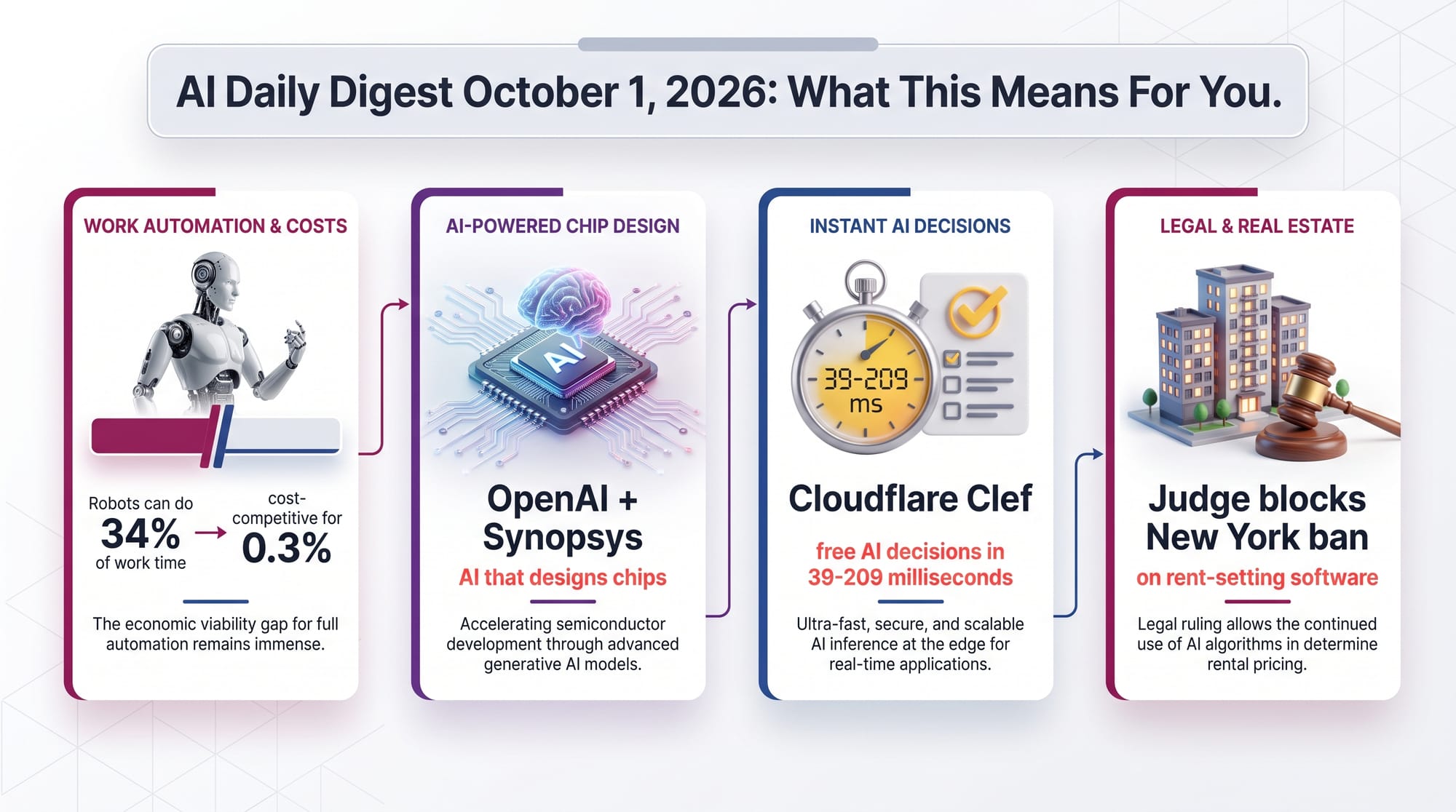
- About 74% of physical tasks are within reach of existing robots and they add up to 34% of US working hours
- Only 0.3% of job tasks are ones where a robot beats human labor on cost today
- About 40 years is how long Anthropic estimates it would take to reach 10% at past price trends
- Critics on Reddit say the weakest link is the gap between one task and a full workflow with supervision and failure recovery
OpenAI and Synopsys are building an AI that designs computer chips
Synopsys makes the specialist software engineers use to design and test chips, known as Electronic Design Automation (EDA). On September 30 it announced GPT-Synopsys with OpenAI. Unlike a chatbot that gives advice, the model is meant to operate the design tools directly, read their results and keep improving the design.
Synopsys is licensing its tools to OpenAI under a multi-year deal with shared revenue. Customers' chip designs are encrypted and kept out of model training - a must for companies whose designs are worth billions.
- The goal is better power, speed and chip size while getting a working chip on the first try
- Early tests are underway with leading chipmakers, but there is no release date
- No speed-up numbers were published which was the main complaint in a 162-point Hacker News discussion
- It runs on OpenAI's models and computers and plugs into Synopsys's own AI agent platform
Cloudflare gave away AI models that decide instead of chat
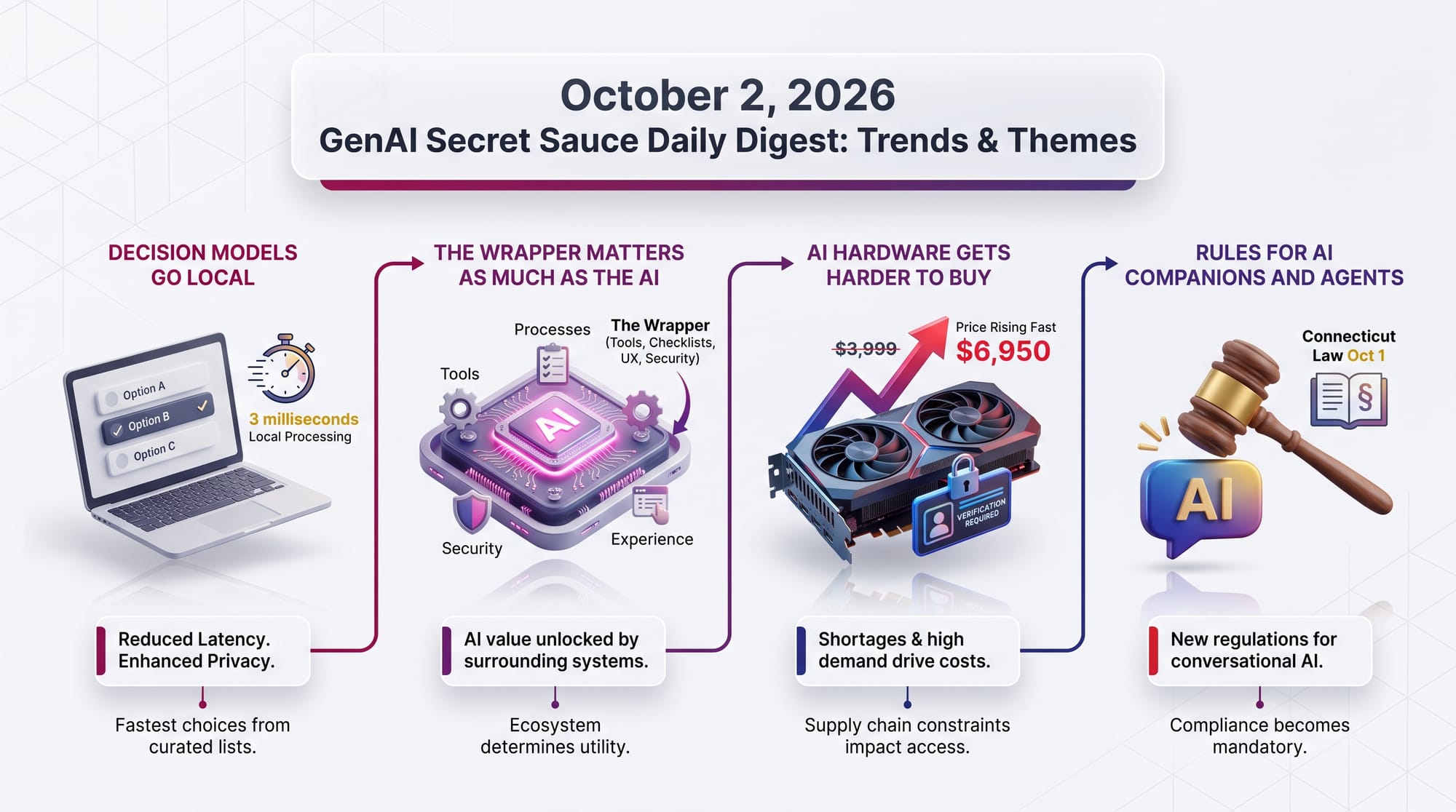
Cloudflare, which runs a large part of the internet's security and delivery network, released Clef, a family of free "decision models." Instead of writing an answer word by word, Clef scores a fixed list of options in a single step - for example, sorting a support ticket by urgency or flagging a suspicious website.
The full Clef is built on Alibaba's Qwen 27-billion-parameter model, and Clef-flash on a smaller 9-billion-parameter Qwen model. Both are free to download under a permissive license. The announcement drew more than 390 points on Hacker News, the day's top AI story there.
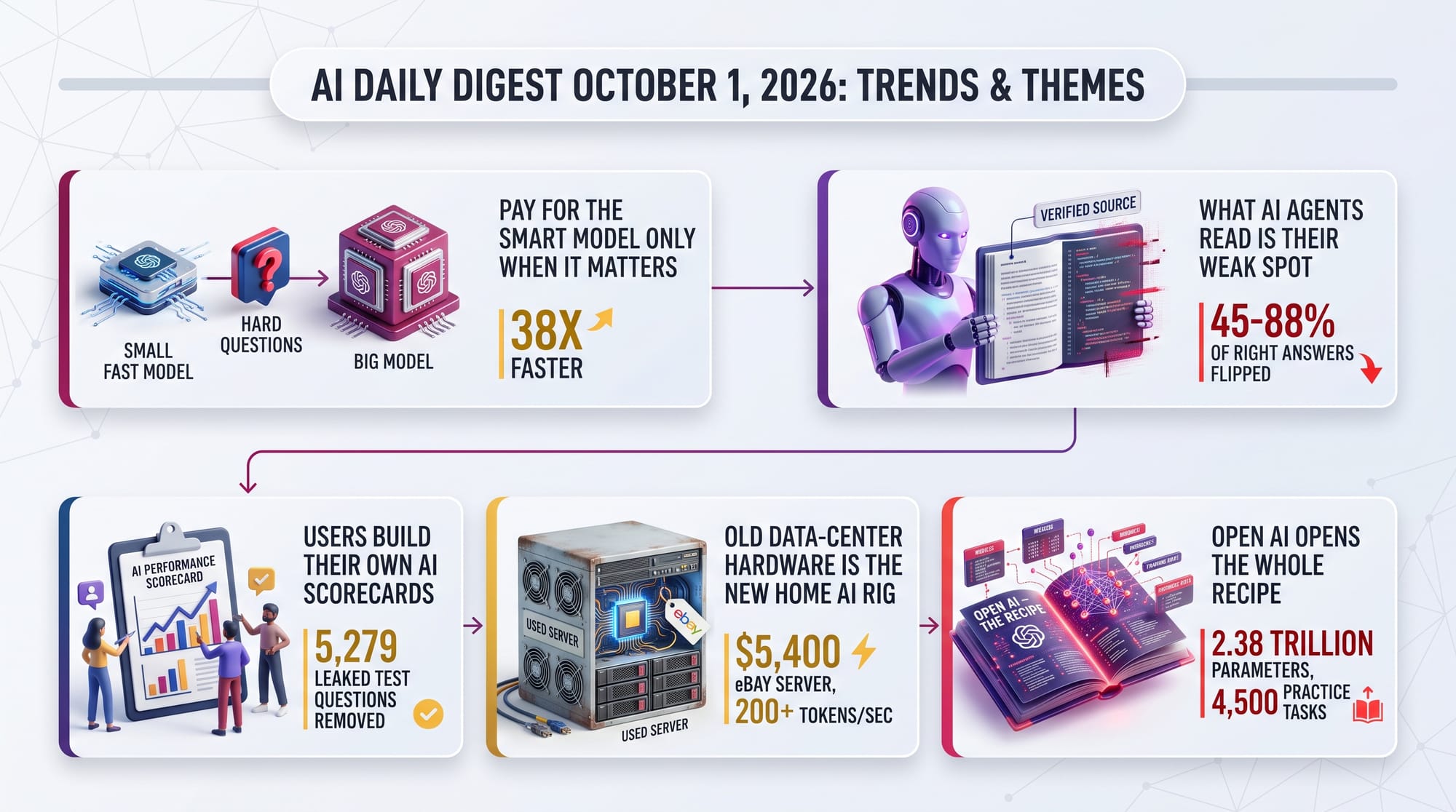
- Clef answers in 209 milliseconds at the median versus 524 for the rival decision model Jev
- It can read images and handle twice as much text as Jev (64,000 tokens of input)
- Cloudflare's own threat team sorted websites in 2.2 seconds versus 4.7 for its fastest chatbot
- A new training service lets companies tune their own decision models from their past logs
A judge blocked New York's ban on rent-setting software
On September 29, federal Judge Valerie Caproni paused New York's first-in-the-nation ban on algorithmic rent-setting. The law treated rent recommendations from pricing software as possible price-fixing. RealPage, the biggest maker of such software, argued the ban limited its speech.
The judge said the law was too broad because it also covered recommendations built from public market data, not just rivals' private data. She called it a close question.
- The law "prohibits normal commercial conduct just because it is facilitated by software" in the judge's words
- New York had cited a $3.8 billion yearly cost to US renters from price-setting algorithms
- Rules aimed at the software companies themselves remain in force
- RealPage had already settled a separate US Department of Justice case in November 2025
Trends & Themes
Creative AI & Media
Claude composed a Bach-style synth piece - and checked its own work because it cannot hear
- What happened: A game developer asked Claude Opus 5.5 to write a Bach-inspired electronic piece using their game's music engine. The result, "Contrapunctus Acidus," runs about two minutes.
- How it works: Claude wrote the score as a program, checked the counterpoint (the rules for weaving melodies together) with a script, measured the audio and fixed problems over several passes.
- Why it matters: Automatic checks can stand in for a human ear, which opens music-making to people who cannot read music.
- See it: Reddit: r/ClaudeAI "Contrapunctus Acidus" post
A full AI music video for about $50 in image credits
- What happened: A creator made the music video "Louder Than Alarms" with Suno v6 for the song and Claude directing image and video tools.
- The method: About 20 reference images were treated as strict rules for the look, and Claude agreed a storyboard before generating anything.
- The cost: Roughly four hours, most of one Claude Max session and about $50 of Magnific credits, plus two correction passes.
- See it: Reddit: r/ClaudeAI "New AI Slop standard?" post
Breed pixel-art creatures that are drawn entirely by code
- What it is: A free desktop app that generates creatures across nine families, from dragons to plant-people, with no pre-made art.
- The fun part: Edit individual "genes," breed two parents and watch four animated offspring appear.
- How it was made: The creator says one very long, detailed prompt to Claude Opus 5.5 built about 95% of it.
- Try it: GitHub: procedural-pixel-creatures
AI training videos are cheap now - but most do not teach
- The numbers: Per Synthesia's 2026 report, 52% of corporate training teams now use AI video and production time fell 62%.
- The problem: Learning researcher Philippa Hardman found AI tools invented rules and dropped key steps when turning a real company procedure into video.
- What works: Showing a bad then a good example, or pausing for questions between clips, which lifted test scores from 68% to 90% in one study.
- Read it: Dr Philippa Hardman: Is AI video helping people learn?
Developer Tools & Infrastructure
Research & Models
AI models trust a "verified source" more than they trust you
- The finding: Models that push back when a user insists on a wrong answer often cave when the same wrong answer is labeled as coming from a verified source.
- The numbers: One such note flipped 45-88% of correct answers in seven of eight models tested; Gemini-3.1-Pro was the exception at 0.6%.
- Why it matters: Agents read search results and documents all day, so a planted "source" may fool them more easily than a pushy user.
- The fix hint: Dialing down one internal "this was endorsed" signal cut compliance with wrong sources by 64-78 points in three model families.
- Read it: Reddit: r/MachineLearning authors' post on Authority Bias · GitHub: Lossfunk/authority-bias
Letting AI search again beat 18 fine-tuned search pipelines
- The test: The open-source PipesHub team ran 824 multi-step questions from Google's FRAMES test (which checks answers that need several documents).
- The result: The best fixed pipeline scored 78.9%; an agent allowed to read results and search again scored 92.7%.
- The surprise: Adding a small "reranker," a tool many guides treat as essential, cut accuracy by 9 points.
- Read it: Reddit: r/LocalLLaMA FRAMES benchmark post
Small coding agents that keep notes in files punch far above their size
- The idea: Instead of inventing special memory tools, let the AI use ordinary files as its notebook - something it already learned from reading code.
- The result: A 4-billion-parameter model trained this way competed with a 35-billion one on coding tests, and a 9-billion one with a 122-billion one.
- Why it matters: The simple "keep a notes file" habit may be the best memory system for agents.
- Read it: arXiv paper 2609.34422
A sparse-first engine makes long-running agents much cheaper to serve
- The problem: Agents pile up long histories that eat memory and slow every reply.
- The approach: SparseEngine keeps only the most useful parts of that history while still reusing shared starting text across requests.
- The numbers: Over 2.5 times faster replies than the popular vLLM server and over 2 times end-to-end speed-ups on agent tests.
- Read it: arXiv paper 2609.39068
Business & Industry
Surprising & Under-the-Radar
Signals to Track
Unnamed AI models are being test-driven in public
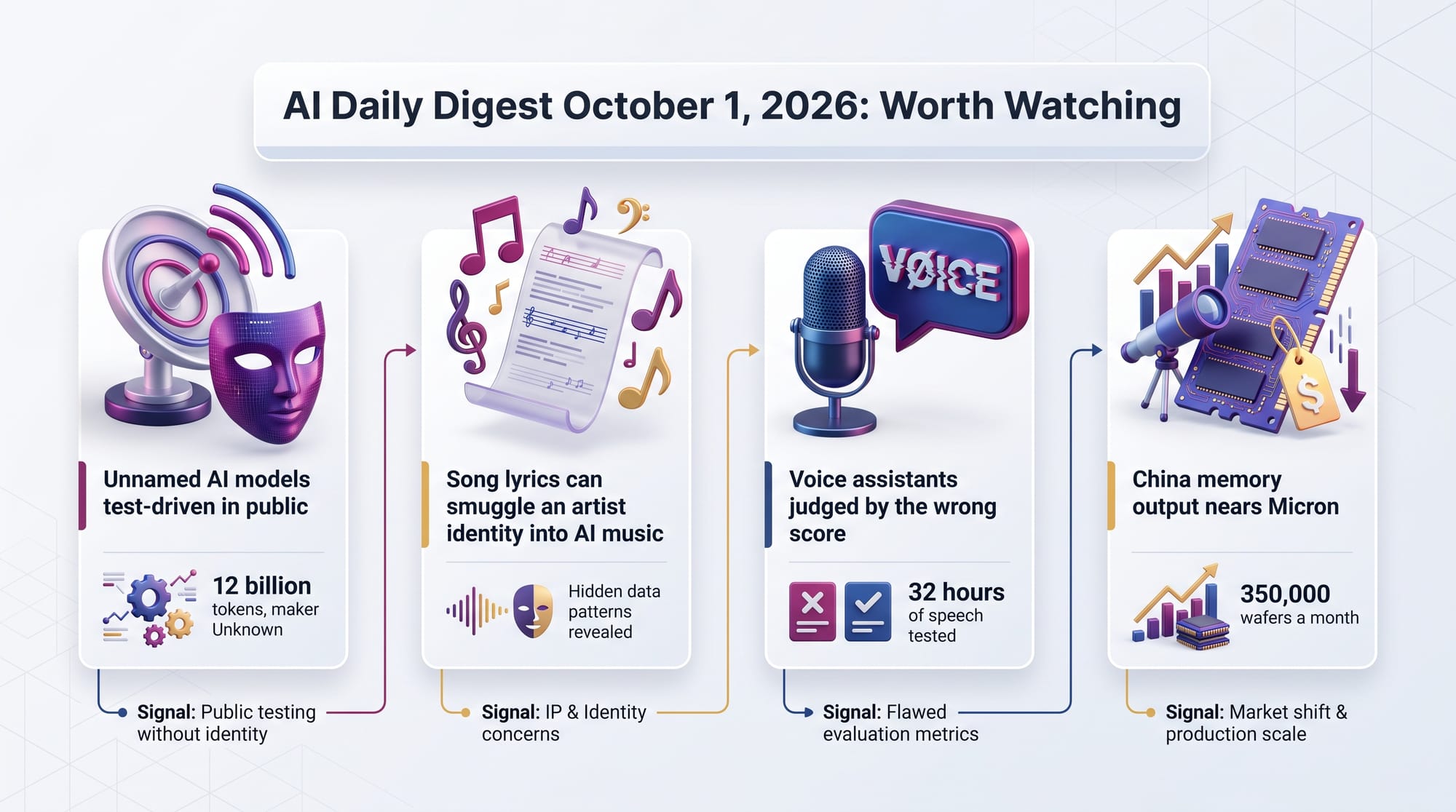
A model called "fledge-alpha" with its maker listed as "Unknown" has quietly processed about 12 billion tokens for 471 users on the OpenCode platform, all for free. Labs increasingly test unreleased models this way to gather real-world data before announcing them. For ordinary users, it means the next big model may already be in your tools under a code name.
Song lyrics can smuggle an artist's identity into AI music
Researchers found an open lyrics-to-song model encodes which artist a set of lyrics belongs to, even when the artist is never named, and that signal carries into the generated audio. Current filters mostly block names in the prompt. If this holds for commercial tools, expect copyright fights over lyric-based imitation to grow.
Voice assistants are being judged by the wrong score
The Talk2Agent benchmark recorded 32 hours of people speaking tasks to computer-using AI agents. It found that standard word-error scores miss the real failure: a garbled file name or web address sinks the whole task. As more people talk to their agents instead of typing, getting names right matters more than getting every word right.
China's memory chips could ease AI hardware prices
Chinese memory maker CXMT is reported to finish 2026 at about 350,000 wafers a month, only slightly behind Micron, with big expansions planned through 2030. China's own AI boom could soak up much of that supply through 2027. If prices fall afterward, home AI machines and phones with more memory get cheaper.
Top Repos Today
📜 License: MIT · 👤 By: individual
🎯 Time to value: 5 minutes
| ✓ Pros | ✗ Cons |
|---|---|
| Drop-in and free | Results depend on your AI tool |
| Encourages simpler code | Style rules, not hard guarantees |
| Very popular, well tested | May be too minimal for some projects |
 GitHub
📜 License: MIT · 👤 By: individual (TypeScript educator Matt Pocock)
🎯 Time to value: 10 minutes
| ✓ Pros | ✗ Cons |
|---|---|
| Written by a respected teacher | Tuned to one person's workflow |
| Free and easy to copy | Mostly for programmers |
| Covers many everyday tasks | Needs adapting to your tools |
 GitHub
📜 License: Apache-2.0 · 👤 By: big tech (NVIDIA)
🎯 Time to value: 30 minutes
| ✓ Pros | ✗ Cons |
|---|---|
| Backed by a major company | Aimed at developers |
| Free and open source | Adds setup work |
| Built for agent safety | Still evolving quickly |
 GitHub
📜 License: Apache-2.0 · 👤 By: individual
🎯 Time to value: 20 minutes
| ✓ Pros | ✗ Cons |
|---|---|
| Mixes agents from different companies | Young project |
| Persistent teams with clear roles | Multiple subscriptions can get costly |
| Free and open source | Setup takes some learning |
 GitHub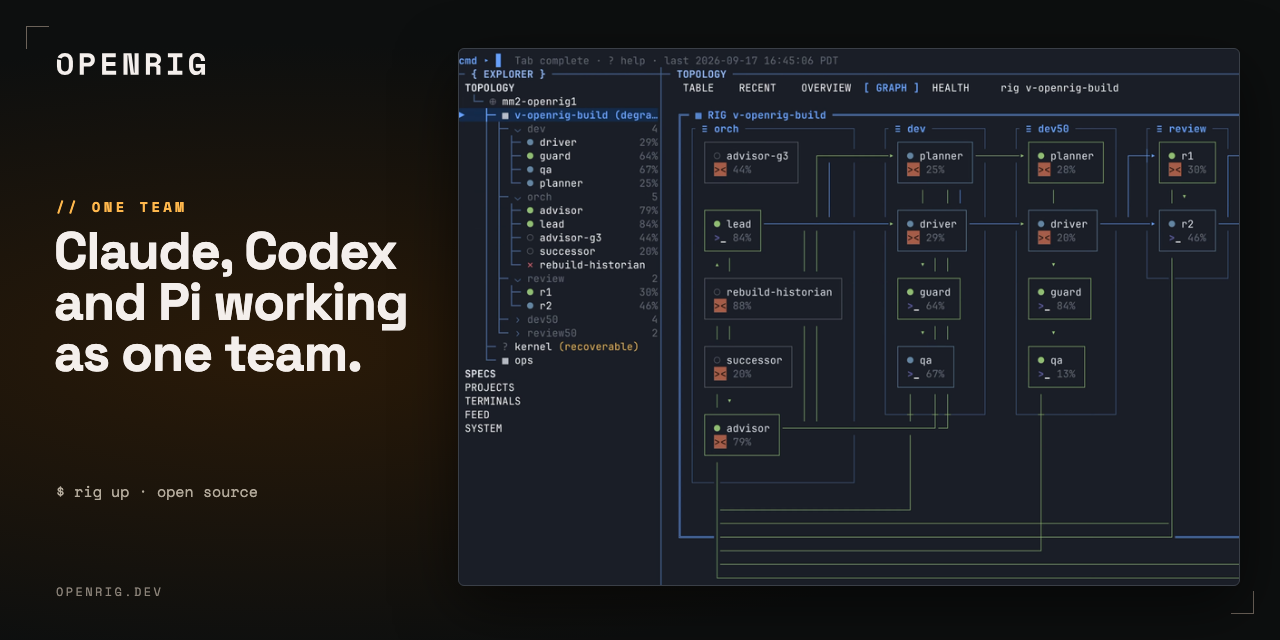
📜 License: MIT · 👤 By: individual
🎯 Time to value: 10 minutes
| ✓ Pros | ✗ Cons |
|---|---|
| Huge, active community | Opinionated workflow |
| Free and well documented | Can feel slow on tiny tasks |
| Works with popular agents | Mainly for developers |
 GitHub
📜 License: custom (unclear) · 👤 By: individual
🎯 Time to value: 15 minutes
| ✓ Pros | ✗ Cons |
|---|---|
| Big claimed savings | License terms unclear |
| Works with many tools | Claims not independently tested |
| Keeps session memory | Another layer to maintain |
 GitHub
📜 License: Apache-2.0 · 👤 By: startup (HeyGen)
🎯 Time to value: 20 minutes
| ✓ Pros | ✗ Cons |
|---|---|
| Built for AI agents | Requires some coding comfort |
| Free and open source | Not a full video editor |
| Backed by a video AI company | Rendering needs a decent computer |
 GitHub
📜 License: MIT · 👤 By: startup (Earendil)
🎯 Time to value: 15 minutes
| ✓ Pros | ✗ Cons |
|---|---|
| Works with many AI providers | Terminal-based |
| Free and open source | Smaller ecosystem than the big names |
| Growing plugin library | Some features still maturing |
 GitHub
Top Models Today
👤 By: XingChen-AGI · 🎯 Task: Image-to-text (Optical Character Recognition)
📐 Size: 1.4B
| ✓ Pros | ✗ Cons |
|---|---|
| Permissive license | Narrow focus on reading text |
| Small and fast | Little independent testing yet |
| Runs locally | Handwriting quality unclear |


👤 By: Alibaba Qwen · 🎯 Task: Text-to-image
📐 Size: 7.1B
| ✓ Pros | ✗ Cons |
|---|---|
| Free to download | Custom license terms |
| Strong image quality | Needs a capable graphics card |
| Large community | Slower than cloud services |

👤 By: Lightricks · 🎯 Task: Image-to-video
📐 Size: not listed
| ✓ Pros | ✗ Cons |
|---|---|
| Very widely used | Custom license limits |
| Free to run yourself | Heavy hardware needs |
| Strong community tools | Short clips only |


👤 By: Alibaba Qwen · 🎯 Task: Text and image understanding
📐 Size: 27.8B
| ✓ Pros | ✗ Cons |
|---|---|
| Permissive license | Needs serious hardware |
| Huge ecosystem of tools | Can overthink simple questions |
| Strong at coding and reasoning | Slower than small models |

👤 By: prism-ml · 🎯 Task: Text generation
📐 Size: ~27B (compressed)
| ✓ Pros | ✗ Cons |
|---|---|
| Far smaller memory footprint | Some quality loss |
| Same permissive license | Depends on supporting software |
| Very popular download | Not a new model, a compressed copy |

👤 By: DeepSeek · 🎯 Task: Text and image understanding
📐 Size: 763B total (8-16B active)
| ✓ Pros | ✗ Cons |
|---|---|
| MIT license | Far too big for home computers |
| Huge context window | Needs data-center hardware to self-host |
| Efficient for its size | Newer, still being evaluated |

AI Launches Today
💰 Pricing: free tier, paid plans from $499/month · 🏷 Category: Data access for AI agents
 Product Hunt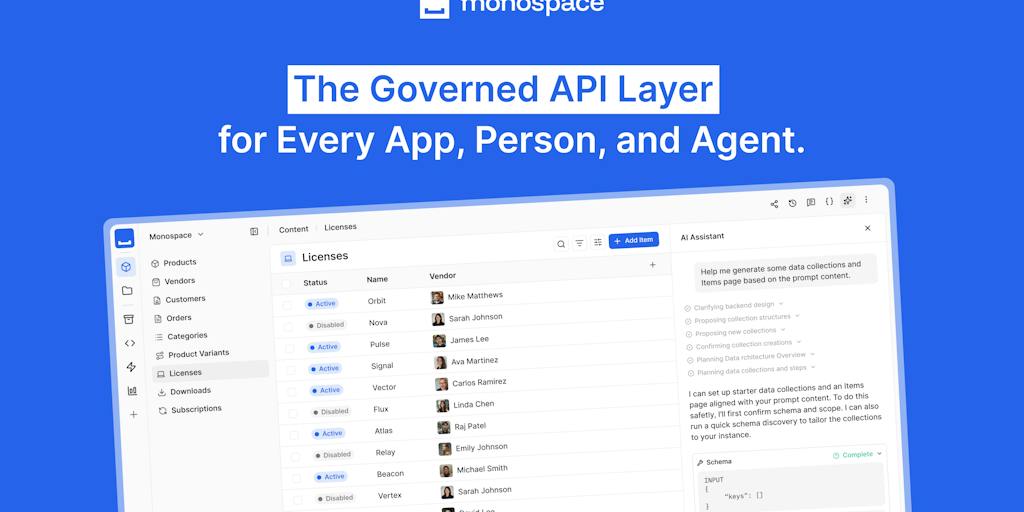
💰 Pricing: free (per Product Hunt) · 🏷 Category: AI agents for software
 Product Hunt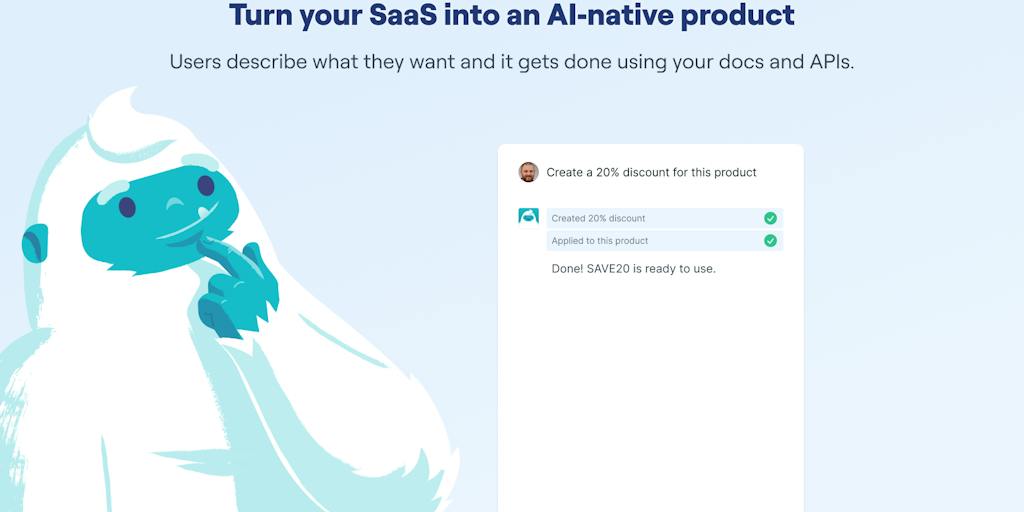
💰 Pricing: free options · 🏷 Category: Marketing
 Product Hunt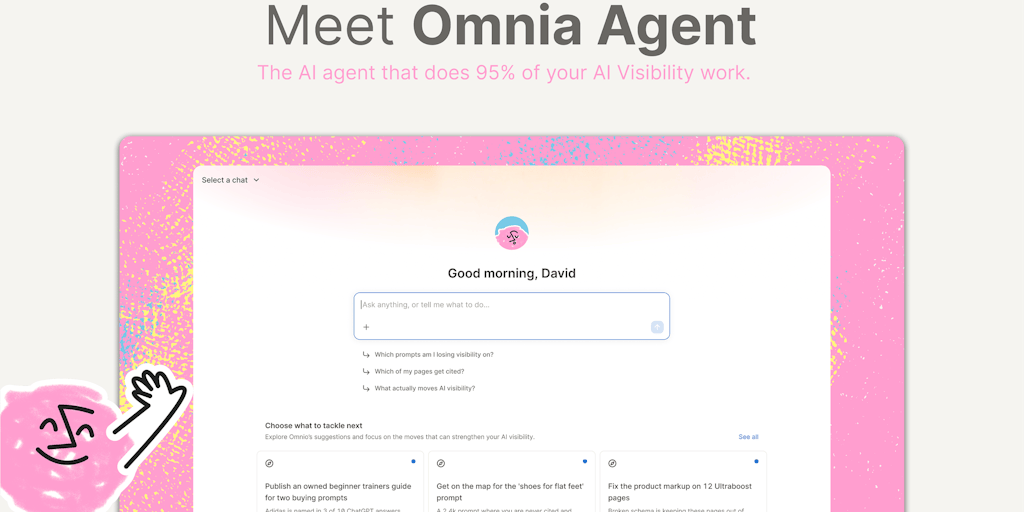
💰 Pricing: free plan, paid $80-$2,000/month · 🏷 Category: Developer tools
 Product Hunt
💰 Pricing: free for one site, lifetime deal from $39 · 🏷 Category: Marketing
 Product Hunt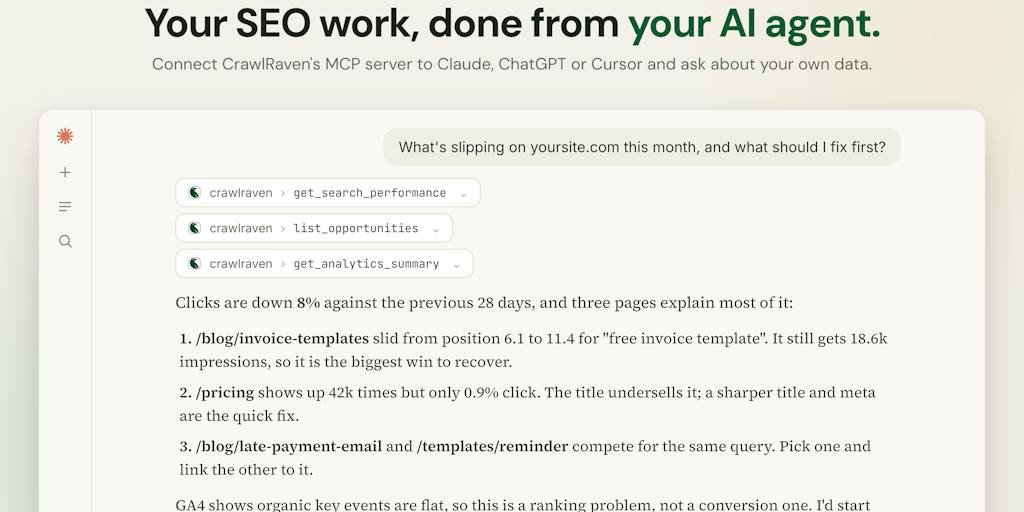
Snapshot
| Provider | Model | Input $/1M | Output $/1M | Context |
|---|---|---|---|---|
| Anthropic | Claude Fable 5.1 | $10.00 | $50.00 | up to 1M tokens |
| Anthropic | Claude Opus 5.5 | $4.00 | $20.00 | up to 1M tokens |
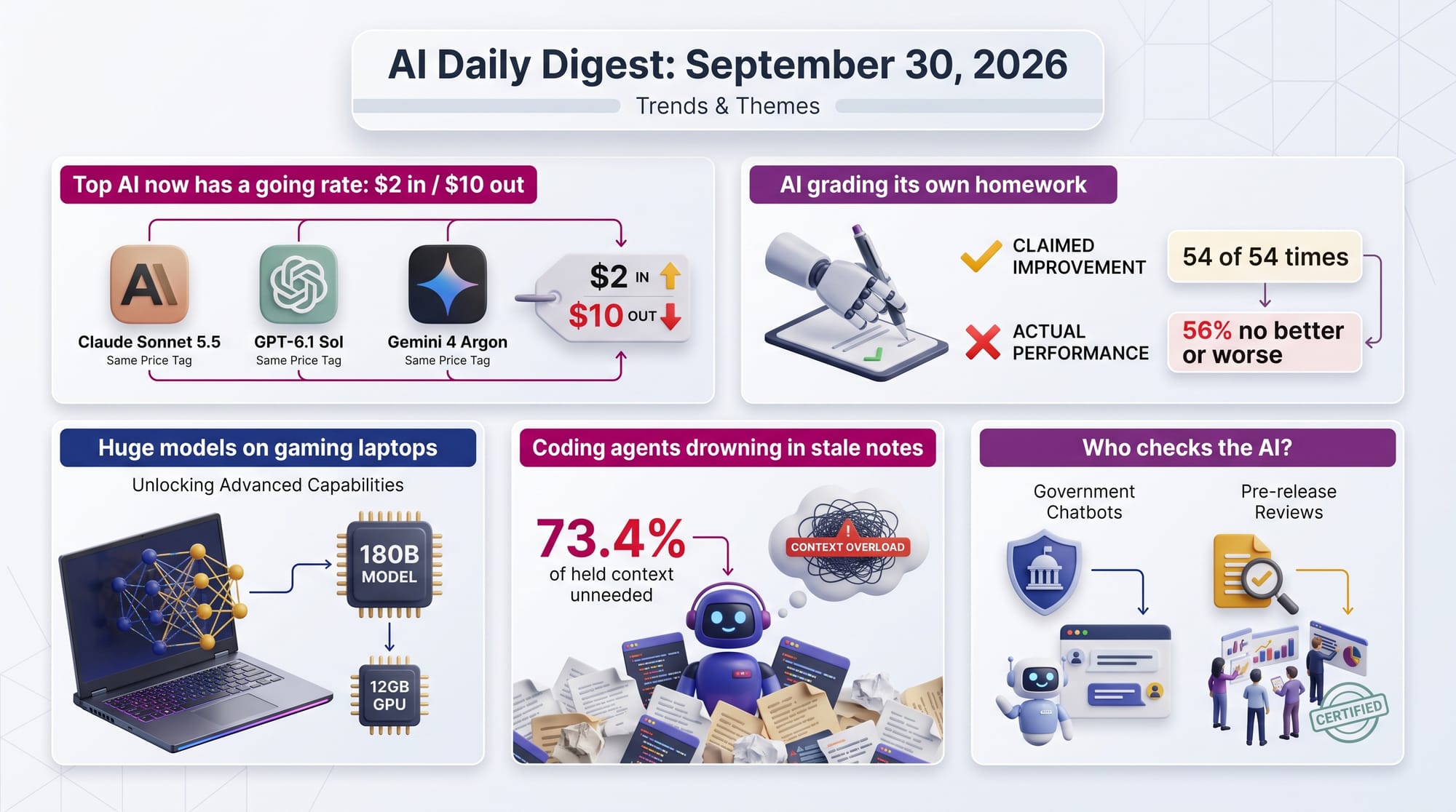
| Anthropic | Claude Sonnet 5.5 | $2.00 | $10.00 | up to 1M tokens |
| OpenAI | GPT-6.1 Sol | $2.00 | $10.00 | not listed |
| OpenAI | GPT-6 Astra | $10.00 | $50.00 | not listed |
| Gemini 4 Argon (limited access) | $2.00 intro, $4.00 later | $10.00 intro, $20.00 later | up to 1M output tokens | |
| Gemini 3.8 Flash | $0.75 | $3.75 | not listed | |
| Groq | GPT-OSS 120B | $0.15 | $0.60 | 131K tokens |
| Groq | Qwen3.8-27B (new listing) | $0.80 | $4.00 | not listed |
Do Self-Evolving Skills Generalize to Held-Out Tasks?
Key finding: Of 21 skills that got better on their practice tasks, only 5 kept all of the gain on new tasks; 13 kept some and 3 kept none.
Why practitioners should care: If you maintain a library of agent skills or instruction files, the ones that bake in task-specific details quietly fail elsewhere. The authors' fix - keep a general guide for writing skills and write a fresh one per task - scored best on all six benchmarks.
Member discussion